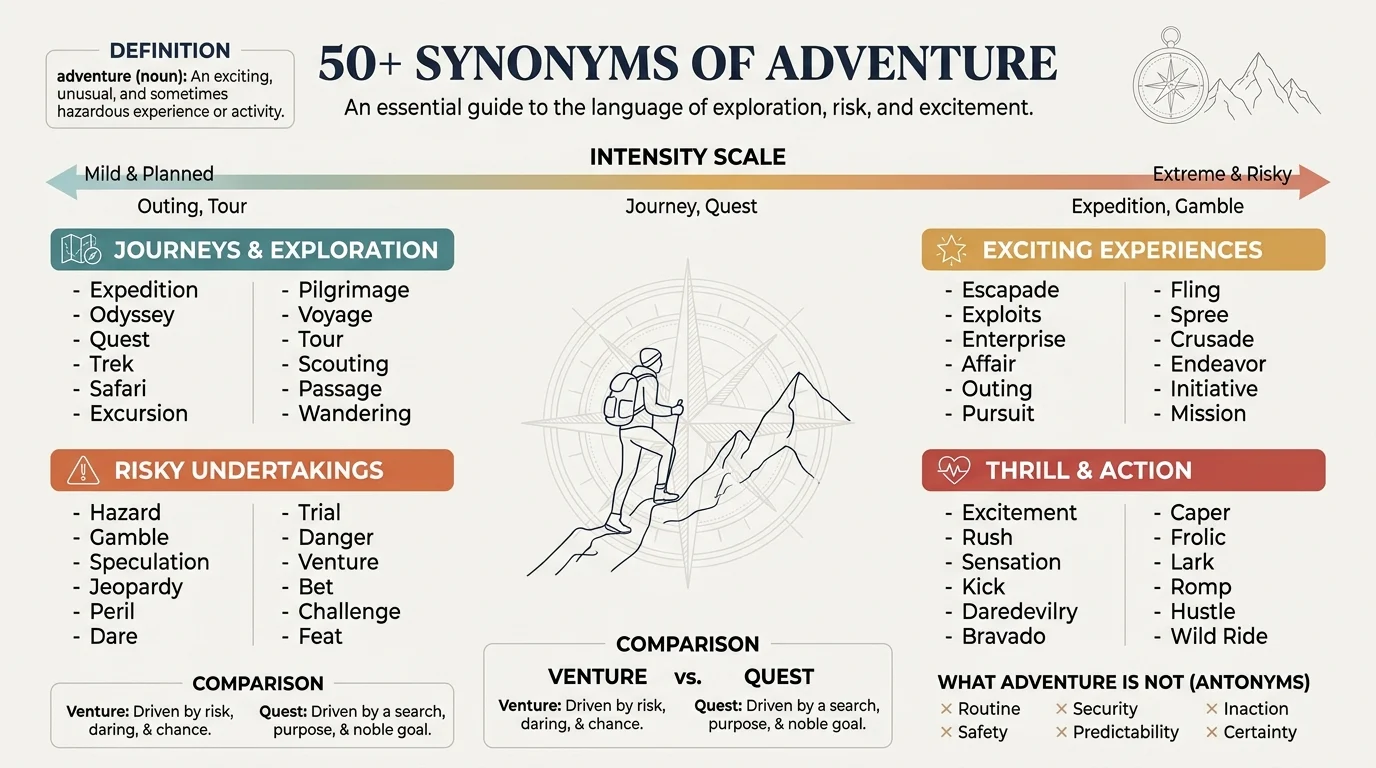
Have you ever needed to describe an exciting or risky experience but felt that “adventure” was too broad or overused? You want to capture the specific thrill, uncertainty, or exploration involved, and the word “adventure” comes to mind. Choosing the right synonym for “adventure” can transform a basic description into a precise expression of excitement, risk, or discovery. This guide explores the best synonyms of adventure, explaining exactly which word to use and when.
Quick Ans: “Adventure” means an unusual and exciting experience, a risky undertaking, or a journey of exploration. For exciting experiences, choose escapade or exploit. For risky undertakings, use venture or enterprise. For journeys, use expedition or quest. For thrilling excitement, use excitement or thrill.
Meaning, Tone, and Context
Understanding the core meaning of “adventure” is the first step to using it effectively.
Simple Definition: An unusual and exciting, typically hazardous, experience or activity; a daring undertaking; a journey of exploration.
Part of Speech: Noun.
Overall Tone: Positive and exciting. It indicates thrill, risk, and discovery.
Formality Level: Neutral. The word works in most contexts.
Common Uses: Native English speakers use it in travel (“mountain adventure”), storytelling (“epic adventure”), business (“business venture”), and general contexts (“sense of adventure”).
Word Forms: Related words include the noun adventurer, the adjective adventurous, and the adverb adventurously.
When and How to Use “Adventure”
“Adventure” is the perfect choice when you want to describe exciting, risky, or exploratory experiences. Here are seven realistic examples.
Travel: “Their trip to the Amazon was a real adventure.”
Storytelling: “The novel is an epic adventure across unknown lands.”
Business: “Starting a company is a risky adventure.”
Personal: “She has a spirit of adventure and loves trying new things.”
Professional: “The expedition was a scientific adventure.”
Academic: “The study examines the role of adventure in child development.”
Social Media: “Looking for adventure this weekend.”
Best Synonyms of “Adventure”
No synonym is identical in every situation. Here is your guide to the best replacement for “adventure” based on your writing context.
For Exciting Experiences
Most Direct: Escapade means an exciting adventure. “Their escapade in the city was unforgettable.”
Exploit: Exploit means a daring feat. “His exploits as a explorer are legendary.”
Experience: Experience means an event or activity. “The safari was an amazing experience.”
Journey: Journey means traveling from one place to another. “The journey across the desert was challenging.”
For Risky Undertakings
Venture: Venture means a risky undertaking. “The business venture was successful.”
Enterprise: Enterprise means a bold undertaking. “The enterprise required courage.”
Undertaking: Undertaking means a task or project. “The undertaking was ambitious.”
Gamble: Gamble means a risky action. “The investment was a gamble.”
For Journeys and Exploration
Expedition: Expedition means a journey for a purpose. “The expedition to the Arctic was dangerous.”
Quest: Quest means a long search. “The quest for the treasure took years.”
Odyssey: Odyssey means a long adventurous journey. “His odyssey across the continent was remarkable.”
Voyage: Voyage means a long journey by sea or space. “The voyage across the Atlantic was historic.”
For Thrill and Excitement
Thrill: Thrill means a sudden feeling of excitement. “The thrill of the roller coaster was intense.”
Excitement: Excitement means a feeling of eager enthusiasm. “The excitement of the trip was palpable.”
Risk: Risk means the possibility of danger. “The risk of the climb was high.”
Challenge: Challenge means a difficult task. “The challenge of the adventure appealed to him.”
When Not to Use “Adventure”
Using “adventure” can sound wrong or awkward in certain situations.
When You Mean “Trip”: “Adventure” is more dramatic. “Trip” is simpler.
Better Choice: Trip or journey. “The trip was relaxing.”
When You Mean “Danger”: “Adventure” is positive. “Danger” is negative.
Better Choice: Danger or risk. “The danger was real.”
When It Sounds Too Dramatic: In casual conversation, “adventure” can sound exaggerated.
Better Choice: Fun or experience. “We had fun.”
Words Commonly Confused With “Adventure”
| Word | Difference | When to Use | Example |
|---|---|---|---|
| Escapade | Exciting adventure | Fun and mischievous | “A daring escapade.” |
| Venture | Risky undertaking | Business and projects | “A business venture.” |
| Expedition | Purposeful journey | Exploration and science | “An expedition to the poles.” |
| Quest | Long search | Fantasy and goals | “A quest for the truth.” |
| Journey | Travel | General and personal | “A journey across the country.” |
| Odyssey | Long adventurous journey | Literary and epic | “An odyssey of self-discovery.” |
Best Synonyms of “Adventure” by Context
| Context | Best Synonym | Why It Works | Example |
|---|---|---|---|
| Formal writing | Expedition | Formal and purposeful | “The expedition was well-organized.” |
| Academic writing | Experience | Standard in research | “The experience shaped his development.” |
| Professional | Venture | Business and risky | “The venture attracted investors.” |
| Business | Enterprise | Business and bold | “The enterprise was ambitious.” |
| Storytelling | Quest | Epic and engaging | “The quest for the holy grail.” |
| Casual | Trip | Simple and natural | “The trip was fun.” |
| Emotional | Thrill | Evokes excitement | “The thrill of the unknown.” |
How to Choose the Best Synonym of “Adventure”
Choosing the right word is a simple decision. Answer these questions.
What type of adventure am I describing? For exciting experiences, use escapade or exploit. And For risky undertakings, use venture or enterprise. For journeys, use expedition or quest. For thrill, use thrill or excitement.
What is my audience? For a formal report, use expedition or venture. For a friend, use trip or experience.
What is my purpose? Are you describing travel, business, or excitement? The correct synonym depends entirely on this.
What is the emotional strength? Odyssey and quest are stronger. Trip is milder. Pick the one that matches your message.
Real Life Examples of “Adventure”
School: Basic: “The field trip was an adventure.” Improved: “The field trip was an exciting experience.”
College: Basic: “The study examines adventure.” Improved: “The study examines exploratory experiences.”
Workplace: Basic: “The project is an adventure.” Improved: “The project is a venture.”
Business: Basic: “Starting a company is an adventure.” Improved: “Starting a company is a risky enterprise.”
Email: Basic: “Looking forward to the adventure.” Improved: “Looking forward to the expedition.”
Conversation: Basic: “The trip was an adventure.” Improved: “The trip was a thrilling experience.”
Storytelling: Basic: “The adventure was epic.” Improved: “The quest was epic.”
Top 10 Synonyms of “Adventure”
| Synonym | Simple Meaning | Best Used For | Example Sentence |
|---|---|---|---|
| Escapade | Exciting adventure | Fun and mischievous | “Their escapade in the city was unforgettable.” |
| Venture | Risky undertaking | Business and projects | “The business venture was successful.” |
| Expedition | Purposeful journey | Exploration and science | “The expedition to the Arctic was dangerous.” |
| Quest | Long search | Fantasy and goals | “The quest for the treasure took years.” |
| Odyssey | Long adventurous journey | Literary and epic | “His odyssey across the continent was remarkable.” |
| Exploit | Daring feat | Heroic and historical | “His exploits as an explorer are legendary.” |
| Enterprise | Bold undertaking | Business and projects | “The enterprise required courage.” |
| Thrill | Sudden excitement | Emotional and dramatic | “The thrill of the roller coaster was intense.” |
| Journey | Travel from one place to another | General and personal | “The journey across the desert was challenging.” |
| Voyage | Long journey by sea or space | Historical and exploratory | “The voyage across the Atlantic was historic.” |
Synonyms of “Adventure” by Usage
Professional vs. Personal Synonyms
In the workplace, choose venture, enterprise, or undertaking. With friends, use trip, experience, or fun.
Formal vs. Conversational Synonyms
For formal writing, use expedition, venture, or enterprise. For casual conversations, use trip, fun, or experience.
Academic Synonyms
For research and essays, choose experience for development, exploration for discovery, and undertaking for projects.
Professional and Business Synonyms
For maximum impact, choose venture for startups, enterprise for bold projects, and undertaking for initiatives.
Creative and Literary Synonyms
To add emotion and imagery, choose quest, odyssey, or voyage. These words create atmosphere.
Slang or Modern Synonyms
In modern American slang, adventure, trip, or escapade are common. For example, “That was quite an adventure.” These are casual and should be avoided in formal writing.
Strongest to Mildest Synonyms
Mild: trip, experience, journey
Moderate: adventure, escapade, venture
Strong: expedition, quest, exploit
Very Strong: odyssey, voyage, enterprise
Emotional vs. Neutral Synonyms
Emotional Synonyms: Thrill, excitement, quest. These words hint at strong emotion. Use them when you want to evoke feeling.
Neutral Synonyms: Adventure, journey, trip. These words communicate factual information.
Antonyms of “Adventure”
| Antonym | Meaning | Example Sentence |
|---|---|---|
| Routine | Regular and habitual | “The routine was boring.” |
| Monotony | Lack of variety | “The monotony of the job was exhausting.” |
| Safety | Being safe | “Safety was the priority.” |
| Security | Being secure | “Security was guaranteed.” |
| Comfort | Ease and contentment | “He preferred comfort over adventure.” |
| Predictability | Being predictable | “The predictability of the schedule was comforting.” |
| Boredom | State of being bored | “Boredom set in after a week.” |
| Inaction | Lack of action | “Inaction led to missed opportunities.” |
| Stagnation | Lack of growth | “Stagnation hurt the business.” |
| Tedium | Boring and tedious | “The tedium of the task was unbearable.” |
| Ordinary | Normal and usual | “The ordinary day passed slowly.” |
| Familiarity | Being familiar | “Familiarity bred contempt.” |
| Confinement | Being confined | “The confinement was oppressive.” |
| Restriction | Being restricted | “The restriction limited movement.” |
| Caution | Being careful | “Caution was advised.” |
Comparison: “Adventure” vs Similar Words
Adventure vs. Escapade
Main Difference: “Adventure” is broader. “Escapade” is mischievous.
Which Is Stronger? “Escapade” is more specific.
Which Is More Formal? “Adventure” is more formal.
When to Use Each: Use “escapade” for fun mischief. Use “adventure” for general contexts.
Examples:
Adventure: “The trip was an adventure.”
Escapade: “Their escapade was thrilling.”
Adventure vs. Venture
Main Difference: “Adventure” is experience. “Venture” is undertaking.
Which Is Stronger? “Venture” is more specific to business.
Which Is More Formal? Both are formal.
When to Use Each: Use “venture” for business. Use “adventure” for general contexts.
Examples:
Adventure: “The journey was an adventure.”
Venture: “The business venture succeeded.”
Adventure vs. Expedition
Main Difference: “Adventure” is broader. “Expedition” is purposeful.
Which Is Stronger? “Expedition” is more specific.
Which Is More Formal? Both are formal.
When to Use Each: Use “expedition” for exploration. Use “adventure” for general contexts.
Examples:
Adventure: “The trip was an adventure.”
Expedition: “The expedition reached the summit.”
Adventure vs. Quest
Main Difference: “Adventure” is broader. “Quest” is a search.
Which Is Stronger? “Quest” is more specific.
Which Is More Formal? Both are formal.
When to Use Each: Use “quest” for goals. Use “adventure” for general contexts.
Examples:
Adventure: “The journey was an adventure.”
Quest: “The quest for truth continued.”
Adventure vs. Odyssey
Main Difference: “Adventure” is broader. “Odyssey” is long and epic.
Which Is Stronger? “Odyssey” is stronger.
Which Is More Formal? Both are formal.
When to Use Each: Use “odyssey” for epic journeys. Use “adventure” for general contexts.
Examples:
Adventure: “The trip was an adventure.”
Odyssey: “His odyssey across the continent.”
Adventure vs. Thrill
Main Difference: “Adventure” is an experience. “Thrill” is a feeling.
Which Is Stronger? “Thrill” is more emotional.
Which Is More Formal? Both are neutral.
When to Use Each: Use “thrill” for excitement. Use “adventure” for general contexts.
Examples:
Adventure: “The climb was an adventure.”
Thrill: “The thrill of the climb was intense.”
Common Phrases and Expressions with “Adventure”
Phrase: Sense of adventure
Meaning: A desire for new experiences.
Example Sentence: “She has a strong sense of adventure.”
Phrase: Adventure travel
Meaning: Travel to exciting places.
Example Sentence: “Adventure travel is growing in popularity.”
Phrase: Seek adventure
Meaning: Look for exciting experiences.
Example Sentence: “He left home to seek adventure.”
Phrase: Adventure awaits
Meaning: Exciting experiences are coming.
Example Sentence: “Pack your bags; adventure awaits.”
Phrase: Spirit of adventure
Meaning: A willingness to try new things.
Example Sentence: “The spirit of adventure led them to explore.”
Phrase: Adventure of a lifetime
Meaning: A once-in-a-lifetime experience.
Example Sentence: “The safari was the adventure of a lifetime.”
Common Mistakes to Avoid
Mistake 1: Using “adventure” when you mean “trip”.
Incorrect: “The adventure to the store was quick.”
Better: “The trip to the store was quick.”
Why: “Adventure” is more dramatic.
Mistake 2: Using “adventure” when you mean “risk”.
Incorrect: “The adventure of the surgery was high.”
Better: “The risk of the surgery was high.”
Why: “Risk” is for danger.
Mistake 3: Overusing “adventure” in conversation.
Incorrect: “My day was an adventure.”
Better: “My day was busy.”
Why: “Adventure” sounds exaggerated.
Mistake 4: Using “adventure” when you mean “venture”.
Incorrect: “The business adventure was successful.”
Better: “The business venture was successful.”
Why: “Venture” is for business.
Mistake 5: Using “adventure” when you mean “quest”.
Incorrect: “The adventure for the treasure took years.”
Better: “The quest for the treasure took years.”
Why: “Quest” is for search.
Frequently Asked Questions
1. What are the best synonyms of “adventure”?
The best synonyms depend on your context. For exciting experiences, choose escapade or exploit. And For risky undertakings, use venture or enterprise. For journeys, use expedition or quest.
2. What are the best formal synonyms of “adventure”?
The best formal synonyms are expedition, venture, and enterprise. These words are suitable for academic papers, professional reports, and business communications.
3. What are common informal synonyms of “adventure”?
For informal settings, use trip, experience, or fun. These alternatives sound more natural in everyday conversation.
4. What is another word for “adventure” in professional writing?
In professional writing, venture is an excellent choice. It conveys a risky undertaking. Expedition is also strong for exploration.
5. What is the difference between “adventure” and “venture”?
“Adventure” is an experience. “Venture” is an undertaking. Use “venture” for business and “adventure” for general contexts.
6. What is the opposite of “adventure”?
The most direct opposites (antonyms) of adventure are routine, monotony, and safety. These words describe things that are not exciting or risky.
Conclusion
“Adventure” is a powerful and exciting word for describing thrilling experiences, risky undertakings, and journeys of exploration. The term is neutral and widely accepted in most contexts, yet it can sound too dramatic for simple trips or too broad for specific descriptions. The best choice among the synonyms of adventure depends entirely on your audience, tone, and purpose. Remember, no single synonym works perfectly in every situation. Your goal is to choose the word that communicates your message with the most clarity and impact. A practical tip for your vocabulary growth is to pay attention to how writers describe exciting experiences and practice using different synonyms in your writing.









