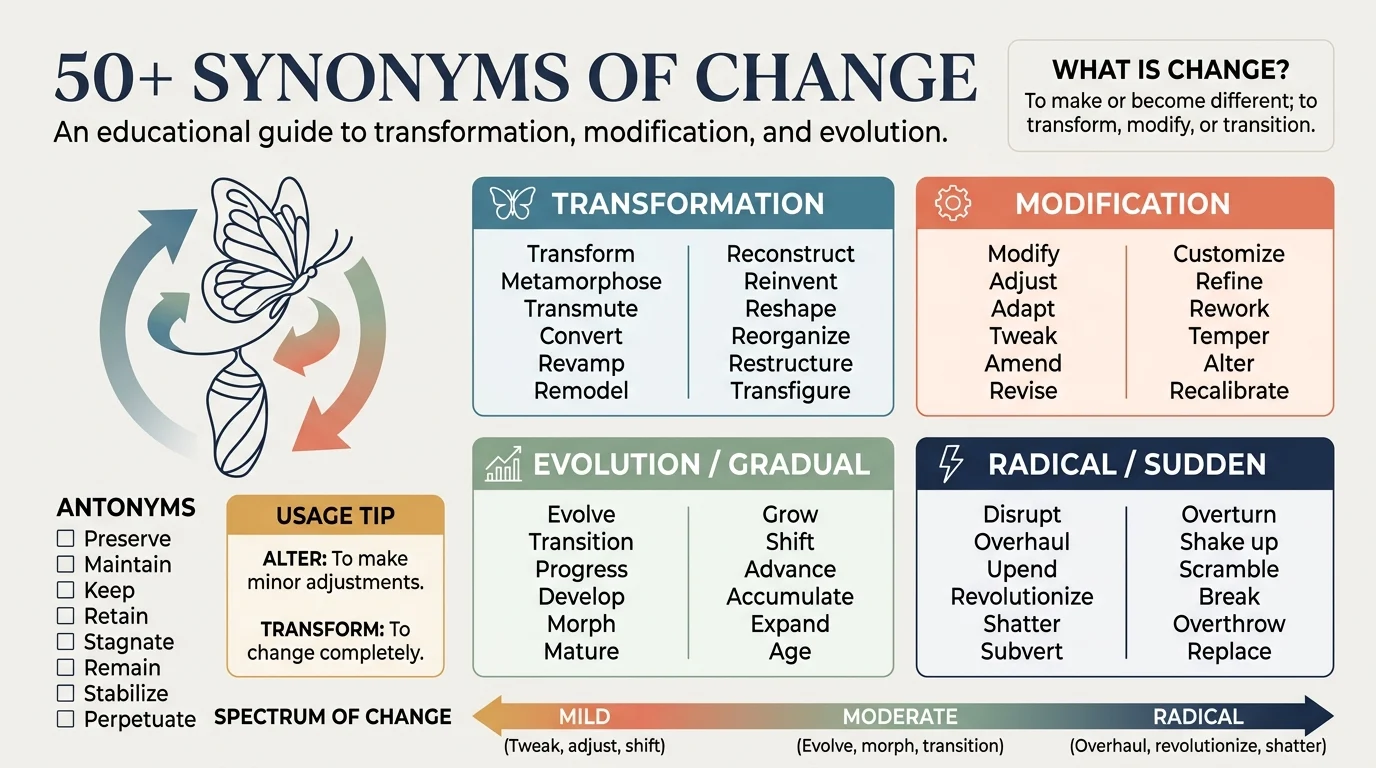
Have you ever needed to describe a shift, a transformation, or a modification but felt that “change” was too simple or repetitive? You want to capture the specific nature of the difference, whether it is a small adjustment or a complete overhaul, and the word “change” comes to mind. Choosing the right synonym for “change” can transform a basic statement into a precise expression of transformation, adjustment, or evolution. This guide explores the best synonyms of change, explaining exactly which word to use and when.
Quick Ans: “Change” means to make or become different, or the act of becoming different. For formal writing, choose transformation or modification. For casual conversation, use switch or shift. For gradual change, use evolution or progression. For sudden change, use upheaval or revolution. For small changes, use adjustment or alteration.
Meaning, Tone, and Context
Understanding the core meaning of “change” is the first step to using it effectively.
Simple Definition: To make or become different; the act or instance of becoming different.
Part of Speech: Noun and verb.
Overall Tone: Neutral. It can indicate improvement, deterioration, or simply difference.
Formality Level: Neutral. The word works in all contexts, with more specific alternatives for particular situations.
Common Uses: Native English speakers use it in everyday life (“change of plans”), business (“organizational change”), science (“climate change”), and personal growth (“change of heart”).
Word Forms: Related words include the adjective changeable, the noun changeability, and the adjective changed.
When and How to Use “Change”
“Change” is the perfect choice when you want to describe making or becoming different. Here are seven realistic examples.
Business: “The company underwent a major change in leadership.”
Academic: “The study examines climate change and its effects.”
Personal: “She made a change in her career.”
Professional: “We need to implement a change in our strategy.”
Email: “There has been a change in the meeting schedule.”
Resume: “Led a change initiative that improved efficiency by 30%.”
Social Media: “Change starts with you.”
Best Synonyms of “Change”
No synonym is identical in every situation. Here is your guide to the best replacement for “change” based on your writing context.
For Transformation and Major Change
Most Formal: Transformation means a complete change. “The transformation of the industry was rapid.”
Revolution: Revolution means a dramatic change. “The revolution in technology changed everything.”
Upheaval: Upheaval means violent or sudden change. “The political upheaval affected the economy.”
Metamorphosis: Metamorphosis means a complete change of form. “The metamorphosis of the company was remarkable.”
For Modification and Adjustment
Modification: Modification means a small change. “The modification improved performance.”
Alteration: Alteration means a change in form. “The alteration to the dress was minor.”
Adjustment: Adjustment means a small change to improve. “The adjustment to the plan was necessary.”
Amendment: Amendment means a formal change. “The amendment to the law passed.”
For Shift and Transition
Shift: Shift means a change in position or direction. “There was a shift in public opinion.”
Transition: Transition means a change from one state to another. “The transition to renewable energy is underway.”
Conversion: Conversion means a change in form or function. “The conversion of the building was costly.”
Turnaround: Turnaround means a complete change for the better. “The turnaround of the company was impressive.”
For Gradual and Natural Change
Evolution: Evolution means gradual development. “The evolution of language is constant.”
Progression: Progression means forward movement. “The progression of the disease was slow.”
Development: Development means growth or advancement. “The development of the project took months.”
Growth: Growth means increase or expansion. “The growth of the business was steady.”
When Not to Use “Change”
Using “change” can sound wrong or awkward in certain situations.
When You Mean “Replace”: “Change” is broader. “Replace” is specific.
Better Choice: Replace or substitute. “We need to replace the old system.”
When You Mean “Improve”: “Change” is neutral. “Improve” is positive.
Better Choice: Improve or enhance. “We need to improve the process.”
When It Sounds Too Vague: “Change” can be unclear.
Better Choice: Modification, adjustment, or transformation. “The modification was successful.”
Words Commonly Confused With “Change”
| Word | Difference | When to Use | Example |
|---|---|---|---|
| Transformation | Complete change | Major and dramatic | “The transformation was remarkable.” |
| Modification | Small change | Technical and specific | “The modification improved it.” |
| Adjustment | Small change to improve | Practical and general | “The adjustment was necessary.” |
| Shift | Change in position | Trends and opinions | “The shift was noticeable.” |
| Transition | Change from one to another | Processes and periods | “The transition was smooth.” |
| Alteration | Change in form | Clothing and documents | “The alteration was minor.” |
Best Synonyms of “Change” by Context
| Context | Best Synonym | Why It Works | Example |
|---|---|---|---|
| Formal writing | Transformation | Formal and dramatic | “The transformation was complete.” |
| Academic writing | Evolution | Standard in research | “The evolution of the species.” |
| Professional | Modification | Professional and precise | “The modification was approved.” |
| Business | Turnaround | Business and results | “The turnaround was impressive.” |
| Technology | Conversion | Technical and precise | “The conversion was seamless.” |
| Personal | Shift | Personal and relatable | “There was a shift in her attitude.” |
| Casual | Switch | Simple and natural | “Let’s switch plans.” |
How to Choose the Best Synonym of “Change”
Choosing the right word is a simple decision. Answer these questions.
What type of change am I describing? For major change, use transformation or revolution. And For small change, use modification or adjustment. For gradual change, use evolution or progression. For sudden change, use upheaval or shift.
What is my audience? For a formal report, use transformation or modification. For a friend, use switch or shift.
What is my purpose? Are you describing improvement, difference, or transition? The correct synonym depends entirely on this.
What is the emotional strength? Revolution and upheaval are stronger. Adjustment is milder. Pick the one that matches your message.
Real Life Examples of “Change”
School: Basic: “The school made a change.” Improved: “The school implemented a modification.”
College: Basic: “The study examined change.” Improved: “The study examined evolution.”
Workplace: Basic: “We need a change.” Improved: “We need a transformation.”
Business: Basic: “The company changed.” Improved: “The company underwent a turnaround.”
Email: Basic: “There is a change.” Improved: “There is an adjustment to the schedule.”
Conversation: Basic: “Let’s change it.” Improved: “Let’s switch it.”
Storytelling: Basic: “The change was dramatic.” Improved: “The transformation was dramatic.”
Top 10 Synonyms of “Change”
| Synonym | Simple Meaning | Best Used For | Example Sentence |
|---|---|---|---|
| Transformation | Complete change | Major and dramatic | “The transformation was remarkable.” |
| Modification | Small change | Technical and specific | “The modification improved performance.” |
| Adjustment | Small change to improve | Practical and general | “The adjustment was necessary.” |
| Shift | Change in position or direction | Trends and opinions | “There was a shift in public opinion.” |
| Transition | Change from one state to another | Processes and periods | “The transition was smooth.” |
| Evolution | Gradual development | Natural and gradual | “The evolution of language is constant.” |
| Revolution | Dramatic change | Major and dramatic | “The revolution changed everything.” |
| Alteration | Change in form | Clothing and documents | “The alteration was minor.” |
| Conversion | Change in form or function | Technical and precise | “The conversion was costly.” |
| Turnaround | Complete change for the better | Business and results | “The turnaround was impressive.” |
Synonyms of “Change” by Usage
Professional vs. Personal Synonyms
In the workplace, choose transformation, modification, or turnaround. With friends, use switch, shift, or adjustment.
Formal vs. Conversational Synonyms
For formal writing, use transformation, modification, or evolution. For casual conversations, use switch, shift, or change.
Academic Synonyms
For research and essays, choose evolution for gradual change, transformation for major change, and transition for periods of change.
Professional and Business Synonyms
For maximum impact, choose turnaround for results, transformation for strategy, and modification for processes.
Creative and Literary Synonyms
To add emotion and imagery, choose metamorphosis, revolution, or upheaval. These words create drama.
Slang or Modern Synonyms
In modern American slang, switch, swap, or shake-up are common. For example, “Let’s switch it up.” These are casual and should be avoided in formal writing.
Strongest to Mildest Synonyms
Mild: adjustment, modification, alteration
Moderate: change, shift, transition
Strong: transformation, evolution, conversion
Very Strong: revolution, upheaval, metamorphosis
Emotional vs. Neutral Synonyms
Emotional Synonyms: Revolution, upheaval, metamorphosis. These words hint at dramatic change. Use them when you want to evoke feeling.
Neutral Synonyms: Change, modification, adjustment. These words communicate factual information.
Antonyms of “Change”
| Antonym | Meaning | Example Sentence |
|---|---|---|
| Stability | State of being stable | “Stability is important for growth.” |
| Continuity | Unbroken existence | “Continuity ensures smooth operations.” |
| Permanence | Lasting existence | “Permanence is rare in business.” |
| Sameness | Lack of difference | “The sameness was monotonous.” |
| Constancy | Unchanging nature | “Constancy is valued in relationships.” |
| Preservation | Keeping safe | “Preservation of the old ways.” |
| Stagnation | Lack of movement | “Stagnation hurt the company.” |
| Stasis | State of inactivity | “The stasis was frustrating.” |
| Consistency | Unchanging over time | “Consistency builds trust.” |
| Uniformity | Being the same | “Uniformity was required.” |
| Monotony | Lack of variety | “Monotony led to boredom.” |
| Routine | Regular procedure | “The routine was comforting.” |
| Tradition | Long-established custom | “Tradition is important.” |
| Immutability | Unchanging nature | “Immutability is rare.” |
| Fixity | State of being fixed | “Fixity of purpose.” |
Comparison: “Change” vs Similar Words
Change vs. Transformation
Main Difference: “Change” is general. “Transformation” is complete.
Which Is Stronger? “Transformation” is stronger.
Which Is More Formal? “Transformation” is more formal.
When to Use Each: Use “change” for general contexts. Use “transformation” for major change.
Examples:
Change: “There was a change in plans.”
Transformation: “The transformation was complete.”
Change vs. Modification
Main Difference: “Change” is general. “Modification” is small and specific.
Which Is Stronger? “Modification” is more specific.
Which Is More Formal? Both are formal.
When to Use Each: Use “modification” for technical changes. Use “change” for general contexts.
Examples:
Change: “We need a change.”
Modification: “The modification was approved.”
Change vs. Shift
Main Difference: “Change” is general. “Shift” is a change in position.
Which Is Stronger? They are similar.
Which Is More Formal? Both are neutral.
When to Use Each: Use “shift” for trends. Use “change” for general contexts.
Examples:
Change: “The change was sudden.”
Shift: “There was a shift in opinion.”
Change vs. Evolution
Main Difference: “Change” is general. “Evolution” is gradual.
Which Is Stronger? “Evolution” is more specific to gradual change.
Which Is More Formal? Both are formal.
When to Use Each: Use “evolution” for natural change. Use “change” for general contexts.
Examples:
Change: “The change was necessary.”
Evolution: “The evolution of the species.”
Change vs. Revolution
Main Difference: “Change” is general. “Revolution” is dramatic.
Which Is Stronger? “Revolution” is much stronger.
Which Is More Formal? Both are formal.
When to Use Each: Use “revolution” for dramatic change. Use “change” for general contexts.
Examples:
Change: “The change was small.”
Revolution: “The revolution changed everything.”
Change vs. Adjustment
Main Difference: “Change” is general. “Adjustment” is small and practical.
Which Is Stronger? “Adjustment” is milder.
Which Is More Formal? Both are neutral.
When to Use Each: Use “adjustment” for small changes. Use “change” for general contexts.
Examples:
Change: “The change was significant.”
Adjustment: “The adjustment was minor.”
Common Phrases and Expressions with “Change”
Phrase: Change of heart
Meaning: A change in opinion or feeling.
Example Sentence: “She had a change of heart about the decision.”
Phrase: Change of plans
Meaning: A change in arrangements.
Example Sentence: “There has been a change of plans.”
Phrase: Climate change
Meaning: Long-term changes in weather.
Example Sentence: “Climate change is a global concern.”
Phrase: Change management
Meaning: Managing organizational change.
Example Sentence: “Change management is crucial for success.”
Phrase: For a change
Meaning: As a different experience.
Example Sentence: “Let’s eat out for a change.”
Phrase: Change your mind
Meaning: Alter your decision.
Example Sentence: “She changed her mind about the job.”
Common Mistakes to Avoid
Mistake 1: Using “change” when you mean “replace”.
Incorrect: “We need to change the old system.”
Better: “We need to replace the old system.”
Why: “Replace” is more specific.
Mistake 2: Using “change” when you mean “improve”.
Incorrect: “We need to change the process.”
Better: “We need to improve the process.”
Why: “Improve” is positive.
Mistake 3: Overusing “change” in conversation.
Incorrect: “Let’s change it.”
Better: “Let’s switch it.”
Why: “Switch” sounds more natural.
Mistake 4: Using “change” when you mean “transformation”.
Incorrect: “The change was complete.”
Better: “The transformation was complete.”
Why: “Transformation” is stronger.
Mistake 5: Using “change” when you mean “adjustment”.
Incorrect: “The change was minor.”
Better: “The adjustment was minor.”
Why: “Adjustment” is for small changes.
Frequently Asked Questions
1. What are the best synonyms of “change”?
The best synonyms depend on your context. For major change, choose transformation or revolution. And For small change, use modification or adjustment. For gradual change, use evolution or progression. For sudden change, use upheaval or shift.
2. What are the best formal synonyms of “change”?
The best formal synonyms are transformation, modification, and evolution. These words are suitable for academic papers, professional reports, and business communications.
3. What are common informal synonyms of “change”?
For informal settings, use switch, shift, or swap. These alternatives sound more natural in everyday conversation.
4. What is another word for “change” in professional writing?
In professional writing, transformation is an excellent choice. It conveys major change. Modification is also strong for adjustments.
5. What is the difference between “change” and “transformation”?
“Change” is general. “Transformation” is complete and dramatic. Use “transformation” for major changes.
6. What is the opposite of “change”?
The most direct opposites (antonyms) of change are stability, continuity, and permanence. These words describe things that remain the same.
Conclusion
“Change” is a fundamental and versatile word for describing shifts, transformations, and modifications. The term is neutral and widely accepted in all contexts, yet it can sound too simple for major changes or too broad for specific descriptions. The best choice among the synonyms of change depends entirely on your audience, tone, and purpose. Remember, no single synonym works perfectly in every situation. Your goal is to choose the word that communicates your message with the most clarity and impact. A practical tip for your vocabulary growth is to pay attention to how writers describe change and practice using different synonyms in your writing.









