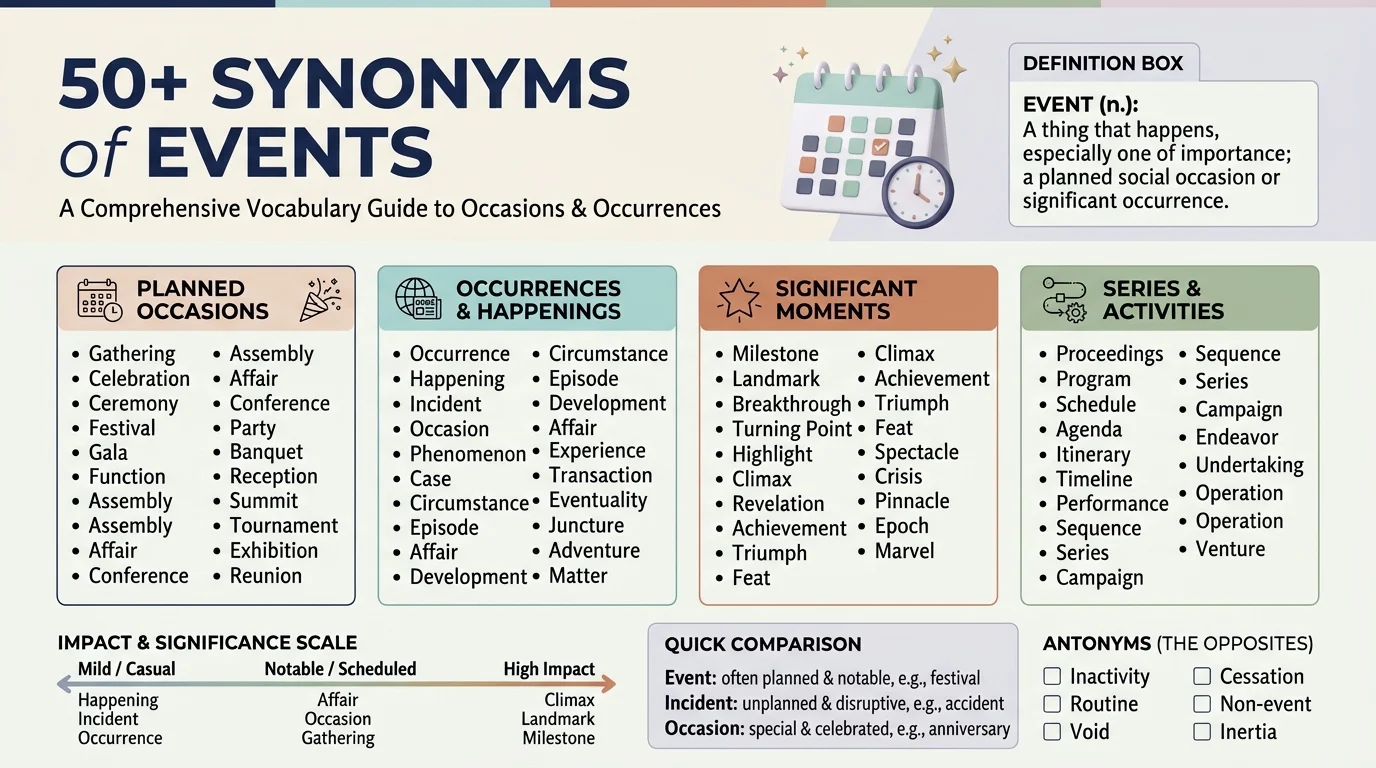
Have you ever needed to describe occurrences, gatherings, or significant moments but felt that “events” was too broad or repetitive? You want to capture the specific nature of what happened, whether it was a planned occasion, an unexpected incident, or a series of actions, and the word “events” comes to mind. Choosing the right synonym for “events” can transform a basic statement into a precise description of occasions, incidents, or phenomena. This guide explores the best synonyms of events, explaining exactly which word to use and when.
Quick Ans: “Events” means things that happen, especially important, interesting, or unusual occurrences; planned social occasions; or a series of activities. For occurrences, choose incidents or occurrences. For planned occasions, use gatherings or functions. For significant moments, use milestones or occasions. For a series of activities, use programs or activities.
Meaning, Tone, and Context
Understanding the core meaning of “events” is the first step to using it effectively.
Simple Definition: Things that happen or occur, especially important, interesting, or unusual ones; planned social occasions; a sequence of activities.
Part of Speech: Noun (plural of “event”).
Overall Tone: Neutral. It can indicate importance, celebration, or simply occurrence.
Formality Level: Neutral to formal. The word works in most contexts.
Common Uses: Native English speakers use it in news (“current events”), business (“corporate events”), science (“natural events”), and personal life (“life events”).
Word Forms: Related words include the adjective eventful, the adverb eventfully, and the noun eventuality.
When and How to Use “Events”
“Events” is the perfect choice when you want to describe occurrences, gatherings, or significant moments. Here are seven realistic examples.
News: “The news covered the major events of the day.”
Business: “The company hosts several events throughout the year.”
Academic: “The study examined the events leading up to the crisis.”
Science: “Natural events like earthquakes are unpredictable.”
Personal: “The wedding was one of the happiest events of her life.”
Professional: “We need to plan the events for the conference.”
Social Media: “The events of last night were unforgettable.”
Best Synonyms of “Events”
No synonym is identical in every situation. Here is your guide to the best replacement for “events” based on your writing context.
For Occurrences and Incidents
Most Direct: Incidents means events, often unpleasant. “The police reported several incidents.”
Occurrences: Occurrences means things that happen. “The occurrences were unusual.”
Happenings: Happenings means events or occurrences. “The happenings of the day were exciting.”
Episodes: Episodes means distinct events. “The episodes of the series were thrilling.”
For Planned Occasions
Gatherings: Gatherings means meetings or assemblies. “The family gatherings were joyful.”
Functions: Functions means formal social events. “The charity function was elegant.”
Occasions: Occasions means special events. “The occasion was celebrated with joy.”
Celebrations: Celebrations means festive events. “The celebrations lasted all night.”
For Significant Moments
Milestones: Milestones means significant events. “Graduation is a major milestone.”
Turning points: Turning points means critical events. “The battle was a turning point in the war.”
Landmarks: Landmarks means important events. “The treaty was a landmark in history.”
Moments: Moments means specific points in time. “The moment was unforgettable.”
For Series of Activities
Programs: Programs means planned series of events. “The program includes workshops and lectures.”
Activities: Activities means things done. “The activities were well-organized.”
Proceedings: Proceedings means formal events or activities. “The proceedings began at noon.”
Agenda: Agenda means a list of events. “The agenda for the conference is packed.”
When Not to Use “Events”
Using “events” can sound wrong or awkward in certain situations.
When You Mean “Things”: “Events” is for occurrences. “Things” is for objects.
Better Choice: Things or items. “The things on the list are needed.”
When You Mean “Results”: “Events” is about what happens. “Results” is about outcomes.
Better Choice: Results or outcomes. “The results were positive.”
When It Sounds Too General: In casual conversation, “events” can be vague.
Better Choice: Party or gathering. “The party was fun.”
Words Commonly Confused With “Events”
| Word | Difference | When to Use | Example |
|---|---|---|---|
| Incidents | Often negative events | News and police | “The incidents were reported.” |
| Occasions | Special events | Celebrations | “The occasion was joyful.” |
| Gatherings | Meetings or assemblies | Social events | “The family gathering.” |
| Milestones | Significant events | Life achievements | “Graduation is a milestone.” |
| Activities | Things done | Programs and plans | “The activities were fun.” |
| Occurrences | Things that happen | General and scientific | “The occurrences were unusual.” |
Best Synonyms of “Events” by Context
| Context | Best Synonym | Why It Works | Example |
|---|---|---|---|
| Formal writing | Occurrences | Formal and precise | “The occurrences were documented.” |
| Academic writing | Phenomena | Standard in research | “The phenomena were observed.” |
| Professional | Functions | Professional and formal | “The function was well-attended.” |
| Business | Programs | Business and planning | “The program includes several events.” |
| News | Incidents | News and reporting | “The incidents were reported.” |
| Casual | Party | Simple and natural | “The party was fun.” |
| Celebration | Occasions | Festive and formal | “The occasion was celebrated.” |
How to Choose the Best Synonym of “Events”
Choosing the right word is a simple decision. Answer these questions.
What type of events am I describing? For occurrences, use incidents or occurrences. And For planned occasions, use gatherings or functions. For significant moments, use milestones or occasions. For series of activities, use programs or activities.
What is my audience? For a formal report, use occurrences or functions. For a friend, use party or gathering.
What is my purpose? Are you describing news, celebrations, or plans? The correct synonym depends entirely on this.
What is the emotional strength? Milestones and turning points are stronger. Happenings is neutral. Pick the one that matches your message.
Real Life Examples of “Events”
School: Basic: “The school events are fun.” Improved: “The school activities are fun.”
College: Basic: “The study examined historical events.” Improved: “The study examined historical occurrences.”
Workplace: Basic: “The company events are important.” Improved: “The company functions are important.”
Business: Basic: “The events were well-planned.” Improved: “The program was well-planned.”
Email: Basic: “The events are listed.” Improved: “The schedule is listed.”
Conversation: Basic: “The events were fun.” Improved: “The party was fun.”
Storytelling: Basic: “The events changed everything.” Improved: “The turning point changed everything.”
Top 10 Synonyms of “Events”
| Synonym | Simple Meaning | Best Used For | Example Sentence |
|---|---|---|---|
| Incidents | Events, often negative | News and reporting | “The police reported several incidents.” |
| Occurrences | Things that happen | Formal and scientific | “The occurrences were unusual.” |
| Gatherings | Meetings or assemblies | Social events | “The family gatherings were joyful.” |
| Functions | Formal social events | Professional and formal | “The charity function was elegant.” |
| Occasions | Special events | Celebrations | “The occasion was celebrated with joy.” |
| Celebrations | Festive events | Parties and holidays | “The celebrations lasted all night.” |
| Milestones | Significant events | Life achievements | “Graduation is a major milestone.” |
| Programs | Planned series of events | Business and planning | “The program includes workshops.” |
| Activities | Things done | Programs and plans | “The activities were well-organized.” |
| Turning points | Critical events | History and change | “The battle was a turning point.” |
Synonyms of “Events” by Usage
Professional vs. Personal Synonyms
In the workplace, choose functions, programs, or activities. With friends, use party, gathering, or celebration.
Formal vs. Conversational Synonyms
For formal writing, use occurrences, functions, or proceedings. For casual conversations, use party, gathering, or celebration.
Academic Synonyms
For research and essays, choose phenomena for scientific events, occurrences for general events, and turning points for historical events.
Professional and Business Synonyms
For maximum impact, choose functions for formal events, programs for planned series, and milestones for achievements.
Creative and Literary Synonyms
To add emotion and imagery, choose milestones, turning points, or occasions. These words create atmosphere.
Slang or Modern Synonyms
In modern American slang, party, gig, or hangout are common. For example, “The gig was great.” These are casual and should be avoided in formal writing.
Strongest to Mildest Synonyms
Mild: happenings, activities, things
Moderate: events, occasions, gatherings
Strong: milestones, turning points, functions
Very Strong: landmarks, phenomena, occurrences
Emotional vs. Neutral Synonyms
Emotional Synonyms: Milestones, turning points, celebrations. These words hint at significance and emotion. Use them when you want to evoke feeling.
Neutral Synonyms: Events, occurrences, activities. These words communicate factual information.
Antonyms of “Events”
| Antonym | Meaning | Example Sentence |
|---|---|---|
| Non-events | Things that did not happen | “The non-events were forgotten.” |
| Stillness | Lack of activity | “The stillness was peaceful.” |
| Inaction | Lack of action | “Inaction led to problems.” |
| Stagnation | Lack of activity | “Stagnation hurt the business.” |
| Routine | Regular and habitual | “The routine was predictable.” |
| Ordinary | Normal and unremarkable | “The ordinary day passed.” |
| Nothing | No thing | “Nothing happened.” |
| Silence | Absence of sound | “The silence was deafening.” |
| Calm | Peaceful and quiet | “The calm was welcome.” |
| Quiet | Lack of activity | “The quiet was soothing.” |
| Inactivity | Lack of activity | “Inactivity led to boredom.” |
| Passivity | Lack of action | “Passivity was disappointing.” |
| Standstill | Complete stop | “The project was at a standstill.” |
| Stasis | Lack of change | “The stasis was frustrating.” |
| Nothingness | State of nothing | “The nothingness was vast.” |
Comparison: “Events” vs Similar Words
Events vs. Incidents
Main Difference: “Events” is neutral. “Incidents” is often negative.
Which Is Stronger? “Incidents” is more specific.
Which Is More Formal? Both are formal.
When to Use Each: Use “incidents” for negative events. Use “events” for general contexts.
Examples:
Events: “The events of the day.”
Incidents: “The police reported several incidents.”
Events vs. Occurrences
Main Difference: “Events” is broader. “Occurrences” is more formal.
Which Is Stronger? “Occurrences” is more formal.
Which Is More Formal? “Occurrences” is more formal.
When to Use Each: Use “occurrences” for formal writing. Use “events” for general contexts.
Examples:
Events: “The events were exciting.”
Occurrences: “The occurrences were unusual.”
Events vs. Gatherings
Main Difference: “Events” is broader. “Gatherings” is social.
Which Is Stronger? “Gatherings” is more specific.
Which Is More Formal? Both are formal.
When to Use Each: Use “gatherings” for social events. Use “events” for general contexts.
Examples:
Events: “The events were planned.”
Gatherings: “The family gatherings were joyful.”
Events vs. Milestones
Main Difference: “Events” is broader. “Milestones” is significant.
Which Is Stronger? “Milestones” is stronger.
Which Is More Formal? Both are formal.
When to Use Each: Use “milestones” for achievements. Use “events” for general contexts.
Examples:
Events: “The events of the year.”
Milestones: “Graduation is a milestone.”
Events vs. Programs
Main Difference: “Events” is broader. “Programs” is planned.
Which Is Stronger? “Programs” is more specific.
Which Is More Formal? Both are formal.
When to Use Each: Use “programs” for planned series. Use “events” for general contexts.
Examples:
Events: “The events were listed.”
Programs: “The program includes workshops.”
Events vs. Occasions
Main Difference: “Events” is broader. “Occasions” is special.
Which Is Stronger? “Occasions” is more specific.
Which Is More Formal? Both are formal.
When to Use Each: Use “occasions” for celebrations. Use “events” for general contexts.
Examples:
Events: “The events were memorable.”
Occasions: “The occasion was celebrated.”
Common Phrases and Expressions with “Events”
Phrase: Current events
Meaning: Recent news.
Example Sentence: “She follows current events closely.”
Phrase: Major events
Meaning: Important occurrences.
Example Sentence: “The major events of the year were documented.”
Phrase: Life events
Meaning: Significant moments in life.
Example Sentence: “Life events shape who we are.”
Phrase: In the event of
Meaning: If something happens.
Example Sentence: “In the event of fire, use the stairs.”
Phrase: Event planning
Meaning: Organizing events.
Example Sentence: “She works in event planning.”
Phrase: Turning point
Meaning: A critical event.
Example Sentence: “The battle was a turning point.”
Common Mistakes to Avoid
Mistake 1: Using “events” when you mean “things”.
Incorrect: “The events on the list are needed.”
Better: “The things on the list are needed.”
Why: “Things” is for objects.
Mistake 2: Using “events” when you mean “results”.
Incorrect: “The events of the experiment were positive.”
Better: “The results of the experiment were positive.”
Why: “Results” is for outcomes.
Mistake 3: Overusing “events” in conversation.
Incorrect: “The events were fun.”
Better: “The party was fun.”
Why: “Party” sounds more natural.
Mistake 4: Using “events” when you mean “incidents”.
Incorrect: “The events were reported by police.”
Better: “The incidents were reported by police.”
Why: “Incidents” is for negative events.
Mistake 5: Using “events” when you mean “milestones”.
Incorrect: “Graduation is an event.”
Better: “Graduation is a milestone.”
Why: “Milestone” is for significant events.
Frequently Asked Questions
1. What are the best synonyms of “events”?
The best synonyms depend on your context. For occurrences, choose incidents or occurrences. And For planned occasions, use gatherings or functions. For significant moments, use milestones or occasions.
2. What are the best formal synonyms of “events”?
The best formal synonyms are occurrences, functions, and proceedings. These words are suitable for academic papers, professional reports, and business communications.
3. What are common informal synonyms of “events”?
For informal settings, use party, gathering, or celebration. These alternatives sound more natural in everyday conversation.
4. What is another word for “events” in professional writing?
In professional writing, functions is an excellent choice. It conveys formal social events. Programs is also strong for planned series.
5. What is the difference between “events” and “incidents”?
“Events” is neutral. “Incidents” is often negative. Use “incidents” for police reports and “events” for general contexts.
6. What is the opposite of “events”?
The most direct opposites (antonyms) of events are non-events, stillness, and inaction. These words describe a lack of activity or occurrence.
Conclusion
“Events” is a versatile and essential word for describing occurrences, gatherings, and significant moments. The term is neutral and widely accepted in most contexts, yet it can sound too broad for specific descriptions or too general for formal writing. The best choice among the synonyms of events depends entirely on your audience, tone, and purpose. Remember, no single synonym works perfectly in every situation. Your goal is to choose the word that communicates your message with the most clarity and impact. A practical tip for your vocabulary growth is to pay attention to how writers describe occurrences and celebrations and practice using different synonyms in your writing.









