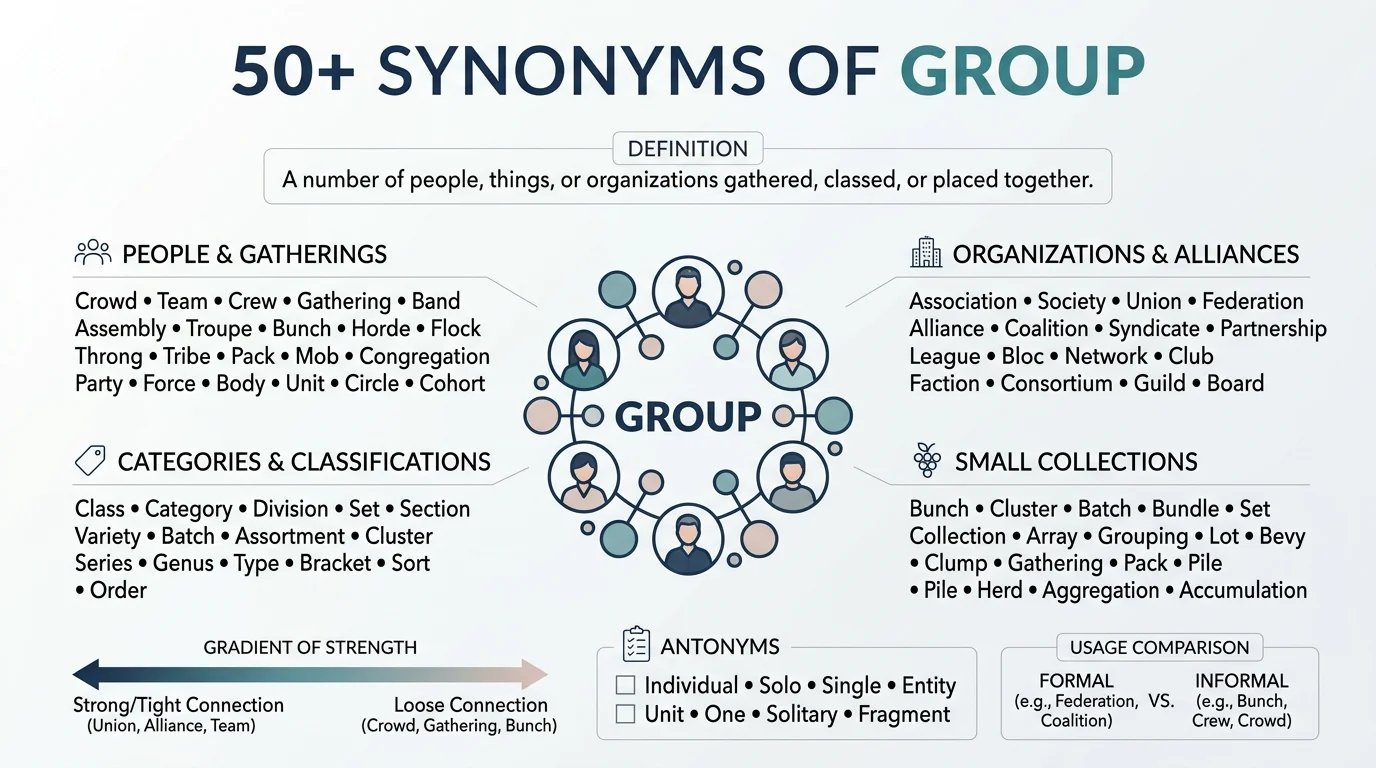
Have you ever needed to describe a collection of people or things but felt that “group” was too vague or repetitive? You want to capture the specific nature of the gathering, whether it is a team, a crowd, or a category, and the word “group” comes to mind. Choosing the right synonym for “group” can transform a basic statement into a precise description of assembly, organization, or classification. This guide explores the best synonyms of group, explaining exactly which word to use and when.
Quick Answer: “Group” means a number of people or things that are together or considered as a unit. For collections of people, choose team, crowd, or assembly. For formal organizations, use organization, association, or committee. For categories, use category, class, or classification. For small gatherings, use cluster, bunch, or set.
Meaning, Tone, and Context
Understanding the core meaning of “group” is the first step to using it effectively.
Simple Definition: A number of people or things that are located, gathered, or classed together; a set of individuals or items considered as a unit.
Part of Speech: Noun and verb.
Overall Tone: Neutral. It is a functional word used across all contexts.
Formality Level: Neutral. The word works in casual and formal contexts.
Common Uses: Native English speakers use it in social contexts (“group of friends”), business (“focus group”), academia (“study group”), and science (“group of elements”).
Word Forms: Related words include the verb group, the noun grouping, and the adjective grouped.
When and How to Use “Group”
“Group” is the perfect choice when you want to describe a collection of people or things. Here are seven realistic examples.
Social: “A group of friends gathered at the café.”
Professional: “The project group meets every Monday.”
Academic: “The study group prepared for the exam together.”
Business: “We conducted a focus group to gather feedback.”
Science: “The periodic table groups elements by properties.”
Personal: “She joined a support group for new parents.”
Social Media: “This group is for sharing recipes and cooking tips.”
Best Synonyms of “Group”
No synonym is identical in every situation. Here is your guide to the best replacement for “group” based on your writing context.
For People and Gatherings
Most Direct: Team means a group working together. “The team completed the project.”
*Crowd means a large group of people. “A crowd gathered in the square.”
*Assembly means a gathering of people. “The assembly listened to the speech.”
*Gathering means a meeting of people. “The family gathering was joyful.”
For Formal Organizations
*Organization means a structured group. “The organization advocates for human rights.”
*Association means a group with a shared purpose. “The medical association held a conference.”
*Committee means a group appointed for a task. “The committee reviewed the proposal.”
*Council means a group that governs. “The city council voted on the budget.”
For Categories and Classification
*Category means a class or division. “The products are divided into categories.”
*Class means a group of similar things. “The class of mammals includes humans.”
*Classification means the act of grouping. “The classification system is complex.”
*Set means a collection of items. “The set of tools was complete.”
For Small Collections
*Cluster means a small group close together. “A cluster of stars appeared in the sky.”
*Bunch means a group of items. “A bunch of grapes hung from the vine.”
*Batch means a group of items produced together. “A batch of cookies was baking.”
*Collection means a group of items gathered. “The collection of stamps was impressive.”
When Not to Use “Group”
Using “group” can sound wrong or awkward in certain situations.
When You Mean “Team”: “Group” is general. “Team” implies collaboration.
Better Choice: Team. “The team worked well together.”
When You Mean “Crowd”: “Group” is small. “Crowd” is large.
Better Choice: Crowd. “The crowd cheered loudly.”
When It Sounds Too Vague: “Group” can be unclear.
Better Choice: Committee, team, or category. “The committee made the decision.”
Words Commonly Confused With “Group”
| Word | Difference | When to Use | Example |
|---|---|---|---|
| Team | Working together | Business and sports | “The team won the game.” |
| Crowd | Large group | Public gatherings | “The crowd was enormous.” |
| Organization | Formal structure | Business and nonprofits | “The organization was founded in 1990.” |
| Category | Classification | Science and business | “The category includes several items.” |
| Committee | Appointed group | Governance and business | “The committee met yesterday.” |
| Cluster | Small close group | Science and general | “A cluster of stars.” |
Best Synonyms of “Group” by Context
| Context | Best Synonym | Why It Works | Example |
|---|---|---|---|
| Formal writing | Organization | Formal and structured | “The organization advocates for change.” |
| Academic writing | Category | Standard in research | “The category includes several species.” |
| Professional | Committee | Professional and formal | “The committee reviewed the plan.” |
| Business | Team | Business and collaborative | “The team completed the project.” |
| Social | Gathering | Social and warm | “The gathering was enjoyable.” |
| Science | Classification | Scientific and precise | “The classification system is complex.” |
| Casual | Bunch | Simple and natural | “A bunch of friends came over.” |
How to Choose the Best Synonym of “Group”
Choosing the right word is a simple decision. Answer these questions.
What type of group am I describing? For people, use team, crowd, or gathering. For organizations, use organization, association, or committee. And for categories, use category, class, or set. Also for small collections, use cluster, bunch, or batch.
What is my audience? For a formal report, use organization or category. For a friend, use bunch or crowd.
What is my purpose? Are you describing people, things, or categories? The correct synonym depends entirely on this.
What is the emotional strength? Gathering is warmer. Category is neutral. Pick the one that matches your message.
Real Life Examples of “Group”
School: Basic: “The group worked on the project.” Improved: “The team worked on the project.”
College: Basic: “The group studied together.” Improved: “The study group prepared for the exam.”
Workplace: Basic: “The group met to discuss the plan.” Improved: “The committee met to discuss the plan.”
Business: Basic: “The group gave feedback.” Improved: “The focus group gave feedback.”
Email: Basic: “The group is attached.” Improved: “The list is attached.”
Conversation: Basic: “A group came over.” Improved: “A bunch of friends came over.”
Storytelling: Basic: “A group gathered in the square.” Improved: “A crowd gathered in the square.”
Top 10 Synonyms of “Group”
| Synonym | Simple Meaning | Best Used For | Example Sentence |
|---|---|---|---|
| Team | A group working together | Business and sports | “The team completed the project.” |
| Crowd | A large group of people | Public gatherings | “The crowd cheered loudly.” |
| Organization | A structured group | Business and nonprofits | “The organization advocates for change.” |
| Committee | An appointed group | Governance and business | “The committee reviewed the plan.” |
| Category | A class or division | Science and business | “The category includes several items.” |
| Gathering | A meeting of people | Social and family | “The gathering was joyful.” |
| Cluster | A small close group | Science and general | “A cluster of stars appeared.” |
| Association | A group with a shared purpose | Professional and formal | “The association held a conference.” |
| Class | A group of similar things | Science and education | “The class of mammals includes humans.” |
| Bunch | A group of items | Casual and general | “A bunch of grapes hung from the vine.” |
Synonyms of “Group” by Usage
Professional vs. Personal Synonyms
In the workplace, choose team, committee, or organization. With friends, use bunch, crowd, or gathering.
Formal vs. Conversational Synonyms
For formal writing, use organization, association, or category. For casual conversations, use bunch, crowd, or gathering.
Academic Synonyms
For research and essays, choose category for classification, class for grouping, and classification for systems.
Professional and Business Synonyms
For maximum impact, choose team for collaboration, committee for governance, and organization for structure.
Creative and Literary Synonyms
To add emotion and imagery, choose gathering, cluster, or crowd. These words create atmosphere.
Slang or Modern Synonyms
In modern American slang, bunch, crew, or squad are common. For example, “The whole crew came.” These are casual and should be avoided in formal writing.
Strongest to Mildest Synonyms
Mild: bunch, cluster, set
Moderate: group, gathering, team
Strong: committee, organization, association
Very Strong: category, classification, assembly
Emotional vs. Neutral Synonyms
Emotional Synonyms: Gathering, crowd, assembly. These words hint at togetherness and energy. Use them when you want to evoke feeling.
Neutral Synonyms: Group, category, set. These words communicate factual information.
Antonyms of “Group”
| Antonym | Meaning | Example Sentence |
|---|---|---|
| Individual | A single person | “Each individual has a role.” |
| Singleton | A single item | “The singleton stood alone.” |
| Separation | The act of dividing | “The separation was necessary.” |
| Isolation | Being alone | “Isolation can be harmful.” |
| Solitude | State of being alone | “He enjoyed solitude.” |
| Unit | A single entity | “The unit operates independently.” |
| Entity | A single thing | “The entity is separate.” |
| Solo | Alone | “She performed solo.” |
| Scattering | Dispersing | “The scattering of the seeds was random.” |
| Dispersal | Spreading out | “The dispersal of the crowd was slow.” |
| Division | Separating into parts | “The division of labor was clear.” |
| Fragment | A small piece | “The fragment was part of a larger whole.” |
| Particle | A tiny piece | “The particle was invisible.” |
| Element | A single component | “Each element is unique.” |
| Item | A single thing | “The item was listed.” |
Comparison: “Group” vs Similar Words
Group vs. Team
Main Difference: “Group” is general. “Team” implies collaboration.
Which Is Stronger? “Team” is stronger for collaboration.
Which Is More Formal? Both are neutral.
When to Use Each: Use “team” for work. Use “group” for general contexts.
Examples:
Group: “A group of people gathered.”
Team: “The team won the game.”
Group vs. Crowd
Main Difference: “Group” is small. “Crowd” is large.
Which Is Stronger? “Crowd” is larger.
Which Is More Formal? Both are neutral.
When to Use Each: Use “crowd” for large gatherings. Use “group” for small gatherings.
Examples:
Group: “A group of friends met.”
Crowd: “The crowd cheered.”
Group vs. Organization
Main Difference: “Group” is general. “Organization” is structured.
Which Is Stronger? “Organization” is more formal.
Which Is More Formal? “Organization” is more formal.
When to Use Each: Use “organization” for formal groups. Use “group” for general contexts.
Examples:
Group: “The group met.”
Organization: “The organization advocates for change.”
Group vs. Category
Main Difference: “Group” is for people and things. “Category” is for classification.
Which Is Stronger? “Category” is more specific.
Which Is More Formal? Both are formal.
When to Use Each: Use “category” for classification. Use “group” for general contexts.
Examples:
Group: “The group of items.”
Category: “The category includes several items.”
Group vs. Committee
Main Difference: “Group” is general. “Committee” is appointed.
Which Is Stronger? “Committee” is more specific.
Which Is More Formal? “Committee” is more formal.
When to Use Each: Use “committee” for governance. Use “group” for general contexts.
Examples:
Group: “The group discussed the issue.”
Committee: “The committee made the decision.”
Group vs. Cluster
Main Difference: “Group” is general. “Cluster” is close together.
Which Is Stronger? “Cluster” is more specific.
Which Is More Formal? Both are neutral.
When to Use Each: Use “cluster” for close items. Use “group” for general contexts.
Examples:
Group: “A group of stars.”
Cluster: “A cluster of stars.”
Common Phrases and Expressions with “Group”
Phrase: Focus group
Meaning: A group for research.
Example Sentence: “The focus group discussed the product.”
Phrase: Age group
Meaning: People of a certain age.
Example Sentence: “The age group most affected was 18 to 25.”
Phrase: Group effort
Meaning: Work done together.
Example Sentence: “Success was a group effort.”
Phrase: Peer group
Meaning: People of similar age or status.
Example Sentence: “Peer group influence is strong during adolescence.”
Phrase: Group dynamics
Meaning: How people interact in groups.
Example Sentence: “Group dynamics affect productivity.”
Phrase: Support group
Meaning: A group offering help.
Example Sentence: “The support group meets weekly.”
Common Mistakes to Avoid
Mistake 1: Using “group” when you mean “team”.
Incorrect: “The group worked well together.”
Better: “The team worked well together.”
Why: “Team” implies collaboration.
Mistake 2: Using “group” when you mean “crowd”.
Incorrect: “The group cheered loudly.”
Better: “The crowd cheered loudly.”
Why: “Crowd” is for large gatherings.
Mistake 3: Overusing “group” in conversation.
Incorrect: “A group of friends came over.”
Better: “A bunch of friends came over.”
Why: “Bunch” sounds more natural.
Mistake 4: Using “group” when you mean “committee”.
Incorrect: “The group made the decision.”
Better: “The committee made the decision.”
Why: “Committee” is for formal decisions.
Mistake 5: Using “group” when you mean “category”.
Incorrect: “The group of elements includes metals.”
Better: “The category of elements includes metals.”
Why: “Category” is for classification.
Frequently Asked Questions
1. What are the best synonyms of “group”?
The best synonyms depend on your context. For people, choose team or crowd. For organizations, use organization or committee. And for categories, use category or class.
2. What are the best formal synonyms of “group”?
The best formal synonyms are organization, association, and committee. These words are suitable for academic papers, professional reports, and business communications.
3. What are common informal synonyms of “group”?
For informal settings, use bunch, crowd, or crew. These alternatives sound more natural in everyday conversation.
4. What is another word for “group” in professional writing?
In professional writing, team is an excellent choice. It conveys collaboration. Committee is also strong for governance.
5. What is the difference between “group” and “team”?
“Group” is general. “Team” implies working together. Use “team” for collaboration and “group” for general contexts.
6. What is the opposite of “group”?
The most direct opposites (antonyms) of group are individual, single, and separation. These words describe a lack of grouping.
Conclusion
“Group” is a versatile and essential word for describing collections of people and things. The term is neutral and widely accepted in all contexts, yet it can sound too vague for specific descriptions or too general for formal writing. The best choice among the synonyms of group depends entirely on your audience, tone, and purpose. For a formal, professional effect, use organization or committee. For a practical, everyday context, team or crowd works perfectly. And for classification, choose category or class. Also for casual conversation, use bunch or crew. Remember, no single synonym works perfectly in every situation. Your goal is to choose the word that communicates your message with the most clarity and impact. A practical tip for your vocabulary growth is to pay attention to how writers describe collections and gatherings and practice using different synonyms in your writing.










1 thought on “50+ Synonyms of Group: Meanings, Uses, Examples, and Best Alternatives”