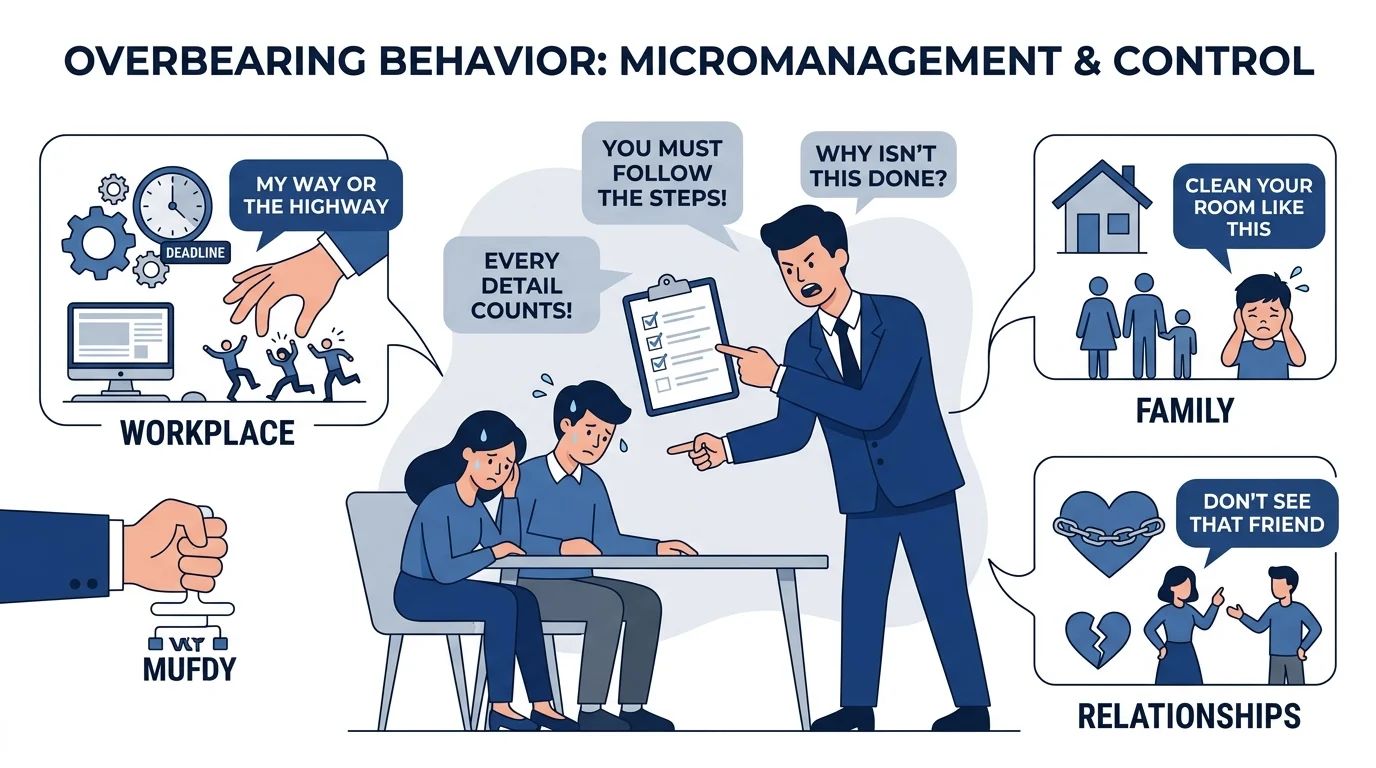
Quick Ans: Overbearing describes a person who is too controlling, domineering, or demanding, often trying to influence or direct others without respecting their opinions or personal boundaries. The term commonly appears when discussing relationships, parenting, friendships, workplaces, and leadership styles.
Have you ever described someone as overbearing or heard someone say, “My boss is overbearing” or “Her parents are overbearing”? The word is frequently used in everyday conversations to describe people who tend to control situations, make decisions for others, or dominate conversations and relationships.
While confidence and leadership are generally positive qualities, they can become problematic when someone consistently ignores the thoughts, feelings, or independence of others. That’s when people often use the word overbearing.
In this guide, you’ll learn the complete overbearing meaning, where the word comes from, how it’s used in different situations, real-life examples, common signs, synonyms, antonyms, misunderstandings, and practical advice for dealing with overbearing behavior.
Quick Answer Box
| Topic | Answer |
|---|---|
| Meaning | Too controlling, domineering, or bossy |
| Part of Speech | Adjective |
| Tone | Usually negative |
| Common Contexts | Relationships, parenting, workplace, friendships, leadership |
| Opposite | Respectful, considerate, easygoing |
| Example | “His overbearing attitude made teamwork difficult.” |
What Does Overbearing Mean?
Overbearing refers to someone who behaves in a way that is excessively controlling, forceful, or domineering. An overbearing person often insists that things be done their way and may ignore the opinions, preferences, or feelings of others.
The word usually carries a negative meaning because it suggests a lack of respect for another person’s independence or boundaries.
Examples include:
- An employer who micromanages every task.
- A parent who makes every decision for their adult child.
- A friend who constantly tells others what they should do.
- A partner who controls every aspect of a relationship.
Full Definition
According to standard English usage, overbearing describes someone who is:
- Bossy
- Controlling
- Domninating
- Forceful
- Intimidating
- Authoritative in an excessive way
The word does not simply mean “confident” or “strong.” Instead, it implies that someone exercises their authority or influence in an unreasonable or oppressive manner.
Context and Usage
The meaning of overbearing depends slightly on the situation, but the core idea remains the same: too much control.
Personal Relationships
People may describe a romantic partner as overbearing if they:
- Constantly make decisions for their partner.
- Tell them who they can spend time with.
- Ignore their opinions.
- Demand constant attention.
Example:
“Her overbearing boyfriend wanted to control every decision she made.”
Family
Parents can sometimes be described as overbearing when they become overly involved in their children’s lives.
Example:
“His overbearing parents chose his university, career, and even his hobbies.”
Workplace
Managers may be considered overbearing if they:
- Micromanage employees.
- Refuse to delegate.
- Reject every suggestion.
- Constantly monitor workers.
Example:
“The team’s productivity declined because of the overbearing manager.”
Friendships
Friends may seem overbearing when they dominate conversations or pressure others into doing things they don’t want to do.
Example:
“She can be kind, but sometimes she’s a little overbearing.”
Real-Life Examples
Conversation Example 1
Emma: Why did you leave your last job?
Lucas: My manager was too overbearing and never trusted the team.
Conversation Example 2
Sarah: Why don’t you travel with your parents anymore?
Olivia: They’re wonderful, but they can be overbearing.
Conversation Example 3
Jake: Did your roommate agree?
Ryan: Not really. He’s pretty overbearing and always wants things his way.
Conversation Example 4
Sophia: How’s your new coach?
Emma: Skilled, but a little overbearing during practice.
Conversation Example 5
Noah: Why did the meeting take so long?
Ethan: One person kept interrupting everyone. He was very overbearing.
Overbearing in Different Situations
Overbearing Parent
An overbearing parent may:
- Make every decision.
- Monitor every activity.
- Discourage independence.
- Solve every problem instead of teaching responsibility.
Overbearing Partner
Common signs include:
- Excessive jealousy.
- Controlling finances.
- Making decisions without discussion.
- Ignoring personal boundaries.
Overbearing Boss
Characteristics often include:
- Micromanagement.
- Lack of trust.
- Constant criticism.
- Unrealistic expectations.
- Refusing employee input.
Overbearing Friend
An overbearing friend might:
- Always choose activities.
- Interrupt conversations.
- Pressure others into agreeing.
- Expect constant attention.
Signs of an Overbearing Person
You may be dealing with an overbearing individual if they regularly:
- Dominate conversations.
- Interrupt others.
- Ignore personal boundaries.
- Believe they’re always right.
- Dismiss different opinions.
- Try to control other people’s choices.
- Offer unwanted advice constantly.
- Become upset when others disagree.
- Struggle to compromise.
- Demand things be done their way.
Having one of these traits occasionally doesn’t necessarily make someone overbearing. The pattern and frequency of the behavior matter.
Synonyms of Overbearing
Several English words share a similar meaning.
Common synonyms include:
- Bossy
- Controlling
- Domineering
- Pushy
- Demanding
- Forceful
- Authoritarian
- Dictatorial
- Oppressive
- Intimidating
Each carries slightly different shades of meaning, but all describe someone who exercises excessive control or influence.
Antonyms of Overbearing
The opposite of overbearing includes qualities that respect others’ independence.
Examples:
- Considerate
- Respectful
- Easygoing
- Supportive
- Understanding
- Cooperative
- Flexible
- Patient
- Open-minded
- Encouraging
How to Respond to Overbearing Behavior
If someone is overbearing, responding calmly and respectfully is usually the most effective approach.
Some helpful strategies include:
- Set clear boundaries.
- Communicate your needs directly.
- Stay calm during disagreements.
- Avoid escalating conflicts.
- Be confident in expressing your opinions.
- Politely decline unreasonable requests.
- Seek compromise where possible.
For example:
“I appreciate your advice, but I’d like to make this decision myself.”
Or:
“I’d like the opportunity to share my perspective before we decide.”
Common Misinterpretations
People sometimes confuse overbearing with:
Strict
A strict person follows rules consistently, while an overbearing person tries to control others beyond what is reasonable.
Confident
Confidence involves believing in yourself. Overbearing behavior involves imposing your views on others.
Assertive
Assertive people communicate clearly while respecting others. Overbearing people often disregard others’ opinions.
Protective
Being protective is motivated by care and concern. Overbearing behavior often limits another person’s independence.
When Not to Use the Word
Avoid describing someone as overbearing if they are simply:
- Giving helpful advice.
- Offering constructive feedback.
- Enforcing reasonable workplace rules.
- Setting healthy family boundaries.
- Leading a team respectfully.
Using the word too casually may unfairly label someone whose intentions are positive.
Usage Tips
To use overbearing correctly:
- Apply it when someone consistently behaves in a controlling way.
- Consider whether the behavior limits another person’s choices.
- Use examples when describing why someone seems overbearing.
- Avoid using it as an insult during arguments unless the description is accurate.
- Remember that occasional leadership is not the same as being overbearing.
Frequently Asked Questions
What does overbearing mean?
It means being excessively controlling, bossy, or domineering toward others.
Is overbearing always negative?
Generally, yes. It usually describes behavior that makes others feel pressured or controlled.
Can a parent be overbearing?
Yes. Parents may be described as overbearing if they don’t allow their children enough independence.
What is an overbearing boss?
An overbearing boss excessively controls employees, micromanages tasks, and rarely trusts others to work independently.
Is overbearing the same as abusive?
Not necessarily. Someone can be overbearing without being abusive, although extreme controlling behavior can become unhealthy.
What is the difference between assertive and overbearing?
Assertive people respect others while expressing themselves. Overbearing people often ignore or overpower others’ opinions.
Can someone stop being overbearing?
Yes. With self-awareness, feedback, and improved communication skills, people can develop healthier interaction habits.
What causes someone to become overbearing?
Possible reasons include insecurity, perfectionism, fear of failure, learned behavior, or a desire to maintain control.
Is overbearing a personality trait?
It is more accurately described as a pattern of behavior rather than a fixed personality trait.
How do I politely tell someone they’re being overbearing?
Use respectful language, focus on specific behaviors, and explain how those actions affect you instead of attacking the person’s character.
Conclusion
The overbearing meaning refers to someone who is too controlling, bossy, or domineering, often trying to direct other people’s decisions without respecting their independence or opinions. Whether describing a manager who micromanages, a parent who refuses to let their child make decisions, a partner who controls every aspect of a relationship, or a friend who dominates every conversation, the word highlights behavior that goes beyond healthy leadership or concern.
Understanding the meaning of overbearing can help you recognize controlling behaviors, communicate more effectively, and build healthier relationships based on mutual respect and trust. While everyone can occasionally be forceful or opinionated, consistently respecting boundaries and encouraging independence is what separates confident leadership from overbearing behavior.

Alexander Cole is a professional content writer and researcher who specializes in creating informative, reader-friendly, and well-researched articles. He is committed to publishing accurate, valuable, and engaging content that helps readers stay informed and make smarter decisions.