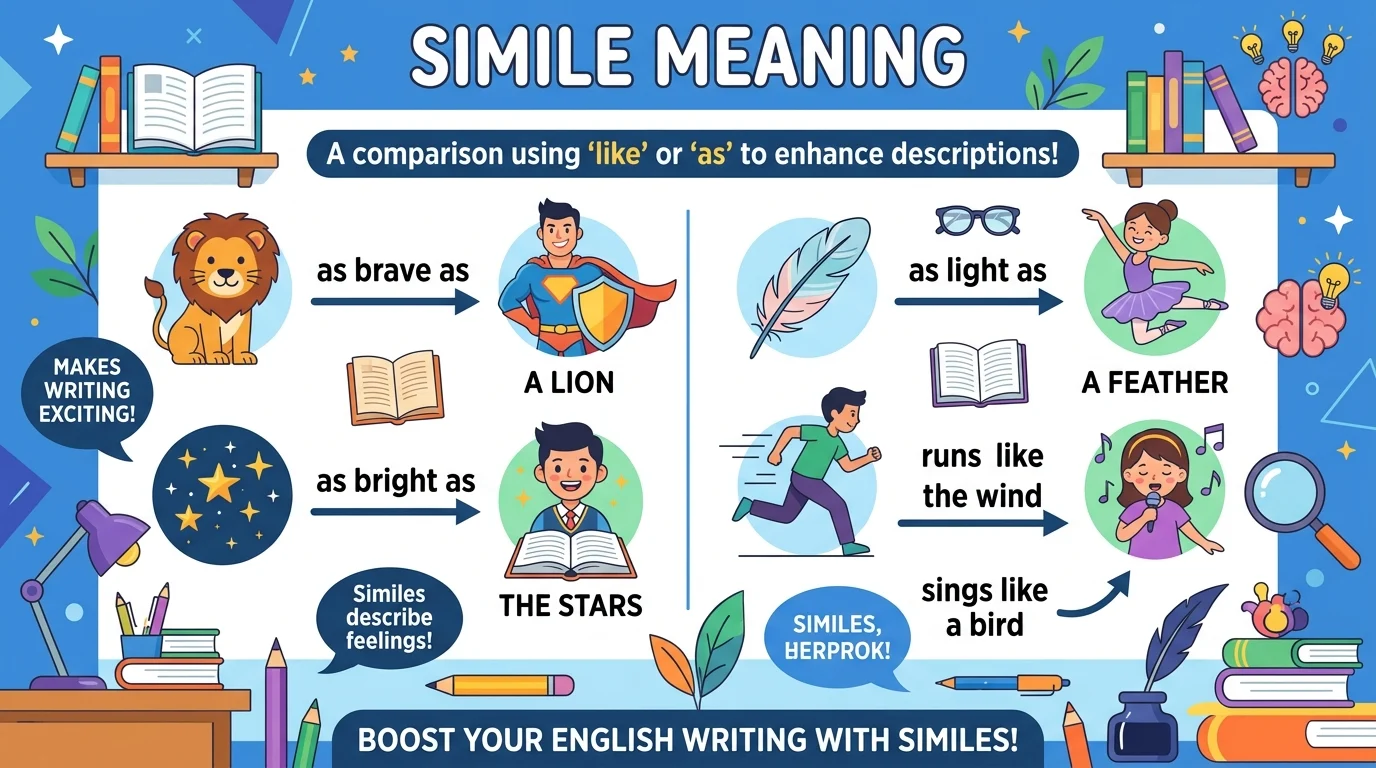
Quick Ans: A simile is a figure of speech that compares two different things using the words “like” or “as.” Similes make writing and speech more vivid by helping readers or listeners visualize ideas through familiar comparisons. For example, “She is as brave as a lion” and “The baby slept like a log” are both similes.
If you’ve searched for “simile meaning,” you’re likely looking for a simple explanation of what a simile is, how it works, and how to use it correctly. Similes are among the most common figures of speech in the English language. They appear in everyday conversations, books, poems, songs, advertisements, speeches, and even social media posts.
Whether you’re a student completing an English assignment, a writer looking to improve your style, or simply curious about literary devices, understanding similes can make your communication more engaging and expressive.
This comprehensive guide explains the meaning of similes, their purpose, examples, differences from metaphors, common mistakes, writing tips, and frequently asked questions.
Quick Answer Box
| Topic | Answer |
|---|---|
| Meaning | A comparison using “like” or “as” |
| Type | Figure of speech |
| Purpose | Makes descriptions clearer and more vivid |
| Common Words | Like, As |
| Used In | Literature, poetry, speeches, essays, conversations |
| Example | “He runs like the wind.” |
What Is a Simile?
A simile is a literary device that compares one thing with another using the connecting words like or as.
Instead of saying something directly, a simile creates an image by comparing it with something familiar.
For example:
- She shines like the sun.
- The water was as clear as glass.
- He fought like a warrior.
- The child slept like a baby.
These comparisons help readers imagine exactly what the writer means.
Full Definition of Simile
A simile is a comparison between two unlike things that share a similar quality.
Unlike a literal statement, a simile doesn’t mean the two things are actually the same. Instead, it highlights a shared characteristic.
For example:
“Her smile was like sunshine.”
This doesn’t mean her smile is literally sunshine. Instead, it suggests that her smile is warm, bright, and cheerful.
Why Are Similes Important?
Similes improve communication by making descriptions easier to understand.
They help readers:
- Visualize scenes
- Understand emotions
- Connect with stories
- Remember ideas
- Enjoy creative writing
Authors use similes because they create strong mental pictures that ordinary descriptions often cannot.
How Similes Work
Every simile contains three main parts:
- The subject being described
- The comparison word (“like” or “as”)
- The object used for comparison
Example:
The athlete ran like lightning.
Subject:
The athlete
Comparison:
Like
Object:
Lightning
Shared quality:
Speed
Common Characteristics of Similes
Good similes are:
- Easy to understand
- Creative
- Relevant
- Clear
- Natural
Poor similes confuse readers or compare things that don’t share meaningful similarities.
Everyday Simile Examples
People use similes more often than they realize.
Examples include:
- Busy as a bee
- Quiet as a mouse
- Cold as ice
- Soft as silk
- White as snow
- Fast as lightning
- Hungry as a wolf
- Light as a feather
- Sweet as honey
- Brave as a lion
These expressions have become common in everyday English.
Similes in Daily Conversations
People naturally use similes while speaking.
Example:
Sarah: How was the exam?
Mike: It was as easy as pie.
Emma: Did you sleep well?
Jake: I slept like a log.
Alex: Is your new car fast?
Ryan: It moves like a rocket.
These comparisons make conversations more expressive.
Similes in Literature
Many famous authors use similes.
Example:
“The stars sparkled like diamonds.”
This creates a beautiful image in the reader’s mind.
Another example:
“Her voice was as soft as velvet.”
Instead of simply saying her voice was gentle, the simile helps readers imagine the sound more clearly.
Similes in Poetry
Poets frequently use similes because they create vivid imagery.
Example:
“My love is like a red, red rose.”
This famous line compares love to a beautiful flower.
Poetry often relies on similes to express emotions creatively.
Similes in Songs
Songwriters also use similes.
Examples include comparisons involving:
- Fire
- Rain
- Rivers
- Stars
- Birds
- Flowers
- Dreams
These comparisons help listeners connect emotionally with lyrics.
Similes in Advertising
Businesses use similes to make products memorable.
Examples:
- Fresh as morning dew
- Strong like steel
- Soft as cotton
- Smooth like silk
These phrases help customers visualize product qualities.
Similes for Students
Students often encounter similes in English classes.
Here are beginner-friendly examples:
- The puppy was as playful as a child.
- My backpack felt as heavy as a mountain.
- The classroom was as quiet as a library.
- Her eyes sparkled like stars.
- The clouds floated like cotton.
Teachers encourage students to create original similes to improve descriptive writing.
Simile vs. Metaphor
Although both compare two things, they are different.
Simile
Uses like or as.
Example:
He is as strong as an ox.
Metaphor
Makes a direct comparison without “like” or “as.”
Example:
He is an ox.
A simile suggests similarity, while a metaphor states one thing is another for dramatic effect.
Simile vs. Idiom
Many people confuse similes with idioms.
Example:
“Busy as a bee.”
This is both a simile and a commonly used idiomatic expression.
However, not every idiom is a simile.
Common Mistakes
Avoid these errors:
Comparing unrelated things
Bad:
The chair was like mathematics.
Good:
The chair was as hard as stone.
Overusing similes
Too many similes can distract readers.
Instead of comparing every sentence, use them only where they add value.
Using clichés excessively
Expressions like:
- Busy as a bee
- Cold as ice
- White as snow
are widely understood but may feel less original in creative writing.
Tips for Writing Better Similes
To write effective similes:
- Compare things with shared qualities.
- Keep comparisons simple.
- Avoid confusing readers.
- Be creative.
- Think about the emotion you want to create.
- Read your sentence aloud.
- Replace weak comparisons with stronger imagery.
Real-Life Conversation Examples
Example 1
Anna: How was the marathon?
James: I felt as tired as a dog afterward.
Example 2
Ben: How’s your coffee?
Olivia: It’s as hot as lava.
Example 3
Emma: How’s your internet?
Liam: Slow like a snail today.
Example 4
Sophia: Is your little brother sleeping?
Lucas: Yes, he’s sleeping like a baby.
Example 5
Noah: How was your presentation?
Ella: I was as nervous as a cat in a room full of rocking chairs.
When Should You Use Similes?
Similes work well in:
- Essays
- Stories
- Poems
- Speeches
- Presentations
- Blogs
- Children’s books
- Creative writing
- Marketing
- Everyday conversations
They make language more colorful without making it difficult to understand.
When Not to Use Similes
Avoid excessive similes in:
- Scientific papers
- Legal documents
- Technical manuals
- Formal reports requiring precise language
In these contexts, direct language is usually better.
Frequently Asked Questions
What is a simple definition of a simile?
A simile is a comparison between two different things using “like” or “as.”
Why are similes used?
They make descriptions more vivid and easier to imagine.
Is every comparison a simile?
No. A comparison is only a simile if it uses “like” or “as.”
What is the difference between a simile and a metaphor?
A simile uses “like” or “as,” while a metaphor compares directly without those words.
Can children learn similes?
Yes. Similes are commonly taught in elementary and middle school English classes.
Are similes figures of speech?
Yes. They are one of the most common figures of speech in English.
Can similes be funny?
Absolutely. Many humorous expressions use similes to exaggerate for effect.
Are similes used in everyday speech?
Yes. Native English speakers use similes regularly in casual conversations.
Can a simile compare people and objects?
Yes. A person can be compared to an animal, object, or natural element using “like” or “as.”
How can I improve my similes?
Read widely, observe everyday comparisons, and create original descriptions instead of relying only on common expressions.
Conclusion
Understanding the simile meaning is essential for improving both written and spoken English. A simile compares two unlike things using “like” or “as” to create vivid, memorable descriptions. From classic literature and poetry to everyday conversations and advertising, similes help express ideas more clearly and creatively.
Whether you’re a student, teacher, writer, or language learner, mastering similes will strengthen your communication skills and make your writing more engaging. By using meaningful comparisons, avoiding clichés when possible, and practicing regularly, you can create descriptions that capture readers’ attention and leave a lasting impression.

Amelia Brooks is a professional content writer and digital publishing specialist with a passion for creating clear, engaging, and informative content. She has extensive experience writing about technology, business, lifestyle, and online services.