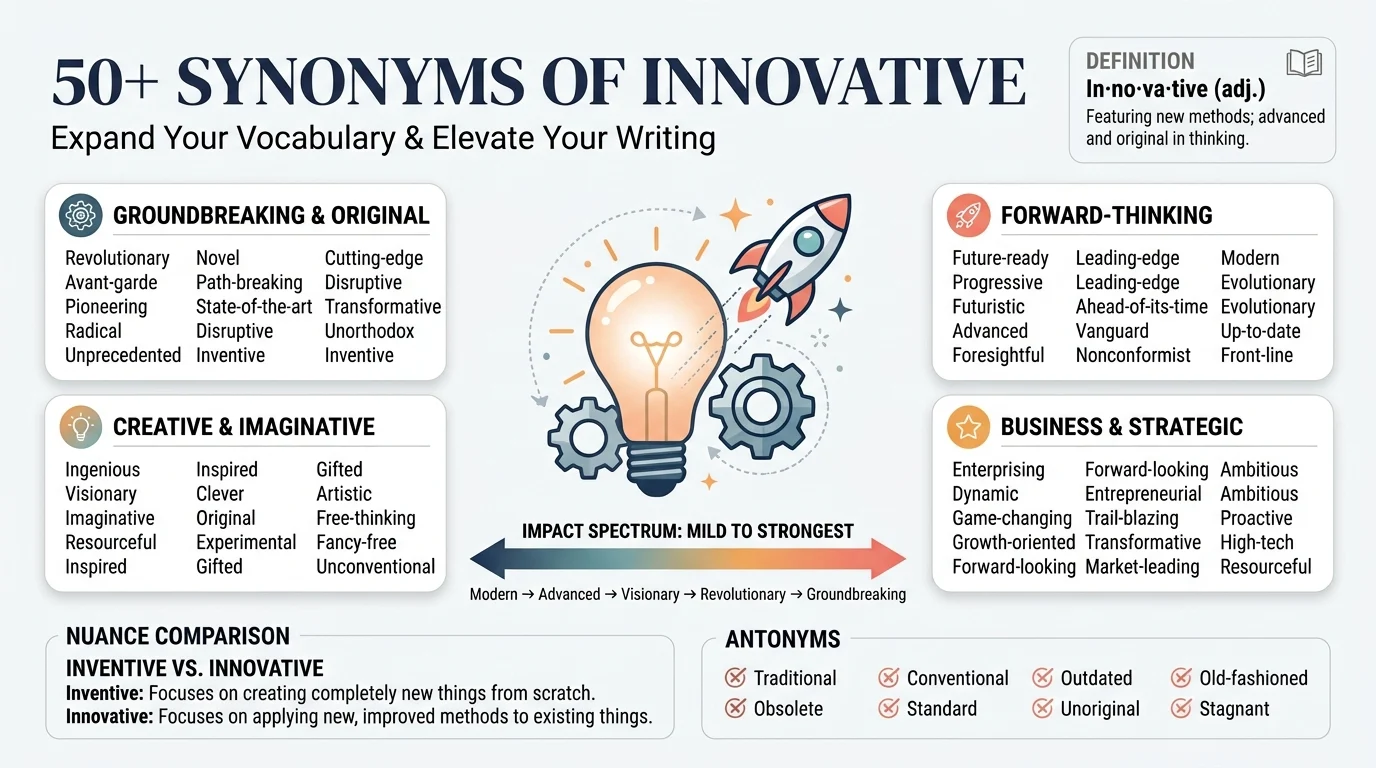
Have you ever needed to describe a fresh idea, a groundbreaking product, or a creative approach but felt that “new” or “creative” was too simple? You want to capture the originality, forward-thinking, and impact of something truly novel, and the word “innovative” comes to mind. Choosing the right synonym for “innovative” can transform a basic compliment into a precise expression of originality, ingenuity, or vision. This guide explores the best synonyms of innovative, explaining exactly which word to use and when.
Quick Ans: “Innovative” means introducing new ideas, methods, or products; original and creative in thinking. For formal writing, choose groundbreaking or pioneering. For business contexts, use cutting-edge or revolutionary. For creative contexts, use inventive or imaginative. For casual conversation, use fresh or original.
Meaning, Tone, and Context
Understanding the core meaning of “innovative” is the first step to using it effectively.
Simple Definition: Featuring new methods; advanced and original; introducing new ideas or ways of doing things.
Part of Speech: Adjective.
Overall Tone: Positive and forward-looking. It indicates creativity, originality, and progress.
Formality Level: Neutral to formal. The word is appropriate in business, academic, and creative contexts.
Common Uses: Native English speakers use it to describe products (“innovative technology”), companies (“innovative startup”), people (“innovative thinker”), and solutions (“innovative approach”).
Word Forms: Related words include the noun innovation, the verb innovate, and the adverb innovatively.
When and How to Use “Innovative”
“Innovative” is the perfect choice when you want to describe something new, original, and impactful. Here are seven realistic examples.
Business: “The company launched an innovative product that changed the market.”
Academic: “The researcher proposed an innovative solution to a longstanding problem.”
Technology: “The innovative software uses artificial intelligence.”
Creative: “Her innovative design won the competition.”
Professional: “We need an innovative approach to solve this challenge.”
Personal: “He has an innovative mind that never stops creating.”
Social Media: “This innovative gadget is a game-changer.”
Best Synonyms of “Innovative”
No synonym is identical in every situation. Here is your guide to the best replacement for “innovative” based on your writing context.
For Groundbreaking and Pioneering
Most Formal: Groundbreaking means introducing new ideas. “The groundbreaking research changed the field.”
Pioneering: Pioneering means leading the way. “Her pioneering work in medicine saved lives.”
Trailblazing: Trailblazing means pioneering and innovative. “His trailblazing approach inspired many.”
Revolutionary: Revolutionary means completely new and different. “The revolutionary design transformed the industry.”
For Business and Technology
Cutting-edge: Cutting-edge means the most advanced. “The cutting-edge technology is impressive.”
State-of-the-art: State-of-the-art means the latest and most advanced. “The state-of-the-art facility opened.”
Disruptive: Disruptive means radically changing an industry. “The disruptive startup challenged the giants.”
Game-changing: Game-changing means fundamentally altering a situation. “The game-changing product sold out.”
For Creative and Inventive
Inventive: Inventive means creative and original. “The inventive design was praised.”
Imaginative: Imaginative means full of new ideas. “The imaginative story captivated readers.”
Original: Original means not copied. “Her original approach stood out.”
Ingenious: Ingenious means clever and original. “The ingenious solution saved time.”
For Forward-Thinking and Progressive
Forward-thinking: Forward-thinking means planning for the future. “The forward-thinking leader embraced change.”
Progressive: Progressive means favoring new ideas. “The progressive policy was welcomed.”
Visionary: Visionary means thinking about the future. “The visionary founder saw the potential.”
Enterprising: Enterprising means showing initiative. “The enterprising team launched a new product.”
When Not to Use “Innovative”
Using “innovative” can sound wrong or awkward in certain situations.
When You Mean “New”: “Innovative” implies originality and impact. “New” is simple.
Better Choice: New or recent. “The new product is available.”
When You Mean “Different”: “Innovative” is positive. “Different” is neutral.
Better Choice: Different or unusual. “The design is different.”
When It Sounds Too Formal: In casual conversation, “innovative” can sound corporate.
Better Choice: Fresh or cool. “That is a cool idea.”
Words Commonly Confused With “Innovative”
| Word | Difference | When to Use | Example |
|---|---|---|---|
| Creative | Imaginative | Arts and general | “Creative writing.” |
| Original | Not copied | Arts and ideas | “Original artwork.” |
| Inventive | Skilled at creating | Problem-solving | “Inventive solution.” |
| Groundbreaking | Introducing new ideas | Formal and academic | “Groundbreaking research.” |
| Cutting-edge | Most advanced | Business and tech | “Cutting-edge technology.” |
| Revolutionary | Completely new | Dramatic and bold | “Revolutionary design.” |
Best Synonyms of “Innovative” by Context
| Context | Best Synonym | Why It Works | Example |
|---|---|---|---|
| Formal writing | Groundbreaking | Formal and impactful | “The groundbreaking study.” |
| Academic writing | Pioneering | Standard in research | “Pioneering work in the field.” |
| Professional | Cutting-edge | Business and technology | “Cutting-edge solutions.” |
| Business | Disruptive | Market-changing | “Disruptive business model.” |
| Creative | Inventive | Artistic and clever | “Inventive design.” |
| Casual | Fresh | Simple and natural | “Fresh approach.” |
| Technology | State-of-the-art | Latest and advanced | “State-of-the-art equipment.” |
How to Choose the Best Synonym of “Innovative”
Choosing the right word is a simple decision. Answer these questions.
What type of innovation am I describing? For groundbreaking, use pioneering or trailblazing. And For business, use cutting-edge or disruptive. For creative, use inventive or imaginative. For forward-thinking, use visionary or progressive.
What is my audience? For a formal report, use groundbreaking or pioneering. For a friend, use fresh or cool.
What is my purpose? Are you describing a product, a person, or an approach? The correct synonym depends entirely on this.
What is the emotional strength? Revolutionary and disruptive are stronger. Fresh is milder. Pick the one that matches your message.
Real Life Examples of “Innovative”
School: Basic: “The project is innovative.” Improved: “The project is inventive and creative.”
College: Basic: “The research is innovative.” Improved: “The research is groundbreaking.”
Workplace: Basic: “We need an innovative solution.” Improved: “We need a cutting-edge solution.”
Business: Basic: “The company is innovative.” Improved: “The company is pioneering in its field.”
Email: Basic: “The idea is innovative.” Improved: “The idea is fresh and original.”
Conversation: Basic: “That is innovative.” Improved: “That is cool.”
Storytelling: Basic: “The design was innovative.” Improved: “The revolutionary design changed everything.”
Top 10 Synonyms of “Innovative”
| Synonym | Simple Meaning | Best Used For | Example Sentence |
|---|---|---|---|
| Groundbreaking | Introducing new ideas | Formal and academic | “The groundbreaking research.” |
| Pioneering | Leading the way | Academic and professional | “Her pioneering work.” |
| Cutting-edge | Most advanced | Business and technology | “Cutting-edge technology.” |
| Revolutionary | Completely new | Dramatic and bold | “The revolutionary design.” |
| Inventive | Creative and original | Arts and problem-solving | “The inventive solution.” |
| Imaginative | Full of new ideas | Creative and artistic | “The imaginative story.” |
| Original | Not copied | Arts and ideas | “Her original approach.” |
| Disruptive | Radically changing | Business and markets | “The disruptive startup.” |
| Visionary | Thinking about the future | Leadership and strategy | “The visionary founder.” |
| State-of-the-art | Latest and most advanced | Technology and facilities | “State-of-the-art equipment.” |
Synonyms of “Innovative” by Usage
Professional vs. Personal Synonyms
In the workplace, choose cutting-edge, disruptive, or pioneering. With friends, use fresh, cool, or original.
Formal vs. Conversational Synonyms
For formal writing, use groundbreaking, pioneering, or revolutionary. For casual conversations, use fresh, cool, or original.
Academic Synonyms
For research and essays, choose groundbreaking for discoveries, pioneering for leadership, and original for contributions.
Professional and Business Synonyms
For maximum impact, choose cutting-edge for technology, disruptive for markets, and visionary for leadership.
Creative and Literary Synonyms
To add emotion and imagery, choose inventive, imaginative, or revolutionary. These words create atmosphere.
Slang or Modern Synonyms
In modern American slang, fresh, cool, or game-changing are common. For example, “That is game-changing.” These are casual and should be avoided in formal writing.
Strongest to Mildest Synonyms
Mild: new, different, fresh
Moderate: innovative, original, creative
Strong: cutting-edge, inventive, imaginative
Very Strong: groundbreaking, revolutionary, pioneering, disruptive
Emotional vs. Neutral Synonyms
Emotional Synonyms: Revolutionary, disruptive, visionary. These words hint at excitement and change. Use them when you want to evoke feeling.
Neutral Synonyms: Innovative, original, new. These words communicate factual information.
Antonyms of “Innovative”
| Antonym | Meaning | Example Sentence |
|---|---|---|
| Traditional | Following long-established customs | “The traditional method is still used.” |
| Conventional | Based on what is generally done | “The conventional approach is safe.” |
| Outdated | No longer useful | “The outdated system needs replacing.” |
| Old-fashioned | Not modern | “The old-fashioned design is charming.” |
| Unoriginal | Not new or fresh | “The unoriginal idea was rejected.” |
| Imitation | Copied from something else | “The imitation product was cheaper.” |
| Derivative | Imitating others | “The derivative work lacked originality.” |
| Stagnant | Not developing | “The stagnant market needed change.” |
| Conservative | Averse to change | “The conservative approach was cautious.” |
| Reactionary | Opposing change | “The reactionary policy was criticized.” |
| Routine | Regular and habitual | “The routine procedure is standard.” |
| Standard | The usual or expected | “The standard method is reliable.” |
| Commonplace | Ordinary and not unusual | “The commonplace design was boring.” |
| Stale | No longer fresh | “The stale ideas needed refreshing.” |
| Obsolete | No longer in use | “The obsolete technology was discarded.” |
Comparison: “Innovative” vs Similar Words
Innovative vs. Creative
Main Difference: “Creative” is imaginative. “Innovative” is about new methods and impact.
Which Is Stronger? “Innovative” is stronger for practical impact.
Which Is More Formal? Both are neutral.
When to Use Each: Use “creative” for arts. Use “innovative” for business and technology.
Examples:
Innovative: “The innovative solution saved money.”
Creative: “The creative design was beautiful.”
Innovative vs. Original
Main Difference: “Original” is not copied. “Innovative” is new and impactful.
Which Is Stronger? “Innovative” is stronger for impact.
Which Is More Formal? Both are neutral.
When to Use Each: Use “original” for authenticity. Use “innovative” for progress.
Examples:
Innovative: “The innovative approach changed the industry.”
Original: “The original artwork was authentic.”
Innovative vs. Inventive
Main Difference: “Inventive” is skilled at creating. “Innovative” is about new methods.
Which Is Stronger? “Inventive” is more about skill.
Which Is More Formal? Both are formal.
When to Use Each: Use “inventive” for problem-solving. Use “innovative” for broader impact.
Examples:
Innovative: “The innovative product was a hit.”
Inventive: “The inventive solution was clever.”
Innovative vs. Groundbreaking
Main Difference: “Groundbreaking” is more formal and dramatic. “Innovative” is broader.
Which Is Stronger? “Groundbreaking” is stronger.
Which Is More Formal? “Groundbreaking” is more formal.
When to Use Each: Use “groundbreaking” for major discoveries. Use “innovative” for general contexts.
Examples:
Innovative: “The innovative design was praised.”
Groundbreaking: “The groundbreaking research changed medicine.”
Innovative vs. Cutting-edge
Main Difference: “Cutting-edge” is the most advanced. “Innovative” is broader.
Which Is Stronger? “Cutting-edge” is stronger for technology.
Which Is More Formal? Both are formal.
When to Use Each: Use “cutting-edge” for technology. Use “innovative” for general contexts.
Examples:
Innovative: “The innovative approach was successful.”
Cutting-edge: “The cutting-edge technology is impressive.”
Innovative vs. Revolutionary
Main Difference: “Revolutionary” is completely new and dramatic. “Innovative” is broader.
Which Is Stronger? “Revolutionary” is stronger.
Which Is More Formal? Both are formal.
When to Use Each: Use “revolutionary” for dramatic change. Use “innovative” for general contexts.
Examples:
Innovative: “The innovative product was popular.”
Revolutionary: “The revolutionary design changed everything.”
Common Phrases and Expressions with “Innovative”
Phrase: Innovative thinking
Meaning: Creative and original thought.
Example Sentence: “The company encourages innovative thinking.”
Phrase: Innovative solution
Meaning: A new and effective answer.
Example Sentence: “We need an innovative solution to this problem.”
Phrase: Innovative approach
Meaning: A new method.
Example Sentence: “The innovative approach yielded results.”
Phrase: Innovative technology
Meaning: Advanced and new technology.
Example Sentence: “The innovative technology is cutting-edge.”
Phrase: Innovative design
Meaning: Original and creative design.
Example Sentence: “The innovative design won awards.”
Phrase: Innovative company
Meaning: A company that introduces new ideas.
Example Sentence: “The innovative company leads the market.”
Common Mistakes to Avoid
Mistake 1: Using “innovative” when you mean “new”.
Incorrect: “The innovative product is available.”
Better: “The new product is available.”
Why: “Innovative” implies originality and impact.
Mistake 2: Using “innovative” when you mean “different”.
Incorrect: “The innovative design is different.”
Better: “The different design is unusual.”
Why: “Innovative” is positive.
Mistake 3: Overusing “innovative” in conversation.
Incorrect: “That is innovative.”
Better: “That is cool.”
Why: “Cool” sounds more natural.
Mistake 4: Using “innovative” when you mean “creative”.
Incorrect: “The innovative painting was beautiful.”
Better: “The creative painting was beautiful.”
Why: “Creative” is for arts.
Mistake 5: Using “innovative” when you mean “groundbreaking”.
Incorrect: “The innovative research changed medicine.”
Better: “The groundbreaking research changed medicine.”
Why: “Groundbreaking” is stronger for discoveries.
Frequently Asked Questions
1. What are the best synonyms of “innovative”?
The best synonyms depend on your context. For formal writing, choose groundbreaking or pioneering. And For business, use cutting-edge or disruptive. For creative, use inventive or imaginative. For casual, use fresh or original.
2. What are the best formal synonyms of “innovative”?
The best formal synonyms are groundbreaking, pioneering, and revolutionary. These words are suitable for academic papers, professional reports, and business communications.
3. What are common informal synonyms of “innovative”?
For informal settings, use fresh, cool, or original. These alternatives sound more natural in everyday conversation.
4. What is another word for “innovative” in professional writing?
In professional writing, cutting-edge is an excellent choice. It conveys advanced technology. Pioneering is also strong for leadership.
5. What is the difference between “innovative” and “creative”?
“Creative” is imaginative. “Innovative” is about new methods and practical impact. Use “creative” for arts and “innovative” for business.
6. What is the opposite of “innovative”?
The most direct opposites (antonyms) of innovative are traditional, conventional, and outdated. These words describe things that are old or unoriginal.
Conclusion
“Innovative” is a powerful and positive word for describing originality, creativity, and forward-thinking. The term is widely accepted in business, academic, and creative contexts, yet it can sound too corporate for casual conversation or too broad for specific descriptions. The best choice among the synonyms of innovative depends entirely on your audience, tone, and purpose. Remember, no single synonym works perfectly in every situation. Your goal is to choose the word that communicates your message with the most clarity and impact. A practical tip for your vocabulary growth is to pay attention to how writers describe new ideas and practice using different synonyms in your writing.










1 thought on “50+ Synonyms of Innovative: Meanings, Uses, Examples, and Best Alternatives 2026”