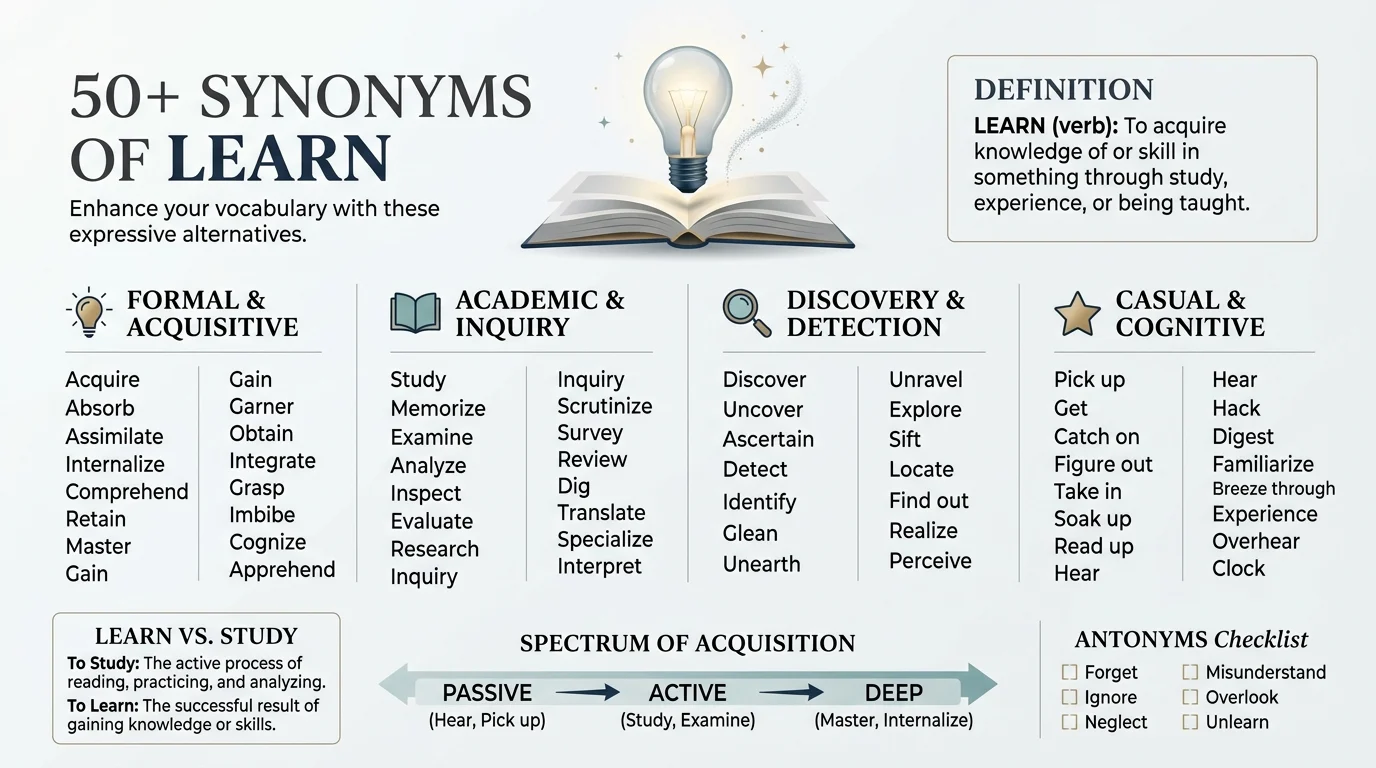
Have you ever needed to describe gaining knowledge, acquiring a skill, or discovering a fact but felt that “learn” was too simple or repetitive? You want to capture the specific nature of how understanding is gained, whether through study, experience, or discovery, and the word “learn” comes to mind. Choosing the right synonym for “learn” can transform a basic statement into a precise expression of education, realization, or mastery. This guide explores the best synonyms of learn, explaining exactly which word to use and when.
Quick Ans: “Learn” means to gain knowledge or skill by study, experience, or being taught, or to become aware of something. For formal writing, choose acquire, master, or comprehend. For casual conversation, use pick up, find out, or get. For academic contexts, use study, research, or absorb. For discovery, use discover, realize, or ascertain.
Meaning, Tone, and Context
Understanding the core meaning of “learn” is the first step to using it effectively.
Simple Definition: To gain knowledge, understanding, or skill through study, experience, or instruction; to become aware of something; to memorize.
Part of Speech: Verb.
Overall Tone: Neutral and positive. It indicates growth, progress, and discovery.
Formality Level: Neutral. The word works in casual and formal contexts.
Common Uses: Native English speakers use it in education (“learn math”), experience (“learn from mistakes”), discovery (“learn the truth”), and skills (“learn to swim”).
Word Forms: Related words include the noun learning, the adjective learned, and the noun learner.
When and How to Use “Learn”
“Learn” is the perfect choice when you want to describe gaining knowledge or skill. Here are seven realistic examples.
Education: “Students learn algebra in the ninth grade.”
Experience: “I learned patience from raising children.”
Discovery: “She learned the truth about her family.”
Skill: “He is learning to play the guitar.”
Professional: “Employees learn new software during onboarding.”
Academic: “The study examines how children learn language.”
Social Media: “Never stop learning and growing.”
Best Synonyms of “Learn”
No synonym is identical in every situation. Here is your guide to the best replacement for “learn” based on your writing context.
For Formal and Academic Contexts
Most Formal: Acquire means to gain knowledge or skill. “She acquired fluency in three languages.”
Master: Master means to learn thoroughly. “He mastered the art of negotiation.”
Comprehend: Comprehend means to understand fully. “Students must comprehend the theory.”
Assimilate: Assimilate means to absorb and integrate. “She assimilated the information quickly.”
For Study and Research
Study: Study means to learn by reading and analysis. “He studied history at university.”
Research: Research means to investigate systematically. “She researched the topic thoroughly.”
Examine: Examine means to inspect carefully. “The class examined the evidence.”
Investigate: Investigate means to explore systematically. “They investigated the causes.”
For Discovery and Awareness
Discover: Discover means to find out. “I discovered a new restaurant.”
Realize: Realize means to become aware. “She realized her mistake.”
Ascertain: Ascertain means to find out for certain. “We ascertained the facts.”
Find out: Find out means to discover. “I found out the truth.”
For Skills and Practice
Pick up: Pick up means to learn casually. “He picked up Spanish while traveling.”
Absorb: Absorb means to take in gradually. “Children absorb new languages easily.”
Practice: Practice means to learn by repetition. “She practiced the piano daily.”
Train: Train means to learn through instruction. “He trained to be a pilot.”
When Not to Use “Learn”
Using “learn” can sound wrong or awkward in certain situations.
When You Mean “Teach”: “Learn” is what the student does. “Teach” is what the instructor does.
Better Choice: Teach or instruct. “She teaches math.”
When You Mean “Study”: “Learn” is the result. “Study” is the process.
Better Choice: Study. “He studies every night.”
When It Sounds Too Simple: In formal writing, “learn” can sound basic.
Better Choice: Acquire or comprehend. “She acquired new skills.”
Words Commonly Confused With “Learn”
| Word | Difference | When to Use | Example |
|---|---|---|---|
| Teach | Instruct others | Teaching context | “She teaches English.” |
| Study | Process of learning | Academic context | “He studies biology.” |
| Discover | Find something new | Discovery context | “She discovered a cure.” |
| Realize | Become aware | Awareness context | “I realized my error.” |
| Memorize | Commit to memory | Memorization context | “He memorized the poem.” |
| Practice | Learn by repetition | Skill development | “She practices daily.” |
Best Synonyms of “Learn” by Context
| Context | Best Synonym | Why It Works | Example |
|---|---|---|---|
| Formal writing | Acquire | Formal and precise | “She acquired new skills.” |
| Academic writing | Comprehend | Deep understanding | “Students comprehend the theory.” |
| Professional | Master | Skill and expertise | “He mastered the software.” |
| Casual conversation | Pick up | Simple and natural | “He picked up Spanish.” |
| Discovery | Find out | Direct and clear | “I found out the truth.” |
| Awareness | Realize | Sudden understanding | “She realized the danger.” |
| Skill | Practice | Repetition and improvement | “He practices the violin.” |
How to Choose the Best Synonym of “Learn”
Choosing the right word is a simple decision. Answer these questions.
What type of learning am I describing? For formal, use acquire or comprehend. And For skills, use master or practice. For discovery, use discover or find out. For casual, use pick up.
What is my audience? For a formal report, use acquire or comprehend. For a friend, use pick up or find out.
What is my purpose? Are you describing education, discovery, or skill development? The correct synonym depends entirely on this.
What is the emotional strength? Master is strong. Pick up is casual. Pick the one that matches your message.
Real Life Examples of “Learn”
School: Basic: “The student learned math.” Improved: “The student mastered algebra.”
College: Basic: “She learned the theory.” Improved: “She comprehended the theory deeply.”
Workplace: Basic: “He learned the software.” Improved: “He acquired proficiency in the software.”
Business: Basic: “We learned the market.” Improved: “We studied the market extensively.”
Email: Basic: “I learned the news.” Improved: “I found out the news.”
Conversation: Basic: “I learned Spanish.” Improved: “I picked up Spanish while traveling.”
Storytelling: Basic: “He learned the truth.” Improved: “He discovered the truth.”
Top 10 Synonyms of “Learn”
| Synonym | Simple Meaning | Best Used For | Example Sentence |
|---|---|---|---|
| Acquire | Gain knowledge or skill | Formal and professional | “She acquired fluency in French.” |
| Master | Learn thoroughly | Skill and expertise | “He mastered the technique.” |
| Comprehend | Understand fully | Academic and formal | “Students comprehend the concept.” |
| Study | Learn by reading and analysis | Academic contexts | “She studied history.” |
| Discover | Find out | Discovery and awareness | “I discovered a new hobby.” |
| Realize | Become aware | Awareness and insight | “She realized her mistake.” |
| Absorb | Take in gradually | Learning and assimilation | “Children absorb languages easily.” |
| Pick up | Learn casually | Casual conversation | “He picked up some Italian.” |
| Practice | Learn by repetition | Skill development | “She practices the piano daily.” |
| Assimilate | Absorb and integrate | Formal and academic | “He assimilated the information.” |
Synonyms of “Learn” by Usage
Professional vs. Personal Synonyms
In the workplace, choose acquire, master, or comprehend. With friends, use pick up, find out, or get.
Formal vs. Conversational Synonyms
For formal writing, use acquire, comprehend, or assimilate. For casual conversations, use pick up, find out, or realize.
Academic Synonyms
For research and essays, choose comprehend for understanding, study for process, and research for investigation.
Professional and Business Synonyms
For maximum impact, choose master for skills, acquire for knowledge, and train for instruction.
Creative and Literary Synonyms
To add emotion and imagery, choose absorb, discover, or realize. These words create depth.
Slang or Modern Synonyms
In modern American slang, pick up, get, or catch on are common. For example, “I caught on quickly.” These are casual and should be avoided in formal writing.
Strongest to Mildest Synonyms
Mild: pick up, find out, get
Moderate: learn, study, practice
Strong: acquire, comprehend, discover
Very Strong: master, assimilate, research
Emotional vs. Neutral Synonyms
Emotional Synonyms: Discover, realize, absorb. These words hint at insight and growth. Use them when you want to evoke feeling.
Neutral Synonyms: Learn, study, acquire. These words communicate factual information.
Antonyms of “Learn”
| Antonym | Meaning | Example Sentence |
|---|---|---|
| Forget | Fail to remember | “I forgot the answer.” |
| Ignore | Refuse to acknowledge | “He ignored the lesson.” |
| Misunderstand | Fail to understand | “She misunderstood the concept.” |
| Unlearn | Discard learned behavior | “He had to unlearn bad habits.” |
| Neglect | Fail to care for | “He neglected his studies.” |
| Overlook | Fail to notice | “She overlooked the details.” |
| Disregard | Pay no attention | “He disregarded the warning.” |
| Confuse | Mix up | “I confused the two theories.” |
| Misinterpret | Understand incorrectly | “He misinterpreted the data.” |
| Teach | Instruct others | “She teaches math.” |
| Instruct | Provide instruction | “He instructed the class.” |
| Train | Teach skills | “She trained the new employees.” |
| Educate | Provide education | “They educate children.” |
| Explain | Make clear | “He explained the concept.” |
| Demonstrate | Show how | “She demonstrated the technique.” |
Comparison: “Learn” vs Similar Words
Learn vs. Study
Main Difference: “Learn” is the result. “Study” is the process.
Which Is Stronger? “Learn” is the outcome.
Which Is More Formal? Both are neutral.
When to Use Each: Use “study” for the process. Use “learn” for the result.
Examples:
Learn: “I learned French.”
Study: “I studied French for years.”
Learn vs. Teach
Main Difference: “Learn” is receiving knowledge. “Teach” is giving knowledge.
Which Is Stronger? They are opposites.
Which Is More Formal? Both are neutral.
When to Use Each: Use “teach” for instructors. Use “learn” for students.
Examples:
Learn: “I learned to swim.”
Teach: “She teaches swimming.”
Learn vs. Discover
Main Difference: “Discover” is finding something new. “Learn” is gaining knowledge.
Which Is Stronger? “Discover” is more dramatic.
Which Is More Formal? Both are formal.
When to Use Each: Use “discover” for new findings. Use “learn” for general knowledge.
Examples:
Learn: “I learned the truth.”
Discover: “I discovered a new species.”
Learn vs. Realize
Main Difference: “Realize” is becoming aware. “Learn” is gaining knowledge.
Which Is Stronger? “Realize” is more sudden.
Which Is More Formal? Both are neutral.
When to Use Each: Use “realize” for sudden awareness. Use “learn” for ongoing process.
Examples:
Learn: “I learned about the problem.”
Realize: “I realized the problem.”
Learn vs. Acquire
Main Difference: “Acquire” is formal. “Learn” is general.
Which Is Stronger? “Acquire” is more formal.
Which Is More Formal? “Acquire” is more formal.
When to Use Each: Use “acquire” in formal writing. Use “learn” in general contexts.
Examples:
Learn: “I learned a new skill.”
Acquire: “I acquired a new skill.”
Learn vs. Master
Main Difference: “Master” is complete knowledge. “Learn” is gaining knowledge.
Which Is Stronger? “Master” is stronger.
Which Is More Formal? Both are formal.
When to Use Each: Use “master” for expertise. Use “learn” for general contexts.
Examples:
Learn: “I learned to play piano.”
Master: “I mastered the piano.”
Common Phrases and Expressions with “Learn”
Phrase: Learn by heart
Meaning: Memorize completely.
Example Sentence: “She learned the poem by heart.”
Phrase: Learn a lesson
Meaning: Gain wisdom from experience.
Example Sentence: “He learned a valuable lesson.”
Phrase: Learn the ropes
Meaning: Understand how things work.
Example Sentence: “It takes time to learn the ropes.”
Phrase: Learn from mistakes
Meaning: Gain wisdom from errors.
Example Sentence: “We must learn from our mistakes.”
Phrase: Learn the hard way
Meaning: Learn through difficult experience.
Example Sentence: “He learned the hard way.”
Phrase: Lifelong learning
Meaning: Continuous education.
Example Sentence: “Lifelong learning is important.”
Common Mistakes to Avoid
Mistake 1: Using “learn” when you mean “teach”.
Incorrect: “She learned the students.”
Better: “She taught the students.”
Why: “Teach” is for instructors.
Mistake 2: Using “learn” when you mean “study”.
Incorrect: “I learned all night.”
Better: “I studied all night.”
Why: “Study” is the process.
Mistake 3: Overusing “learn” in conversation.
Incorrect: “I learned the news.”
Better: “I found out the news.”
Why: “Found out” sounds more natural.
Mistake 4: Using “learn” when you mean “discover”.
Incorrect: “I learned a new planet.”
Better: “I discovered a new planet.”
Why: “Discover” is for new findings.
Mistake 5: Using “learn” when you mean “master”.
Incorrect: “I learned the violin.”
Better: “I mastered the violin.”
Why: “Master” is for complete knowledge.
Frequently Asked Questions
1. What are the best synonyms of “learn”?
The best synonyms depend on your context. For formal, choose acquire or comprehend. And For skills, use master or practice. For discovery, use discover or find out. For casual, use pick up.
2. What are the best formal synonyms of “learn”?
The best formal synonyms are acquire, comprehend, and assimilate. These words are suitable for academic papers, professional reports, and business communications.
3. What are common informal synonyms of “learn”?
For informal settings, use pick up, find out, or get. These alternatives sound more natural in everyday conversation.
4. What is another word for “learn” in professional writing?
In professional writing, acquire is an excellent choice. It conveys gaining knowledge. Master is also strong for skills.
5. What is the difference between “learn” and “study”?
“Learn” is the result. “Study” is the process. Use “study” for the act and “learn” for the outcome.
6. What is the opposite of “learn”?
The most direct opposites (antonyms) of learn are forget, ignore, and misunderstand. These words describe a lack of knowledge.
Conclusion
“Learn” is a fundamental and versatile word for describing the acquisition of knowledge, skills, and awareness. The term is neutral and widely accepted in all contexts, yet it can sound too simple for formal writing or too vague for specific descriptions. The best choice among the synonyms of learn depends entirely on your audience, tone, and purpose. Remember, no single synonym works perfectly in every situation. Your goal is to choose the word that communicates your message with the most clarity and impact. A practical tip for your vocabulary growth is to pay attention to how writers describe learning and practice using different synonyms in your writing.









