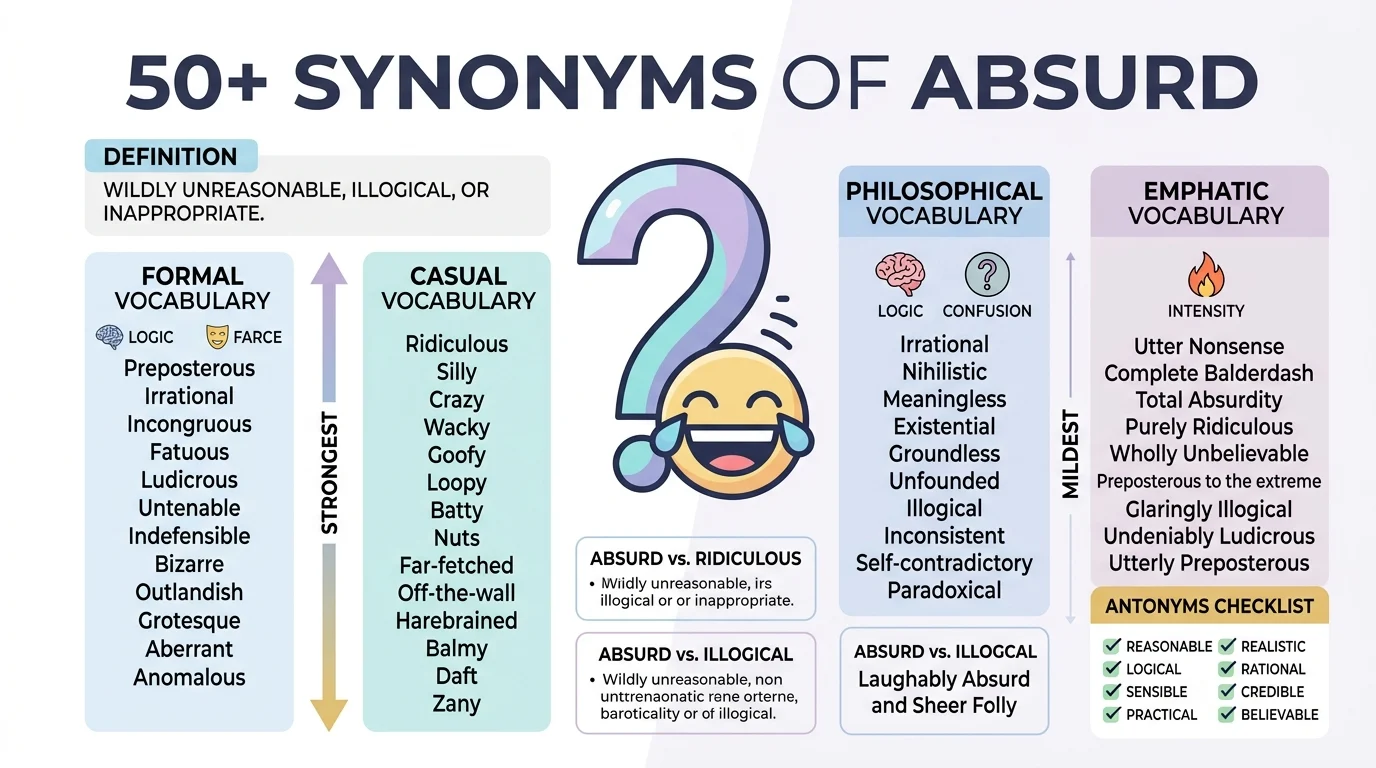
Have you ever encountered a situation, statement, or idea so illogical or ridiculous that “strange” or “silly” felt too weak? You want to capture the sheer unreasonableness and laughable nature of something, and the word “absurd” comes to mind. Choosing the right synonym for “absurd” can transform a simple observation into a precise expression of disbelief, ridicule, or philosophical insight. This guide explores the best synonyms of absurd, explaining exactly which word to use and when.
Quick Ans: “Absurd” means wildly unreasonable, illogical, or inappropriate, often to the point of being laughable. For formal writing, choose preposterous or ludicrous. For casual conversation, use ridiculous. For philosophical contexts, use irrational or nonsensical. For extreme ridicule, use farcical or laughable.
Meaning, Tone, and Context
Understanding the core meaning of “absurd” is the first step to using it effectively.
Simple Definition: Wildly unreasonable, illogical, or inappropriate. Contrary to reason or common sense.
Part of Speech: Adjective.
Overall Tone: Negative to neutral. It can indicate disbelief, ridicule, or philosophical observation.
Formality Level: Neutral to formal. The word is appropriate in most contexts.
Common Uses: Native English speakers use it to describe situations, ideas, statements, and behaviors. For example, “The bureaucracy is absurd,” or “That is an absurd claim.”
Word Forms: Related words include the noun absurdity, the adverb absurdly, and the noun absurdism (philosophical movement).
When and How to Use “Absurd”
“Absurd” is the perfect choice when you want to emphasize the illogical or ridiculous nature of something. Here are seven realistic examples.
Professional: “The proposal was rejected as absurd and impractical.”
Academic: “The philosopher explored the absurd in his work on existentialism.”
Workplace: “The new policy is absurd and will only create more problems.”
Personal: “It is absurd to worry about things you cannot control.”
Email: “The timeline is absurd and impossible to meet.”
Resume: (Rarely used) “Identified absurd inefficiencies and implemented practical solutions.”
Social Media: “The price of that bag is absurd.”
Best Synonyms of “Absurd”
No synonym is identical in every situation. Here is your guide to the best replacement for “absurd” based on your writing context.
For Formal and Literary Contexts
Most Formal: Preposterous means contrary to reason or common sense. “The idea was preposterous.”
Ridiculous: Ludicrous means so foolish as to cause derision. “The claim was ludicrous.”
Laughable: Farcical means absurd or ridiculous. “The proceedings were farcical.”
Illogical: Irrational means not based on reason. “His fear was irrational.”
For Casual and Emphatic Contexts
Ridiculous: Ridiculous means deserving or inviting derision. “That is ridiculous.”
Silly: Silly means showing a lack of judgment. “Do not be silly.”
For Philosophical Contexts
Nonsensical: Nonsensical means having no meaning or sense. “The argument was nonsensical.”
Meaningless: Meaningless means having no purpose or value. “The struggle felt meaningless.”
Irrational: Irrational means not logical. “The belief was irrational.”
For Extreme Ridicule
Laughable: Laughable means so ridiculous as to be amusing. “The excuse was laughable.”
Ludicrous: Ludicrous means ridiculous. “The price was ludicrous.”
Farcical: Farcical means absurd and ridiculous. “The situation was farcical.”
When Not to Use “Absurd”
Using “absurd” can sound wrong or awkward in certain situations.
When You Mean “Strange”: “Absurd” is stronger than “strange.”
Better Choice: Strange or odd. “That is a strange habit.”
When You Mean “Unfair”: “Absurd” is about logic. “Unfair” is about justice.
Better Choice: Unfair or unjust. “The decision was unfair.”
When It Sounds Too Harsh: In polite conversation, “absurd” can sound dismissive.
Better Choice: Surprising or unexpected. “That is surprising.”
Words Commonly Confused With “Absurd”
| Word | Difference | When to Use | Example |
|---|---|---|---|
| Ridiculous | Deserving derision | Casual and emphatic | “That is ridiculous.” |
| Preposterous | Contrary to reason | Formal and literary | “A preposterous claim.” |
| Ludicrous | So foolish as to cause derision | Formal and emphatic | “A ludicrous idea.” |
| Nonsensical | Having no meaning | Philosophical and logical | “A nonsensical argument.” |
| Irrational | Not based on reason | Psychological and logical | “An irrational fear.” |
| Farcical | Absurd and ridiculous | Theatrical and descriptive | “A farcical situation.” |
Best Synonyms of “Absurd” by Context
| Context | Best Synonym | Why It Works | Example |
|---|---|---|---|
| Formal writing | Preposterous | Formal and precise | “A preposterous claim.” |
| Academic writing | Irrational | Logical and psychological | “An irrational belief.” |
| Professional | Ludicrous | Strong and formal | “A ludicrous proposal.” |
| Casual conversation | Ridiculous | Simple and natural | “That is ridiculous.” |
| Emotional emphasis | Laughable | Evokes amusement | “The excuse was laughable.” |
| Philosophical | Nonsensical | Logical and philosophical | “A nonsensical argument.” |
| Storytelling | Farcical | Evokes absurdity | “A farcical series of events.” |
How to Choose the Best Synonym of “Absurd”
Choosing the right word is a simple decision. Answer these questions.
What type of absurdity am I describing? For formal, use preposterous or ludicrous. And For casual, use ridiculous or chaotic. For philosophical, use nonsensical or irrational. And For extreme ridicule, use farcical or laughable.
What is my audience? For a formal report, use preposterous or irrational. For a friend, use ridiculous or chaotic.
What is my purpose? Are you criticizing, observing, or ridiculing? The correct synonym depends entirely on this.
What is the emotional strength? Laughable and ludicrous are stronger. Silly is milder. Pick the one that matches your message.
Real Life Examples of “Absurd”
School: Basic: “The rule is absurd.” Improved: “The rule is preposterous and serves no purpose.”
College: Basic: “The theory is absurd.” Improved: “The theory is nonsensical and lacks evidence.”
Workplace: Basic: “The deadline is absurd.” Improved: “The deadline is ludicrous and impossible to meet.”
Business: Basic: “The price is absurd.” Improved: “The price is ridiculous for the quality.”
Email: Basic: “This is absurd.” Improved: “This is laughable and needs to be addressed.”
Conversation: Basic: “That is absurd.” Improved: “That is chaotic.”
Storytelling: Basic: “The situation was absurd.” Improved: “The situation was farcical, with one mishap after another.”
Top 10 Synonyms of “Absurd”
| Synonym | Simple Meaning | Best Used For | Example Sentence |
|---|---|---|---|
| Preposterous | Contrary to reason | Formal and literary | “A preposterous claim.” |
| Ludicrous | So foolish as to cause derision | Formal and emphatic | “A ludicrous idea.” |
| Ridiculous | Deserving or inviting derision | Casual and general | “That is ridiculous.” |
| Nonsensical | Having no meaning or sense | Philosophical and logical | “A nonsensical argument.” |
| Irrational | Not based on reason | Psychological and logical | “An irrational fear.” |
| Farcical | Absurd and ridiculous | Theatrical and descriptive | “A farcical situation.” |
| Laughable | So ridiculous as to be amusing | Emotional and emphatic | “The excuse was laughable.” |
| Silly | Showing a lack of judgment | Casual and mild | “Do not be silly.” |
| Wild | Extremely foolish | Emphatic and informal | “The traffic was wild.” |
Synonyms of “Absurd” by Usage
Professional vs. Personal Synonyms
In the workplace, choose preposterous, ludicrous, or irrational. With friends, use ridiculous or silly.
Formal vs. Conversational Synonyms
For formal writing, use preposterous, ludicrous, nonsensical, or irrational. For casual conversations, use ridiculous.
Academic Synonyms
For research and essays, choose irrational for psychological contexts, nonsensical for logical contexts, and absurd for philosophical contexts.
Professional and Business Synonyms
For maximum impact, choose preposterous for proposals, ludicrous for prices, and irrational for behavior.
Creative and Literary Synonyms
To add emotion and imagery, choose farcical, laughable, or ludicrous. These words create atmosphere.
Slang or Modern Synonyms
In modern American slang, ridiculous, or wild are common. For example, “That is wild.” These are casual and should be avoided in formal writing.
Strongest to Mildest Synonyms
Mild: silly, odd, strange
Moderate: absurd, ridiculous, irrational
Strong: preposterous, ludicrous, nonsensical
Very Strong: farcical, laughable
Emotional vs. Neutral Synonyms
Emotional Synonyms: Laughable, farcical, ludicrous. These words hint at amusement and derision. Use them when you want to evoke feeling.
Neutral Synonyms: Absurd, irrational, nonsensical. These words communicate factual information about logic.
Antonyms of “Absurd”
| Antonym | Meaning | Example Sentence |
|---|---|---|
| Logical | Based on reason | “The argument was logical.” |
| Reasonable | Sensible and fair | “The request was reasonable.” |
| Sensible | Showing good judgment | “That is a sensible plan.” |
| Rational | Based on reason | “The decision was rational.” |
| Sane | Mentally healthy | “The policy is sane.” |
| Practical | Useful and sensible | “The solution was practical.” |
| Realistic | Representing things as they are | “The goal is realistic.” |
| Sound | Based on good judgment | “The reasoning was sound.” |
| Coherent | Logical and consistent | “The explanation was coherent.” |
| Sensible | Showing good judgment | “The advice was sensible.” |
| Credible | Believable | “The story was credible.” |
| Plausible | Seeming reasonable | “The excuse was plausible.” |
| Valid | Legally or logically acceptable | “The point is valid.” |
| Sound | In good condition | “The argument is sound.” |
| Judicious | Showing good judgment | “The decision was judicious.” |
Comparison: “Absurd” vs Similar Words
Absurd vs. Ridiculous
Main Difference: “Ridiculous” is more casual. “Absurd” is broader.
Which Is Stronger? They are similar. “Absurd” is more formal.
Which Is More Formal? “Absurd” is more formal.
When to Use Each: Use “ridiculous” in casual conversation. Use “absurd” in formal writing.
Examples:
Absurd: “The situation is absurd.”
Ridiculous: “That is ridiculous.”
Absurd vs. Preposterous
Main Difference: “Preposterous” is more formal. “Absurd” is more general.
Which Is Stronger? “Preposterous” is stronger for unreasonableness.
Which Is More Formal? “Preposterous” is more formal.
When to Use Each: Use “preposterous” in formal writing. Use “absurd” in general contexts.
Examples:
Absurd: “An absurd idea.”
Preposterous: “A preposterous claim.”
Absurd vs. Ludicrous
Main Difference: “Ludicrous” emphasizes foolishness. “Absurd” is broader.
Which Is Stronger? “Ludicrous” is stronger for derision.
Which Is More Formal? Both are formal.
When to Use Each: Use “ludicrous” for extreme foolishness. Use “absurd” for general illogicality.
Examples:
Absurd: “An absurd situation.”
Ludicrous: “A ludicrous price.”
Absurd vs. Nonsensical
Main Difference: “Nonsensical” means having no meaning. “Absurd” means contrary to reason.
Which Is Stronger? “Nonsensical” is stronger for meaninglessness.
Which Is More Formal? Both are formal.
When to Use Each: Use “nonsensical” for arguments. Use “absurd” for situations.
Examples:
Absurd: “An absurd rule.”
Nonsensical: “A nonsensical argument.”
Absurd vs. Irrational
Main Difference: “Irrational” is about lack of reason. “Absurd” is about illogicality.
Which Is Stronger? They are similar. “Irrational” is more psychological.
Which Is More Formal? Both are formal.
When to Use Each: Use “irrational” for fears. Use “absurd” for situations.
Examples:
Absurd: “An absurd claim.”
Irrational: “An irrational fear.”
Absurd vs. Farcical
Main Difference: “Farcical” implies comedy. “Absurd” is broader.
Which Is Stronger? “Farcical” is stronger for comedy.
Which Is More Formal? Both are formal.
When to Use Each: Use “farcical” for ridiculous events. Use “absurd” for general illogicality.
Examples:
Absurd: “An absurd situation.”
Farcical: “A farcical series of events.”
Common Phrases and Expressions with “Absurd”
Phrase: Absurd to think
Meaning: Unreasonable to believe.
Example Sentence: “It is absurd to think that way.”
Phrase: Absurdly expensive
Meaning: Ridiculously costly.
Example Sentence: “The meal was absurdly expensive.”
Phrase: Theater of the absurd
Meaning: A style of drama emphasizing the meaninglessness of life.
Example Sentence: “Beckett is famous for theater of the absurd.”
Phrase: Absurd situation
Meaning: A ridiculous or illogical situation.
Example Sentence: “We found ourselves in an absurd situation.”
Phrase: Reductio ad absurdum
Meaning: A method of proving a statement by showing its absurd consequences.
Example Sentence: “He used reductio ad absurdum to make his point.”
Common Mistakes to Avoid
Mistake 1: Using “absurd” when you mean “strange”.
Incorrect: “He has an absurd habit.”
Better: “He has a strange habit.”
Why: “Absurd” is stronger than “strange.”
Mistake 2: Using “absurd” when you mean “unfair”.
Incorrect: “The decision was absurd.”
Better: “The decision was unfair.”
Why: “Absurd” is about logic. “Unfair” is about justice.
Mistake 3: Overusing “absurd” in conversation.
Incorrect: “That movie was absurd.”
Better: “That movie was ridiculous.”
Why: “Ridiculous” sounds more natural.
Mistake 4: Using “absurd” when you mean “silly”.
Incorrect: “Do not be absurd.”
Better: “Do not be silly.”
Why: “Silly” is milder for lighthearted situations.
Mistake 5: Using “absurd” when you mean “nonsensical”.
Incorrect: “The argument was absurd.”
Better: “The argument was nonsensical.”
Why: “Nonsensical” is more precise for arguments.
Frequently Asked Questions
1. What are the best synonyms of “absurd”?
The best synonyms depend on your context. For formal writing, choose preposterous or ludicrous. And For casual conversation, use ridiculous. For philosophical contexts, use nonsensical or irrational.
2. What are the best formal synonyms of “absurd”?
The best formal synonyms are preposterous, ludicrous, and nonsensical. These words are suitable for academic papers, professional reports, and business communications.
3. What are common informal synonyms of “absurd”?
For informal settings, use ridiculous, or silly. These alternatives sound more natural in everyday conversation.
4. What is another word for “absurd” in professional writing?
In professional writing, preposterous is an excellent choice. It conveys unreasonableness. Ludicrous is also strong for extreme foolishness.
5. What is the difference between “absurd” and “ridiculous”?
“Absurd” is more formal and broad. “Ridiculous” is more casual and emphatic. Use “ridiculous” in conversation and “absurd” in writing.
6. What is the opposite of “absurd”?
The most direct opposites (antonyms) of absurd are logical, reasonable, and rational. These words describe things that are based on reason.
Conclusion
“Absurd” is a powerful and expressive word for describing situations, ideas, and statements that defy logic and reason. The term is neutral and widely accepted in most contexts, yet it can sound too strong for minor oddities or too formal for casual conversation. The best choice among the synonyms of absurd depends entirely on your audience, tone, and purpose. Remember, no single synonym works perfectly in every situation. Your goal is to choose the word that communicates your message with the most clarity and impact. A practical tip for your vocabulary growth is to pay attention to how writers express disbelief and ridicule and practice using different synonyms in your writing.









