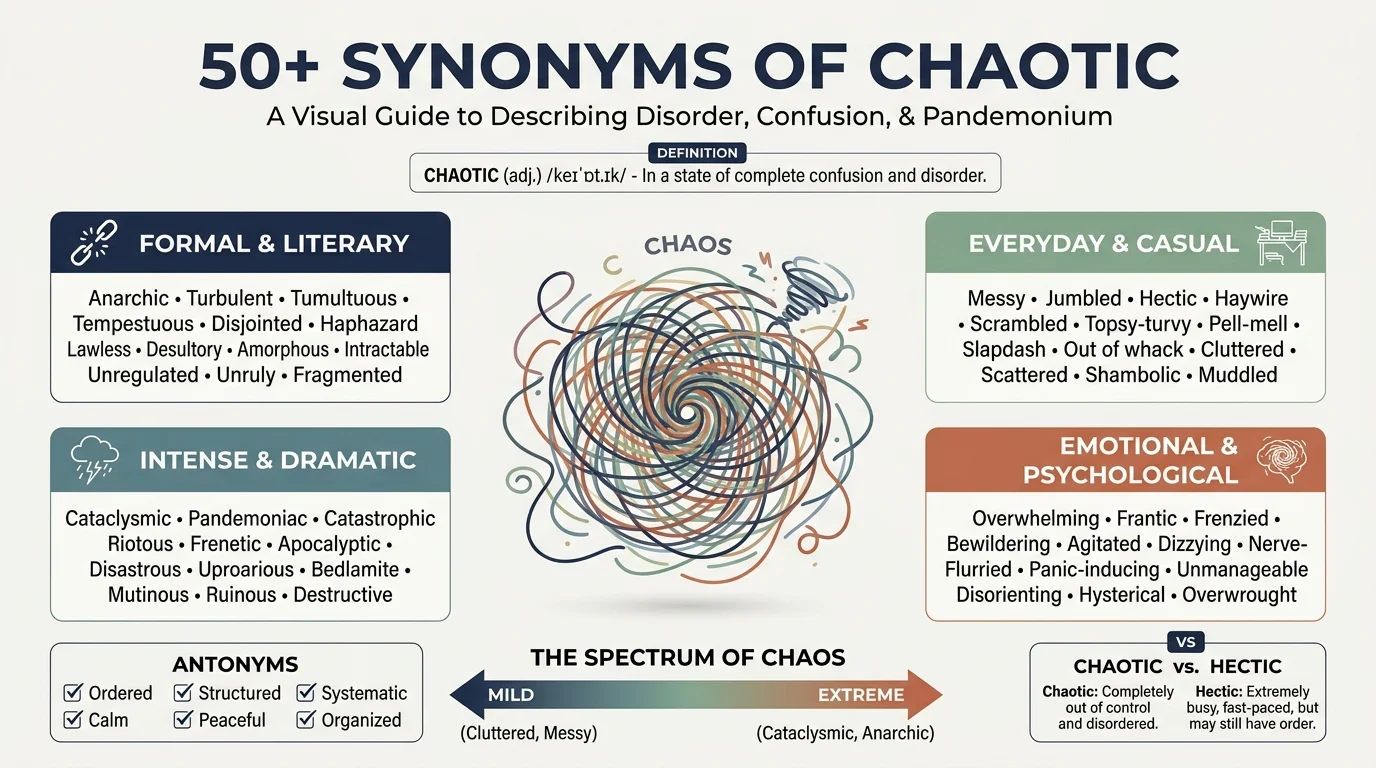
Have you ever needed to describe a situation that is completely disordered, confusing, or out of control but felt that “messy” was too mild? You want to capture the sheer unpredictability and lack of organization, and the word “chaotic” comes to mind. Choosing the right synonym for “chaotic” can transform a basic observation into a precise expression of disorder, confusion, or turmoil. This guide explores the best synonyms of chaotic, explaining exactly which word to use and when.
Quick Ans: “Chaotic” means completely disordered, confused, or lacking any organization. For formal writing, choose disordered or tumultuous. For casual conversation, use messy or hectic. For dramatic effect, use anarchic or pandemonium. For emotional intensity, use turbulent or tempestuous. For a mild tone, use disorganized or unruly.
Meaning, Tone, and Context
Understanding the core meaning of “chaotic” is the first step to using it effectively.
Simple Definition: In a state of complete disorder and confusion; lacking any organized structure.
Part of Speech: Adjective.
Overall Tone: Negative. It indicates confusion, disorder, and lack of control.
Formality Level: Neutral to formal. The word is appropriate in most contexts.
Common Uses: Native English speakers use it to describe situations (“chaotic scene”), schedules (“chaotic day”), environments (“chaotic office”), and events (“chaotic meeting”).
Word Forms: Related words include the noun chaos, the adverb chaotically, and the adjective chaotic.
When and How to Use “Chaotic”
“Chaotic” is the perfect choice when you want to describe extreme disorder and confusion. Here are seven realistic examples.
Professional: “The merger created a chaotic work environment.”
Academic: “The study examined how chaotic systems behave over time.”
Workplace: “The office was chaotic after the power outage.”
Personal: “My schedule has been chaotic lately.”
Email: “Apologies for the chaotic response; it has been a busy morning.”
Resume: (Avoid in resumes) Use “fast-paced” instead.
Social Media: “The concert was chaotic but unforgettable.”
Best Synonyms of “Chaotic”
No synonym is identical in every situation. Here is your guide to the best replacement for “chaotic” based on your writing context.
For Formal and Academic Contexts
Most Formal: Disordered means lacking order. “The disordered files needed reorganization.”
Tumultuous: Tumultuous means loud and disorderly. “The tumultuous meeting ended in arguments.”
Anarchic: Anarchic means lacking order or control. “The anarchic protest blocked the streets.”
Lawless: Lawless means without laws or control. “The lawless region was dangerous.”
For Casual and Conversational Contexts
Messy: Messy means untidy or disorganized. “The room was messy after the party.”
Hectic: Hectic means busy and chaotic. “It has been a hectic week.”
Wild: Wild means uncontrolled. “The party got a little wild.”
For Emotional and Dramatic Contexts
Turbulent: Turbulent means full of conflict or disorder. “The turbulent period tested their patience.”
Tempestuous: Tempestuous means stormy and volatile. “Their tempestuous relationship was exhausting.”
Frantic: Frantic means wild with fear or worry. “The frantic search for the missing child continued.”
Frenzied: Frenzied means wildly excited or uncontrolled. “The frenzied crowd rushed the stage.”
For Mild and Neutral Contexts
Disorganized: Disorganized means lacking organization. “The disorganized office needed a system.”
Unruly: Unruly means disorderly and difficult to control. “The unruly crowd was asked to leave.”
Jumbled: Jumbled means mixed up in a confused way. “The jumbled papers covered the desk.”
Cluttered: Cluttered means filled with too many things. “The cluttered room felt overwhelming.”
When Not to Use “Chaotic”
Using “chaotic” can sound wrong or awkward in certain situations.
When You Mean “Busy”: “Chaotic” implies disorder. “Busy” is neutral.
Better Choice: Busy or hectic. “The restaurant was busy.”
When You Mean “Messy”: “Chaotic” is stronger than messy.
Better Choice: Messy or untidy. “The room was messy.”
When It Sounds Too Dramatic: For minor issues, “chaotic” is too strong.
Better Choice: Disorganized or cluttered. “The desk was cluttered.”
Words Commonly Confused With “Chaotic”
| Word | Difference | When to Use | Example |
|---|---|---|---|
| Messy | Untidy | Rooms and situations | “The room was messy.” |
| Hectic | Very busy | Schedules and days | “A hectic schedule.” |
| Disorganized | Lacking order | Offices and systems | “The disorganized files.” |
| Turbulent | Full of conflict | Periods and relationships | “Turbulent times.” |
| Anarchic | Lacking control | Protests and systems | “Anarchic conditions.” |
| Frantic | Wild with worry | Searches and activity | “A frantic search.” |
Best Synonyms of “Chaotic” by Context
| Context | Best Synonym | Why It Works | Example |
|---|---|---|---|
| Formal writing | Disordered | Formal and precise | “The disordered system failed.” |
| Academic writing | Turbulent | Standard in research | “The turbulent period was studied.” |
| Professional | Hectic | Professional and clear | “The hectic schedule continued.” |
| Business | Disorganized | Business and systems | “The disorganized process caused delays.” |
| Emotional | Turbulent | Emotional and dramatic | “The turbulent relationship ended.” |
| Dramatic | Anarchic | Strong and dramatic | “The anarchic scene was terrifying.” |
| Casual conversation | Messy | Simple and natural | “The party was messy.” |
How to Choose the Best Synonym of “Chaotic”
Choosing the right word is a simple decision. Answer these questions.
What type of chaos am I describing? For formal, use disordered or tumultuous. And For casual, use messy or hectic. For dramatic, use anarchic or frantic. For emotional, use turbulent or tempestuous.
What is my audience? For a formal report, use disordered or tumultuous. For a friend, use messy.
What is my purpose? Are you describing a situation, a schedule, or a scene? The correct synonym depends entirely on this.
What is the emotional strength? Anarchic and frantic are stronger. Disorganized is milder. Pick the one that matches your message.
Real Life Examples of “Chaotic”
School: Basic: “The classroom was chaotic.” Improved: “The classroom was disorganized and noisy.”
College: Basic: “The campus was chaotic.” Improved: “The campus was tumultuous during the protests.”
Workplace: Basic: “The office was chaotic.” Improved: “The office was hectic after the announcement.”
Business: Basic: “The meeting was chaotic.” Improved: “The meeting was tumultuous and unproductive.”
Email: Basic: “Sorry for the chaotic reply.” Improved: “Sorry for the hurried reply.”
Conversation: Basic: “It was chaotic.” Improved: “It was chaotic.”
Storytelling: Basic: “The scene was chaotic.” Improved: “The scene was frenzied and terrifying.”
Top 10 Synonyms of “Chaotic”
| Synonym | Simple Meaning | Best Used For | Example Sentence |
|---|---|---|---|
| Disordered | Lacking order | Formal and medical | “The disordered files were reorganized.” |
| Tumultuous | Loud and disorderly | Formal and historical | “The tumultuous crowd surged forward.” |
| Hectic | Very busy and chaotic | Professional and personal | “The hectic day left her exhausted.” |
| Messy | Untidy and disorganized | Casual and general | “The messy room needed cleaning.” |
| Anarchic | Lacking order or control | Dramatic and political | “The anarchic protest blocked traffic.” |
| Turbulent | Full of conflict | Emotional and historical | “The turbulent relationship ended.” |
| Frantic | Wild with fear or worry | Emotional and urgent | “The frantic search continued all night.” |
| Frenzied | Wildly excited | Dramatic and energetic | “The frenzied crowd rushed the stage.” |
| Disorganized | Lacking organization | Professional and general | “The disorganized office needed a system.” |
| Unruly | Disorderly and difficult | Social and behavioral | “The unruly crowd was asked to leave.” |
Synonyms of “Chaotic” by Usage
Professional vs. Personal Synonyms
In the workplace, choose hectic, disorganized, or tumultuous. With friends, use messy or wild.
Formal vs. Conversational Synonyms
For formal writing, use disordered, tumultuous, or anarchic. For casual conversations, use messy or wild.
Academic Synonyms
For research and essays, choose turbulent for historical periods, disordered for systems, and anarchic for political contexts.
Professional and Business Synonyms
For maximum impact, choose hectic for schedules, disorganized for processes, and tumultuous for meetings.
Creative and Literary Synonyms
To add emotion and imagery, choose frenzied, tempestuous, or frantic. These words create atmosphere.
Slang or Modern Synonyms
In modern American slang, wild, or a mess are common. For example, “The party was a mess.” These are casual and should be avoided in formal writing.
Strongest to Mildest Synonyms
Mild: cluttered, jumbled, messy
Moderate: chaotic, disorganized, hectic
Strong: disordered, unruly, tumultuous
Very Strong: anarchic, turbulent, frantic, frenzied
Emotional vs. Neutral Synonyms
Emotional Synonyms: Frantic, turbulent, tempestuous. These words hint at strong emotion. Use them when you want to evoke feeling.
Neutral Synonyms: Chaotic, disorganized, messy. These words communicate factual information.
Antonyms of “Chaotic”
| Antonym | Meaning | Example Sentence |
|---|---|---|
| Orderly | Arranged neatly | “The orderly line moved quickly.” |
| Organized | Arranged systematically | “The organized desk was efficient.” |
| Systematic | Methodical | “The systematic approach worked.” |
| Calm | Peaceful and quiet | “The calm atmosphere was soothing.” |
| Peaceful | Free from disturbance | “The peaceful garden was relaxing.” |
| Tranquil | Free from disturbance | “The tranquil lake was beautiful.” |
| Stable | Firmly established | “The stable economy grew.” |
| Controlled | Managed or regulated | “The controlled environment was safe.” |
| Methodical | Orderly and systematic | “The methodical process was efficient.” |
| Harmonious | Forming a pleasing whole | “The harmonious team worked well.” |
| Neat | Tidy and clean | “The neat room was inviting.” |
| Structured | Organized according to a plan | “The structured program was effective.” |
| Regulated | Controlled by rules | “The regulated industry was stable.” |
| Predictable | Able to be foreseen | “The predictable schedule was easy.” |
| Serene | Calm and peaceful | “The serene scene was beautiful.” |
Comparison: “Chaotic” vs Similar Words
Chaotic vs. Messy
Main Difference: “Messy” is untidy. “Chaotic” is more extreme.
Which Is Stronger? “Chaotic” is stronger.
Which Is More Formal? Both are neutral.
When to Use Each: Use “messy” for rooms. Use “chaotic” for situations.
Examples:
Chaotic: “The meeting was chaotic.”
Messy: “The room was messy.”
Chaotic vs. Hectic
Main Difference: “Hectic” is very busy. “Chaotic” is disordered.
Which Is Stronger? “Chaotic” is stronger.
Which Is More Formal? Both are neutral.
When to Use Each: Use “hectic” for schedules. Use “chaotic” for disorder.
Examples:
Chaotic: “The scene was chaotic.”
Hectic: “The schedule was hectic.”
Chaotic vs. Disorganized
Main Difference: “Disorganized” is lacking order. “Chaotic” is more intense.
Which Is Stronger? “Chaotic” is stronger.
Which Is More Formal? Both are formal.
When to Use Each: Use “disorganized” for offices. Use “chaotic” for extreme situations.
Examples:
Chaotic: “The event was chaotic.”
Disorganized: “The office was disorganized.”
Chaotic vs. Turbulent
Main Difference: “Turbulent” implies conflict. “Chaotic” implies disorder.
Which Is Stronger? “Turbulent” is more emotional.
Which Is More Formal? Both are formal.
When to Use Each: Use “turbulent” for relationships. Use “chaotic” for general contexts.
Examples:
Chaotic: “The classroom was chaotic.”
Turbulent: “The relationship was turbulent.”
Chaotic vs. Anarchic
Main Difference: “Anarchic” implies lack of government or control. “Chaotic” is broader.
Which Is Stronger? “Anarchic” is stronger.
Which Is More Formal? Both are formal.
When to Use Each: Use “anarchic” for political contexts. Use “chaotic” for general contexts.
Examples:
Chaotic: “The party was chaotic.”
Anarchic: “The protest was anarchic.”
Chaotic vs. Frantic
Main Difference: “Frantic” implies wild emotion. “Chaotic” implies disorder.
Which Is Stronger? “Frantic” is more emotional.
Which Is More Formal? Both are neutral.
When to Use Each: Use “frantic” for searches. Use “chaotic” for situations.
Examples:
Chaotic: “The scene was chaotic.”
Frantic: “The search was frantic.”
Common Phrases and Expressions with “Chaotic”
Phrase: Chaotic scene
Meaning: A disorderly and confusing situation.
Example Sentence: “The accident created a chaotic scene.”
Phrase: Chaotic schedule
Meaning: A very busy and disorganized schedule.
Example Sentence: “Her chaotic schedule left no time for rest.”
Phrase: Chaotic environment
Meaning: A disordered and confusing setting.
Example Sentence: “The chaotic environment hindered productivity.”
Phrase: Chaotic situation
Meaning: A confused and unpredictable situation.
Example Sentence: “The chaotic situation required immediate action.”
Phrase: Chaotic meeting
Meaning: A disorganized and noisy meeting.
Example Sentence: “The chaotic meeting ended without decisions.”
Common Mistakes to Avoid
Mistake 1: Using “chaotic” when you mean “busy”.
Incorrect: “The restaurant was chaotic.”
Better: “The restaurant was busy.”
Why: “Busy” is neutral.
Mistake 2: Using “chaotic” when you mean “messy”.
Incorrect: “The room was chaotic.”
Better: “The room was messy.”
Why: “Messy” is for untidiness.
Mistake 3: Overusing “chaotic” in conversation.
Incorrect: “My day was chaotic.”
Better: “My day was hectic.”
Why: “Hectic” sounds more natural.
Mistake 4: Using “chaotic” when you mean “turbulent”.
Incorrect: “The relationship was chaotic.”
Better: “The relationship was turbulent.”
Why: “Turbulent” is for emotional conflict.
Mistake 5: Using “chaotic” when you mean “anarchic”.
Incorrect: “The protest was chaotic.”
Better: “The protest was anarchic.”
Why: “Anarchic” is for political contexts.
Frequently Asked Questions
1. What are the best synonyms of “chaotic”?
The best synonyms depend on your context. For formal writing, choose disordered or tumultuous. And For casual conversation, use messy or hectic. For dramatic effect, use anarchic or frantic.
2. What are the best formal synonyms of “chaotic”?
The best formal synonyms are disordered, tumultuous, and anarchic. These words are suitable for academic papers, professional reports, and business communications.
3. What are common informal synonyms of “chaotic”?
For informal settings, use messy or wild. These alternatives sound more natural in everyday conversation.
4. What is another word for “chaotic” in professional writing?
In professional writing, hectic is an excellent choice. It conveys busy disorder. Disorganized is also strong for processes.
5. What is the difference between “chaotic” and “messy”?
“Messy” is untidy. “Chaotic” is more extreme and implies complete disorder. Use “messy” for rooms and “chaotic” for situations.
6. What is the opposite of “chaotic”?
The most direct opposites (antonyms) of chaotic are orderly, organized, and systematic. These words describe things that are in order.
Conclusion
“Chaotic” is a powerful and expressive word for describing extreme disorder, confusion, and lack of control. The term is neutral and widely accepted in most contexts, yet it can sound too dramatic for minor issues or too informal for formal writing. The best choice among the synonyms of chaotic depends entirely on your audience, tone, and purpose. Remember, no single synonym works perfectly in every situation. Your goal is to choose the word that communicates your message with the most clarity and impact. A practical tip for your vocabulary growth is to pay attention to how writers describe disorder and confusion and practice using different synonyms in your writing.









