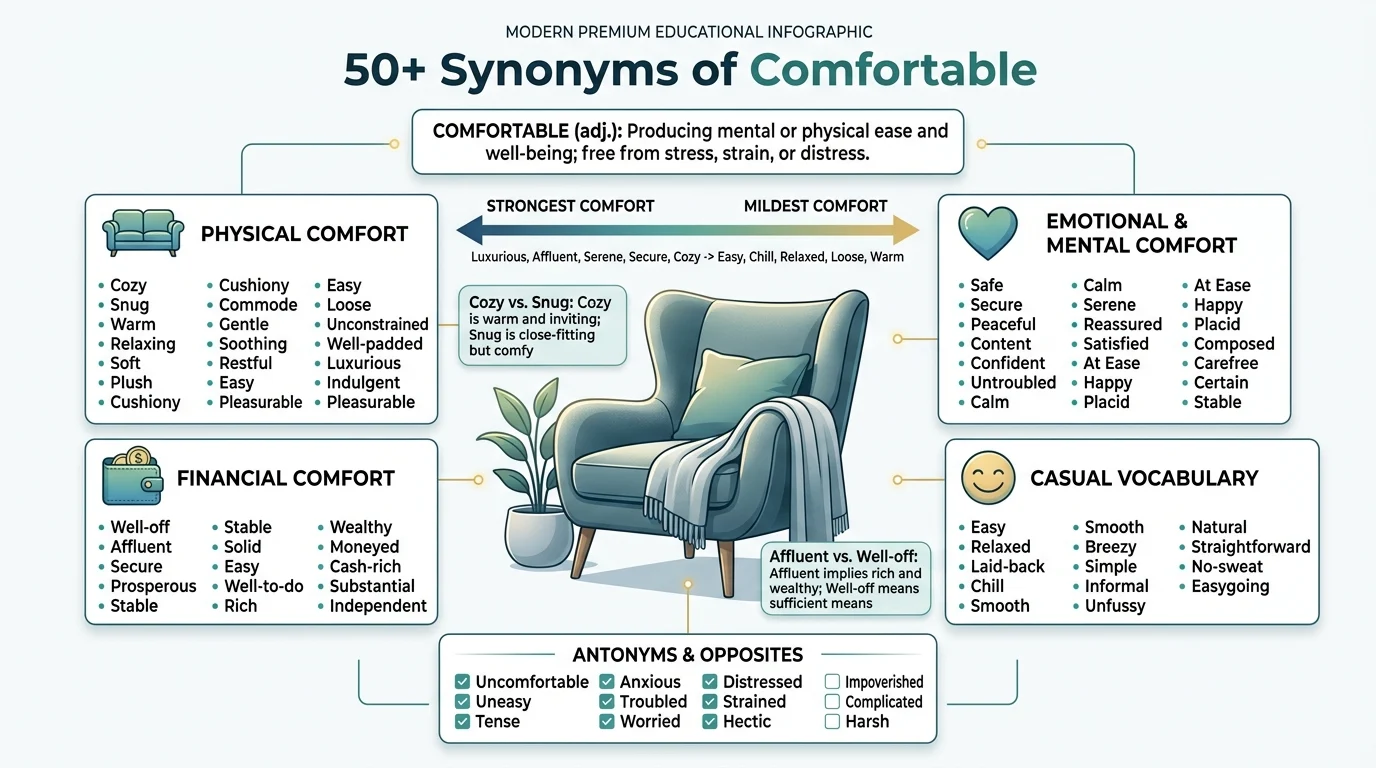
Have you ever needed to describe a feeling of ease, relaxation, or financial security but felt that “comfortable” was too simple or repetitive? You want to capture the specific type of comfort, whether it is physical, emotional, or financial, and the word “comfortable” comes to mind. Choosing the right synonym for “comfortable” can transform a basic statement into a precise expression of ease, contentment, or security. This guide explores the best synonyms of comfortable, explaining exactly which word to use and when.
Quick Ans: “Comfortable” means providing physical ease, feeling relaxed, or being financially secure. For physical ease, choose cozy, snug, or relaxed. For emotional ease, use at ease, content, or peaceful. For financial security, use well-off, affluent, or secure. For casual conversation, use chill or comfy.
Meaning, Tone, and Context
Understanding the core meaning of “comfortable” is the first step to using it effectively.
Simple Definition: Providing physical ease and relaxation; free from stress or pain; financially secure.
Part of Speech: Adjective.
Overall Tone: Positive and reassuring. It indicates ease, contentment, and security.
Formality Level: Neutral. The word works in most contexts, from casual to formal.
Common Uses: Native English speakers use it to describe furniture, clothing, situations, people, and finances. For example, “The sofa is very comfortable,” or “They live a comfortable life.”
Word Forms: Related words include the noun comfort, the adverb comfortably, and the adjective uncomfortable (the opposite).
When and How to Use “Comfortable”
“Comfortable” is the perfect choice when you want to describe physical ease, emotional relaxation, or financial security. Here are seven realistic examples.
Physical: “This chair is incredibly comfortable.”
Emotional: “I feel comfortable around you.”
Financial: “They are comfortable and do not worry about money.”
Professional: “The team is comfortable with the new software.”
Academic: “Students learn best in a comfortable environment.”
Workplace: “We want employees to feel comfortable sharing ideas.”
Social Media: “Nothing beats a comfortable night in.”
Best Synonyms of “Comfortable”
No synonym is identical in every situation. Here is your guide to the best replacement for “comfortable” based on your writing context.
For Physical Ease
Most Cozy: Cozy means warm and comfortable. “The cabin was cozy.”
Snug: Snug means warm and protected. “The baby was snug in the blanket.”
Relaxed: Relaxed means free from tension. “The atmosphere was relaxed.”
Soft: Soft means yielding and gentle to touch. “The bed was soft.”
For Emotional Ease
At ease: At ease means relaxed and confident. “She felt at ease during the interview.”
Content: Content means satisfied and peaceful. “He was content with his life.”
Peaceful: Peaceful means tranquil and calm. “The garden was peaceful.”
Secure: Secure means safe and protected. “She felt secure in her home.”
For Financial Security
Well-off: Well-off means wealthy and comfortable. “They are well-off.”
Affluent: Affluent means wealthy. “The affluent neighborhood was quiet.”
Prosperous: Prosperous means successful and wealthy. “The prosperous family owned several homes.”
For Casual Contexts
Comfy: Comfy is an informal synonym. “These shoes are so comfy.”
Chill: Chill means relaxed and easygoing. “The vibe was chill.”
Easy: Easy means free from difficulty. “It was an easy day.”
When Not to Use “Comfortable”
Using “comfortable” can sound wrong or awkward in certain situations.
When You Mean “Wealthy”: “Comfortable” implies enough, not rich.
Better Choice: Wealthy or rich. “They are wealthy.”
When You Mean “Happy”: “Comfortable” is about ease. “Happy” is about joy.
Better Choice: Happy or joyful. “She was happy.”
When It Sounds Too Mild: For intense relaxation, “comfortable” is too mild.
Better Choice: Blissful or serene. “The spa was blissful.”
Words Commonly Confused With “Comfortable”
| Word | Difference | When to Use | Example |
|---|---|---|---|
| Cozy | Warm and comfortable | Home and winter contexts | “The room was cozy.” |
| Content | Satisfied and peaceful | Emotional well-being | “He was content.” |
| At ease | Relaxed and confident | Social situations | “She felt at ease.” |
| Well-off | Financially secure | Financial contexts | “They are well-off.” |
| Relaxed | Free from tension | General and physical | “The atmosphere was relaxed.” |
| Snug | Warm and protected | Physical comfort | “The baby was snug.” |
Best Synonyms of “Comfortable” by Context
| Context | Best Synonym | Why It Works | Example |
|---|---|---|---|
| Formal writing | Content | Formal and emotional | “He was content with the results.” |
| Professional | At ease | Professional and social | “She felt at ease in the meeting.” |
| Physical | Cozy | Warm and comfortable | “The cabin was cozy.” |
| Financial | Well-off | Wealthy and comfortable | “They are well-off.” |
| Casual conversation | Comfy | Simple and natural | “These shoes are comfy.” |
| Emotional | Peaceful | Calm and serene | “The garden was peaceful.” |
| Workplace | Relaxed | Free from tension | “The office is relaxed.” |
How to Choose the Best Synonym of “Comfortable”
Choosing the right word is a simple decision. Answer these questions.
What type of comfort am I describing? For physical, use cozy or snug. And For emotional, use at ease or content. For financial, use well-off or affluent. For casual, use comfy or chill.
What is my audience? For a formal report, use content or at ease. For a friend, use comfy or chill.
What is my purpose? Are you describing a feeling, a situation, or a status? The correct synonym depends entirely on this.
What is the emotional strength? Blissful and serene are stronger. Easy and chill are milder. Pick the one that matches your message.
Real Life Examples of “Comfortable”
School: Basic: “The classroom is comfortable.” Improved: “The classroom is cozy and inviting.”
College: Basic: “The student felt comfortable.” Improved: “The student felt at ease during the presentation.”
Workplace: Basic: “The office is comfortable.” Improved: “The office has a relaxed atmosphere.”
Business: Basic: “The family is comfortable.” Improved: “The family is well-off.”
Email: Basic: “I am comfortable with the plan.” Improved: “I am content with the plan.”
Conversation: Basic: “This chair is comfortable.” Improved: “This chair is comfy.”
Storytelling: Basic: “The room was comfortable.” Improved: “The room was snug and warm.”
Top 10 Synonyms of “Comfortable”
| Synonym | Simple Meaning | Best Used For | Example Sentence |
|---|---|---|---|
| Cozy | Warm and comfortable | Home and winter contexts | “The room was cozy.” |
| Content | Satisfied and peaceful | Emotional well-being | “He was content.” |
| At ease | Relaxed and confident | Social situations | “She felt at ease.” |
| Well-off | Financially secure | Financial contexts | “They are well-off.” |
| Relaxed | Free from tension | General and physical | “The atmosphere was relaxed.” |
| Snug | Warm and protected | Physical comfort | “The baby was snug.” |
| Peaceful | Calm and serene | Emotional and environmental | “The garden was peaceful.” |
| Affluent | Wealthy | Financial contexts | “The affluent neighborhood.” |
| Comfy | Informal for comfortable | Casual conversation | “These shoes are comfy.” |
| Secure | Safe and protected | Emotional and financial | “She felt secure.” |
Synonyms of “Comfortable” by Usage
Professional vs. Personal Synonyms
In the workplace, choose at ease, relaxed, or secure. With friends, use comfy, chill, or easy.
Formal vs. Conversational Synonyms
For formal writing, use content, at ease, or affluent. For casual conversations, use comfy, chill, or easy.
Academic Synonyms
For research and essays, choose content for emotional contexts, secure for financial contexts, and peaceful for environmental contexts.
Professional and Business Synonyms
For maximum impact, choose at ease for employees, affluent for clients, and relaxed for culture.
Creative and Literary Synonyms
To add emotion and imagery, choose cozy, snug, or serene. These words create atmosphere.
Slang or Modern Synonyms
In modern American slang, comfy, chill, or easy are common. For example, “I am just chilling.” These are casual and should be avoided in formal writing.
Strongest to Mildest Synonyms
Mild: easy, chill, comfy
Moderate: comfortable, relaxed, content
Strong: cozy, snug, at ease
Very Strong: affluent, peaceful, secure
Emotional vs. Neutral Synonyms
Emotional Synonyms: Content, peaceful, at ease. These words hint at emotional well-being. Use them when you want to evoke feeling.
Neutral Synonyms: Comfortable, relaxed, well-off. These words communicate factual information.
Antonyms of “Comfortable”
| Antonym | Meaning | Example Sentence |
|---|---|---|
| Uncomfortable | Not at ease | “The chair was uncomfortable.” |
| Awkward | Causing embarrassment | “The silence was awkward.” |
| Tense | Stressed and anxious | “The atmosphere was tense.” |
| Uneasy | Anxious and uncertain | “She felt uneasy.” |
| Poor | Lacking money | “The family was poor.” |
| Destitute | Extremely poor | “The refugees were destitute.” |
| Stiff | Rigid and formal | “The reception was stiff.” |
| Painful | Causing pain | “The injury was painful.” |
| Harsh | Severe and unpleasant | “The conditions were harsh.” |
| Anxious | Worried and nervous | “He was anxious about the test.” |
| Distressed | Suffering or upset | “She was distressed.” |
| Restless | Unable to relax | “He was restless.” |
| Insecure | Not confident or safe | “She felt insecure.” |
| Needy | Lacking resources | “The needy family received help.” |
| Deprived | Lacking necessities | “The deprived area needed support.” |
Comparison: “Comfortable” vs Similar Words
Comfortable vs. Cozy
Main Difference: “Cozy” is warm and intimate. “Comfortable” is broader.
Which Is Stronger? “Cozy” is stronger for warmth.
Which Is More Formal? Both are neutral.
When to Use Each: Use “cozy” for small, warm spaces. Use “comfortable” for general ease.
Examples:
Comfortable: “The bed is comfortable.”
Cozy: “The cabin is cozy.”
Comfortable vs. Content
Main Difference: “Content” is emotional satisfaction. “Comfortable” is about ease.
Which Is Stronger? “Content” is stronger for emotional well-being.
Which Is More Formal? “Content” is more formal.
When to Use Each: Use “content” for emotional states. Use “comfortable” for physical ease.
Examples:
Comfortable: “The sofa is comfortable.”
Content: “He is content with his life.”
Comfortable vs. At ease
Main Difference: “At ease” is about confidence and relaxation. “Comfortable” is broader.
Which Is Stronger? “At ease” is stronger for social confidence.
Which Is More Formal? Both are formal.
When to Use Each: Use “at ease” for social situations. Use “comfortable” for physical ease.
Examples:
Comfortable: “The room is comfortable.”
At ease: “She felt at ease.”
Comfortable vs. Well-off
Main Difference: “Well-off” is financial. “Comfortable” can also mean financial but is broader.
Which Is Stronger? “Well-off” is specific to wealth.
Which Is More Formal? Both are formal.
When to Use Each: Use “well-off” for finances. Use “comfortable” for general ease.
Examples:
Comfortable: “They live a comfortable life.”
Well-off: “They are well-off.”
Comfortable vs. Relaxed
Main Difference: “Relaxed” is about tension. “Comfortable” is about ease.
Which Is Stronger? They are similar.
Which Is More Formal? Both are neutral.
When to Use Each: Use “relaxed” for atmosphere. Use “comfortable” for physical ease.
Examples:
Comfortable: “The chair is comfortable.”
Relaxed: “The atmosphere is relaxed.”
Comfortable vs. Secure
Main Difference: “Secure” is about safety. “Comfortable” is about ease.
Which Is Stronger? “Secure” is stronger for safety.
Which Is More Formal? Both are formal.
When to Use Each: Use “secure” for safety. Use “comfortable” for ease.
Examples:
Comfortable: “She felt comfortable.”
Secure: “She felt secure.”
Common Phrases and Expressions with “Comfortable”
Phrase: Comfortable with
Meaning: Feeling at ease about something.
Example Sentence: “I am comfortable with the decision.”
Phrase: Comfortable life
Meaning: A life of financial ease.
Example Sentence: “They live a comfortable life.”
Phrase: Comfortable shoes
Meaning: Shoes that feel good.
Example Sentence: “These are comfortable shoes.”
Phrase: Too comfortable
Meaning: Overly relaxed, possibly complacent.
Example Sentence: “He got too comfortable and stopped trying.”
Phrase: Comfortable silence
Meaning: A peaceful pause in conversation.
Example Sentence: “They shared a comfortable silence.”
Common Mistakes to Avoid
Mistake 1: Using “comfortable” when you mean “wealthy”.
Incorrect: “They are comfortable.”
Better: “They are wealthy.”
Why: “Comfortable” implies enough, not rich.
Mistake 2: Using “comfortable” when you mean “happy”.
Incorrect: “She is comfortable.”
Better: “She is happy.”
Why: “Comfortable” is about ease, not joy.
Mistake 3: Overusing “comfortable” in conversation.
Incorrect: “This chair is comfortable.”
Better: “This chair is comfy.”
Why: “Comfy” sounds more natural.
Mistake 4: Using “comfortable” when you mean “secure”.
Incorrect: “She feels comfortable in her home.”
Better: “She feels secure in her home.”
Why: “Secure” is for safety.
Mistake 5: Using “comfortable” when you mean “cozy”.
Incorrect: “The cabin was comfortable.”
Better: “The cabin was cozy.”
Why: “Cozy” is warmer.
Frequently Asked Questions
1. What are the best synonyms of “comfortable”?
The best synonyms depend on your context. For physical, choose cozy or snug. And For emotional, use at ease or content. For financial, use well-off or affluent. For casual, use comfy or chill.
2. What are the best formal synonyms of “comfortable”?
The best formal synonyms are content, at ease, and affluent. These words are suitable for academic papers, professional reports, and business communications.
3. What are common informal synonyms of “comfortable”?
For informal settings, use comfy, chill, or easy. These alternatives sound more natural in everyday conversation.
4. What is another word for “comfortable” in professional writing?
In professional writing, at ease is an excellent choice. It conveys confidence and relaxation. Content is also strong for emotional states.
5. What is the difference between “comfortable” and “cozy”?
“Comfortable” is broader ease. “Cozy” is warm and intimate. Use “cozy” for small, warm spaces.
6. What is the opposite of “comfortable”?
The most direct opposites (antonyms) of comfortable are uncomfortable, awkward, and tense. These words describe a lack of ease.
Conclusion
“Comfortable” is a versatile and reassuring word for describing physical ease, emotional relaxation, and financial security. The term is neutral and widely accepted in most contexts, yet it can sound too simple for specific descriptions or too mild for strong emotions. The best choice among the synonyms of comfortable depends entirely on your audience, tone, and purpose. Remember, no single synonym works perfectly in every situation. Your goal is to choose the word that communicates your message with the most clarity and impact. A practical tip for your vocabulary growth is to pay attention to how writers describe ease and contentment and practice using different synonyms in your writing.









