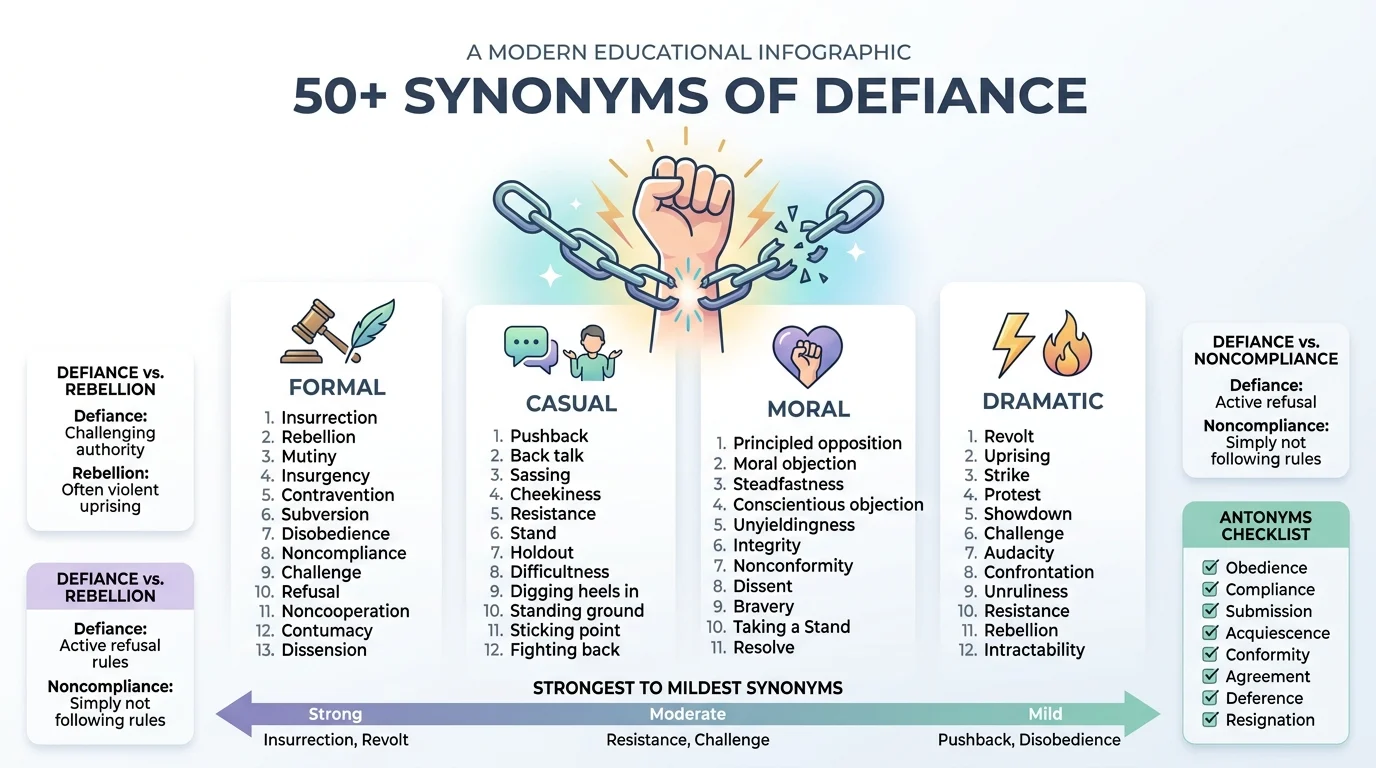
Have you ever needed to describe a bold refusal to obey, a challenge to authority, or a rebellious spirit but felt that “disobedience” or “rebellion” was too broad? You want to capture the open, often courageous resistance to power, and the word “defiance” comes to mind. Choosing the right synonym for “defiance” can transform a simple observation into a powerful statement of resistance, courage, or rebellion. This guide explores the best synonyms of defiance, explaining exactly which word to use and when.
Quick Ans: “Defiance” means open resistance, bold disobedience, or a challenge to authority. For formal writing, choose insubordination or contumacy. For casual conversation, use rebellion or stubbornness. For dramatic effect, use mutiny or insurgence. For moral courage, use intransigence or noncompliance.
Meaning, Tone, and Context
Understanding the core meaning of “defiance” is the first step to using it effectively.
Simple Definition: Open resistance to authority or an opposing force; bold disobedience; a challenge to conform.
Part of Speech: Noun.
Overall Tone: Neutral to positive or negative, depending on perspective. It can indicate courage or rebellion.
Formality Level: Neutral to formal. The word is appropriate in most contexts.
Common Uses: Native English speakers use it to describe acts of resistance, rebellious attitudes, and challenges to rules. For example, “She acted in defiance of the rules,” or “His defiance inspired others.”
Word Forms: Related words include the verb defy, the adjective defiant, and the adverb defiantly.
When and How to Use “Defiance”
“Defiance” is the perfect choice when you want to describe open resistance and bold disobedience. Here are seven realistic examples.
Professional: “His defiance of company policy led to disciplinary action.”
Academic: “The study examined acts of defiance in authoritarian regimes.”
Workplace: “Her defiance of the manager’s instructions surprised everyone.”
Personal: “He acted in defiance of his parents’ wishes.”
Email: “We must address this defiance of established procedures.”
Resume: (Avoid in resumes) Use “independent” or “principled” instead.
Social Media: “Sometimes defiance is the only answer.”
Best Synonyms of “Defiance”
No synonym is identical in every situation. Here is your guide to the best replacement for “defiance” based on your writing context.
For Formal and Legal Contexts
Most Formal: Insubordination means refusal to obey authority. “Insubordination is grounds for termination.”
Legal: Contumacy means stubborn refusal to obey. “The court found him in contumacy.”
Noncompliance: Noncompliance means failure to comply. “Noncompliance with regulations resulted in fines.”
Intransigence: Intransigence means refusal to compromise. “Her intransigence frustrated the negotiators.”
For Casual and Dramatic Contexts
Rebellion: Rebellion means open resistance. “The rebellion was quickly suppressed.”
Stubbornness: Stubbornness means refusal to change. “His stubbornness caused problems.”
Disobedience: Disobedience means refusal to obey. “The child’s disobedience was punished.”
Insolence: Insolence means rude and disrespectful behavior. “His insolence shocked the teacher.”
For Strong and Dramatic Contexts
Mutiny: Mutiny means rebellion against authority, especially military. “The mutiny was crushed.”
Insurgence: Insurgence means an active revolt. “The insurgence spread across the region.”
Uprising: Uprising means a rebellion. “The uprising was led by students.”
Revolt: Revolt means a rebellion against authority. “The revolt was brutally suppressed.”
For Moral and Principled Contexts
Conscientious objection: Conscientious objection means refusal based on moral principles. “He was a conscientious objector.”
Civil disobedience: Civil disobedience means peaceful refusal to obey unjust laws. “Civil disobedience is a form of protest.”
Noncooperation: Noncooperation means refusal to cooperate. “The noncooperation movement gained momentum.”
When Not to Use “Defiance”
Using “defiance” can sound wrong or awkward in certain situations.
When You Mean “Agreement”: “Defiance” is the opposite of agreement.
Better Choice: Agreement or compliance. “Their agreement was clear.”
When You Mean “Independence”: “Defiance” is about resistance. “Independence” is about freedom.
Better Choice: Independence or autonomy. “She valued her independence.”
When It Sounds Too Strong: For minor disagreements, “defiance” is too dramatic.
Better Choice: Disagreement or dissent. “Their disagreement was noted.”
Words Commonly Confused With “Defiance”
| Word | Difference | When to Use | Example |
|---|---|---|---|
| Rebellion | Open resistance to authority | Large-scale or organized | “The rebellion was organized.” |
| Disobedience | Refusal to obey | General and mild | “The child’s disobedience.” |
| Insubordination | Refusal to obey in workplace | Formal and professional | “Insubordination is serious.” |
| Mutiny | Military rebellion | Military contexts | “The mutiny was crushed.” |
| Dissent | Disagreement | Opinion and debate | “His dissent was noted.” |
| Noncompliance | Failure to comply | Legal and regulatory | “Noncompliance led to fines.” |
Best Synonyms of “Defiance” by Context
| Context | Best Synonym | Why It Works | Example |
|---|---|---|---|
| Formal writing | Insubordination | Formal and precise | “Insubordination is grounds for dismissal.” |
| Legal context | Contumacy | Legal and technical | “The court found him in contumacy.” |
| Workplace | Noncompliance | Professional and clear | “Noncompliance with policy.” |
| Casual conversation | Rebellion | Simple and dramatic | “It felt like a rebellion.” |
| Moral context | Civil disobedience | Principled and peaceful | “Civil disobedience is justified.” |
| Dramatic context | Mutiny | Strong and military | “The mutiny was suppressed.” |
| Mild context | Disobedience | General and mild | “The disobedience was minor.” |
How to Choose the Best Synonym of “Defiance”
Choosing the right word is a simple decision. Answer these questions.
What type of defiance am I describing? For workplace, use insubordination or noncompliance. And For legal, use contumacy. For moral, use civil disobedience. For dramatic, use mutiny or revolt.
What is my audience? For a formal report, use insubordination or noncompliance. For a friend, use rebellion or stubbornness.
What is my purpose? Are you condemning, praising, or describing? The correct synonym depends entirely on this.
What is the emotional strength? Mutiny and uprising are stronger. Disobedience is milder. Pick the one that matches your message.
Real Life Examples of “Defiance”
School: Basic: “His defiance was noted.” Improved: “His disobedience was noted by the teacher.”
College: Basic: “The protest was an act of defiance.” Improved: “The protest was an act of civil disobedience.”
Workplace: Basic: “Her defiance led to consequences.” Improved: “Her insubordination led to disciplinary action.”
Business: Basic: “The defiance of regulations was costly.” Improved: “The noncompliance with regulations was costly.”
Email: Basic: “This defiance cannot continue.” Improved: “This noncompliance cannot continue.”
Conversation: Basic: “It was an act of defiance.” Improved: “It was an act of rebellion.”
Storytelling: Basic: “The defiance was crushed.” Improved: “The mutiny was brutally crushed.”
Top 10 Synonyms of “Defiance”
| Synonym | Simple Meaning | Best Used For | Example Sentence |
|---|---|---|---|
| Insubordination | Refusal to obey authority | Workplace and formal | “Insubordination is grounds for dismissal.” |
| Rebellion | Open resistance to authority | General and dramatic | “The rebellion was suppressed.” |
| Disobedience | Refusal to obey | General and mild | “The disobedience was minor.” |
| Mutiny | Military rebellion | Military contexts | “The mutiny was crushed.” |
| Noncompliance | Failure to comply | Legal and regulatory | “Noncompliance led to fines.” |
| Intransigence | Refusal to compromise | Negotiation and politics | “Her intransigence frustrated talks.” |
| Insolence | Rude and disrespectful behavior | Social and formal | “His insolence shocked the room.” |
| Civil disobedience | Peaceful refusal to obey unjust laws | Moral and political | “Civil disobedience is a form of protest.” |
| Uprising | A rebellion | Political and historical | “The uprising was led by students.” |
| Revolt | A rebellion against authority | Political and dramatic | “The revolt was brutally suppressed.” |
Synonyms of “Defiance” by Usage
Professional vs. Personal Synonyms
In the workplace, choose insubordination, noncompliance, or intransigence. With friends, use rebellion, stubbornness, or disobedience.
Formal vs. Conversational Synonyms
For formal writing, use insubordination, contumacy, or noncompliance. For casual conversations, use rebellion, stubbornness, or disobedience.
Academic Synonyms
For research and essays, choose civil disobedience for moral contexts, insurgence for political contexts, and intransigence for negotiation contexts.
Professional and Business Synonyms
For maximum impact, choose insubordination for workplace, noncompliance for regulatory, and intransigence for negotiation.
Creative and Literary Synonyms
To add emotion and imagery, choose mutiny, revolt, or uprising. These words create drama.
Slang or Modern Synonyms
In modern American slang, acting out, talking back, or going rogue are common. For example, “He went rogue.” These are casual and should be avoided in formal writing.
Strongest to Mildest Synonyms
Mild: disobedience, noncooperation, dissent
Moderate: defiance, rebellion, noncompliance
Strong: insubordination, intransigence, insolence
Very Strong: mutiny, revolt, uprising, insurgence
Emotional vs. Neutral Synonyms
Emotional Synonyms: Mutiny, revolt, uprising. These words hint at strong emotion. Use them when you want to evoke feeling.
Neutral Synonyms: Noncompliance, disobedience, insubordination. These words communicate factual information about rule-breaking.
Antonyms of “Defiance”
| Antonym | Meaning | Example Sentence |
|---|---|---|
| Compliance | Obedience to rules | “Compliance is mandatory.” |
| Obedience | Following orders | “Obedience was expected.” |
| Submission | Yielding to authority | “Submission was required.” |
| Conformity | Following norms | “Conformity was the norm.” |
| Acquiescence | Passive acceptance | “Acquiescence was assumed.” |
| Cooperation | Working together | “Cooperation was essential.” |
| Agreement | Harmony of opinion | “Agreement was reached.” |
| Docility | Willingness to be taught | “The docility of the students.” |
| Meekness | Gentle and submissive | “Her meekness was noted.” |
| Passivity | Lack of resistance | “Passivity was criticized.” |
| Respect | Regard for authority | “Respect for rules is important.” |
| Deference | Respectful submission | “Deference to authority.” |
| Allegiance | Loyalty | “Allegiance to the crown.” |
| Loyalty | Faithfulness | “Loyalty was rewarded.” |
| Compliance | Following rules | “Compliance is required.” |
Comparison: “Defiance” vs Similar Words
Defiance vs. Rebellion
Main Difference: “Defiance” can be individual. “Rebellion” is usually organized.
Which Is Stronger? “Rebellion” is stronger and more organized.
Which Is More Formal? Both are formal.
When to Use Each: Use “defiance” for individual acts. Use “rebellion” for organized resistance.
Examples:
Defiance: “His defiance was personal.”
Rebellion: “The rebellion was organized.”
Defiance vs. Disobedience
Main Difference: “Disobedience” is milder. “Defiance” is more open and bold.
Which Is Stronger? “Defiance” is stronger.
Which Is More Formal? Both are formal.
When to Use Each: Use “disobedience” for mild cases. Use “defiance” for bold resistance.
Examples:
Defiance: “Her defiance was evident.”
Disobedience: “The disobedience was minor.”
Defiance vs. Insubordination
Main Difference: “Insubordination” is specific to workplace. “Defiance” is broader.
Which Is Stronger? “Insubordination” is more formal and specific.
Which Is More Formal? “Insubordination” is more formal.
When to Use Each: Use “insubordination” in workplace contexts. Use “defiance” in general contexts.
Examples:
Defiance: “His defiance was noted.”
Insubordination: “Insubordination is grounds for dismissal.”
Defiance vs. Mutiny
Main Difference: “Mutiny” is military. “Defiance” is general.
Which Is Stronger? “Mutiny” is stronger and more dramatic.
Which Is More Formal? Both are formal.
When to Use Each: Use “mutiny” for military contexts. Use “defiance” for general contexts.
Examples:
Defiance: “The defiance was crushed.”
Mutiny: “The mutiny was suppressed.”
Defiance vs. Noncompliance
Main Difference: “Noncompliance” is about failing to follow rules. “Defiance” is about open resistance.
Which Is Stronger? “Defiance” is stronger and more active.
Which Is More Formal? Both are formal.
When to Use Each: Use “noncompliance” for regulatory contexts. Use “defiance” for active resistance.
Examples:
Defiance: “Her defiance was clear.”
Noncompliance: “Noncompliance led to fines.”
Defiance vs. Intransigence
Main Difference: “Intransigence” is refusal to compromise. “Defiance” is refusal to obey.
Which Is Stronger? They are similar.
Which Is More Formal? “Intransigence” is more formal.
When to Use Each: Use “intransigence” in negotiations. Use “defiance” in general contexts.
Examples:
Defiance: “His defiance was noted.”
Intransigence: “Her intransigence frustrated talks.”
Common Phrases and Expressions with “Defiance”
Phrase: In defiance of
Meaning: In open resistance to.
Example Sentence: “She acted in defiance of the rules.”
Phrase: Act of defiance
Meaning: An action showing resistance.
Example Sentence: “It was an act of defiance.”
Phrase: Defiance of authority
Meaning: Resistance to those in power.
Example Sentence: “His defiance of authority was punished.”
Phrase: Spirit of defiance
Meaning: An attitude of resistance.
Example Sentence: “The spirit of defiance was strong.”
Phrase: Defiance campaign
Meaning: An organized resistance effort.
Example Sentence: “The defiance campaign gained momentum.”
Common Mistakes to Avoid
Mistake 1: Using “defiance” when you mean “disagreement”.
Incorrect: “His defiance was noted.”
Better: “His disagreement was noted.”
Why: “Defiance” is about resistance. “Disagreement” is about opinion.
Mistake 2: Using “defiance” when you mean “independence”.
Incorrect: “Her defiance was admirable.”
Better: “Her independence was admirable.”
Why: “Defiance” is about resistance. “Independence” is about freedom.
Mistake 3: Using “defiance” when you mean “rebellion”.
Incorrect: “The defiance was organized.”
Better: “The rebellion was organized.”
Why: “Rebellion” is for organized resistance.
Mistake 4: Using “defiance” when you mean “insubordination”.
Incorrect: “His defiance led to termination.”
Better: “His insubordination led to termination.”
Why: “Insubordination” is the workplace term.
Mistake 5: Using “defiance” when you mean “mutiny”.
Incorrect: “The defiance was crushed by the army.”
Better: “The mutiny was crushed by the army.”
Why: “Mutiny” is the military term.
Frequently Asked Questions
1. What are the best synonyms of “defiance”?
The best synonyms depend on your context. For formal writing, choose insubordination or noncompliance. And For casual conversation, use rebellion or disobedience. For moral contexts, use civil disobedience.
2. What are the best formal synonyms of “defiance”?
The best formal synonyms are insubordination, contumacy, and noncompliance. These words are suitable for academic papers, professional reports, and legal documents.
3. What are common informal synonyms of “defiance”?
For informal settings, use rebellion, stubbornness, or disobedience. These alternatives sound more natural in everyday conversation.
4. What is another word for “defiance” in professional writing?
In professional writing, insubordination is an excellent choice. It conveys refusal to obey authority. Noncompliance is also strong for regulatory contexts.
5. What is the difference between “defiance” and “rebellion”?
“Defiance” can be individual. “Rebellion” is usually organized and collective. Use “defiance” for personal acts and “rebellion” for group movements.
6. What is the opposite of “defiance”?
The most direct opposites (antonyms) of defiance are compliance, obedience, and submission. These words describe yielding to authority.
Conclusion
“Defiance” is a powerful and evocative word for describing open resistance, bold disobedience, and challenges to authority. The term is neutral and widely accepted in most contexts, yet it can sound too strong for minor disagreements or too broad for specific situations. The best choice among the synonyms of defiance depends entirely on your audience, tone, and purpose. Remember, no single synonym works perfectly in every situation. Your goal is to choose the word that communicates your message with the most clarity and impact. A practical tip for your vocabulary growth is to pay attention to how writers describe resistance and rebellion and practice using different synonyms in your writing.









