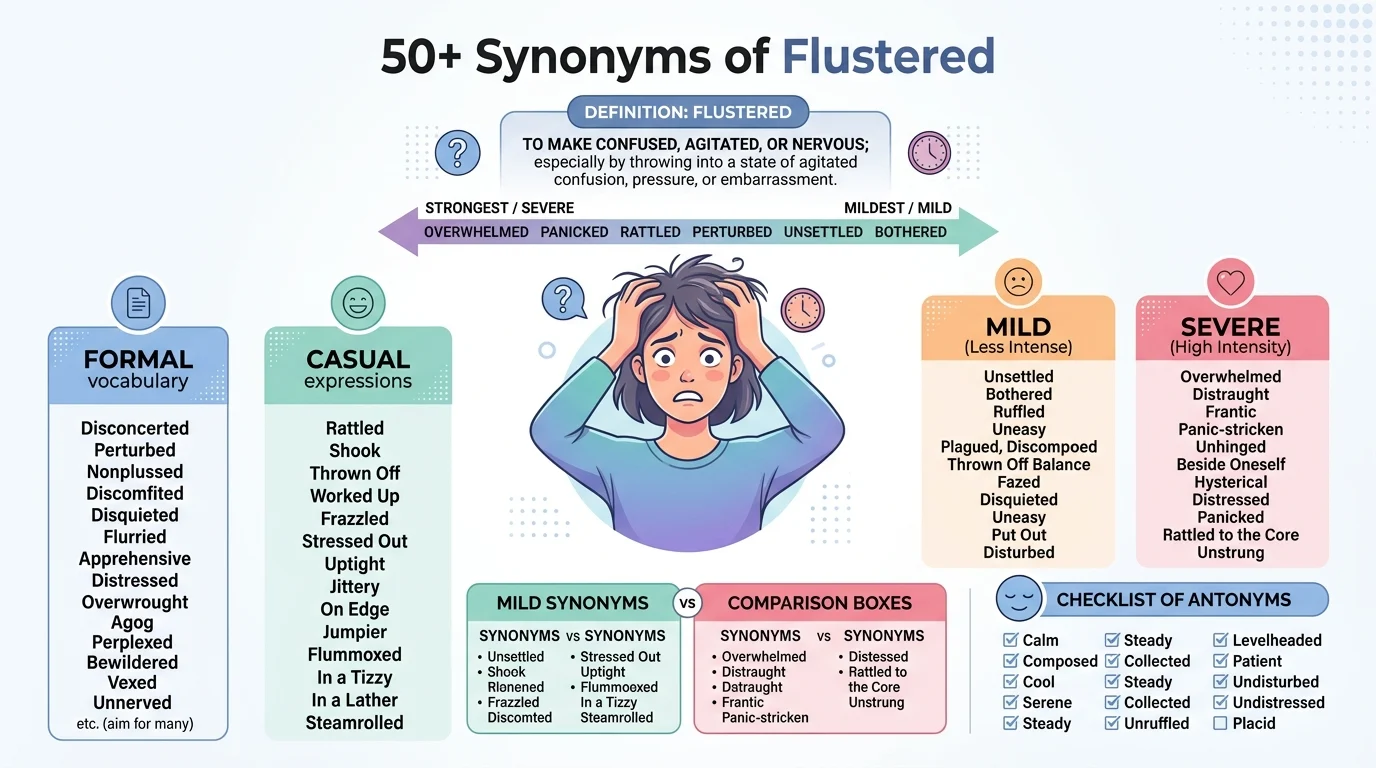
Have you ever needed to describe someone who is confused, nervous, or agitated but felt that “upset” or “worried” was too vague? You want to capture that specific state of being hurriedly confused and disorganized, and the word “flustered” comes to mind. Choosing the right synonym for “flustered” can transform a basic observation into a precise expression of embarrassment, panic, or agitation. This guide explores the best synonyms of flustered, while explaining exactly which word to use and when.
Quick Ans: “Flustered” means confused, nervous, or agitated, often due to being hurried or under pressure. For formal writing, choose agitated or discomposed. Therefore in casual conversation, use rattled or thrown off.For emotional emphasis, use panicked or frantic. For mild cases, use ruffled or unsettled.
Meaning, Tone, and Context
Understanding the core meaning of “flustered” is the first step to using it effectively.
Simple Definition: In a state of confusion, nervousness, or agitation, often caused by pressure, interruption, or embarrassment.
Part of Speech: Adjective.
Overall Tone: Negative to neutral. While It indicates a temporary loss of composure.
Formality Level: Neutral. The word is appropriate in most contexts, though more formal alternatives exist.
Common Uses: Native English speakers use it to describe people who are overwhelmed, embarrassed, or hurried. For example, “She was flustered by the unexpected question,” or “He got flustered during his presentation.”
Word Forms: Related words include the verb fluster, the noun fluster, and the adverb flusteredly.
When and How to Use “Flustered”
“Flustered” is the perfect choice when you want to describe someone who has lost their composure. Here are seven realistic examples.
Professional: “The candidate was flustered when asked about the gap in their resume.”
Academic: “The student appeared flustered during the oral exam.”
Workplace: “He got flustered trying to juggle multiple deadlines.”
Personal: “She was flustered after realizing she had lost her keys.”
Email: “I apologize if my last email seemed flustered; it was a hectic morning.”
Resume: (Avoid in resumes) Use “calm under pressure” instead.
Social Media: “Totally flustered after that surprise meeting!”
Best Synonyms of “Flustered”
No synonym is identical in every situation. Here is your guide to the best replacement for “flustered” based on your writing context.
For Formal and Professional Contexts
Most Formal: Discomposed means disturbed or agitated. “He remained calm and was not discomposed by the interruption.”
Agitated: Agitated means feeling or appearing troubled. “While she was visibly agitated after the argument.”
Unsettled: Unsettled means anxious or uneasy. “The news left him feeling unsettled.”
Disconcerted: Disconcerted means unsettled or confused. “Therefore she was disconcerted by his strange behavior.”
For Casual and Conversational Contexts
Rattled: Rattled means nervous or shaken. “He was rattled by the criticism.”
Thrown off: Thrown off means confused or disrupted. “The unexpected question threw me off.”
Shaken: Shaken means shocked or upset. “She was shaken by the accident.”
Out of sorts: Out of sorts means not feeling one’s usual self. “He seemed out of sorts today.”
For Stronger Emotional States
Panicked: Panicked means feeling uncontrollable fear or anxiety. “She panicked when she could not find her passport.”
Frantic: Frantic means wild with fear or worry. “He was frantic trying to meet the deadline.”
Overwhelmed: Overwhelmed means feeling buried or overpowered. “She was overwhelmed by the workload.”
Distraught: Distraught means deeply upset and agitated. “He was distraught after the bad news.”
For Milder States
Ruffled: Ruffled means slightly annoyed or disorganized. “She was a bit ruffled by the comment.”
Perturbed: Perturbed means slightly anxious or unsettled. “He was perturbed by the change in plans.”
Embarrassed: Embarrassed means feeling shame or awkwardness. “She was embarrassed by the mistake.”
Sheepish: Sheepish means showing embarrassment. “He gave a sheepish grin.”
When Not to Use “Flustered”
Using “flustered” can sound wrong or awkward in certain situations.
When You Mean “Angry”: “Flustered” is about confusion, not anger.
Better Choice: Angry or furious. “He was furious about the delay.”
When You Mean “Sad”: “Flustered” is not about sadness.
Better Choice: Sad or upset. “She was sad about the news.”
When It Sounds Too Mild: For severe panic, “flustered” is too weak.
Words Commonly Confused With “Flustered”
| Word | Difference | When to Use | Example |
|---|---|---|---|
| Agitated | Troubled and restless | Stronger than flustered | “He was agitated.” |
| Rattled | Nervous and shaken | Casual and informal | “She was rattled.” |
| Panicked | Overcome by fear | Severe anxiety | “He panicked.” |
| Embarrassed | Feeling shame | Social awkwardness | “She was embarrassed.” |
| Confused | Lacking clarity | Mental fog | “I was confused.” |
| Overwhelmed | Buried by demands | Too much to handle | “She was overwhelmed.” |
Best Synonyms of “Flustered” by Context
| Context | Best Synonym | Why It Works | Example |
|---|---|---|---|
| Formal writing | Discomposed | Formal and precise | “He was discomposed by the news.” |
| Professional | Agitated | Professional and clear | “She was agitated during the meeting.” |
| Casual conversation | Rattled | Simple and natural | “He was rattled by the question.” |
| Mild state | Ruffled | Light and mild | “She was slightly ruffled.” |
| Strong state | Panicked | Strong and urgent | “He panicked when he was late.” |
| Emotional | Distraught | Deeply emotional | “She was distraught.” |
| Social | Embarrassed | Social awkwardness | “He was embarrassed.” |
How to Choose the Best Synonym of “Flustered”
Choosing the right word is a simple decision. Answer these questions.
How severe is the flustered state? For mild, use ruffled or perturbed. And For moderate, use rattled or agitated. For severe, use panicked or distraught.
What is my audience? For a formal report, use discomposed or agitated. For a friend, use rattled or thrown off.
What is the cause? For embarrassment, use embarrassed or sheepish. And For pressure, use overwhelmed. For surprise, use thrown off.
What is the emotional strength? Panicked and frantic are stronger. Ruffled is milder. Pick the one that matches your message.
Real Life Examples of “Flustered”
School: Basic: “The student was flustered.” Improved: “The student was rattled by the surprise quiz.”
College: Basic: “She was flustered during the presentation.” Improved: “She was discomposed during the presentation.”
Workplace: Basic: “He was flustered by the deadline.” Improved: “He was overwhelmed by the tight deadline.”
Business: Basic: “The client was flustered.” Improved: “The client was agitated by the delay.”
Email: Basic: “Sorry for the flustered email.” Improved: “Sorry for the hurried email.”
Conversation: Basic: “I was flustered.” Improved: “I was thrown off.”
Storytelling: Basic: “She was flustered.” Improved: “She was distraught and could not think clearly.”
Top 10 Synonyms of “Flustered”
| Synonym | Simple Meaning | Best Used For | Example Sentence |
|---|---|---|---|
| Agitated | Troubled and restless | Formal and professional | “He was agitated by the interruption.” |
| Rattled | Nervous and shaken | Casual and informal | “She was rattled by the criticism.” |
| Discomposed | Disturbed and agitated | Formal and literary | “He was discomposed by the news.” |
| Panicked | Overcome by fear | Severe anxiety | “She panicked when she was late.” |
| Overwhelmed | Buried by demands | Work and pressure | “He was overwhelmed by the workload.” |
| Ruffled | Slightly annoyed or disorganized | Mild states | “She was ruffled by the comment.” |
| Perturbed | Slightly anxious | Mild and formal | “He was perturbed by the change.” |
| Embarrassed | Feeling shame | Social situations | “She was embarrassed by the mistake.” |
| Thrown off | Confused or disrupted | Casual and conversational | “The question threw me off.” |
| Distraught | Deeply upset | Emotional and severe | “He was distraught after the loss.” |
Synonyms of “Flustered” by Usage
Professional vs. Personal Synonyms
In the workplace, choose agitated, discomposed, or overwhelmed. With friends, use rattled, thrown off, or out of sorts.
Formal vs. Conversational Synonyms
For formal writing, use discomposed, agitated, or perturbed. For casual conversations, use rattled, thrown off, or shaken.
Academic Synonyms
For research and essays, choose discomposed for formal analysis, agitated for psychological contexts, and perturbed for mild states.
Professional and Business Synonyms
For maximum impact, choose agitated for client interactions, overwhelmed for workload, and discomposed for formal writing.
Creative and Literary Synonyms
To add emotion and imagery, choose distraught, frantic, or panicked. These words create atmosphere.
Slang or Modern Synonyms
In modern American slang, rattled, thrown off, or freaked out are common. For example, “I was totally freaked out.” Therefore these are casual and should be avoided in formal writing.
Strongest to Mildest Synonyms
Mild: ruffled, perturbed, sheepish
Moderate: flustered, rattled, unsettled
Strong: agitated, discomposed, overwhelmed
Very Strong: panicked, frantic, distraught
Emotional vs. Neutral Synonyms
Emotional Synonyms: Panicked, distraught, frantic. These words hint at strong emotion.Therefore Use them when you want to evoke feeling.
Neutral Synonyms: Flustered, rattled, unsettled. These words communicate factual information about a state.
Antonyms of “Flustered”
| Antonym | Meaning | Example Sentence |
|---|---|---|
| Calm | Peaceful and composed | “She remained calm.” |
| Composed | Self-controlled | “He was composed under pressure.” |
| Collected | Calm and in control | “She stayed collected.” |
| Serene | Peaceful and untroubled | “He was serene.” |
| Poised | Confident and elegant | “She was poised.” |
| Unruffled | Not disturbed | “He was unruffled by the chaos.” |
| Relaxed | Free from tension | “She felt relaxed.” |
| Confident | Self-assured | “He was confident.” |
| Assured | Certain and secure | “She was assured.” |
| Tranquil | Free from disturbance | “The scene was tranquil.” |
| Steady | Firm and stable | “His voice was steady.” |
| Cool | Calm and unemotional | “He stayed cool.” |
| Nonchalant | Casually calm | “She was nonchalant.” |
| Unfazed | Not disturbed | “He was unfazed.” |
| Placid | Calm and peaceful | “Her expression was placid.” |
Comparison: “Flustered” vs Similar Words
Flustered vs. Agitated
Main Difference: “Agitated” is stronger and more restless. “Flustered” is about confusion and disorganization.
Which Is Stronger? “Agitated” is stronger.
Which Is More Formal? Both are formal.
When to Use Each: Use “agitated” for strong restlessness.While Use “flustered” for mild confusion.
Examples:
Flustered: “She was flustered by the question.”
Agitated: “He was agitated by the delay.”
Flustered vs. Rattled
Main Difference: “Rattled” is casual and means shaken. “Flustered” is about confusion.
Which Is Stronger? They are similar.
Which Is More Formal? “Flustered” is more formal.
When to Use Each: Use “rattled” in casual conversation. Therefore Use “flustered” in general contexts.
Examples:
Flustered: “He was flustered.”
Rattled: “He was rattled.”
Flustered vs. Panicked
Main Difference: “Panicked” is severe fear. “Flustered” is mild confusion.
Which Is Stronger? “Panicked” is much stronger.
Which Is More Formal? Both are neutral.
When to Use Each: Use “panicked” for severe situations. While Use “flustered” for mild situations.
Examples:
Flustered: “She was flustered.”
Panicked: “She panicked.”
Flustered vs. Overwhelmed
Main Difference: “Overwhelmed” is about too much to handle. “Flustered” is about confusion.
Which Is Stronger? “Overwhelmed” is stronger.
Which Is More Formal? Both are neutral.
When to Use Each: Use “overwhelmed” for workload.Therefore Use “flustered” for confusion.
Examples:
Flustered: “He was flustered.”
Overwhelmed: “He was overwhelmed.”
Flustered vs. Embarrassed
Main Difference: “Embarrassed” is about shame. “Flustered” is about confusion.
Which Is Stronger? They are different.
Which Is More Formal? Both are neutral.
When to Use Each: Use “embarrassed” for social shame. While Use “flustered” for confusion.
Examples:
Flustered: “She was flustered.”
Embarrassed: “She was embarrassed.”
Flustered vs. Perturbed
Main Difference: “Perturbed” is milder and more formal. “Flustered” is more visible.
Which Is Stronger? “Flustered” is stronger.
Which Is More Formal? “Perturbed” is more formal.
When to Use Each: Use “perturbed” for mild anxiety. Use “flustered” for visible confusion.
Examples:
Flustered: “He was flustered.”
Perturbed: “He was perturbed.”
Common Phrases and Expressions with “Flustered”
Phrase: Get flustered
Meaning: Become confused or agitated.
Example Sentence: “She tends to get flustered under pressure.”
Phrase: Visibly flustered
Meaning: Clearly showing confusion.
Example Sentence: “He was visibly flustered.”
Phrase: Flustered and confused
Meaning: Both confused and agitated.
Example Sentence: “She was flustered and confused.”
Phrase: Flustered by
Meaning: Caused to be flustered by something.
Example Sentence: “He was flustered by the sudden change.”
Common Mistakes to Avoid
Mistake 1: Using “flustered” when you mean “angry”.
Incorrect: “He was flustered about the delay.”
Better: “He was angry about the delay.”
Why: “Flustered” is confusion, not anger.
Mistake 2: Using “flustered” when you mean “sad”.
Incorrect: “She was flustered about the news.”
Better: “She was sad about the news.”
Why: “Flustered” is not about sadness.
Mistake 3: Using “flustered” when you mean “panicked”.
Incorrect: “He was flustered during the emergency.”
Better: “He panicked during the emergency.”
Why: “Panicked” is stronger for emergencies.
Mistake 4: Using “flustered” in formal writing.
Incorrect: “The client was flustered.”
Better: “The client was agitated.”
Why: “Agitated” is more formal.
Mistake 5: Overusing “flustered” in conversation.
Incorrect: “I was flustered.”
Better: “I was thrown off.”
Why: “Thrown off” sounds more natural.
Frequently Asked Questions
1. What are the best synonyms of “flustered”?
The best synonyms depend on your context. For formal writing, choose agitated or discomposed. Therefore casual conversation, use rattled or thrown off. For mild states, use ruffled or perturbed.
2. What are the best formal synonyms of “flustered”?
The best formal synonyms are discomposed, agitated, and perturbed. These words are suitable for academic papers, professional reports, and business communications.
3. What are common informal synonyms of “flustered”?
For informal settings, use rattled, thrown off, or out of sorts. These alternatives sound more natural in everyday conversation.
4. What is another word for “flustered” in professional writing?
In professional writing, agitated is an excellent choice. It conveys visible disturbance. While Discomposed is also strong for formal contexts.
5. What is the difference between “flustered” and “panicked”?
“Flustered” means confused and disorganized. “Panicked” means overcome by fear. Use “panicked” for severe situations and “flustered” for mild confusion.
6. What is the opposite of “flustered”?
The most direct opposites (antonyms) of flustered are calm, composed, and collected. While These words describe a state of control and peace.
Conclusion
“Flustered” is a useful and expressive word for describing a state of confusion, nervousness, and agitation. The term is neutral and widely accepted in most contexts, yet it can sound too mild for severe panic or too informal for formal writing. The best choice among the synonyms of flustered depends entirely on your audience, tone, and purpose. Remember, no single synonym works perfectly in every situation. Your goal is to choose the word that communicates your message with the most clarity and impact. A practical tip for your vocabulary growth is to pay attention to how writers describe emotional states and practice using different synonyms in your writing.









