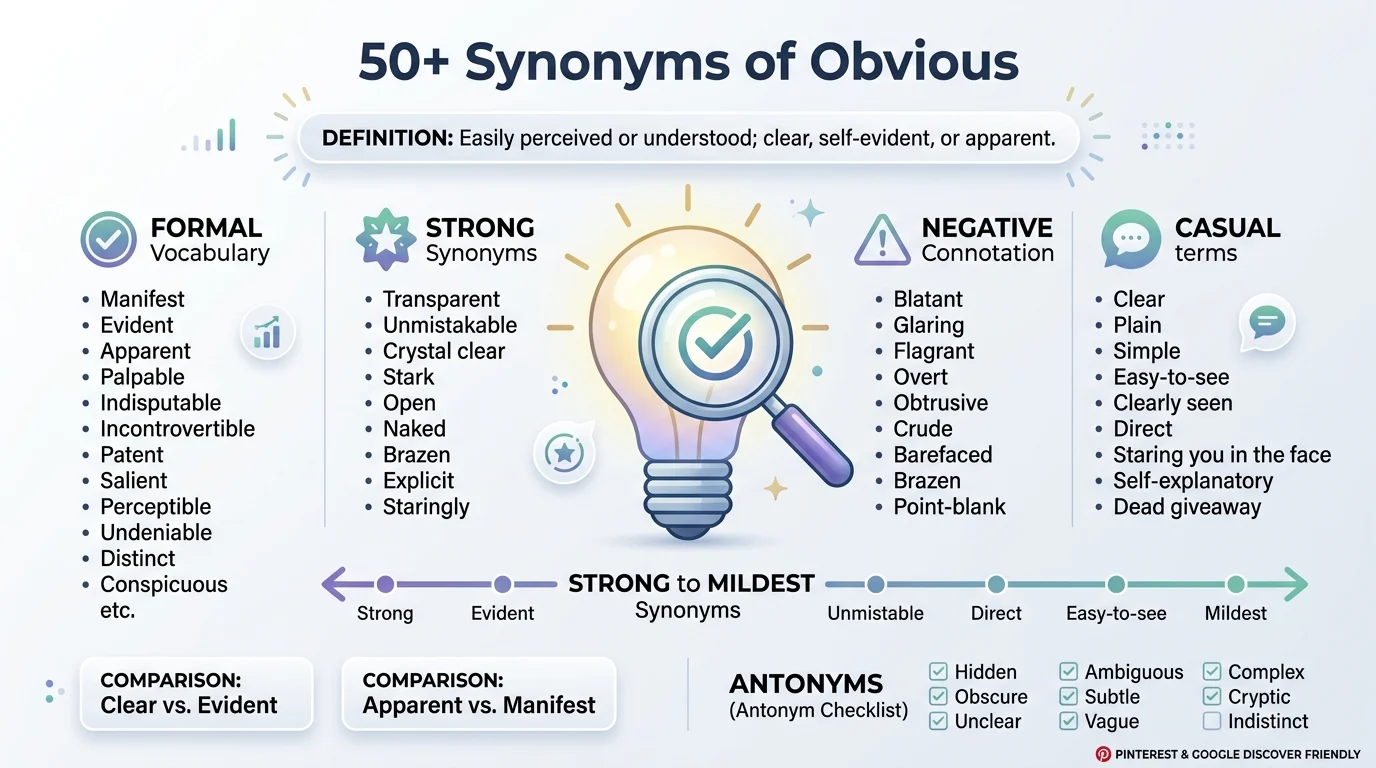
Have you ever needed to point out something that is clearly visible or easily understood but felt that “clear” or “plain” was too simple? You want to emphasize that something is unmistakable and requires no explanation, and the word “obvious” comes to mind. Choosing the right synonym for “obvious” can transform a basic observation into a precise statement about clarity and evidence. This guide explores the best synonyms of obvious, explaining exactly which word to use and when.
Quick Ans: “Obvious” means easily perceived or understood; clear and self-evident. For formal writing, choose evident or apparent. For strong emphasis, use unmistakable or undeniable. For casual conversation, use clear or plain. For something glaringly obvious, use blatant or conspicuous.
Meaning, Tone, and Context
Understanding the core meaning of “obvious” is the first step to using it effectively.
Simple Definition: Easily perceived or understood; clear and apparent; requiring no explanation.
Part of Speech: Adjective.
Overall Tone: Neutral. It can be positive (clear) or negative (blatant), depending on context.
Formality Level: Neutral. The word works in most contexts, from casual to formal.
Common Uses: Native English speakers use it to describe facts, truths, solutions, and behaviors that are easily seen or understood. For example, “The answer is obvious,” or “It was obvious that he was lying.”
Word Forms: Related words include the adverb obviously and the noun obviousness.
When and How to Use “Obvious”
“Obvious” is the perfect choice when you want to emphasize that something is clear and easily understood. Here are seven realistic examples.
Professional: “The solution to the problem is obvious once you review the data.”
Academic: “It is obvious from the research that climate change is accelerating.”
Workplace: “The need for better communication is obvious.”
Personal: “It was obvious that she was upset.”
Email: “The error is obvious and needs immediate correction.”
Resume: (Rarely used) “Identified obvious inefficiencies and implemented solutions.”
Social Media: “The obvious choice is to be kind.”
Best Synonyms of “Obvious”
No synonym is identical in every situation. Here is your guide to the best replacement for “obvious” based on your writing context.
For Formal and Academic Contexts
Most Formal: Evident means clearly seen or understood. “The evidence is evident.”
Clear: Apparent means clearly visible or understood. “The reason is apparent.”
Self-Evident: Self-evident means obvious without needing proof. “The truth is self-evident.”
For Strong Emphasis
Unmistakable: Unmistakable means impossible to confuse with something else. “The resemblance is unmistakable.”
Undeniable: Undeniable means impossible to deny. “The facts are undeniable.”
Indisputable: Indisputable means impossible to dispute. “The evidence is indisputable.”
For Glaringly Obvious
Blatant: Blatant means very obvious and unashamed. “The blatant disregard for rules was shocking.”
Conspicuous: Conspicuous means clearly visible and attracting attention. “The conspicuous error was embarrassing.”
Glaring: Glaring means highly obvious and conspicuous. “The glaring mistake was impossible to miss.”
For Casual Conversation
Clear: Clear is the simplest synonym. “The instructions are clear.”
Plain: Plain means easy to see or understand. “It is plain that he is lying.”
Evident: Evident is slightly formal but natural. “The disappointment was evident.”
When Not to Use “Obvious”
Using “obvious” can sound wrong or awkward in certain situations.
When It Sounds Condescending: “Obvious” can imply that the other person should have known.
Better Choice: Clear or apparent. “The solution is clear.”
When You Mean “Easy”: “Obvious” is about clarity, not difficulty.
Better Choice: Easy or simple. “The task is easy.”
When It Sounds Too Blunt: “Obvious” can sound dismissive.
Better Choice: Evident or apparent. “The reason is apparent.”
Words Commonly Confused With “Obvious”
| Word | Difference | When to Use | Example |
|---|---|---|---|
| Evident | Clearly seen or understood | Formal and academic | “The evidence is evident.” |
| Apparent | Clearly visible or understood | Formal and general | “The reason is apparent.” |
| Clear | Easy to perceive | Casual and general | “The instructions are clear.” |
| Plain | Easy to see or understand | Casual and emphatic | “It is plain to see.” |
| Blatant | Very obvious and unashamed | Negative contexts | “A blatant lie.” |
| Conspicuous | Attracting attention | Descriptive contexts | “A conspicuous error.” |
Best Synonyms of “Obvious” by Context
| Context | Best Synonym | Why It Works | Example |
|---|---|---|---|
| Formal writing | Evident | Formal and precise | “The trend is evident.” |
| Academic writing | Apparent | Standard in research | “The correlation is apparent.” |
| Professional | Clear | Professional and direct | “The solution is clear.” |
| Strong emphasis | Unmistakable | Emphasizes certainty | “The resemblance is unmistakable.” |
| Negative contexts | Blatant | Emphasizes shamelessness | “A blatant violation.” |
| Casual conversation | Plain | Simple and natural | “It is plain to see.” |
| Descriptive | Conspicuous | Emphasizes visibility | “A conspicuous error.” |
How to Choose the Best Synonym of “Obvious”
Choosing the right word is a simple decision. Answer these questions.
What type of obvious am I describing? For formal, use evident or apparent. And For strong emphasis, use unmistakable or undeniable. For negative, use blatant. For casual, use clear or plain.
What is my audience? For a formal report, use evident or apparent. For a friend, use clear or plain.
What is my purpose? Are you informing, emphasizing, or criticizing? The correct synonym depends entirely on this.
What is the emotional strength? Blatant and glaring are stronger. Clear is milder. Pick the one that matches your message.
Real Life Examples of “Obvious”
School: Basic: “The answer is obvious.” Improved: “The answer is evident from the text.”
College: Basic: “The trend is obvious.” Improved: “The trend is apparent in the data.”
Workplace: Basic: “The problem is obvious.” Improved: “The problem is clear to everyone.”
Business: Basic: “The mistake was obvious.” Improved: “The mistake was blatant and costly.”
Email: Basic: “This is an obvious error.” Improved: “This is a glaring error that needs correction.”
Conversation: Basic: “It is obvious.” Improved: “It is plain to see.”
Storytelling: Basic: “The truth was obvious.” Improved: “The truth was unmistakable.”
Top 10 Synonyms of “Obvious”
| Synonym | Simple Meaning | Best Used For | Example Sentence |
|---|---|---|---|
| Evident | Clearly seen or understood | Formal and academic | “The evidence is evident.” |
| Apparent | Clearly visible or understood | Formal and general | “The reason is apparent.” |
| Clear | Easy to perceive | Casual and general | “The instructions are clear.” |
| Plain | Easy to see or understand | Casual and emphatic | “It is plain to see.” |
| Unmistakable | Impossible to confuse | Strong emphasis | “The resemblance is unmistakable.” |
| Undeniable | Impossible to deny | Strong emphasis | “The facts are undeniable.” |
| Blatant | Very obvious and unashamed | Negative contexts | “A blatant lie.” |
| Conspicuous | Attracting attention | Descriptive contexts | “A conspicuous error.” |
| Glaring | Highly obvious | Negative and emphatic | “A glaring mistake.” |
| Self-evident | Obvious without proof | Formal and philosophical | “The truth is self-evident.” |
Synonyms of “Obvious” by Usage
Professional vs. Personal Synonyms
In the workplace, choose evident, apparent, or clear. With friends, use plain, clear, or obvious.
Formal vs. Conversational Synonyms
For formal writing, use evident, apparent, or self-evident. For casual conversations, use clear, plain, or obvious.
Academic Synonyms
For research and essays, choose evident for evidence, apparent for trends, and self-evident for truths.
Professional and Business Synonyms
For maximum impact, choose clear for solutions, evident for trends, and blatant for violations.
Creative and Literary Synonyms
To add emotion and imagery, choose unmistakable, undeniable, or glaring. These words create emphasis.
Slang or Modern Synonyms
In modern American slang, no-brainer, duh, or clear as day are common. For example, “That is a no-brainer.” These are casual and should be avoided in formal writing.
Strongest to Mildest Synonyms
Mild: clear, plain, obvious
Moderate: evident, apparent
Strong: unmistakable, undeniable, conspicuous
Very Strong: blatant, glaring, indisputable
Emotional vs. Neutral Synonyms
Emotional Synonyms: Blatant, glaring, unmistakable. These words hint at strong reaction. Use them when you want to evoke feeling.
Neutral Synonyms: Obvious, evident, apparent. These words simply communicate factual information.
Antonyms of “Obvious”
| Antonym | Meaning | Example Sentence |
|---|---|---|
| Obscure | Not clearly understood | “The meaning is obscure.” |
| Hidden | Not visible | “The truth is hidden.” |
| Unclear | Not easy to understand | “The instructions are unclear.” |
| Ambiguous | Open to more than one interpretation | “The statement is ambiguous.” |
| Vague | Not clearly expressed | “The plan is vague.” |
| Subtle | Not obvious | “The difference is subtle.” |
| Concealed | Kept secret | “The evidence was concealed.” |
| Cryptic | Having a meaning that is mysterious | “The message was cryptic.” |
| Enigmatic | Difficult to interpret | “His smile was enigmatic.” |
| Mysterious | Difficult to understand | “The event was mysterious.” |
| Confusing | Not easy to understand | “The directions were confusing.” |
| Puzzling | Confusing | “The result was puzzling.” |
| Impenetrable | Impossible to understand | “The theory is impenetrable.” |
| Opaque | Difficult to understand | “The writing is opaque.” |
| Abstruse | Difficult to understand | “The concept is abstruse.” |
Comparison: “Obvious” vs Similar Words
Obvious vs. Evident
Main Difference: “Evident” is more formal. “Obvious” is more general.
Which Is Stronger? They are similar.
Which Is More Formal? “Evident” is more formal.
When to Use Each: Use “evident” in formal writing. Use “obvious” in general contexts.
Examples:
Obvious: “The answer is obvious.”
Evident: “The trend is evident.”
Obvious vs. Apparent
Main Difference: “Apparent” is formal and often implies visibility. “Obvious” is broader.
Which Is Stronger? They are similar.
Which Is More Formal? “Apparent” is more formal.
When to Use Each: Use “apparent” in academic writing. Use “obvious” in general contexts.
Examples:
Obvious: “It was obvious he was upset.”
Apparent: “The reason is apparent.”
Obvious vs. Clear
Main Difference: “Clear” is simpler and more casual. “Obvious” is stronger.
Which Is Stronger? “Obvious” is stronger.
Which Is More Formal? Both are neutral.
When to Use Each: Use “clear” in casual conversation. Use “obvious” for emphasis.
Examples:
Obvious: “The mistake was obvious.”
Clear: “The instructions are clear.”
Obvious vs. Blatant
Main Difference: “Blatant” is negative and implies shamelessness. “Obvious” is neutral.
Which Is Stronger? “Blatant” is stronger and more negative.
Which Is More Formal? Both are formal.
When to Use Each: Use “blatant” for violations. Use “obvious” for general contexts.
Examples:
Obvious: “The answer is obvious.”
Blatant: “A blatant lie.”
Obvious vs. Conspicuous
Main Difference: “Conspicuous” means attracting attention. “Obvious” means easily understood.
Which Is Stronger? “Conspicuous” is stronger for visibility.
Which Is More Formal? Both are formal.
When to Use Each: Use “conspicuous” for physical visibility. Use “obvious” for understanding.
Examples:
Obvious: “The solution is obvious.”
Conspicuous: “A conspicuous error.”
Obvious vs. Unmistakable
Main Difference: “Unmistakable” means impossible to confuse. “Obvious” is broader.
Which Is Stronger? “Unmistakable” is stronger.
Which Is More Formal? Both are formal.
When to Use Each: Use “unmistakable” for certainty. Use “obvious” for general clarity.
Examples:
Obvious: “It was obvious she was tired.”
Unmistakable: “The resemblance is unmistakable.”
Common Phrases and Expressions with “Obvious”
Phrase: Obvious choice
Meaning: The clear and easy decision.
Example Sentence: “She was the obvious choice for the job.”
Phrase: Obvious question
Meaning: The question that naturally arises.
Example Sentence: “The obvious question is why.”
Phrase: State the obvious
Meaning: To say something everyone already knows.
Example Sentence: “I do not want to state the obvious, but we need more time.”
Phrase: For obvious reasons
Meaning: For reasons that are clear.
Example Sentence: “For obvious reasons, we cannot share that information.”
Phrase: Glaringly obvious
Meaning: Extremely obvious.
Example Sentence: “The error was glaringly obvious.”
Common Mistakes to Avoid
Mistake 1: Using “obvious” when you mean “easy”.
Incorrect: “The test was obvious.”
Better: “The test was easy.”
Why: “Obvious” is about clarity, not difficulty.
Mistake 2: Using “obvious” in a condescending way.
Incorrect: “It is obvious that you did not read the instructions.”
Better: “It seems clear that the instructions were missed.”
Why: “Obvious” can sound condescending.
Mistake 3: Overusing “obvious” in conversation.
Incorrect: “That is obvious.”
Better: “That is clear.”
Why: “Clear” sounds more natural.
Mistake 4: Using “obvious” when you mean “blatant”.
Incorrect: “The obvious violation was punished.”
Better: “The blatant violation was punished.”
Why: “Blatant” is stronger for violations.
Mistake 5: Using “obvious” when you mean “apparent”.
Incorrect: “The obvious trend is concerning.”
Better: “The apparent trend is concerning.”
Why: “Apparent” is more formal for trends.
Frequently Asked Questions
1. What are the best synonyms of “obvious”?
The best synonyms depend on your context. For formal writing, choose evident or apparent. And For strong emphasis, use unmistakable or undeniable. For casual conversation, use clear or plain.
2. What are the best formal synonyms of “obvious”?
The best formal synonyms are evident, apparent, and self-evident. These words are suitable for academic papers, professional reports, and business communications.
3. What are common informal synonyms of “obvious”?
For informal settings, use clear, plain, or obvious. These alternatives sound more natural in everyday conversation.
4. What is another word for “obvious” in professional writing?
In professional writing, evident is an excellent choice. It conveys clarity and formality. Apparent is also strong for trends.
5. What is the difference between “obvious” and “evident”?
“Obvious” is general and direct. “Evident” is more formal and often used in academic contexts. Use “evident” for evidence and “obvious” for general clarity.
6. What is the opposite of “obvious”?
The most direct opposites (antonyms) of obvious are obscure, hidden, and unclear. These words describe things that are not easily understood.
Conclusion
“Obvious” is a versatile and essential word for describing things that are clear and easily understood. The term is neutral and widely accepted in most contexts, yet it can sound condescending or too simple for specific situations. The best choice among the synonyms of obvious depends entirely on your audience, tone, and purpose. Remember, no single synonym works perfectly in every situation. Your goal is to choose the word that communicates your message with the most clarity and impact. A practical tip for your vocabulary growth is to pay attention to how writers express clarity and evidence and practice using different synonyms in your writing.









