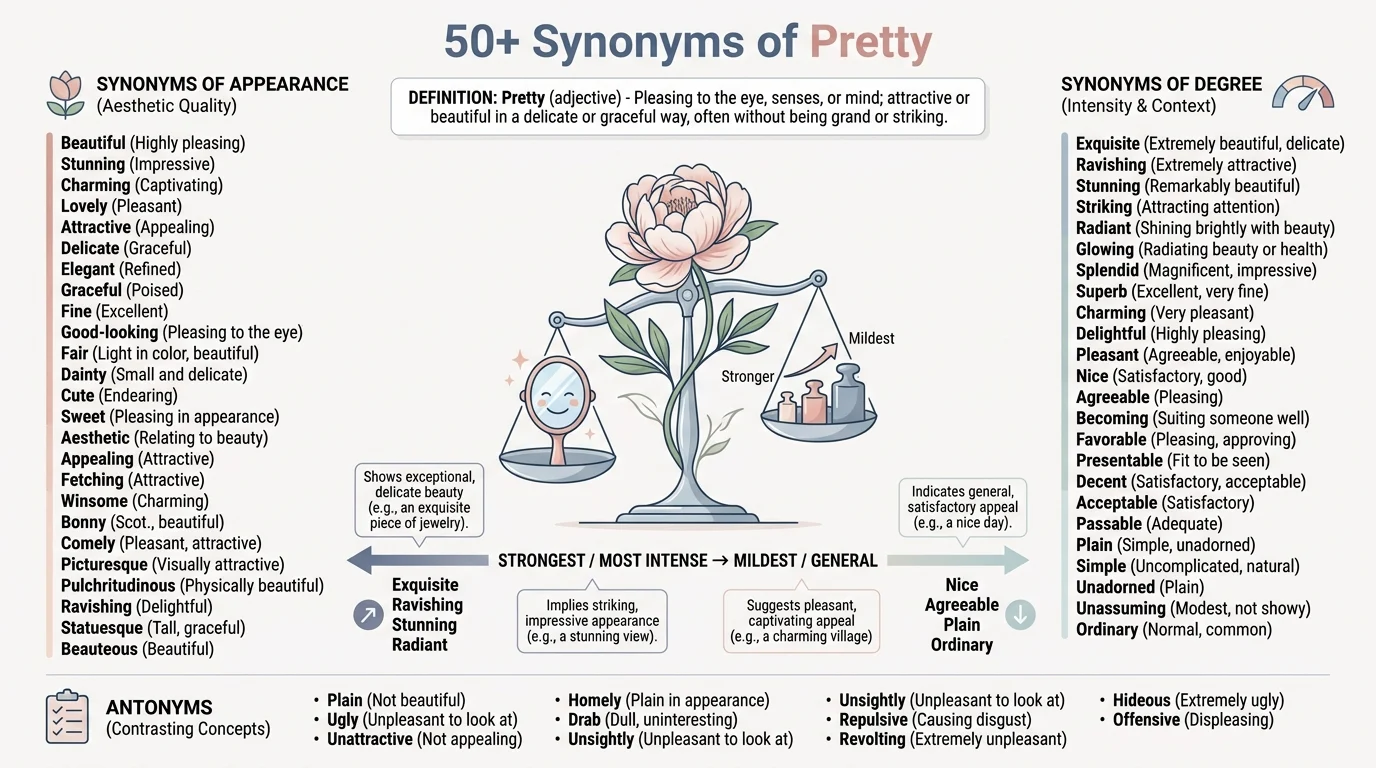
Have you ever called someone “pretty” and felt the word didn’t fully capture their beauty or your intended meaning? You want to compliment someone’s appearance, describe a pleasant view, or even qualify a statement with a moderate degree, and the word “pretty” comes to mind. Choosing the right synonym for “pretty” can transform a simple description into a precise expression of attraction, admiration, or degree. This guide explores the best synonyms of pretty, explaining exactly which word to use and when.
Quick Ans: “Pretty” is a versatile word with two distinct meanings . As an adjective describing appearance, it means attractive in a delicate, graceful way without being grand or intimidating . For this sense, choose attractive, lovely, or cute. As an adverb meaning “to a moderate degree,” it means fairly or somewhat . For this sense, choose fairly, quite, or somewhat . The adjective is more delicate than beautiful, while the adverb is informal but widely used .
Meaning, Tone, and Context
Understanding the core meaning of “pretty” is the first step to using it effectively.
Simple Definition: As an adjective, pleasing or attractive to the eye, especially in a delicate or graceful way. As an adverb, to a moderately sufficient extent or degree.
Part of Speech: Adjective and adverb .
Overall Tone: Positive and neutral. It indicates pleasantness without being too strong or intimidating .
Formality Level: Neutral to informal. The adverb “pretty” is common in informal speech and writing, although far from restricted to them .
Common Uses: Native English speakers use “pretty” to describe people, places, and things that are pleasing in a simple or delicate way . For example, “She has a pretty face,” or “That is a pretty tune.” As an adverb, it is used to moderate statements, as in “It is pretty cold outside” . It can also be used ironically to describe a bad situation, as in “a pretty mess” .
When and How to Use “Pretty”
“Pretty” is the perfect choice when you want to describe something pleasing in a delicate way or to express a moderate degree. Here are seven realistic examples.
Describing Appearance: “She looked very pretty in the new dress.”
And Describing Places: “The village is a pretty little place.”
Describing Sound: “I heard a pretty tune on the radio.”
Moderating Statements: “The work is pretty hard.”
Describing Degree: “I am pretty sure I locked the door.”
Expressing Sarcasm: “This is a pretty mess you have gotten us into.”
Professional Email: “We are in a pretty good position to negotiate.”
Best Synonyms of “Pretty”
No synonym is identical in every situation. Here is your guide to the best replacement for “pretty” based on your writing context.
For Describing Appearance (Adjective)
Professional/Formal: Attractive is a very common, neutral synonym . “The candidate had an attractive resume.”
Stronger/More Dramatic: Gorgeous is a much more emphatic synonym for extreme beauty . “She looked gorgeous at the premiere.”
Delicate/Charming: Lovely implies attractiveness combined with delightfulness or endearment . “What a lovely garden.”
Youthful/Charming: Cute suggests attractiveness in a dainty, endearing, or diminutive way . “The puppy was so cute.”
Formal/Literary: Comely is a formal term for a pleasing appearance, especially of women . “She was a comely lass.”
For Expressing a Moderate Degree (Adverb)
Formal/Widely Used: Fairly is a more formal alternative for the adverb ‘pretty’ . “The performance was fairly good.”
Slightly Emphatic: Quite is slightly stronger than “pretty” and is often preferred in British English . “The film was quite enjoyable.”
Formal/Precise: Somewhat implies a small but noticeable degree . “The results were somewhat disappointing.”
Formal/Practical: Reasonably suggests a satisfactory or moderate degree . “The plan worked reasonably well.”
Relatively: Relatively suggests something in comparison to other things . “The task was relatively easy.”
When Not to Use “Pretty”
Using “pretty” can sound wrong or awkward in certain situations.
When You Mean “Excellent”: “Pretty” is for moderate praise, not for high praise . Use beautiful or gorgeous instead.
Better Choice: Beautiful. “The sunset was beautiful.”
When It Sounds Too Informal: In formal academic writing, the adverb “pretty” can sound too casual . Use fairly or somewhat instead.
Better Choice: Fairly. “The results were fairly consistent.”
When You Mean “Very”: “Pretty” means “to a moderate degree,” not “very” .
Better Choice: Very. “It is very cold outside.” (Use “pretty” if it is moderately cold.)
When Describing a Man: “Pretty” can be seen as diminishing or inappropriate for describing adult men. Use handsome or good-looking.
Better Choice: Handsome. “He is a handsome man.”
Words Commonly Confused With “Pretty”
Several words are often confused with “pretty.” Here is how to keep them straight .
Word: Beautiful
Difference: Implies a more powerful, grand, or perfect form of attractiveness. “Pretty” is more delicate .
When to Use: Use it for something that inspires admiration.
Example: “The sunset was absolutely beautiful.”
Word: Handsome
Difference: Usually used to describe men, implying dignity and pleasing proportions .
When to Use: Use this for men or for something that is well-made.
Example: “He is a handsome young man.”
Word: Good-looking
Difference: A general term for being pleasing to the eye .
When to Use: Use this in casual contexts.
Example: “He is a good-looking person.”
Word: Fair
Difference: A more old-fashioned term meaning beautiful or pleasing .
When to Use: Use it for a literary or poetic effect.
Example: “The fair maiden stood at the window.”
Word: Adorable
Difference: Implies endearment and charm, often used for children .
When to Use: Use this for small, cute things or people.
Example: “The kitten was absolutely adorable.”
Best Synonyms of “Pretty” by Context
| Context | Best Synonym | Why It Works | Example |
|---|---|---|---|
| Appearance (Formal) | Comely | A formal and literary term. | “She was a comely and gracious hostess.” |
| Appearance (Neutral) | Attractive | A widely accepted, neutral term . | “The product is packaged in an attractive way.” |
| Appearance (Strong) | Gorgeous | Much more emphatic than “pretty” . | “The view from the window was gorgeous.” |
| Appearance (Delicate) | Lovely | Emphasizes charm and delight . | “What a lovely dress you are wearing.” |
| Appearance (Charming) | Cute | Describes attractiveness in a dainty, endearing way . | “The new baby is so cute!” |
| Degree (Formal) | Fairly | A more formal alternative for the adverb . | “The work was fairly difficult.” |
| Degree (Slightly Emphatic) | Quite | Slightly stronger and more formal . | “She is quite skilled at her job.” |
| Degree (Precise) | Somewhat | Precise for a small degree . | “The decision was somewhat unexpected.” |
| Degree (Practical) | Reasonably | Suggests a satisfactory, moderate degree . | “The project is progressing reasonably well.” |
| Ironic/Negative | Fine | Used ironically to mean “bad” . | “This is a fine mess you have made.” |
How to Choose the Best Synonym of “Pretty”
Choosing the right word is a simple decision. Answer these questions.
What is my audience? For a formal report, attractive or fairly is appropriate. For a friend, cute or quite is more natural.
What is my purpose? Are you describing appearance, expressing a degree, or being ironic? Use gorgeous for appearance, somewhat for degree, and pretty for irony.
Am I describing a person, a place, or an amount? For a person, lovely, handsome, or attractive work. And for a place, picturesque is best. For an amount, fairly or quite are best.
What is the emotional strength? Gorgeous and lovely are stronger. Attractive and cute are milder. Pick the one that matches your message.
Real Life Examples of “Pretty”
School: Basic: “The student is pretty.” Improved: “The student has a lovely smile.”
College: Basic: “The campus is pretty.” Improved: “The campus is picturesque.”
Workplace: Basic: “The presentation was pretty good.” Improved: “The presentation was reasonably good.”
Business: Basic: “We are pretty close to the target.” Improved: “We are fairly close to the target.”
Email: Basic: “I am pretty sure the answer is yes.” Improved: “I am fairly certain the answer is yes.”
Conversation: Basic: “She is pretty.” Improved: “She is attractive.”
Storytelling: Basic: “The pretty castle was old.” Improved: “The beautiful castle was steeped in history.”
Top 10 Synonyms of “Pretty”
| Synonym | Simple Meaning | Best Used For | Example Sentence |
|---|---|---|---|
| Attractive | Pleasing to the eye | General, neutral context . | “The attractive offer convinced us.” |
| Lovely | Beautiful and pleasing | Delightful and charming context . | “It was a lovely evening.” |
| Cute | Attractive in an endearing way | Children, small objects . | “She had a cute dress.” |
| Gorgeous | Extremely beautiful | Strongly emphatic compliment . | “You look gorgeous tonight!” |
| Appealing | Attractive or interesting | Ideas, concepts, and people . | “The proposal is appealing to our clients.” |
| Fair | Beautiful, pleasing | Old-fashioned, literary . | “It was a fair maiden.” |
| Fairly | To a moderate degree | Formal adverb . | “The results were fairly good.” |
| Quite | To a moderate degree | Slightly emphatic adverb . | “She is quite beautiful.” |
| Somewhat | Slightly, to a degree | Precise adverb . | “The plan was somewhat flawed.” |
| Handsome | Good-looking (male) | Describing men . | “He is a handsome man.” |
Synonyms of “Pretty” by Usage
Professional vs. Personal Synonyms
In the workplace (professional), choose attractive or appealing to describe offers and proposals. These words convey professionalism and precision. “The terms are attractive to us” is more formal than “The terms look pretty good to us.”
With friends (personal), cute, nice, or lovely keep the tone relaxed and relatable.
Formal vs. Conversational Synonyms
For formal writing (reports, essays, professional emails), use attractive, fairly, or quite . For casual conversations and texting, use nice, cute, or quite.
Academic Synonyms
For research and essays, choose precise, authoritative words. Somewhat is great for describing data, attractive for describing concepts, and handsome for historic figures.
Professional and Business Synonyms
For maximum impact in business writing, choose attractive for offers, reasonably for performance, and appealing for proposals.
Creative and Literary Synonyms
To add emotion and imagery to your writing, choose gorgeous, lovely, or picturesque. These words create atmosphere.
Slang or Modern Synonyms
In modern American slang, fine or phat (pronounced “fat”) can be used for “pretty,” though these are often informal and can sound dated .
Strongest to Mildest Synonyms
Mild: nice, cute, fairly
Moderate: pretty, attractive, good-looking, reasonably
Strong: lovely, beautiful, quite
Very Strong: gorgeous, stunning, gorgeous
Emotional vs. Neutral Synonyms
Emotional Synonyms: Lovely, gorgeous, beautiful. These words often hint at strong admiration. Use them when you want to evoke feeling.
Neutral Synonyms: Attractive, good-looking, reasonably. These words simply communicate factual information. Use them when you want to inform without emotional coloring.
Antonyms of “Pretty”
Here are 15 genuine opposites of “pretty.”
| Antonym | Meaning | Example Sentence |
|---|---|---|
| Ugly | Unpleasant to look at | “The house was ugly and neglected.” |
| Unattractive | Not pleasing to the eye | “The unattractive packaging hurt sales.” |
| Plain | Ordinary in appearance | “He was a plain man with no outstanding features.” |
| Hideous | Very ugly | “The hideous monster scared the children.” |
| Repulsive | Causing strong dislike | “The act was repulsive.” |
| Unappealing | Not attractive or interesting | “The unappealing dish sat untouched.” |
| Frightful | Very unpleasant or shocking | “The frightful sight made them turn away.” |
| Homely | Unattractive in appearance (US) | “She is a homely person.” |
| Grotesque | Very ugly or distorted | “The grotesque statue was an eyesore.” |
| Harsh | Unpleasantly rough or severe | “The harsh lighting made everyone look tired.” |
| Unpleasant | Not pleasing or agreeable | “The unpleasant smell filled the room.” |
| Not at all | Not to any degree | “He was not at all tired.” |
| Barely | Only just, almost not | “It is barely adequate.” |
| Not very | To a small degree | “It is not very good.” |
| Extremely | To a very great degree (opposite of moderately) | “It is extremely important.” |
Comparison: “Pretty” vs Similar Words
Pretty vs. Beautiful
Main Difference: Beautiful is more powerful and intimidating; “pretty” is more delicate . “Pretty” is less powerful and intimidating .
Which Is Stronger? Beautiful is stronger .
Which Is More Formal? Both are used across formality levels, but “pretty” can be more casual.
When to Use Each: Use “pretty” for delicate, simple attractiveness. Use “beautiful” for grand, powerful appeal .
Examples:
Pretty: “The garden was pretty.”
Beautiful: “The sunset was beautiful.”
Pretty vs. Handsome
Main Difference: “Pretty” is usually for women or delicate things; “handsome” is for men or well-made things .
Which Is Stronger? They are different in application.
Which Is More Formal? Both are neutral.
When to Use Each: Use “handsome” for men and sturdy objects. Use “pretty” for women and delicate objects.
Examples:
Pretty: “She is a pretty girl.”
Handsome: “He is a handsome man.”
Pretty vs. Attractive
Main Difference: “Attractive” is a more neutral and formal term .
Which Is Stronger? They are similar in strength.
Which Is More Formal? “Attractive” is more formal.
When to Use Each: Use “pretty” for a feminine, delicate look. Use “attractive” for a neutral description of something or someone appealing.
Examples:
Pretty: “She wore a pretty dress.”
Attractive: “The offer is attractive.”
Pretty vs. Lovely
Main Difference: “Lovely” implies delightfulness and charm .
Which Is Stronger? “Lovely” is more emotional.
Which Is More Formal? Both are neutral.
When to Use Each: Use “lovely” for something that brings pleasure or affection. Use “pretty” for something visually pleasing.
Examples:
Pretty: “The room was pretty.”
Lovely: “What a lovely person she is.”
Pretty vs. Quite
Main Difference: “Pretty” and “quite” are both adverbs. “Quite” is stronger and more formal .
Which Is Stronger? “Quite” is stronger .
Which Is More Formal? “Quite” is more formal .
When to Use Each: Use “pretty” in informal contexts. Use “quite” in more formal or British English contexts.
Examples:
Pretty: “It is pretty big.”
Quite: “It is quite big.”
Pretty vs. Fairly
Main Difference: “Fairly” is a more formal alternative for the adverb .
Which Is Stronger? They are similar in degree.
Which Is More Formal? “Fairly” is more formal .
When to Use Each: Use “fairly” in formal writing. Use “pretty” in informal writing.
Examples:
Pretty: “It is pretty good.”
Fairly: “The performance was fairly good.”
Common Phrases and Expressions with “Pretty”
Phrase: Pretty much
Meaning: Almost completely, mostly .
Example Sentence: “The work is pretty much finished.”
Phrase: Pretty well
Meaning: Almost completely .
Example Sentence: “I am pretty well done with my chores.”
Phrase: Sitting pretty
Meaning: In an advantageous position, well-to-do .
Example Sentence: “The company is sitting pretty after the merger.”
Phrase: A pretty penny
Meaning: A large sum of money .
Example Sentence: “This car must have cost a pretty penny.”
Phrase: Pretty as a picture
Meaning: Very attractive or pleasant to look at .
Example Sentence: “The scene was as pretty as a picture.”
Phrase: Pretty kettle of fish
Meaning: A state of confusion or difficulty .
Example Sentence: “This is a pretty kettle of fish you have gotten us into.”
Common Mistakes to Avoid
Mistake 1: Using “pretty” to describe men in a professional context.
Incorrect: “He is a pretty man.”
Better: “He is a handsome man.”
Why: “Pretty” is usually used to describe women, children, or things, not adult men.
Mistake 2: Using “pretty” when you mean “very”.
Incorrect: “It is pretty cold today.” (If it is extremely cold)
Better: “It is very cold today.”
Why: “Pretty” means “to a moderate degree.” If you mean “extreme,” use “very.”
Mistake 3: Using “pretty” in formal academic writing.
Incorrect: “The data was pretty conclusive.”
Better: “The data was fairly conclusive.”
Why: “Fairly” is a more formal adverb.
Mistake 4: Confusing “pretty” with “beautiful”.
Incorrect: “The majestic mountain is pretty.”
Better: “The majestic mountain is beautiful.”
Why: “Pretty” suggests delicacy and small-scale charm, not grandeur.
Mistake 5: Using “pretty” with comparative adjectives.
Incorrect: “He is pretty smarter than his friend.”
Better: “He is pretty smart compared to his friend.”
Why: “Pretty” modifies adjectives in their base form, not comparative forms.
Frequently Asked Questions
1. What are the best synonyms of “pretty”?
The best synonyms depend on your context. For appearance, choose attractive or lovely. For degree, use fairly or quite.
2. What are the best formal synonyms of “pretty”?
The best formal synonyms are attractive, comely, and fairly. These words are suitable for academic and professional communications.
3. What are common informal synonyms of “pretty”?
For informal settings, use cute for appearance and quite for degree.
4. What is another word for “pretty” in professional writing?
In professional writing, attractive is an excellent choice for appearance, and fairly is a good alternative for the adverb.
5. What is the difference between “pretty” and “beautiful”?
“Pretty” suggests a delicate, simple charm, while “beautiful” implies a more powerful, grand, and perfect form of attractiveness.
6. What is the opposite of “pretty”?
The most direct opposites are ugly for appearance and not at all for degree.
Conclusion
“Pretty” is a versatile and useful word for describing pleasing appearance and moderate degree. The term is widely accepted in most contexts, yet it can sound too informal for academic writing or too delicate for describing men or grand scenery. The best choice among the synonyms of pretty depends entirely on your audience, tone, and purpose. Remember, no single synonym works perfectly in every situation. Your goal is to choose the word that communicates your message with the most clarity and impact. A practical tip for your vocabulary growth is to pay attention to how writers describe attractive things and practice using different synonyms in your writing.










1 thought on “50+ Synonyms of Pretty: Meanings, Uses, Examples, and Best Alternatives 2026”