Have you ever needed to describe a mood, a color, or an occasion that feels heavy, dark, or serious but felt that “sad” or “dark” was too simple? You want to capture the solemn, gloomy, and subdued quality of the atmosphere, and the word “somber” comes to mind. Choosing the right synonym for “somber” can transform a basic observation into a precise expression of gravity, melancholy, or seriousness. This guide explores the best synonyms of somber, explaining exactly which word to use and when.
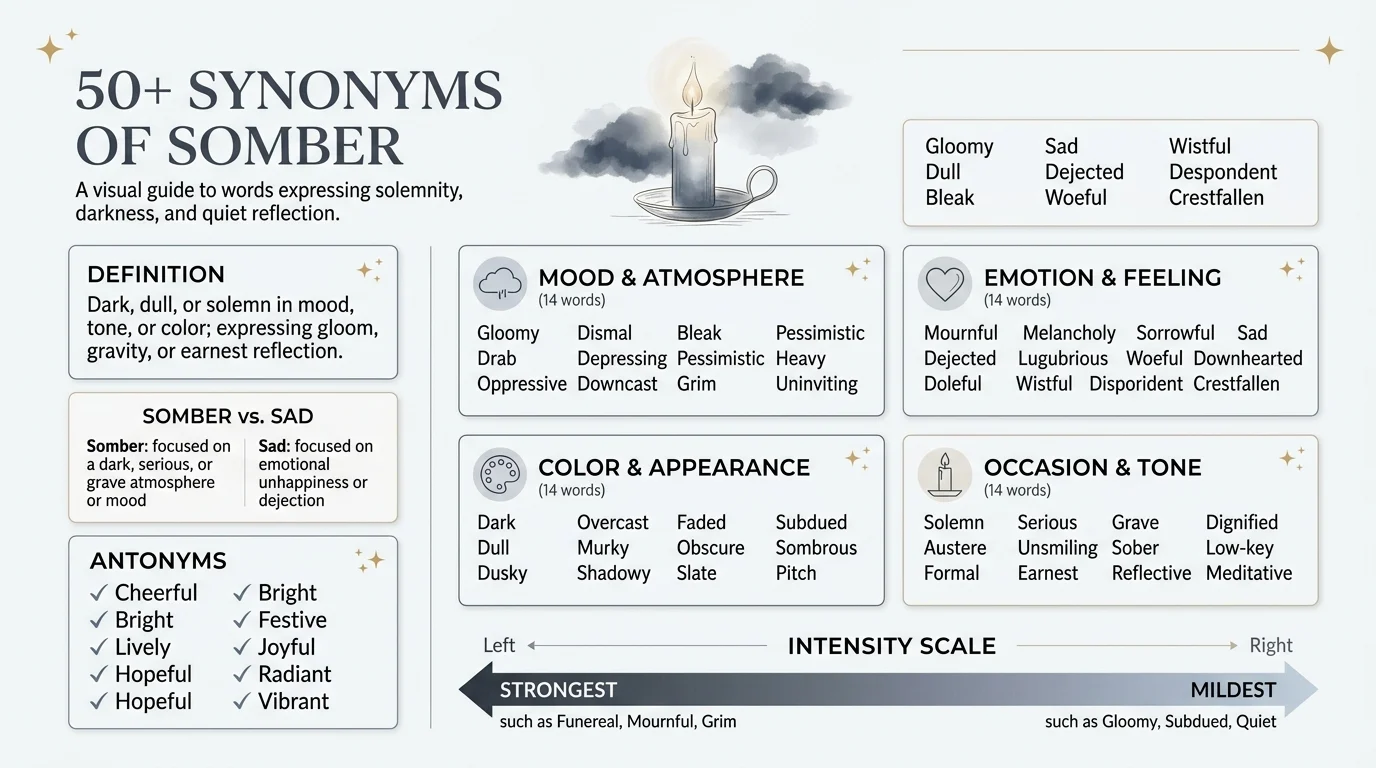
Quick Ans: “Somber” means dark, gloomy, or grave in mood, color, or tone. For formal writing, choose solemn, grave, or sedate. For emotional contexts, use melancholy, mournful, or dismal. For color and tone, use drab, subdued, or dark. For casual conversation, use serious or gloomy.
Meaning, Tone, and Context
Understanding the core meaning of “somber” is the first step to using it effectively.
Simple Definition: Dark or dull in color or tone; oppressively solemn or sober in mood; grave or serious.
Part of Speech: Adjective.
Overall Tone: Negative to neutral. It indicates seriousness, sadness, or gloom.
Formality Level: Formal to neutral. The word is appropriate in literary, academic, and professional contexts.
Common Uses: Native English speakers use it to describe moods (“somber atmosphere”), colors (“somber colors”), occasions (“somber ceremony”), and expressions (“somber face”).
Word Forms: Related words include the adverb somberly and the noun somberness.
When and How to Use “Somber”
“Somber” is the perfect choice when you want to describe a serious, gloomy, or subdued mood. Here are seven realistic examples.
Mood: “A somber atmosphere filled the room after the news.”
Occasion: “The somber ceremony honored the fallen soldiers.”
Color: “She wore a somber black dress to the funeral.”
Expression: “His somber face revealed his concern.”
Literary: “The somber tone of the novel reflected the author’s grief.”
Professional: “The CEO delivered a somber message about the company’s future.”
Social Media: “A somber reminder of what we have lost.”
Best Synonyms of “Somber”
No synonym is identical in every situation. Here is your guide to the best replacement for “somber” based on your writing context.
For Mood and Atmosphere
Most Formal: Solemn means serious and dignified. “The solemn occasion demanded respect.”
Grave: Grave means serious and worrying. “The situation is grave.”
Sedate: Sedate means calm and dignified. “The sedate atmosphere was appropriate.”
Serious: Serious means not joking. “The discussion was serious.”
For Emotional Contexts
Melancholy: Melancholy means a feeling of pensive sadness. “A melancholy mood settled over the group.”
Mournful: Mournful means feeling or expressing grief. “The mournful music moved everyone.”
Dismal: Dismal means depressing and dreary. “The dismal weather matched the mood.”
Gloomy: Gloomy means dark and depressing. “The gloomy room needed light.”
For Color and Tone
Drab: Drab means dull and lacking brightness. “The drab colors were uninspiring.”
Subdued: Subdued means quiet and restrained. “The subdued lighting created intimacy.”
Dark: Dark means with little or no light. “He wore dark colors.”
Muted: Muted means softened or subdued. “The muted tones were elegant.”
For Occasions and Events
Funereal: Funereal means suggestive of a funeral. “The funereal atmosphere was heavy.”
Stately: Stately means dignified and formal. “The stately procession moved slowly.”
Ceremonial: Ceremonial means relating to ceremony. “The ceremonial event was somber.”
Formal: Formal means following official rules. “The formal occasion required dark attire.”
When Not to Use “Somber”
Using “somber” can sound wrong or awkward in certain situations.
When You Mean “Sad”: “Somber” is more about mood and gravity. “Sad” is simple emotion.
Better Choice: Sad or unhappy. “I felt sad.”
When You Mean “Dark”: “Somber” is about mood. “Dark” is about light.
Better Choice: Dark or dim. “The room was dark.”
When It Sounds Too Formal: In casual conversation, “somber” can sound literary.
Better Choice: Serious or gloomy. “The mood was serious.”
Words Commonly Confused With “Somber”
| Word | Difference | When to Use | Example |
|---|---|---|---|
| Solemn | Serious and dignified | Ceremonies and promises | “A solemn vow.” |
| Grave | Serious and worrying | Situations and news | “A grave situation.” |
| Melancholy | Pensive sadness | Emotions and moods | “A melancholy mood.” |
| Gloomy | Dark and depressing | Weather and moods | “A gloomy day.” |
| Dismal | Depressing and dreary | Conditions and outcomes | “A dismal performance.” |
| Subdued | Quiet and restrained | Lighting and tones | “Subdued lighting.” |
Best Synonyms of “Somber” by Context
| Context | Best Synonym | Why It Works | Example |
|---|---|---|---|
| Formal writing | Solemn | Formal and dignified | “The solemn ceremony.” |
| Academic writing | Grave | Serious and formal | “A grave concern.” |
| Professional | Serious | Professional and clear | “A serious discussion.” |
| Emotional | Melancholy | Emotional and poetic | “A melancholy mood.” |
| Color | Subdued | Specific to tone | “Subdued colors.” |
| Occasion | Funereal | Specific to mourning | “A funereal atmosphere.” |
| Casual conversation | Gloomy | Simple and natural | “A gloomy day.” |
How to Choose the Best Synonym of “Somber”
Choosing the right word is a simple decision. Answer these questions.
What type of somberness am I describing? For mood, use solemn or grave. And For emotion, use melancholy or mournful. For color, use subdued or drab. For occasions, use funereal or ceremonial.
What is my audience? For a formal report, use solemn or grave. For a friend, use gloomy or serious.
What is my purpose? Are you describing a mood, a color, or an event? The correct synonym depends entirely on this.
What is the emotional strength? Funereal and mournful are stronger. Serious is milder. Pick the one that matches your message.
Real Life Examples of “Somber”
School: Basic: “The mood was somber.” Improved: “The mood was solemn after the announcement.”
College: Basic: “The ceremony was somber.” Improved: “The funereal ceremony honored the victims.”
Workplace: Basic: “The meeting was somber.” Improved: “The meeting was grave and serious.”
Business: Basic: “The report was somber.” Improved: “The report painted a dismal picture.”
Email: Basic: “The news is somber.” Improved: “The news is grave.”
Conversation: Basic: “He looked somber.” Improved: “He looked gloomy.”
Storytelling: Basic: “The atmosphere was somber.” Improved: “A melancholy atmosphere filled the room.”
Top 10 Synonyms of “Somber”
| Synonym | Simple Meaning | Best Used For | Example Sentence |
|---|---|---|---|
| Solemn | Serious and dignified | Ceremonies and promises | “The solemn vow.” |
| Grave | Serious and worrying | Situations and news | “A grave situation.” |
| Melancholy | Pensive sadness | Emotions and moods | “A melancholy mood.” |
| Mournful | Expressing grief | Funerals and music | “Mournful music.” |
| Gloomy | Dark and depressing | Weather and moods | “A gloomy day.” |
| Dismal | Depressing and dreary | Conditions and outcomes | “A dismal performance.” |
| Subdued | Quiet and restrained | Lighting and tones | “Subdued lighting.” |
| Drab | Dull and lacking brightness | Colors and appearance | “Drab colors.” |
| Funereal | Suggestive of a funeral | Occasions and atmosphere | “A funereal atmosphere.” |
| Sedate | Calm and dignified | Atmosphere and pace | “A sedate pace.” |
Synonyms of “Somber” by Usage
Professional vs. Personal Synonyms
In the workplace, choose solemn, grave, or serious. With friends, use gloomy, serious, or down.
Formal vs. Conversational Synonyms
For formal writing, use solemn, grave, or sedate. For casual conversations, use gloomy, serious, or down.
Academic Synonyms
For research and essays, choose grave for concerns, solemn for ceremonies, and melancholy for literary analysis.
Professional and Business Synonyms
For maximum impact, choose grave for news, serious for discussions, and dismal for results.
Creative and Literary Synonyms
To add emotion and imagery, choose melancholy, mournful, or funereal. These words create atmosphere.
Slang or Modern Synonyms
In modern American slang, down, heavy, or dark are common. For example, “The vibe was heavy.” These are casual and should be avoided in formal writing.
Strongest to Mildest Synonyms
Mild: serious, subdued, quiet
Moderate: somber, solemn, gloomy
Strong: grave, melancholy, mournful
Very Strong: funereal, dismal, drab
Emotional vs. Neutral Synonyms
Emotional Synonyms: Melancholy, mournful, funereal. These words hint at sadness and grief. Use them when you want to evoke feeling.
Neutral Synonyms: Somber, serious, subdued. These words communicate factual information about mood.
Antonyms of “Somber”
| Antonym | Meaning | Example Sentence |
|---|---|---|
| Cheerful | Happy and optimistic | “The cheerful mood was contagious.” |
| Bright | Full of light | “The bright room was welcoming.” |
| Joyful | Feeling great happiness | “The joyful celebration continued.” |
| Lively | Full of energy | “The lively party was fun.” |
| Festive | Celebratory | “The festive decorations were colorful.” |
| Cheery | Happy and optimistic | “Her cheery disposition lifted spirits.” |
| Sunny | Bright and cheerful | “The sunny day was perfect.” |
| Vibrant | Full of energy and life | “The vibrant colors popped.” |
| Upbeat | Cheerful and optimistic | “The upbeat music made us dance.” |
| Lighthearted | Carefree and cheerful | “The lighthearted conversation was refreshing.” |
| Merry | Cheerful and lively | “The merry group sang songs.” |
| Jovial | Cheerful and friendly | “His jovial laugh was infectious.” |
| Blithe | Carefree and happy | “Her blithe spirit was refreshing.” |
| Exuberant | Full of energy | “The exuberant crowd cheered.” |
| Optimistic | Hopeful and confident | “The optimistic outlook was encouraging.” |
Comparison: “Somber” vs Similar Words
Somber vs. Solemn
Main Difference: “Solemn” is dignified and formal. “Somber” is gloomy and dark.
Which Is Stronger? “Solemn” is more dignified.
Which Is More Formal? Both are formal.
When to Use Each: Use “solemn” for ceremonies. Use “somber” for moods.
Examples:
Somber: “The somber mood was heavy.”
Solemn: “The solemn vow was binding.”
Somber vs. Grave
Main Difference: “Grave” is serious and worrying. “Somber” is gloomy and dark.
Which Is Stronger? “Grave” is stronger for seriousness.
Which Is More Formal? Both are formal.
When to Use Each: Use “grave” for situations. Use “somber” for moods.
Examples:
Somber: “The somber atmosphere was palpable.”
Grave: “The grave situation required action.”
Somber vs. Melancholy
Main Difference: “Melancholy” is pensive sadness. “Somber” is broader.
Which Is Stronger? “Melancholy” is more emotional.
Which Is More Formal? Both are formal.
When to Use Each: Use “melancholy” for emotions. Use “somber” for general contexts.
Examples:
Somber: “The somber colors were appropriate.”
Melancholy: “A melancholy mood settled over her.”
Somber vs. Gloomy
Main Difference: “Gloomy” is dark and depressing. “Somber” is more dignified.
Which Is Stronger? “Gloomy” is more negative.
Which Is More Formal? “Somber” is more formal.
When to Use Each: Use “gloomy” in casual conversation. Use “somber” in formal writing.
Examples:
Somber: “The somber ceremony was dignified.”
Gloomy: “The gloomy weather was depressing.”
Somber vs. Dismal
Main Difference: “Dismal” is depressing and dreary. “Somber” is more restrained.
Which Is Stronger? “Dismal” is stronger for negativity.
Which Is More Formal? Both are formal.
When to Use Each: Use “dismal” for results. Use “somber” for moods.
Examples:
Somber: “The somber news was delivered quietly.”
Dismal: “The dismal performance disappointed everyone.”
Somber vs. Subdued
Main Difference: “Subdued” is quiet and restrained. “Somber” is gloomy and serious.
Which Is Stronger? “Somber” is stronger for mood.
Which Is More Formal? Both are formal.
When to Use Each: Use “subdued” for lighting. Use “somber” for moods.
Examples:
Somber: “The somber tone was appropriate.”
Subdued: “The subdued lighting was romantic.”
Common Phrases and Expressions with “Somber”
Phrase: Somber mood
Meaning: A serious, gloomy atmosphere.
Example Sentence: “A somber mood fell over the crowd.”
Phrase: Somber occasion
Meaning: A serious or sad event.
Example Sentence: “The somber occasion was a memorial.”
Phrase: Somber expression
Meaning: A serious, sad face.
Example Sentence: “He wore a somber expression.”
Phrase: Somber colors
Meaning: Dark, muted colors.
Example Sentence: “She chose somber colors for the funeral.”
Phrase: Somber tone
Meaning: A serious, grave manner.
Example Sentence: “The somber tone of the speech was fitting.”
Phrase: Somber reality
Meaning: A serious, unpleasant truth.
Example Sentence: “The somber reality of the situation set in.”
Common Mistakes to Avoid
Mistake 1: Using “somber” when you mean “sad”.
Incorrect: “I felt somber.”
Better: “I felt sad.”
Why: “Somber” describes mood and atmosphere.
Mistake 2: Using “somber” when you mean “dark”.
Incorrect: “The room was somber.”
Better: “The room was dark.”
Why: “Somber” is about mood, not light.
Mistake 3: Overusing “somber” in conversation.
Incorrect: “The mood was somber.”
Better: “The mood was serious.”
Why: “Serious” sounds more natural.
Mistake 4: Using “somber” when you mean “solemn”.
Incorrect: “The somber vow was binding.”
Better: “The solemn vow was binding.”
Why: “Solemn” is for ceremonies.
Mistake 5: Using “somber” when you mean “melancholy”.
Incorrect: “A somber mood settled over her.”
Better: “A melancholy mood settled over her.”
Why: “Melancholy” is for personal emotions.
Frequently Asked Questions
1. What are the best synonyms of “somber”?
The best synonyms depend on your context. For mood, choose solemn or grave. And For emotion, use melancholy or mournful. For color, use subdued or drab. For occasions, use funereal or ceremonial.
2. What are the best formal synonyms of “somber”?
The best formal synonyms are solemn, grave, and sedate. These words are suitable for academic papers, professional reports, and business communications.
3. What are common informal synonyms of “somber”?
For informal settings, use gloomy, serious, or down. These alternatives sound more natural in everyday conversation.
4. What is another word for “somber” in professional writing?
In professional writing, grave is an excellent choice. It conveys seriousness. Solemn is also strong for ceremonies.
5. What is the difference between “somber” and “solemn”?
“Somber” is gloomy and dark. “Solemn” is dignified and formal. Use “solemn” for ceremonies and “somber” for moods.
6. What is the opposite of “somber”?
The most direct opposites (antonyms) of somber are cheerful, bright, and joyful. These words describe things that are happy and light.
Conclusion
“Somber” is a powerful and evocative word for describing serious, gloomy, and subdued moods, colors, and occasions. The term is formal and widely accepted in literary, academic, and professional contexts, yet it can sound too literary for casual conversation or too broad for specific descriptions. The best choice among the synonyms of somber depends entirely on your audience, tone, and purpose. Remember, no single synonym works perfectly in every situation. Your goal is to choose the word that communicates your message with the most clarity and impact. A practical tip for your vocabulary growth is to pay attention to how writers describe mood and atmosphere and practice using different synonyms in your writing.










1 thought on “50+ Synonyms of Somber: Meanings, Uses, Examples, and Best Alternatives 2026”