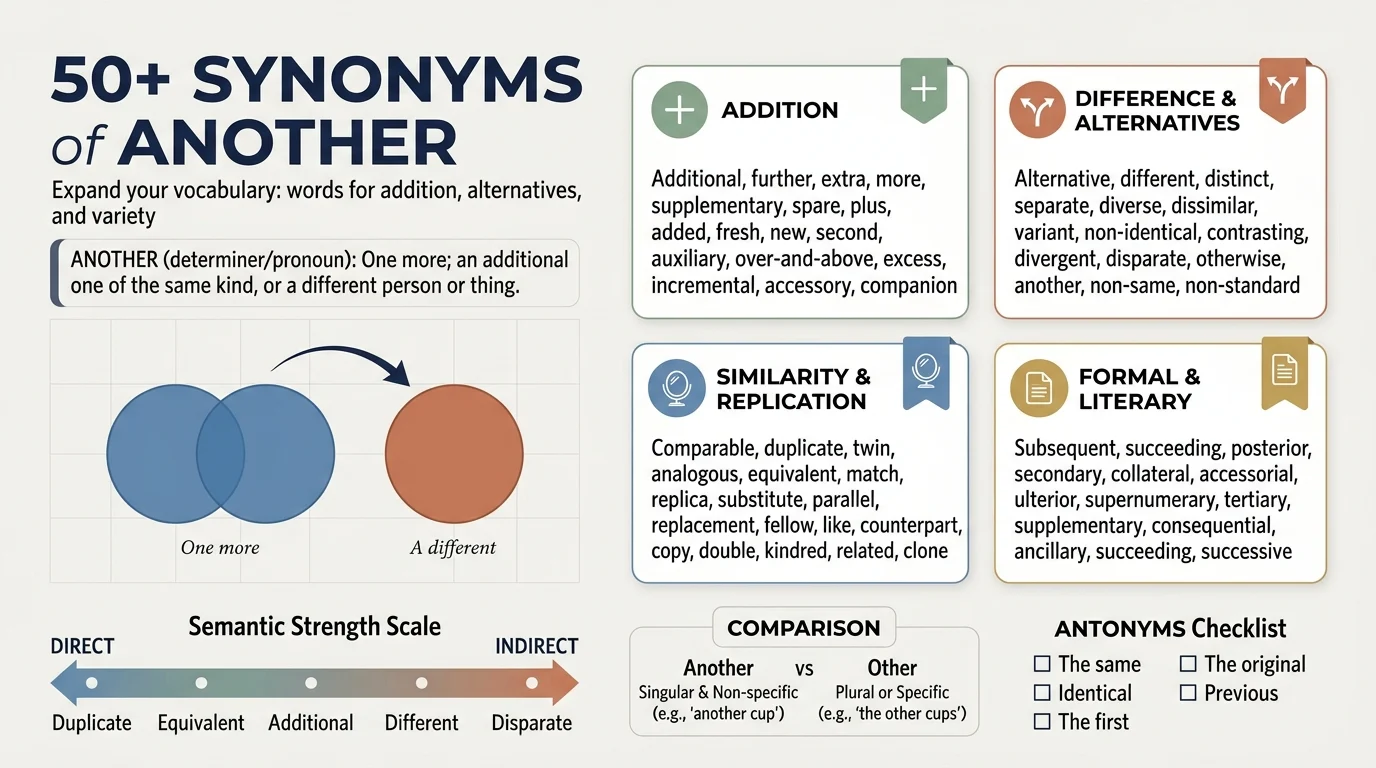
Have you ever needed to refer to an additional item, a different option, or one more of something but felt that “another” was too simple or repetitive? You want to capture the specific sense of addition, difference, or repetition, and the word “another” comes to mind. Choosing the right synonym for “another” can transform a basic statement into a precise expression of addition, alternative, or similarity. This guide explores the best synonyms of another, explaining exactly which word to use and when.
Quick Answer: “Another” means one more of the same kind, a different one, or a similar person or thing. For addition, choose additional or further. For difference, use different or alternative. For similarity, use similar or comparable. For formal writing, use one more or an additional. For casual conversation, use one more or a different.
Meaning, Tone, and Context
Understanding the core meaning of “another” is the first step to using it effectively.
Simple Definition: One more person or thing of the same kind; a different person or thing; a similar person or thing.
Part of Speech: Determiner and pronoun.
Overall Tone: Neutral. It is a functional word with no emotional coloring.
Formality Level: Neutral. The word works in most contexts.
Common Uses: Native English speakers use it in requests (“another cup of coffee”), alternatives (“another option”), and descriptions (“another example”).
Word Forms: Related words include the adjective other, the pronoun others, and the adverb otherwise.
When and How to Use “Another”
“Another” is the perfect choice when you want to refer to an additional or different item. Here are seven realistic examples.
Addition: “Would you like another piece of cake?”
Alternative: “We need another approach to solve this problem.”
Similarity: “That is another example of his generosity.”
Time: “We will meet another day.”
Professional: “Please provide another estimate.”
Academic: “Another study confirmed the findings.”
Social Media: “Here is another reason to visit this city.”
Best Synonyms of “Another”
No synonym is identical in every situation. Here is your guide to the best replacement for “another” based on your writing context.
For Addition and More
Most Direct: Additional means extra or more. “We need additional resources.”
Further: Further means more or additional. “Further research is needed.”
One more: One more means an additional one. “We need one more volunteer.”
Extra: Extra means more than usual. “I have an extra pen.”
For Difference and Alternative
Different: Different means not the same. “Let us try a different method.”
Alternative: Alternative means another possibility. “We need an alternative solution.”
Other: Other means different from the one mentioned. “The other option is cheaper.”
Separate: Separate means distinct. “We need a separate meeting.”
For Similarity and Comparison
Similar: Similar means alike. “We have a similar problem.”
Comparable: Comparable means similar in size or quality. “The results are comparable.”
Equivalent: Equivalent means equal in value. “This is equivalent to a full-time job.”
Corresponding: Corresponding means matching. “The corresponding figure is higher.”
When Not to Use “Another”
Using “another” can sound wrong or awkward in certain situations.
When You Mean “Different”: “Another” can mean different, but “different” is clearer.
Better Choice: Different or alternative. “Try a different approach.”
When You Mean “Additional”: “Another” is simple. “Additional” is formal.
Better Choice: Additional or further. “We need additional funding.”
When It Sounds Too Vague: “Another” can be unclear.
Better Choice: One more or a second. “One more example.”
Words Commonly Confused With “Another”
| Word | Difference | When to Use | Example |
|---|---|---|---|
| Additional | Extra or more | Formal and general | “Additional resources.” |
| Different | Not the same | Alternatives | “A different approach.” |
| Other | Different from the one mentioned | Comparisons | “The other option.” |
| Alternative | Another possibility | Choices | “An alternative solution.” |
| One more | An additional one | Casual and general | “One more time.” |
| Further | More or additional | Formal and academic | “Further research.” |
Best Synonyms of “Another” by Context
| Context | Best Synonym | Why It Works | Example |
|---|---|---|---|
| Formal writing | Additional | Formal and precise | “Additional evidence is needed.” |
| Academic writing | Further | Standard in research | “Further study is required.” |
| Professional | Alternative | Professional and clear | “We need an alternative plan.” |
| Business | Extra | Business and practical | “We need extra time.” |
| Casual | One more | Simple and natural | “One more cookie.” |
| Comparison | Different | Clear and direct | “A different option.” |
| Similarity | Similar | Evokes likeness | “A similar case.” |
How to Choose the Best Synonym of “Another”
Choosing the right word is a simple decision. Answer these questions.
What type of “another” am I describing? For addition, use additional or further. For difference, use different or alternative. And for similarity, use similar or comparable.
What is my audience? For a formal report, use additional or further. For a friend, use one more or different.
What is my purpose? Are you adding, comparing, or offering choices? The correct synonym depends entirely on this.
What is the emotional strength? One more is casual. Additional is formal. Pick the one that matches your message.
Real Life Examples of “Another”
School: Basic: “The student needs another book.” Improved: “The student needs an additional book.”
College: Basic: “Another study confirmed the results.” Improved: “Further study confirmed the results.”
Workplace: Basic: “We need another meeting.” Improved: “We need an additional meeting.”
Business: Basic: “We need another plan.” Improved: “We need an alternative plan.”
Email: Basic: “Please send another copy.” Improved: “Please send an additional copy.”
Conversation: Basic: “Can I have another?” Improved: “Can I have one more?”
Storytelling: Basic: “Another problem arose.” Improved: “A different problem arose.”
Top 10 Synonyms of “Another”
| Synonym | Simple Meaning | Best Used For | Example Sentence |
|---|---|---|---|
| Additional | Extra or more | Formal and general | “Additional resources are needed.” |
| Further | More or additional | Academic and formal | “Further research is required.” |
| One more | An additional one | Casual and general | “One more piece of cake.” |
| Different | Not the same | Alternatives and choices | “A different approach.” |
| Alternative | Another possibility | Choices and solutions | “An alternative plan.” |
| Other | Different from the one mentioned | Comparisons | “The other option.” |
| Extra | More than usual | Casual and practical | “An extra pen.” |
| Similar | Alike | Comparisons and likeness | “A similar situation.” |
| Comparable | Similar in size or quality | Formal and analytical | “Comparable results.” |
| Separate | Distinct | Distinctness | “A separate issue.” |
Synonyms of “Another” by Usage
Professional vs. Personal Synonyms
In the workplace, choose additional, alternative, or further. With friends, use one more, different, or extra.
Formal vs. Conversational Synonyms
For formal writing, use additional, further, or alternative. For casual conversations, use one more, extra, or different.
Academic Synonyms
For research and essays, choose further for research, additional for evidence, and comparable for analysis.
Professional and Business Synonyms
For maximum impact, choose additional for resources, alternative for plans, and extra for time.
Creative and Literary Synonyms
To add variety, choose different, similar, or separate. These words create specificity.
Slang or Modern Synonyms
In modern American slang, one more, another one, or a second are common. For example, “Another one.” These are casual and should be avoided in formal writing.
Strongest to Mildest Synonyms
Mild: one more, extra, other
Moderate: another, additional, different
Strong: further, alternative, separate
Very Strong: comparable, similar, equivalent
Emotional vs. Neutral Synonyms
Emotional Synonyms: Similar, comparable. These words hint at likeness. Use them when you want to evoke connection.
Neutral Synonyms: Another, additional, different. These words communicate factual information.
Antonyms of “Another”
| Antonym | Meaning | Example Sentence |
|---|---|---|
| Same | Not different | “The same option is available.” |
| Identical | Exactly the same | “The identical item was chosen.” |
| Equal | The same in value | “The equal choice was made.” |
| Matching | Corresponding | “The matching pair was found.” |
| One | A single one | “Only one option remains.” |
| Single | Only one | “A single choice was offered.” |
| Only | No other | “The only option is this one.” |
| Unique | One of a kind | “The unique item was sold.” |
| Selfsame | Exactly the same | “The selfsame issue arose.” |
| Equivalent | Equal in value | “The equivalent option was chosen.” |
| Uniform | All the same | “The uniform design was used.” |
| Consistent | Always the same | “The consistent result was expected.” |
| Unchanging | Not changing | “The unchanging policy remained.” |
| Fixed | Not variable | “The fixed price was set.” |
| Constant | Not changing | “The constant factor was noted.” |
Comparison: “Another” vs Similar Words
Another vs. Additional
Main Difference: “Another” is one more. “Additional” is extra.
Which Is Stronger? They are similar.
Which Is More Formal? “Additional” is more formal.
When to Use Each: Use “additional” in formal writing. Use “another” in casual conversation.
Examples:
Another: “Another example.”
Additional: “Additional evidence.”
Another vs. Different
Main Difference: “Another” can mean one more. “Different” means not the same.
Which Is Stronger? “Different” is clearer for contrast.
Which Is More Formal? Both are neutral.
When to Use Each: Use “different” for alternatives. Use “another” for addition.
Examples:
Another: “Another option.”
Different: “A different option.”
Another vs. Other
Main Difference: “Another” is one more. “Other” is different from the one mentioned.
Which Is Stronger? They are similar.
Which Is More Formal? Both are neutral.
When to Use Each: Use “other” for specific alternatives. Use “another” for addition.
Examples:
Another: “Another choice.”
Other: “The other choice.”
Another vs. Alternative
Main Difference: “Another” is general. “Alternative” is a specific option.
Which Is Stronger? “Alternative” is more specific.
Which Is More Formal? “Alternative” is more formal.
When to Use Each: Use “alternative” for solutions. Use “another” for general contexts.
Examples:
Another: “Another plan.”
Alternative: “An alternative plan.”
Another vs. Further
Main Difference: “Another” is one more. “Further” is additional.
Which Is Stronger? “Further” is more formal.
Which Is More Formal? “Further” is more formal.
When to Use Each: Use “further” for research. Use “another” for general contexts.
Examples:
Another: “Another study.”
Further: “Further study.”
Another vs. Similar
Main Difference: “Another” is one more. “Similar” means alike.
Which Is Stronger? They are different.
Which Is More Formal? Both are neutral.
When to Use Each: Use “similar” for likeness. Use “another” for addition.
Examples:
Another: “Another case.”
Similar: “A similar case.”
Common Phrases and Expressions with “Another”
Phrase: Another one
Meaning: One more of the same.
Example Sentence: “Another one, please.”
Phrase: Another day
Meaning: A different day.
Example Sentence: “We will try another day.”
Phrase: Another way
Meaning: A different method.
Example Sentence: “Let us find another way.”
Phrase: Another time
Meaning: A different occasion.
Example Sentence: “We will discuss it another time.”
Phrase: Another matter
Meaning: A different issue.
Example Sentence: “That is another matter entirely.”
Phrase: Another story
Meaning: A different situation.
Example Sentence: “That is another story.”
Common Mistakes to Avoid
Mistake 1: Using “another” when you mean “different”.
Incorrect: “We need another approach.”
Better: “We need a different approach.”
Why: “Different” is clearer for alternatives.
Mistake 2: Using “another” when you mean “additional”.
Incorrect: “We need another funding.”
Better: “We need additional funding.”
Why: “Additional” is more formal.
Mistake 3: Overusing “another” in conversation.
Incorrect: “Can I have another?”
Better: “Can I have one more?”
Why: “One more” sounds more natural.
Mistake 4: Using “another” when you mean “other”.
Incorrect: “The another option is cheaper.”
Better: “The other option is cheaper.”
Why: “Other” is for specific alternatives.
Mistake 5: Using “another” when you mean “further”.
Incorrect: “Another research is needed.”
Better: “Further research is needed.”
Why: “Further” is more formal.
Frequently Asked Questions
1. What are the best synonyms of “another”?
The best synonyms depend on your context. For addition, choose additional or further. For difference, use different or alternative. And for similarity, use similar or comparable.
2. What are the best formal synonyms of “another”?
The best formal synonyms are additional, further, and alternative. These words are suitable for academic papers, professional reports, and business communications.
3. What are common informal synonyms of “another”?
For informal settings, use one more, extra, or different. These alternatives sound more natural in everyday conversation.
4. What is another word for “another” in professional writing?
In professional writing, additional is an excellent choice. It conveys extra. Alternative is also strong for choices.
5. What is the difference between “another” and “different”?
“Another” means one more. “Different” means not the same. Use “different” for alternatives and “another” for addition.
6. What is the opposite of “another”?
The most direct opposites (antonyms) of another are same, identical, and one. These words describe things that are not additional or different.
Conclusion
“Another” is a simple and versatile word for describing addition, difference, and similarity. The term is neutral and widely accepted in all contexts, yet it can sound too vague for specific descriptions or too casual for formal writing. The best choice among the synonyms of another depends entirely on your audience, tone, and purpose. For a formal, professional effect, use additional or further. For a practical, everyday context, one more or extra works perfectly. And for alternatives, choose different or alternative. For comparisons, use similar or comparable. Remember, no single synonym works perfectly in every situation. Your goal is to choose the word that communicates your message with the most clarity and impact. A practical tip for your vocabulary growth is to pay attention to how writers describe addition and alternatives and practice using different synonyms in your writing.









