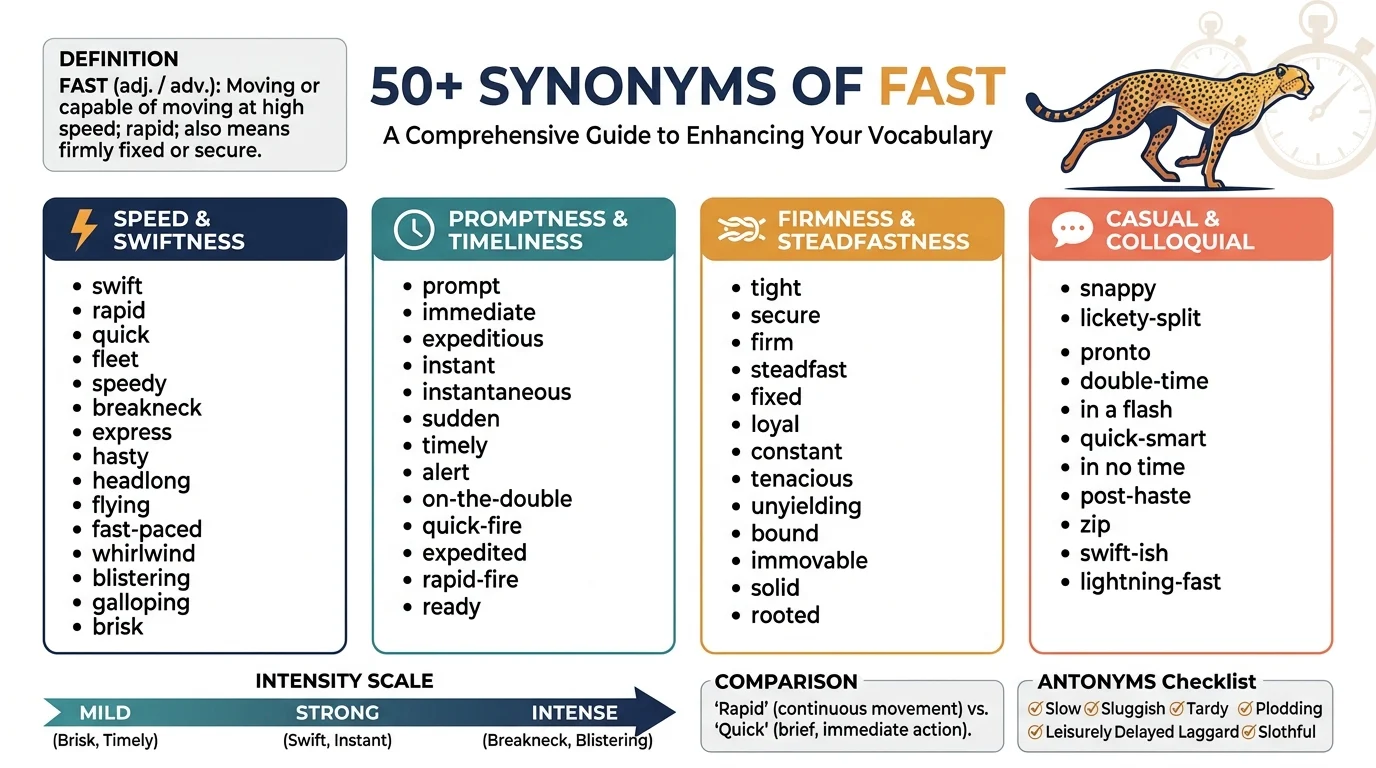
Have you ever needed to describe something moving quickly, happening soon, or being firmly fixed but felt that “fast” was too simple or repetitive? You want to capture the specific sense of speed, quickness, or stability, and the word “fast” comes to mind. Choosing the right synonym for “fast” can transform a basic statement into a precise expression of rapidity, haste, or firmness. This guide explores the best synonyms of fast, explaining exactly which word to use and when.
Quick Answer: “Fast” means moving or capable of moving at high speed, happening quickly, or firmly fixed. For speed, choose quick, rapid, or swift. For happening soon, use prompt or immediate. For firmness, use secure or fixed. For casual conversation, use speedy or quick. For formal contexts, use rapid or expeditious.
Meaning, Tone, and Context
Understanding the core meaning of “fast” is the first step to using it effectively.
Simple Definition: Moving or capable of moving at high speed; happening or done quickly; firmly fixed or attached.
Part of Speech: Adjective and adverb.
Overall Tone: Neutral. It can indicate speed, promptness, or firmness.
Formality Level: Neutral. The word works in most contexts.
Common Uses: Native English speakers use it to describe vehicles (“fast car”), runners (“fast runner”), processes (“fast learner”), and firmness (“held fast”).
Word Forms: Related words include the noun fastness, the adverb fast, and the adjective fast-paced.
When and How to Use “Fast”
“Fast” is the perfect choice when you want to describe speed, promptness, or firmness. Here are seven realistic examples.
Vehicles: “The fast car zoomed past us.”
People: “She is a fast runner.”
Processes: “He is a fast learner.”
Time: “The meeting was fast and efficient.”
Firmness: “The rope held fast to the anchor.”
Professional: “We need a fast response to the crisis.”
Social Media: “That was a fast workout!”
Best Synonyms of “Fast”
No synonym is identical in every situation. Here is your guide to the best replacement for “fast” based on your writing context.
For Speed and Quickness
Most Direct: Quick means moving fast. “She gave a quick reply.”
Rapid: Rapid means happening quickly. “The rapid growth surprised everyone.”
Swift: Swift means moving quickly. “The swift runner won the race.”
Speedy: Speedy means fast. “We need a speedy resolution.”
For Happening Soon
Prompt: Prompt means done without delay. “The prompt response was appreciated.”
Immediate: Immediate means happening now. “The immediate action prevented a crisis.”
Instant: Instant means happening at once. “The instant reaction was positive.”
Expeditious: Expeditious means done quickly. “The expeditious delivery was praised.”
For Firmness and Stability
Secure: Secure means firmly fixed. “The secure knot held fast.”
Fixed: Fixed means firmly in place. “The fixed anchor held the boat.”
Firm: Firm means solid and stable. “The firm grip prevented slipping.”
Tight: Tight means firmly held. “The tight knot was difficult to untie.”
For Casual and Conversational
Quick: Quick is simple and common. “Let us take a quick break.”
Speedy: Speedy is casual and positive. “Wishing you a speedy recovery.”
Rapid: Rapid is formal. “The rapid response was impressive.”
When Not to Use “Fast”
Using “fast” can sound wrong or awkward in certain situations.
When You Mean “Quick”: “Fast” is about speed. “Quick” is about duration.
Better Choice: Quick. “Let us take a quick break.”
When You Mean “Early”: “Fast” is about speed. “Early” is about time.
Better Choice: Early. “She arrived early.”
When It Sounds Too Simple: In formal writing, “fast” can sound basic.
Better Choice: Rapid or swift. “The rapid response was appreciated.”
Words Commonly Confused With “Fast”
| Word | Difference | When to Use | Example |
|---|---|---|---|
| Quick | Moving fast or short duration | General and casual | “A quick reply.” |
| Rapid | Happening quickly | Formal and scientific | “Rapid growth.” |
| Swift | Moving quickly | Literary and formal | “A swift response.” |
| Speedy | Fast | Casual and positive | “A speedy recovery.” |
| Prompt | Done without delay | Formal and professional | “A prompt reply.” |
| Secure | Firmly fixed | Safety and stability | “A secure hold.” |
Best Synonyms of “Fast” by Context
| Context | Best Synonym | Why It Works | Example |
|---|---|---|---|
| Formal writing | Rapid | Formal and precise | “The rapid growth was noted.” |
| Academic writing | Swift | Standard in research | “The swift response was crucial.” |
| Professional | Prompt | Professional and clear | “A prompt reply is appreciated.” |
| Business | Expeditious | Business and formal | “The expeditious delivery was praised.” |
| Casual | Quick | Simple and natural | “Let us take a quick break.” |
| Descriptive | Speedy | Evokes speed | “A speedy resolution.” |
| Firmness | Secure | Safety and stability | “The secure knot held.” |
How to Choose the Best Synonym of “Fast”
Choosing the right word is a simple decision. Answer these questions.
What type of fast am I describing? For speed, use quick or rapid. For promptness, use prompt or immediate. And for firmness, use secure or fixed.
What is my audience? For a formal report, use rapid or swift. For a friend, use quick or speedy.
What is my purpose? Are you describing speed, promptness, or firmness? The correct synonym depends entirely on this.
What is the emotional strength? Swift and rapid are stronger. Quick is neutral. Pick the one that matches your message.
Real Life Examples of “Fast”
School: Basic: “The student is fast.” Improved: “The student is a quick learner.”
College: Basic: “The response was fast.” Improved: “The response was prompt.”
Workplace: Basic: “We need a fast solution.” Improved: “We need a swift solution.”
Business: Basic: “The delivery was fast.” Improved: “The delivery was expeditious.”
Email: Basic: “Please reply fast.” Improved: “Please reply promptly.”
Conversation: Basic: “That was fast.” Improved: “That was quick.”
Storytelling: Basic: “The runner was fast.” Improved: “The runner was swift.”
Top 10 Synonyms of “Fast”
| Synonym | Simple Meaning | Best Used For | Example Sentence |
|---|---|---|---|
| Quick | Moving fast or short duration | General and casual | “She gave a quick reply.” |
| Rapid | Happening quickly | Formal and scientific | “The rapid growth surprised everyone.” |
| Swift | Moving quickly | Literary and formal | “The swift runner won the race.” |
| Speedy | Fast | Casual and positive | “We need a speedy resolution.” |
| Prompt | Done without delay | Formal and professional | “The prompt response was appreciated.” |
| Immediate | Happening now | Urgent and formal | “The immediate action prevented a crisis.” |
| Expeditious | Done quickly | Business and formal | “The expeditious delivery was praised.” |
| Secure | Firmly fixed | Safety and stability | “The secure knot held fast.” |
| Firm | Solid and stable | Physical stability | “The firm grip prevented slipping.” |
| Instant | Happening at once | Immediate and casual | “The instant reaction was positive.” |
Synonyms of “Fast” by Usage
Professional vs. Personal Synonyms
In the workplace, choose prompt, rapid, or expeditious. With friends, use quick, speedy, or fast.
Formal vs. Conversational Synonyms
For formal writing, use rapid, swift, or expeditious. For casual conversations, use quick, speedy, or fast.
Academic Synonyms
For research and essays, choose rapid for growth, swift for response, and prompt for action.
Professional and Business Synonyms
For maximum impact, choose prompt for replies, expeditious for delivery, and rapid for growth.
Creative and Literary Synonyms
To add emotion and imagery, choose swift, fleet, or lightning-fast. These words create atmosphere.
Slang or Modern Synonyms
In modern American slang, quick, speedy, or zippy are common. For example, “That was zippy.” These are casual and should be avoided in formal writing.
Strongest to Mildest Synonyms
Mild: quick, prompt, ready
Moderate: fast, rapid, speedy
Strong: swift, expeditious, immediate
Very Strong: lightning-fast, instantaneous, fleet
Emotional vs. Neutral Synonyms
Emotional Synonyms: Swift, lightning-fast, fleet. These words hint at speed and grace. Use them when you want to evoke feeling.
Neutral Synonyms: Fast, quick, rapid. These words communicate factual information.
Antonyms of “Fast”
| Antonym | Meaning | Example Sentence |
|---|---|---|
| Slow | Not fast | “The slow traffic frustrated drivers.” |
| Sluggish | Slow-moving | “The sluggish response was disappointing.” |
| Slack | Not tight or fast | “The slack rope hung loosely.” |
| Loose | Not firmly fixed | “The loose knot came undone.” |
| Gradual | Happening slowly | “The gradual improvement was encouraging.” |
| Delayed | Happening later | “The delayed flight was annoying.” |
| Leisurely | Relaxed and unhurried | “The leisurely walk was pleasant.” |
| Unhurried | Not rushed | “The unhurried pace was calming.” |
| Plodding | Slow and steady | “The plodding progress was frustrating.” |
| Dawdling | Wasting time | “The dawdling child was late.” |
| Lingering | Lasting a long time | “The lingering smell was unpleasant.” |
| Protracted | Lasting longer than expected | “The protracted negotiation was exhausting.” |
| Insecure | Not firmly fixed | “The insecure shelf fell.” |
| Unstable | Not stable | “The unstable chair wobbled.” |
| Loose | Not tight | “The loose tooth fell out.” |
Comparison: “Fast” vs Similar Words
Fast vs. Quick
Main Difference: “Fast” is about speed. “Quick” is about short duration.
Which Is Stronger? They are similar.
Which Is More Formal? Both are neutral.
When to Use Each: Use “fast” for vehicles. Use “quick” for actions.
Examples:
Fast: “The fast car zoomed past.”
Quick: “She gave a quick reply.”
Fast vs. Rapid
Main Difference: “Fast” is general. “Rapid” is formal.
Which Is Stronger? “Rapid” is more formal.
Which Is More Formal? “Rapid” is more formal.
When to Use Each: Use “rapid” in formal writing. Use “fast” in general contexts.
Examples:
Fast: “The fast runner won.”
Rapid: “The rapid growth surprised everyone.”
Fast vs. Swift
Main Difference: “Fast” is general. “Swift” is literary.
Which Is Stronger? “Swift” is more evocative.
Which Is More Formal? “Swift” is more formal.
When to Use Each: Use “swift” in creative writing. Use “fast” in general contexts.
Examples:
Fast: “The fast train arrived.”
Swift: “The swift runner won the race.”
Fast vs. Prompt
Main Difference: “Fast” is about speed. “Prompt” is about promptness.
Which Is Stronger? “Prompt” is more specific to time.
Which Is More Formal? “Prompt” is more formal.
When to Use Each: Use “prompt” for replies. Use “fast” for general contexts.
Examples:
Fast: “The fast response was good.”
Prompt: “The prompt reply was appreciated.”
Fast vs. Secure
Main Difference: “Fast” is about speed. “Secure” is about firmness.
Which Is Stronger? They are different.
Which Is More Formal? Both are neutral.
When to Use Each: Use “secure” for knots. Use “fast” for speed.
Examples:
Fast: “The fast horse ran.”
Secure: “The secure knot held.”
Fast vs. Expeditious
Main Difference: “Fast” is general. “Expeditious” is formal.
Which Is Stronger? “Expeditious” is more formal.
Which Is More Formal? “Expeditious” is more formal.
When to Use Each: Use “expeditious” in business. Use “fast” in general contexts.
Examples:
Fast: “The fast service was good.”
Expeditious: “The expeditious delivery was praised.”
Common Phrases and Expressions with “Fast”
Phrase: Fast food
Meaning: Quick-service food.
Example Sentence: “We grabbed fast food on the way.”
Phrase: Fast track
Meaning: A quick route to progress.
Example Sentence: “The project was put on the fast track.”
Phrase: Fast forward
Meaning: To advance quickly.
Example Sentence: “Let us fast forward to the end.”
Phrase: Hold fast
Meaning: To remain firmly attached.
Example Sentence: “The sailor held fast to the rope.”
Phrase: Fast asleep
Meaning: Deeply asleep.
Example Sentence: “The baby was fast asleep.”
Phrase: Fast-paced
Meaning: Moving quickly.
Example Sentence: “The fast-paced movie kept us engaged.”
Common Mistakes to Avoid
Mistake 1: Using “fast” when you mean “quick”.
Incorrect: “Let us take a fast break.”
Better: “Let us take a quick break.”
Why: “Quick” is for duration.
Mistake 2: Using “fast” when you mean “early”.
Incorrect: “She arrived fast.”
Better: “She arrived early.”
Why: “Early” is for time.
Mistake 3: Overusing “fast” in conversation.
Incorrect: “The reply was fast.”
Better: “The reply was prompt.”
Why: “Prompt” adds variety.
Mistake 4: Using “fast” when you mean “secure”.
Incorrect: “The knot was fast.”
Better: “The knot was secure.”
Why: “Secure” is for firmness.
Mistake 5: Using “fast” when you mean “rapid”.
Incorrect: “The fast growth was noted.”
Better: “The rapid growth was noted.”
Why: “Rapid” is more formal.
Frequently Asked Questions
1. What are the best synonyms of “fast”?
The best synonyms depend on your context. For speed, choose quick or rapid. For promptness, use prompt or immediate. And for firmness, use secure or fixed.
2. What are the best formal synonyms of “fast”?
The best formal synonyms are rapid, swift, and expeditious. These words are suitable for academic papers, professional reports, and business communications.
3. What are common informal synonyms of “fast”?
For informal settings, use quick, speedy, or zippy. These alternatives sound more natural in everyday conversation.
4. What is another word for “fast” in professional writing?
In professional writing, prompt is an excellent choice. It conveys efficiency. Rapid is also strong for growth.
5. What is the difference between “fast” and “quick”?
“Fast” is about speed. “Quick” is about short duration. Use “fast” for vehicles and “quick” for actions.
6. What is the opposite of “fast”?
The most direct opposites (antonyms) of fast are slow, sluggish, and slack. These words describe a lack of speed or firmness.
Conclusion
“Fast” is a simple, versatile, and essential word for describing speed, promptness, and firmness. The term is neutral and widely accepted in all contexts, yet it can sound too simple for formal writing or too broad for specific descriptions. The best choice among the synonyms of fast depends entirely on your audience, tone, and purpose. For a formal, academic effect, use rapid or swift. For a practical, business context, prompt or expeditious works perfectly. And for casual conversation, use quick or speedy. For firmness, choose secure or fixed. Remember, no single synonym works perfectly in every situation. Your goal is to choose the word that communicates your message with the most clarity and impact. A practical tip for your vocabulary growth is to pay attention to how writers describe speed and promptness and practice using different synonyms in your writing.









