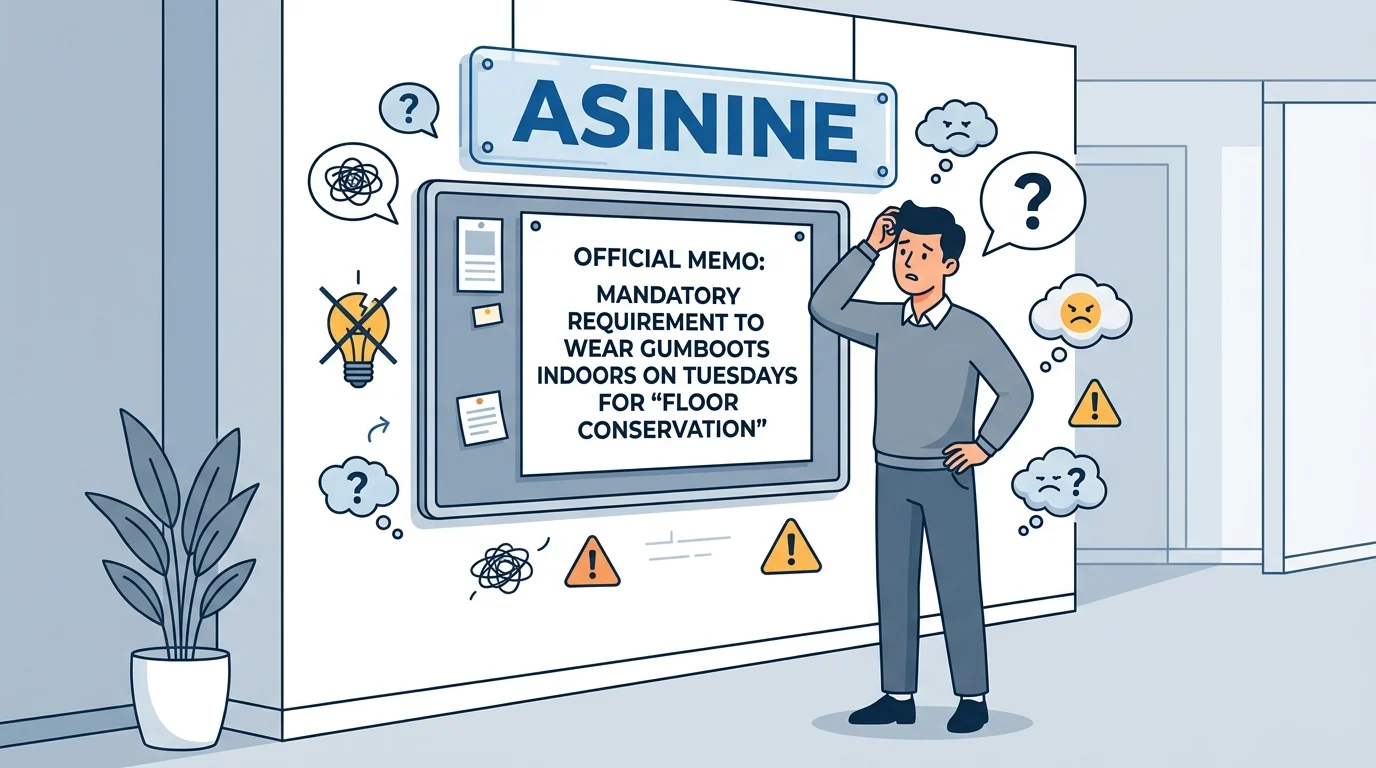
Quick Ans: Asinine is an adjective that means extremely foolish, reckless, or lacking good judgment. It is commonly used to describe ideas, actions, decisions, comments, or behavior that seem unreasonable or senseless. The word comes from the Latin asininus, meaning “of a donkey.”
If you’ve come across the word asinine while reading a news article, book, social media post, or hearing someone speak, you might wonder exactly what it means. Although it’s not used as often as words like foolish, asinine is a well-established English adjective that conveys a stronger sense of irrationality or poor judgment.
People use asinine to criticize ideas, decisions, remarks, or actions they believe are incredibly unreasonable or lacking common sense. Because it has a formal tone, it’s frequently found in journalism, literature, political discussions, workplace conversations, and online debates.
This guide explains the asinine meaning, pronunciation, origin, examples, synonyms, antonyms, common usage, and practical tips to help you understand and use the word confidently.
Quick Answer Box
| Topic | Answer |
|---|---|
| Word | Asinine |
| Part of Speech | Adjective |
| Meaning | Extremely foolish |
| Tone | Negative, critical |
| Common Usage | Describing ideas, decisions, actions, comments, or behavior |
| Example | “That was an asinine decision.” |
What Does Asinine Mean?
The word asinine means extremely foolish, senseless, ridiculous, or lacking good judgment.
It is usually used to criticize something rather than someone directly. Instead of calling a person foolish, speakers often describe the person’s decision, comment, behavior, or idea as asinine.
Examples:
- That was an asinine suggestion.
- His explanation sounded asinine.
- The company made an asinine decision.
- Everyone agreed the rule was asinine.
The word carries a stronger and more formal tone than simply saying “silly.”
Full Definition
According to standard English dictionaries, asinine describes something that is:
- Extremely foolish
- Completely unreasonable
- Ridiculously foolish
- Lacking common sense
- Illogical or absurd
Unlike playful words such as silly, asinine often expresses frustration or criticism.
Origin of the Word
The word asinine comes from the Latin word asininus, meaning “of a donkey.”
Historically, donkeys were unfairly associated with stubbornness and a lack of intelligence. Because of that association, the adjective evolved to describe behavior or ideas considered foolish.
Today, the word no longer refers to animals. Instead, it is used figuratively to criticize actions or statements.
How Is Asinine Used?
People most often use asinine to describe:
Decisions
Examples:
- The manager made an asinine decision.
- Canceling the project was asinine.
Comments
Examples:
- His comment was completely asinine.
- She ignored the asinine remark.
Rules
Examples:
- Many employees considered the new policy asinine.
- That regulation seems asinine.
Behavior
Examples:
- His behavior during the meeting was asinine.
- They laughed at the asinine stunt.
Ideas
Examples:
- That’s an asinine idea.
- The proposal sounded asinine from the beginning.
Real-Life Examples
Conversation Example 1
Alex: Did you hear they doubled the prices overnight?
Jordan: Yes, it was an asinine decision.
Conversation Example 2
Emma: Why would someone park across two spaces?
Sophia: That’s completely asinine.
Conversation Example 3
Mark: He ignored every warning.
Ryan: That was an asinine thing to do.
Conversation Example 4
Sarah: They deleted the backup files.
David: That’s an asinine mistake.
Conversation Example 5
Olivia: Someone suggested removing all safety checks.
Lucas: That’s one of the most asinine ideas I’ve ever heard.
Common Contexts
Everyday Conversations
People use asinine when expressing strong disagreement with an action or opinion.
Example:
“That excuse is asinine.”
Workplace
Managers and employees may use the word carefully when discussing poor decisions, although it is generally best avoided in formal meetings because it can sound insulting.
News and Politics
Journalists and commentators often describe controversial proposals or statements as asinine.
Example:
“Critics called the proposal asinine.”
Literature
Authors use the word to portray characters who make irrational or foolish choices.
Synonyms of Asinine
Depending on the context, similar words include:
- Foolish
- Silly
- Ridiculous
- Idiotic
- Absurd
- Irrational
- Senseless
- Illogical
- Mindless
- Ludicrous
- Preposterous
- Nonsensical
- Unreasonable
- ignorant
Each synonym has a slightly different tone. For example, ridiculous often suggests something laughable, while asinine emphasizes poor judgment.
Antonyms of Asinine
Words with the opposite meaning include:
- Intelligent
- Wise
- Sensible
- Logical
- Rational
- Thoughtful
- Practical
- Reasonable
- Sound
- Smart
Common Phrases Using Asinine
You’ll often hear expressions such as:
- Asinine decision
- Asinine comment
- Asinine behavior
- Asinine policy
- Asinine argument
- Asinine assumption
- Asinine mistake
- Asinine rule
- Asinine proposal
- Asinine question
These combinations are common in both spoken and written English.
Difference Between Asinine and Ignorant
Although both words express a negative opinion, they are not exactly the same.
| Word | Meaning | Tone |
|---|---|---|
| Asinine | Extremely foolish or unreasonable | More formal |
| Ignorant | Lacking intelligence or good judgment | More direct |
| Silly | Light-hearted or mildly foolish | Less harsh |
| Ridiculous | Extremely unreasonable or laughable | Often humorous |
Using asinine can sound more sophisticated than simply saying something is “ignorant.”
Common Mistakes
Many English learners misuse asinine in a few ways.
Using It Positively
Incorrect:
“That was an asinine performance.”
Unless you’re criticizing it, this is incorrect because the word always has a negative meaning.
Confusing It with “Ignorant”
Being ignorant means lacking knowledge.
Being asinine means behaving in a foolish or unreasonable way.
These ideas are related but not identical.
Overusing It
Because it’s a strong criticism, using asinine too often may make your speech sound overly harsh.
Usage Tips
To use asinine naturally:
- Describe actions instead of attacking people.
- Use it when something is clearly unreasonable.
- Avoid using it in professional emails.
- Consider whether a softer word like unwise or unreasonable fits better.
- Remember that it expresses criticism, so use it thoughtfully.
Frequently Asked Questions
What does asinine mean?
It means extremely foolish or lacking good judgment.
Is asinine an insult?
It can be. Describing someone’s idea or behavior as asinine is generally considered critical and may offend them.
Is asinine a formal word?
Yes. It is more formal than words like foolish and ignorant.
Can I describe a person as asinine?
Yes, but it’s more common to describe a person’s actions, comments, or decisions instead.
Where does the word come from?
It comes from the Latin word asininus, meaning “of a donkey.”
Is asinine commonly used?
Yes, especially in journalism, literature, opinion writing, and educated conversation.
What’s the difference between asinine and absurd?
Asinine emphasizes foolishness, while absurd focuses on something being illogical or impossible to take seriously.
Can I use asinine in academic writing?
Only if the tone is appropriate. In formal academic writing, more neutral words such as unreasonable or unsupported are often preferred.
Is asinine stronger than silly?
Yes. Asinine is much stronger and more critical than silly.
How do you pronounce asinine?
It is commonly pronounced AZ-uh-nine (/ˈæsɪnaɪn/).
Conclusion
The asinine meaning is extremely foolish, unreasonable, or lacking good judgment. Whether describing a poor decision, an illogical argument, a careless mistake, or an unrealistic proposal, the word communicates strong criticism while maintaining a more formal tone than everyday alternatives like reckless or silly.
Understanding the meaning, origin, and correct usage of asinine will help you recognise it in books, news articles, conversations, and online discussions. By using it thoughtfully and in the right context, you can express criticism with precision while expanding your English vocabulary.
Discover More:-
- Catalyst Meaning: Definition, Examples, Types & Uses Explained 2026
- Avid Meaning: Definition, Examples, Synonyms & Usage Guide 2026

Amelia Brooks is a professional content writer and digital publishing specialist with a passion for creating clear, engaging, and informative content. She has extensive experience writing about technology, business, lifestyle, and online services.