Quick Ans: A catalyst is something or someone that causes or speeds up change without being permanently changed itself. In chemistry, a catalyst increases the rate of a chemical reaction. In everyday language, it refers to a person, event, or idea that triggers significant change or action.
The word catalyst is widely used in both science and everyday conversations. If you’ve heard someone describe a person as “the catalyst for change” or learned about catalysts in chemistry class, you may wonder what the term really means.
Although its scientific definition is well known, catalyst has evolved into a powerful metaphor used in business, education, politics, relationships, sports, and personal development. Whether you’re reading a news article, studying chemistry, or listening to a motivational speech, understanding the meaning of catalyst helps you interpret the message correctly.
This guide explains the complete catalyst meaning, including its scientific definition, figurative usage, real-life examples, types of catalysts, common phrases, synonyms, practical applications, and frequently asked questions.
Quick Answer Box
| Topic | Answer |
|---|---|
| Meaning | Something that causes or speeds up change |
| Part of Speech | Noun |
| Scientific Meaning | A substance that speeds up a chemical reaction without being consumed |
| Everyday Meaning | A person, event, or idea that triggers change |
| Common Contexts | Chemistry, business, education, leadership, relationships, technology |
| Example | “The new manager became the catalyst for company growth.” |
What Does Catalyst Mean?
A catalyst is anything that initiates, accelerates, or influences change.
In chemistry, it refers to a substance that increases the speed of a chemical reaction without being permanently altered.
In everyday language, the word describes a person, event, innovation, or decision that inspires progress or causes important developments.
Examples include:
- A mentor who motivates students.
- A new technology that transforms an industry.
- A major event that changes public opinion.
- A leader who inspires organizational growth.
In each case, the catalyst helps create change rather than being the final result.
Full Definition
According to standard English usage, a catalyst is:
A person, event, substance, or factor that causes or accelerates significant change or action.
The meaning varies slightly depending on the context.
Scientific Definition
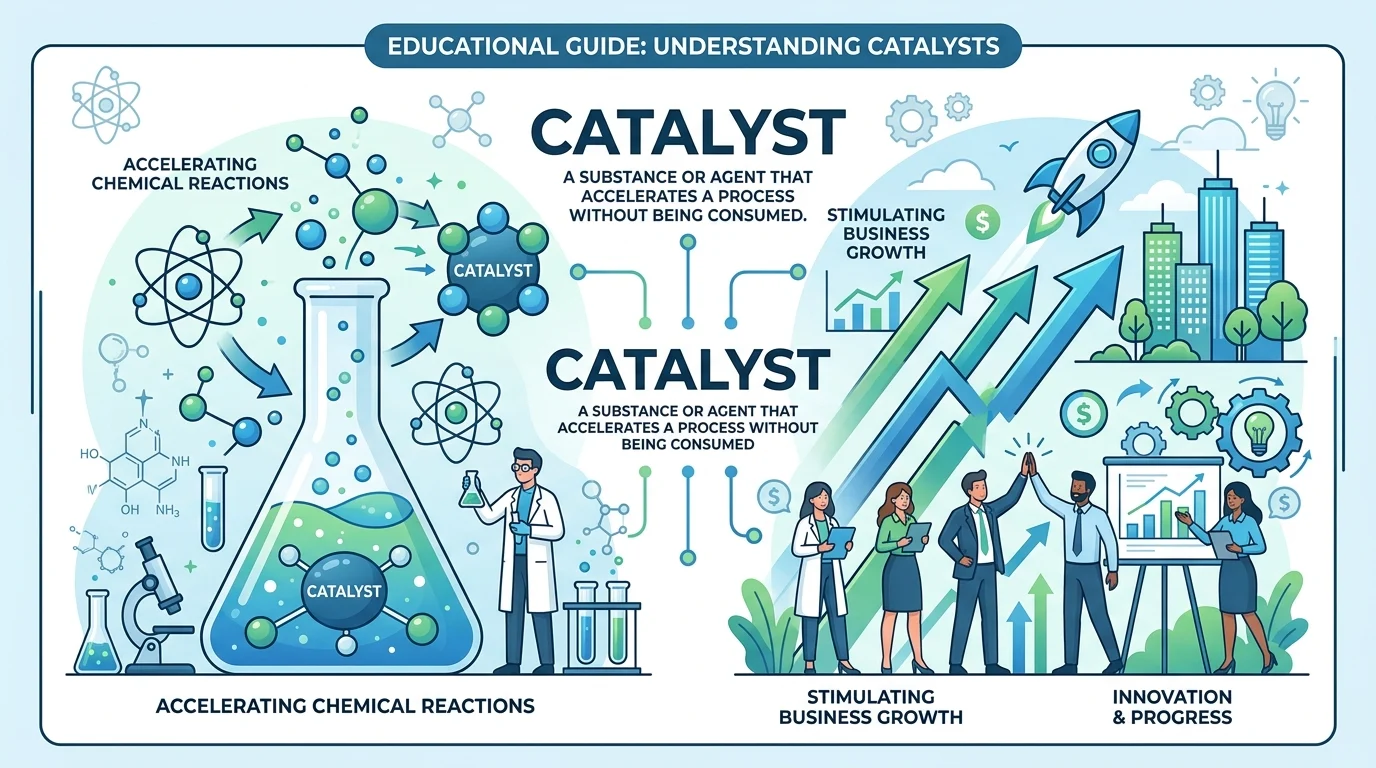
A catalyst is a substance that increases the rate of a chemical reaction without being consumed during the process.
Figurative Definition
A catalyst is someone or something that inspires, triggers, or speeds up progress, development, or transformation.
Both meanings share one central idea:
A catalyst helps change happen more quickly or efficiently.
Types of Catalysts
Chemical Catalysts
Used in laboratories and industries to speed up chemical reactions.
Examples include:
- Platinum
- Nickel
- Iron
- Enzymes
These substances help reactions occur faster while remaining chemically unchanged after the reaction.
Biological Catalysts
Living organisms rely on biological catalysts called enzymes.
Examples:
- Amylase
- Lipase
- Protease
These enzymes make digestion and other biological processes possible.
Social Catalysts
A person who inspires positive change within a group or community.
Example:
“A dedicated teacher became the catalyst for improving student performance.”
Business Catalysts
Businesses often describe innovations as catalysts for growth.
Examples:
- Artificial intelligence
- Cloud computing
- Digital marketing
- Automation
Personal Catalysts
Life experiences can become catalysts for self-improvement.
Examples include:
- Reading a motivational book.
- Starting a new career.
- Traveling abroad.
- Overcoming challenges.
Catalyst in Chemistry
In chemistry, catalysts play an essential role by lowering the activation energy required for reactions.
Important characteristics include:
- Speed up reactions.
- Are not consumed.
- Can be reused.
- Improve efficiency.
- Reduce energy requirements.
Everyday Chemistry Examples
- Catalytic converters in cars.
- Enzymes helping digestion.
- Industrial fertilizer production.
- Petroleum refining.
- Pharmaceutical manufacturing.
Without catalysts, many industrial processes would be far slower and more expensive.
Catalyst in Everyday Language
Outside science, catalyst has become a popular metaphor.
Examples:
- “Her speech was the catalyst for social change.”
- “The pandemic became a catalyst for remote work.”
- “The investment served as a catalyst for rapid expansion.”
- “Winning the championship was the catalyst for the team’s confidence.”
These examples highlight how the word represents transformation rather than chemistry.
Real-Life Examples
Example 1: Business
“The company’s new CEO became the catalyst for record-breaking growth.”
Meaning:
The CEO inspired major improvements.
Example 2: Education
“The scholarship was the catalyst that encouraged her to attend college.”
Meaning:
The scholarship made the opportunity possible.
Example 3: Technology
“Artificial intelligence is becoming a catalyst for innovation.”
Meaning:
AI is driving rapid progress.
Example 4: Relationships
“Honest communication became the catalyst for rebuilding trust.”
Meaning:
Communication initiated positive change.
Example 5: Personal Growth
“Reading that book became the catalyst for changing his lifestyle.”
Meaning:
The book inspired lasting improvement.
Industry-Specific Meaning
Business
Companies often use catalyst to describe events that increase revenue, innovation, or productivity.
Examples:
- Product launches
- Strategic partnerships
- Leadership changes
- Market expansion
Healthcare
Medical researchers may describe a breakthrough treatment as a catalyst for improved patient care.
Education
Teachers and educational leaders frequently become catalysts for student success through inspiration and guidance.
Technology
New inventions often act as catalysts that transform industries and create new opportunities.
Finance
Investors refer to earnings reports, mergers, acquisitions, or policy changes as market catalysts because they can significantly influence stock prices.
Common Phrases Using Catalyst
Some frequently used expressions include:
- Catalyst for change
- Economic catalyst
- Growth catalyst
- Innovation catalyst
- Positive catalyst
- Social catalyst
- Market catalyst
- Catalyst event
- Catalyst for success
- Catalyst for transformation
These phrases appear regularly in news articles, business reports, and motivational writing.
Synonyms and Related Words
Depending on the context, similar words include:
- Trigger
- Stimulus
- Accelerator
- Driving force
- Spark
- Influence
- Inspiration
- Motivator
- Impetus
- Activator
Although these words share similar meanings, “catalyst” often implies helping change happen without being the final outcome itself.
How to Use Catalyst Correctly
Use catalyst when referring to:
- Something that starts change.
- Something that speeds up progress.
- A person who inspires action.
- An event that causes transformation.
Correct examples:
- “The new law became a catalyst for reform.”
- “Exercise was the catalyst for improving his health.”
- “Technology acted as a catalyst for economic growth.”
Common Mistakes
People sometimes confuse catalyst with:
Result
A catalyst creates change but is not the final result.
Cause
Although similar, a catalyst often accelerates or enables change rather than being the only reason it happens.
Solution
A catalyst encourages progress but may not completely solve a problem.
When to Use the Word Catalyst
Use catalyst when discussing:
- Scientific reactions
- Personal development
- Leadership
- Innovation
- Social movements
- Business growth
- Economic trends
- Educational success
- Technological advancement
Avoid using it when no meaningful change or acceleration is involved.
Usage Tips
To use the word naturally:
- Pair it with “for” (catalyst for change).
- Reserve it for significant developments.
- Don’t overuse it in casual conversation.
- Consider whether another word like “cause” or “trigger” fits better.
- Match the context—scientific or figurative.
Frequently Asked Questions
What is the simple meaning of catalyst?
A catalyst is something that causes or speeds up change.
What is a catalyst in chemistry?
It is a substance that increases the speed of a chemical reaction without being permanently consumed.
Can a person be called a catalyst?
Yes. Someone who inspires or initiates positive change can be described as a catalyst.
What does “catalyst for change” mean?
It refers to a person, event, or idea that starts or accelerates meaningful change.
Is catalyst always related to chemistry?
No. It’s also widely used in business, leadership, education, relationships, and everyday conversations.
What are examples of catalysts?
Examples include enzymes, platinum in industrial reactions, inspiring leaders, technological innovations, and life-changing experiences.
Is catalyst a positive word?
Usually, yes. However, it can also describe events that accelerate negative changes, depending on the context.
What is the difference between catalyst and trigger?
A trigger starts an event immediately, while a catalyst generally accelerates or promotes ongoing change.
Why are catalysts important?
They make processes more efficient, whether in chemical reactions or real-world situations involving growth and transformation.
How do you use catalyst in a sentence?
Example: “The scholarship became the catalyst for her academic success.”
Conclusion
The meaning of catalyst extends far beyond the chemistry classroom. Scientifically, it describes a substance that speeds up a reaction without being permanently changed. In everyday language, it refers to a person, event, innovation, or idea that inspires progress, transformation, or significant change.
From business and education to technology, healthcare, finance, and personal growth, catalysts play an essential role in helping people and organizations move forward. Understanding both the literal and figurative meanings allows you to recognize how the term is used across different fields and communicate more effectively.
Whether you’re studying science, reading the news, or discussing leadership and innovation, the word catalyst represents one powerful concept: creating meaningful change by helping things happen faster and more effectively.
Discover More:-
- Progressive Meaning: Definition, Uses, Examples & Explained 2026
- Mitigation Meaning: Definition, Examples & Everyday Uses 2026

Alexander Cole is a professional content writer and researcher who specializes in creating informative, reader-friendly, and well-researched articles. He is committed to publishing accurate, valuable, and engaging content that helps readers stay informed and make smarter decisions.