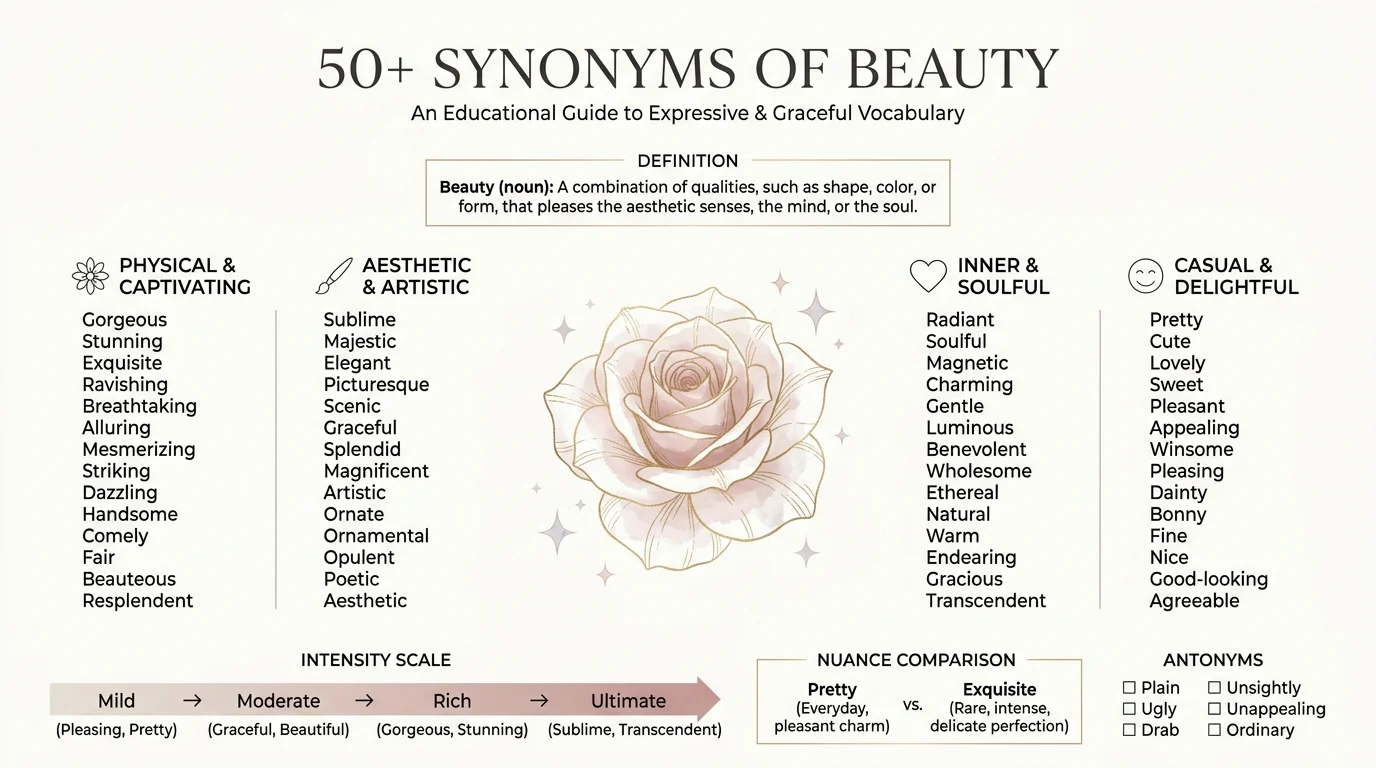
Have you ever needed to describe someone or something that is visually stunning but felt that “beautiful” or “pretty” was too simple or repetitive? You want to capture the specific type of attractiveness, elegance, or splendor, and the word “beauty” comes to mind. Choosing the right synonym for “beauty” can transform a basic compliment into a precise expression of aesthetic wonder, charm, or grace. This guide explores the best synonyms of beauty, explaining exactly which word to use and when.
Quick Answer: “Beauty” means the quality of being physically attractive, pleasing to the senses, or having a deep, admirable quality. For physical attractiveness, choose attractiveness, loveliness, or gorgeousness. For aesthetic quality, use elegance, grace, or splendor. For inner beauty, use kindness, goodness, or radiance. For casual conversation, use looks or appeal.
Meaning, Tone, and Context
Understanding the core meaning of “beauty” is the first step to using it effectively.
Simple Definition: The quality or aggregate of qualities in a person or thing that gives pleasure to the senses or pleasurably exalts the mind or spirit.
Part of Speech: Noun.
Overall Tone: Positive and evocative. It indicates admiration, pleasure, and excellence.
Formality Level: Neutral to formal. The word is appropriate in most contexts.
Common Uses: Native English speakers use it in art (“the beauty of the painting”), people (“her beauty is stunning”), nature (“the beauty of the landscape”), and ideas (“the beauty of simplicity”).
Word Forms: Related words include the adjective beautiful, the adverb beautifully, the verb beautify, and the noun beautician.
When and How to Use “Beauty”
“Beauty” is the perfect choice when you want to describe physical attractiveness, aesthetic excellence, or admirable qualities. Here are seven realistic examples.
Physical: “Her beauty captivated everyone in the room.”
Artistic: “The beauty of the sculpture is undeniable.”
Natural: “The beauty of the sunset took our breath away.”
Abstract: “The beauty of mathematics lies in its elegance.”
Personal: “He saw the beauty in her kindness.”
Professional: “The beauty of this design is its simplicity.”
Social Media: “The beauty of nature is truly inspiring.”
Best Synonyms of “Beauty”
No synonym is identical in every situation. Here is your guide to the best replacement for “beauty” based on your writing context.
For Physical Attractiveness
Most Direct: Attractiveness means the quality of being appealing. “Her attractiveness was undeniable.”
Loveliness: Loveliness means beauty and charm. “She possessed a rare loveliness.”
Gorgeousness: Gorgeousness means striking beauty. “The actress’s gorgeousness amazed fans.”
Allure: Allure means the quality of being powerfully attractive. “The allure of the city drew visitors.”
For Aesthetic Excellence
Elegance: Elegance means graceful and stylish appearance. “The gown had an air of elegance.”
Grace: Grace means smooth and elegant movement. “She moved with grace.”
Splendor: Splendor means magnificent beauty. “The palace was a sight of splendor.”
Magnificence: Magnificence means extraordinary beauty. “The magnificence of the cathedral awed us.”
For Inner Beauty
Kindness: Kindness means the quality of being friendly. “Her kindness was her true beauty.”
Goodness: Goodness means moral excellence. “The goodness of his heart was evident.”
Radiance: Radiance means glowing beauty. “Her radiance lit up the room.”
Charm: Charm means an appealing quality. “He was captivated by her charm.”
For Casual and Modern Contexts
Looks: Looks means physical appearance. “He has good looks.”
Appeal: Appeal means attractiveness. “The design has broad appeal.”
Attraction: Attraction means the power to draw interest. “The attraction between them was obvious.”
When Not to Use “Beauty”
Using “beauty” can sound wrong or awkward in certain situations.
When You Mean “Usefulness”: “Beauty” is aesthetic. “Usefulness” is practical.
Better Choice: Usefulness or utility. “The usefulness of the tool is clear.”
When You Mean “Cuteness”: “Beauty” is broader. “Cuteness” is specific.
Better Choice: Cuteness. “The puppy’s cuteness melted hearts.”
When It Sounds Too Formal: In casual conversation, “beauty” can sound poetic.
Better Choice: Looks or appeal. “She has great looks.”
Words Commonly Confused With “Beauty”
| Word | Difference | When to Use | Example |
|---|---|---|---|
| Loveliness | Beautiful and charming | General and emotional | “Her loveliness was striking.” |
| Elegance | Graceful and stylish | Fashion and design | “The dress was elegant.” |
| Grace | Smooth and elegant | Movement and manner | “She danced with grace.” |
| Splendor | Magnificent beauty | Nature and architecture | “The splendor of the mountains.” |
| Charm | Appealing quality | Personality and style | “He had great charm.” |
| Radiance | Glowing beauty | Emotional and descriptive | “Her radiance was contagious.” |
Best Synonyms of “Beauty” by Context
| Context | Best Synonym | Why It Works | Example |
|---|---|---|---|
| Formal writing | Splendor | Formal and dramatic | “The splendor of the palace.” |
| Academic writing | Elegance | Standard in research | “The elegance of the theory.” |
| Professional | Attractiveness | Professional and clear | “The attractiveness of the design.” |
| Business | Appeal | Business and marketing | “The appeal of the product.” |
| Emotional | Radiance | Emotional and personal | “Her radiance was contagious.” |
| Casual | Looks | Simple and natural | “He has good looks.” |
| Creative | Loveliness | Evocative and charming | “The loveliness of the garden.” |
How to Choose the Best Synonym of “Beauty”
Choosing the right word is a simple decision. Answer these questions.
What type of beauty am I describing? For physical, use attractiveness or loveliness. For aesthetic, use elegance or splendor. And for inner, use kindness or radiance. Also for casual, use looks or appeal.
What is my audience? For a formal report, use splendor or magnificence. For a friend, use looks or charm.
What is my purpose? Are you describing a person, a place, or an idea? The correct synonym depends entirely on this.
What is the emotional strength? Radiance and splendor are stronger. Appeal is milder. Pick the one that matches your message.
Real Life Examples of “Beauty”
School: Basic: “The poem describes beauty.” Improved: “The poem describes loveliness.”
College: Basic: “The study examines beauty.” Improved: “The study examines aesthetic appeal.”
Workplace: Basic: “The design has beauty.” Improved: “The design has elegance.”
Business: Basic: “The product’s beauty is its simplicity.” Improved: “The product’s appeal is its simplicity.”
Email: Basic: “The beauty of the plan is clear.” Improved: “The elegance of the plan is clear.”
Conversation: Basic: “She is a beauty.” Improved: “She is gorgeous.”
Storytelling: Basic: “The beauty of the scene moved him.” Improved: “The splendor of the scene moved him.”
Top 10 Synonyms of “Beauty”
| Synonym | Simple Meaning | Best Used For | Example Sentence |
|---|---|---|---|
| Attractiveness | The quality of being appealing | General and professional | “Her attractiveness was undeniable.” |
| Loveliness | Beauty and charm | Emotional and descriptive | “She possessed a rare loveliness.” |
| Elegance | Graceful and stylish appearance | Fashion and design | “The gown had an air of elegance.” |
| Grace | Smooth and elegant movement | Movement and manner | “She moved with grace.” |
| Splendor | Magnificent beauty | Nature and architecture | “The palace was a sight of splendor.” |
| Magnificence | Extraordinary beauty | Formal and dramatic | “The magnificence of the cathedral awed us.” |
| Charm | Appealing quality | Personality and style | “He was captivated by her charm.” |
| Radiance | Glowing beauty | Emotional and personal | “Her radiance lit up the room.” |
| Allure | Powerfully attractive quality | Fashion and marketing | “The allure of the city drew visitors.” |
| Appeal | Attractiveness | Casual and business | “The design has broad appeal.” |
Synonyms of “Beauty” by Usage
Professional vs. Personal Synonyms
In the workplace, choose attractiveness, elegance, or appeal. With friends, use looks, charm, or gorgeousness.
Formal vs. Conversational Synonyms
For formal writing, use splendor, magnificence, or elegance. For casual conversations, use looks, appeal, or charm.
Academic Synonyms
For research and essays, choose elegance for theories, aesthetics for art, and magnificence for historical contexts.
Professional and Business Synonyms
For maximum impact, choose appeal for products, attractiveness for design, and elegance for branding.
Creative and Literary Synonyms
To add emotion and imagery, choose loveliness, radiance, or splendor. These words create atmosphere.
Slang or Modern Synonyms
In modern American slang, good looks, hot, or stunning are common. For example, “She looks stunning.” These are casual and should be avoided in formal writing.
Strongest to Mildest Synonyms
Mild: looks, appeal, attractiveness
Moderate: beauty, loveliness, charm
Strong: elegance, grace, radiance
Very Strong: splendor, magnificence, allure
Emotional vs. Neutral Synonyms
Emotional Synonyms: Radiance, loveliness, charm. These words hint at warmth and admiration. Use them when you want to evoke feeling.
Neutral Synonyms: Beauty, attractiveness, appeal. These words communicate factual information.
Antonyms of “Beauty”
| Antonym | Meaning | Example Sentence |
|---|---|---|
| Ugliness | The quality of being unattractive | “The ugliness of the building was striking.” |
| Plainness | Lack of beauty | “The plainness of the room was deliberate.” |
| Drabness | Dullness | “The drabness of the outfit disappointed her.” |
| Homeliness | Unattractive appearance | “The homeliness of the cottage was charming.” |
| Hideousness | Extreme ugliness | “The hideousness of the monster scared them.” |
| Grace | Lack of grace | “His awkwardness was noticeable.” |
| Clumsiness | Lack of elegance | “Her clumsiness was endearing.” |
| Coarseness | Roughness | “The coarseness of the fabric was unpleasant.” |
| Crudeness | Lack of refinement | “The crudeness of the design was criticized.” |
| Vulgarity | Lack of taste | “The vulgarity of the display offended many.” |
| Offensiveness | Causing displeasure | “The offensiveness of the remark was clear.” |
| Repulsiveness | Causing disgust | “The repulsiveness of the scene was disturbing.” |
| Unattractiveness | Lack of appeal | “The unattractiveness of the product hurt sales.” |
| Dullness | Lack of interest | “The dullness of the colors was depressing.” |
| Shabbiness | Worn and untidy | “The shabbiness of the curtains was obvious.” |
Comparison: “Beauty” vs Similar Words
Beauty vs. Loveliness
Main Difference: “Beauty” is broader. “Loveliness” is softer and more emotional.
Which Is Stronger? They are similar.
Which Is More Formal? Both are neutral.
When to Use Each: Use “loveliness” for charm. Use “beauty” for general contexts.
Examples:
Beauty: “The beauty of the sunset.”
Loveliness: “The loveliness of her smile.”
Beauty vs. Elegance
Main Difference: “Beauty” is broader. “Elegance” is about style.
Which Is Stronger? “Elegance” is more specific.
Which Is More Formal? Both are formal.
When to Use Each: Use “elegance” for design. Use “beauty” for general contexts.
Examples:
Beauty: “The beauty of the garden.”
Elegance: “The elegance of the dress.”
Beauty vs. Grace
Main Difference: “Beauty” is broader. “Grace” is about movement.
Which Is Stronger? “Grace” is more specific.
Which Is More Formal? Both are formal.
When to Use Each: Use “grace” for movement. Use “beauty” for general contexts.
Examples:
Beauty: “The beauty of the dancer.”
Grace: “She moved with grace.”
Beauty vs. Splendor
Main Difference: “Beauty” is broader. “Splendor” is magnificent.
Which Is Stronger? “Splendor” is stronger.
Which Is More Formal? Both are formal.
When to Use Each: Use “splendor” for architecture. Use “beauty” for general contexts.
Examples:
Beauty: “The beauty of the mountains.”
Splendor: “The splendor of the palace.”
Beauty vs. Charm
Main Difference: “Beauty” is visual. “Charm” is appealing personality.
Which Is Stronger? “Charm” is more personal.
Which Is More Formal? Both are neutral.
When to Use Each: Use “charm” for personality. Use “beauty” for appearance.
Examples:
Beauty: “Her beauty was striking.”
Charm: “His charm won everyone over.”
Beauty vs. Radiance
Main Difference: “Beauty” is broader. “Radiance” is glowing.
Which Is Stronger? “Radiance” is more evocative.
Which Is More Formal? Both are formal.
When to Use Each: Use “radiance” for glow. Use “beauty” for general contexts.
Examples:
Beauty: “The beauty of the scene.”
Radiance: “Her radiance lit up the room.”
Common Phrases and Expressions with “Beauty”
Phrase: Beauty is in the eye of the beholder
Meaning: Beauty is subjective.
Example Sentence: “Beauty is in the eye of the beholder, so tastes vary.”
Phrase: Natural beauty
Meaning: Beauty found in nature.
Example Sentence: “The natural beauty of the park is stunning.”
Phrase: Inner beauty
Meaning: Beauty of character.
Example Sentence: “Her inner beauty shines through.”
Phrase: Beauty sleep
Meaning: Sleep that improves appearance.
Example Sentence: “She needs her beauty sleep.”
Phrase: Beauty contest
Meaning: A competition based on appearance.
Example Sentence: “She won the beauty contest.”
Phrase: Beauty salon
Meaning: A place for personal care.
Example Sentence: “She goes to the beauty salon weekly.”
Common Mistakes to Avoid
Mistake 1: Using “beauty” when you mean “cuteness”.
Incorrect: “The puppy’s beauty is adorable.”
Better: “The puppy’s cuteness is adorable.”
Why: “Cuteness” is for small, cute things.
Mistake 2: Using “beauty” when you mean “usefulness”.
Incorrect: “The beauty of the tool is its efficiency.”
Better: “The usefulness of the tool is its efficiency.”
Why: “Usefulness” is practical.
Mistake 3: Overusing “beauty” in conversation.
Incorrect: “She is a beauty.”
Better: “She is gorgeous.”
Why: “Gorgeous” sounds more natural.
Mistake 4: Using “beauty” when you mean “elegance”.
Incorrect: “The beauty of the dress was striking.”
Better: “The elegance of the dress was striking.”
Why: “Elegance” is for style.
Mistake 5: Using “beauty” when you mean “charm”.
Incorrect: “His beauty won everyone over.”
Better: “His charm won everyone over.”
Why: “Charm” is for personality.
Frequently Asked Questions
1. What are the best synonyms of “beauty”?
The best synonyms depend on your context. For physical, choose attractiveness or loveliness. For aesthetic, use elegance or splendor. And for inner, use kindness or radiance.
2. What are the best formal synonyms of “beauty”?
The best formal synonyms are splendor, magnificence, and elegance. These words are suitable for academic papers, professional reports, and literary writing.
3. What are common informal synonyms of “beauty”?
For informal settings, use looks, charm, or gorgeousness. These alternatives sound more natural in everyday conversation.
4. What is another word for “beauty” in professional writing?
In professional writing, elegance is an excellent choice. It conveys style and grace. Appeal is also strong for products.
5. What is the difference between “beauty” and “elegance”?
“Beauty” is broader. “Elegance” is about style and grace. Use “elegance” for design and fashion.
6. What is the opposite of “beauty”?
The most direct opposites (antonyms) of beauty are ugliness, plainness, and drabness. These words describe a lack of beauty.
Conclusion
“Beauty” is a powerful and evocative word for describing physical attractiveness, aesthetic excellence, and admirable qualities. The term is neutral and widely accepted in most contexts, yet it can sound too simple for specific descriptions or too poetic for casual conversation. The best choice among the synonyms of beauty depends entirely on your audience, tone, and purpose. For a formal, literary effect, use splendor or magnificence. For a practical, business context, appeal or elegance works perfectly. And for personal descriptions, choose loveliness or charm. Also for casual conversation, use looks or stunning. Remember, no single synonym works perfectly in every situation. Your goal is to choose the word that communicates your message with the most clarity and impact. A practical tip for your vocabulary growth is to pay attention to how writers describe appearance and aesthetics and practice using different synonyms in your writing.









