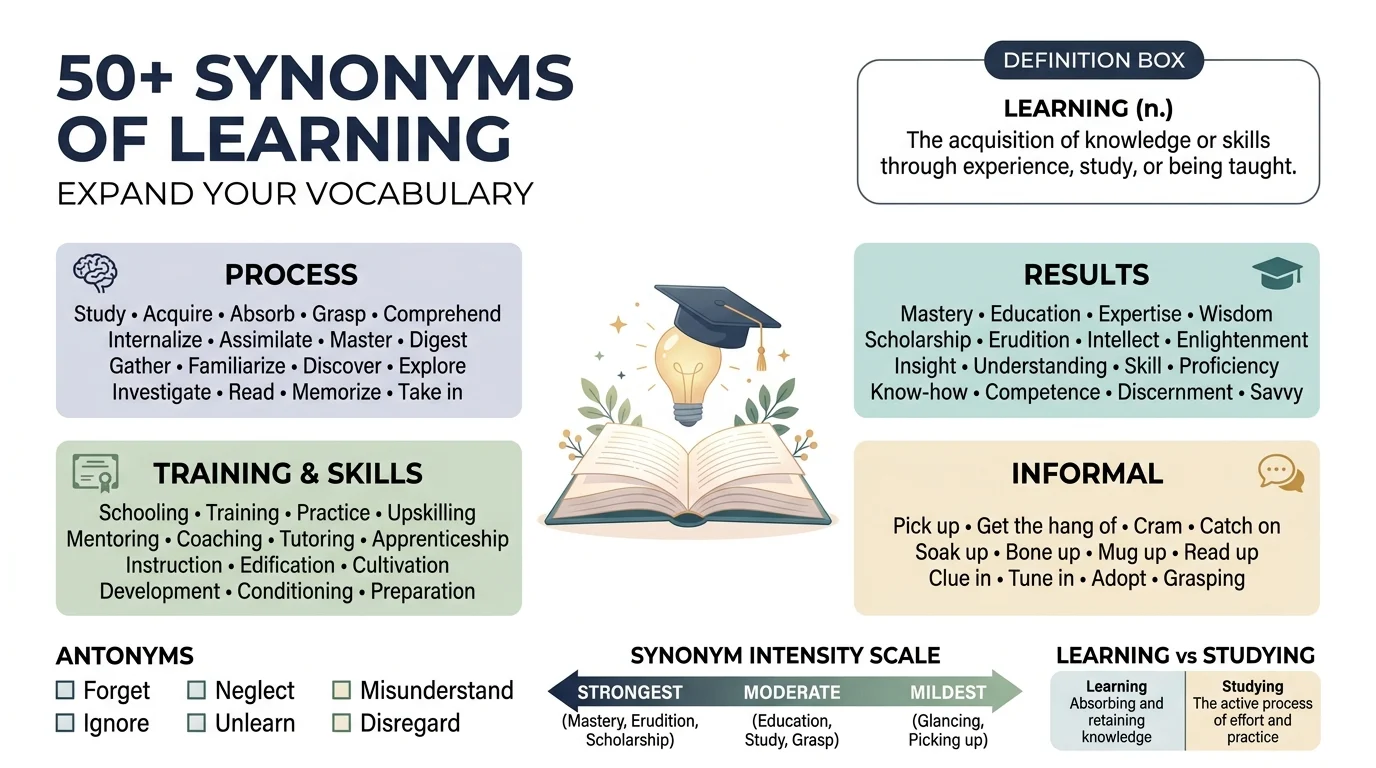
Have you ever needed to describe the process of gaining knowledge, the act of studying, or the wisdom acquired through experience but felt that “learning” was too broad or repetitive? You want to capture the specific nature of intellectual growth, education, or acquired knowledge, and the word “learning” comes to mind. Choosing the right synonym for “learning” can transform a basic statement into a precise expression of education, scholarship, or understanding. This guide explores the best synonyms of learning, explaining exactly which word to use and when.
Quick Ans: “Learning” means the acquisition of knowledge or skills through study, experience, or teaching, or the knowledge acquired. For the process, choose education, study, or instruction. For the result, use knowledge, scholarship, or erudition. For informal contexts, use gaining or picking up. For skill acquisition, use training or development.
Meaning, Tone, and Context
Understanding the core meaning of “learning” is the first step to using it effectively.
Simple Definition: The acquisition of knowledge or skills through study, experience, or being taught; knowledge acquired through education.
Part of Speech: Noun (also the present participle of the verb “learn”).
Overall Tone: Neutral to positive. It indicates growth, education, and understanding.
Formality Level: Neutral to formal. The word is appropriate in most contexts.
Common Uses: Native English speakers use it in education (“online learning”), professional development (“continuous learning”), and general contexts (“lifelong learning”).
Word Forms: Related words include the verb learn, the noun learner, and the adjective learned.
When and How to Use “Learning”
“Learning” is the perfect choice when you want to describe gaining knowledge or skills. Here are seven realistic examples.
Education: “Online learning has become increasingly popular.”
Professional: “Continuous learning is essential for career growth.”
Academic: “The study examines learning outcomes in early childhood.”
Personal: “Learning a new language takes time and practice.”
Workplace: “The company encourages learning and development.”
Technology: “Machine learning is transforming industries.”
Social Media: “Never stop learning; it is the key to growth.”
Best Synonyms of “Learning”
No synonym is identical in every situation. Here is your guide to the best replacement for “learning” based on your writing context.
For the Process of Gaining Knowledge
Most Direct: Education means the process of learning. “Education is the foundation of success.”
Study: Study means the act of learning. “The study of history is fascinating.”
Instruction: Instruction means teaching. “The instruction was clear and effective.”
Schooling: Schooling means formal education. “His schooling prepared him for university.”
For the Result of Learning
Knowledge: Knowledge means information and understanding. “Her knowledge of the subject is impressive.”
Scholarship: Scholarship means academic study. “The scholarship in the field is extensive.”
Erudition: Erudition means deep knowledge. “His erudition impressed everyone.”
Wisdom: Wisdom means good judgment based on experience. “Wisdom comes with age.”
For Skill Acquisition
Training: Training means learning skills. “The training program lasts six weeks.”
Development: Development means growth. “Professional development is important.”
Practice: Practice means repeated exercise. “Practice makes perfect.”
Mastery: Mastery means complete skill. “Her mastery of the piano is remarkable.”
For Informal and Casual Contexts
Picking up: Picking up means learning casually. “He picked up Spanish while traveling.”
Gaining: Gaining means acquiring. “She is gaining experience in the field.”
Absorbing: Absorbing means taking in. “He is absorbing new information quickly.”
Studying: Studying means learning. “She is studying for the exam.”
When Not to Use “Learning”
Using “learning” can sound wrong or awkward in certain situations.
When You Mean “Education”: “Learning” is broader. “Education” is formal.
Better Choice: Education. “Education is essential.”
When You Mean “Skill”: “Learning” is the process. “Skill” is the ability.
Better Choice: Skill. “His skill in carpentry is impressive.”
When It Sounds Too Formal: In casual conversation, “learning” can sound academic.
Better Choice: Picking up or studying. “He is picking up guitar.”
Words Commonly Confused With “Learning”
| Word | Difference | When to Use | Example |
|---|---|---|---|
| Education | Formal process | Schools and institutions | “Education is important.” |
| Knowledge | Information and understanding | Academic and general | “Knowledge is power.” |
| Training | Skill acquisition | Professional and practical | “Training is required.” |
| Study | Act of learning | Academic and personal | “The study of science.” |
| Scholarship | Academic study | Academic and formal | “Scholarship is valued.” |
| Wisdom | Good judgment | Personal and philosophical | “Wisdom comes with age.” |
Best Synonyms of “Learning” by Context
| Context | Best Synonym | Why It Works | Example |
|---|---|---|---|
| Formal writing | Education | Formal and precise | “Education is the foundation.” |
| Academic writing | Scholarship | Standard in research | “The scholarship is extensive.” |
| Professional | Development | Professional and clear | “Professional development is key.” |
| Business | Training | Business and practical | “Training is provided.” |
| Personal | Study | Personal and academic | “The study of history.” |
| Technology | Machine learning | Technical and specific | “Machine learning is transforming industries.” |
| Casual | Picking up | Simple and natural | “He is picking up Spanish.” |
How to Choose the Best Synonym of “Learning”
Choosing the right word is a simple decision. Answer these questions.
What type of learning am I describing? For the process, use education or study. And For the result, use knowledge or scholarship. For skills, use training or development. For informal, use picking up or gaining.
What is my audience? For a formal report, use education or scholarship. For a friend, use picking up or studying.
What is my purpose? Are you describing the process, the result, or the skill? The correct synonym depends entirely on this.
What is the emotional strength? Mastery and wisdom are stronger. Picking up is milder. Pick the one that matches your message.
Real Life Examples of “Learning”
School: Basic: “The student is learning.” Improved: “The student is studying for the exam.”
College: Basic: “The learning outcomes are assessed.” Improved: “The educational outcomes are assessed.”
Workplace: Basic: “We encourage learning.” Improved: “We encourage professional development.”
Business: Basic: “Learning is important.” Improved: “Training is important for success.”
Email: Basic: “Thank you for the learning opportunity.” Improved: “Thank you for the educational opportunity.”
Conversation: Basic: “I am learning Spanish.” Improved: “I am picking up Spanish.”
Storytelling: Basic: “His learning impressed everyone.” Improved: “His erudition impressed everyone.”
Top 10 Synonyms of “Learning”
| Synonym | Simple Meaning | Best Used For | Example Sentence |
|---|---|---|---|
| Education | The process of learning | Formal and academic | “Education is the foundation.” |
| Knowledge | Information and understanding | Academic and general | “Knowledge is power.” |
| Study | The act of learning | Academic and personal | “The study of history.” |
| Training | Skill acquisition | Professional and practical | “Training is required.” |
| Development | Growth and improvement | Professional and personal | “Professional development is key.” |
| Scholarship | Academic study | Academic and formal | “The scholarship is extensive.” |
| Erudition | Deep knowledge | Formal and literary | “His erudition impressed everyone.” |
| Wisdom | Good judgment | Personal and philosophical | “Wisdom comes with age.” |
| Mastery | Complete skill | Skill and expertise | “Her mastery of the piano.” |
| Instruction | Teaching | Education and formal | “The instruction was clear.” |
Synonyms of “Learning” by Usage
Professional vs. Personal Synonyms
In the workplace, choose development, training, or education. With friends, use studying, picking up, or gaining.
Formal vs. Conversational Synonyms
For formal writing, use education, scholarship, or erudition. For casual conversations, use picking up, studying, or gaining.
Academic Synonyms
For research and essays, choose scholarship for academic work, knowledge for understanding, and erudition for deep learning.
Professional and Business Synonyms
For maximum impact, choose development for growth, training for skills, and education for knowledge.
Creative and Literary Synonyms
To add emotion and imagery, choose wisdom, erudition, or mastery. These words create depth.
Slang or Modern Synonyms
In modern American slang, picking up, getting the hang of, or leveling up are common. For example, “I am leveling up my skills.” These are casual and should be avoided in formal writing.
Strongest to Mildest Synonyms
Mild: studying, gaining, picking up
Moderate: learning, education, training
Strong: development, knowledge, scholarship
Very Strong: erudition, mastery, wisdom
Emotional vs. Neutral Synonyms
Emotional Synonyms: Wisdom, mastery, erudition. These words hint at depth and achievement. Use them when you want to evoke admiration.
Neutral Synonyms: Learning, education, training. These words communicate factual information.
Antonyms of “Learning”
| Antonym | Meaning | Example Sentence |
|---|---|---|
| Ignorance | Lack of knowledge | “Ignorance is not bliss.” |
| Illiteracy | Inability to read | “Illiteracy is declining.” |
| Unawareness | Lack of awareness | “Unawareness of the risks is dangerous.” |
| Inexperience | Lack of experience | “Inexperience caused mistakes.” |
| Forgetting | Loss of memory | “Forgetting is part of learning.” |
| Misunderstanding | Failure to understand | “Misunderstanding led to errors.” |
| Incompetence | Lack of ability | “Incompetence caused the failure.” |
| Stagnation | Lack of growth | “Stagnation is the enemy of progress.” |
| Unfamiliarity | Lack of familiarity | “Unfamiliarity with the system slowed him.” |
| Incapacity | Lack of capacity | “Incapacity prevented him from working.” |
| Benightedness | Lack of enlightenment | “Benightedness hindered progress.” |
| Unlettered | Not educated | “The unlettered man struggled.” |
| Unschooled | Not trained | “The unschooled worker needed training.” |
| Unlearned | Not knowledgeable | “The unlearned scholar was humble.” |
| Insufficiency | Lack of sufficiency | “Insufficiency of skills hurt him.” |
Comparison: “Learning” vs Similar Words
Learning vs. Education
Main Difference: “Learning” is the process. “Education” is the formal system.
Which Is Stronger? “Education” is more formal.
Which Is More Formal? “Education” is more formal.
When to Use Each: Use “learning” for the process. Use “education” for the system.
Examples:
Learning: “Learning is a lifelong process.”
Education: “Education is the foundation of success.”
Learning vs. Knowledge
Main Difference: “Learning” is the process. “Knowledge” is the result.
Which Is Stronger? “Knowledge” is the result.
Which Is More Formal? Both are formal.
When to Use Each: Use “learning” for the process. Use “knowledge” for the result.
Examples:
Learning: “Learning takes time.”
Knowledge: “Knowledge is power.”
Learning vs. Study
Main Difference: “Learning” is broader. “Study” is the act.
Which Is Stronger? “Study” is more specific.
Which Is More Formal? Both are neutral.
When to Use Each: Use “study” for academic work. Use “learning” for general contexts.
Examples:
Learning: “Learning is important.”
Study: “The study of history.”
Learning vs. Training
Main Difference: “Learning” is broader. “Training” is skill acquisition.
Which Is Stronger? “Training” is more specific.
Which Is More Formal? Both are formal.
When to Use Each: Use “training” for skills. Use “learning” for general contexts.
Examples:
Learning: “Learning new skills is important.”
Training: “The training program lasts six weeks.”
Learning vs. Scholarship
Main Difference: “Learning” is broader. “Scholarship” is academic study.
Which Is Stronger? “Scholarship” is more formal.
Which Is More Formal? “Scholarship” is more formal.
When to Use Each: Use “scholarship” for academic work. Use “learning” for general contexts.
Examples:
Learning: “Learning is a lifelong pursuit.”
Scholarship: “The scholarship is extensive.”
Learning vs. Mastery
Main Difference: “Learning” is the process. “Mastery” is complete skill.
Which Is Stronger? “Mastery” is stronger.
Which Is More Formal? Both are formal.
When to Use Each: Use “mastery” for expertise. Use “learning” for general contexts.
Examples:
Learning: “Learning takes time.”
Mastery: “Her mastery of the piano.”
Common Phrases and Expressions with “Learning”
Phrase: Lifelong learning
Meaning: Continuous education throughout life.
Example Sentence: “Lifelong learning is essential for personal growth.”
Phrase: Online learning
Meaning: Education via the internet.
Example Sentence: “Online learning has become increasingly popular.”
Phrase: Machine learning
Meaning: AI that learns from data.
Example Sentence: “Machine learning is transforming industries.”
Phrase: Learning curve
Meaning: The rate of progress in learning.
Example Sentence: “The learning curve was steep.”
Phrase: Learning outcomes
Meaning: What students should learn.
Example Sentence: “The learning outcomes are clearly defined.”
Phrase: Learning disability
Meaning: A condition affecting learning.
Example Sentence: “The school supports students with learning disabilities.”
Common Mistakes to Avoid
Mistake 1: Using “learning” when you mean “education”.
Incorrect: “Learning is the key to success.”
Better: “Education is the key to success.”
Why: “Education” is the formal system.
Mistake 2: Using “learning” when you mean “knowledge”.
Incorrect: “His learning of the subject is impressive.”
Better: “His knowledge of the subject is impressive.”
Why: “Knowledge” is the result.
Mistake 3: Overusing “learning” in conversation.
Incorrect: “I am learning Spanish.”
Better: “I am picking up Spanish.”
Why: “Picking up” sounds more natural.
Mistake 4: Using “learning” when you mean “training”.
Incorrect: “The learning program lasts six weeks.”
Better: “The training program lasts six weeks.”
Why: “Training” is for skills.
Mistake 5: Using “learning” when you mean “scholarship”.
Incorrect: “His learning is respected.”
Better: “His scholarship is respected.”
Why: “Scholarship” is academic.
Frequently Asked Questions
1. What are the best synonyms of “learning”?
The best synonyms depend on your context. For the process, choose education or study. And For the result, use knowledge or scholarship. For skills, use training or development.
2. What are the best formal synonyms of “learning”?
The best formal synonyms are education, scholarship, and erudition. These words are suitable for academic papers, professional reports, and business communications.
3. What are common informal synonyms of “learning”?
For informal settings, use picking up, studying, or gaining. These alternatives sound more natural in everyday conversation.
4. What is another word for “learning” in professional writing?
In professional writing, development is an excellent choice. It conveys growth. Training is also strong for skills.
5. What is the difference between “learning” and “education”?
“Learning” is the process. “Education” is the formal system. Use “education” for schools and “learning” for general contexts.
6. What is the opposite of “learning”?
The most direct opposites (antonyms) of learning are ignorance, illiteracy, and inexperience. These words describe a lack of knowledge or skill.
Conclusion
“Learning” is a fundamental and versatile word for describing the acquisition of knowledge and skills. The term is neutral and widely accepted in all contexts, yet it can sound too broad for specific descriptions or too academic for casual conversation. The best choice among the synonyms of learning depends entirely on your audience, tone, and purpose. Remember, no single synonym works perfectly in every situation. Your goal is to choose the word that communicates your message with the most clarity and impact. A practical tip for your vocabulary growth is to pay attention to how writers describe education and growth and practice using different synonyms in your writing.










3 thoughts on “50+ Synonyms of Learning: Meanings, Uses, Examples, and Best Alternatives 2026”