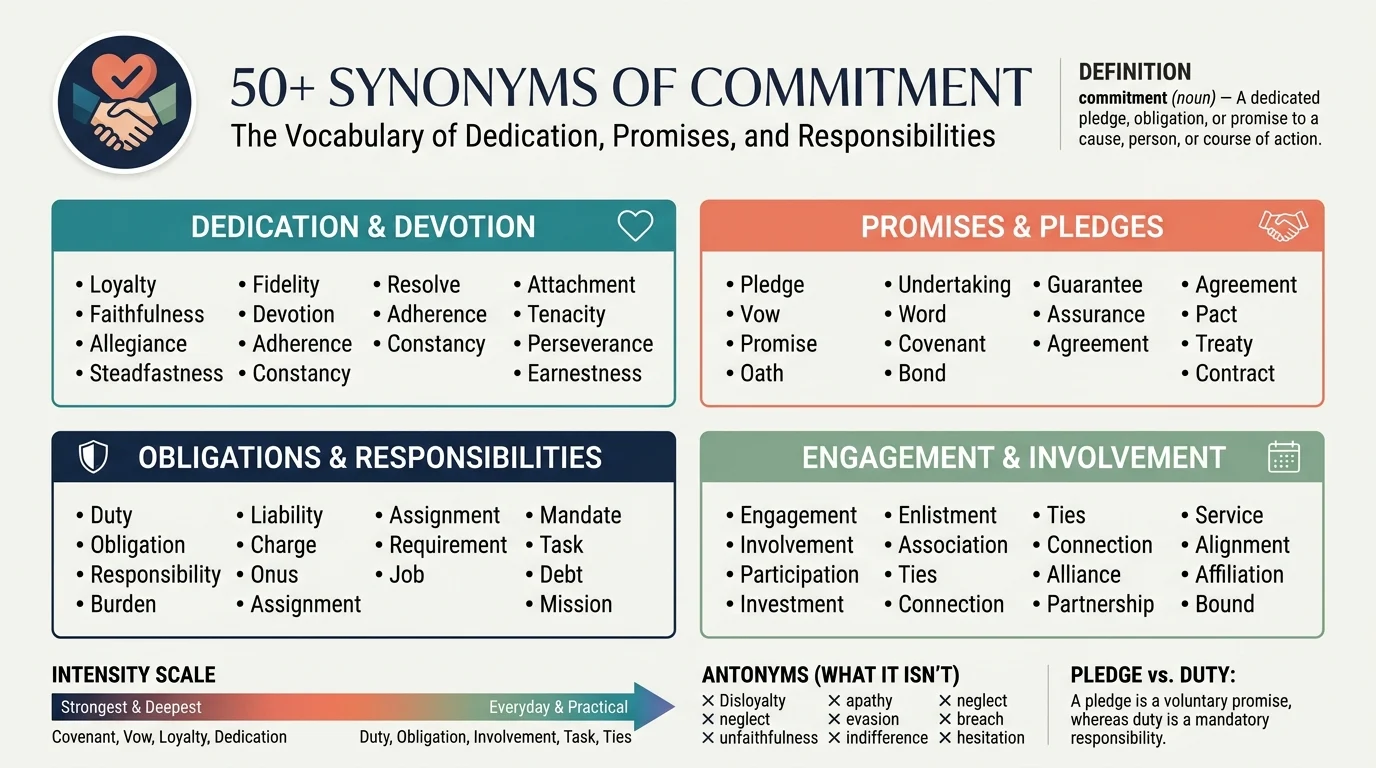
Have you ever needed to describe dedication, a promise, or a firm decision but felt that “commitment” was too formal or repetitive? You want to capture the specific sense of loyalty, obligation, or engagement, and the word “commitment” comes to mind. Choosing the right synonym for “commitment” can transform a basic statement into a precise expression of dedication, responsibility, or devotion. This guide explores the best synonyms of commitment, explaining exactly which word to use and when.
Quick Ans: “Commitment” means dedication to a cause, activity, or relationship; a promise or pledge; or the state of being bound to a course of action. For dedication, choose dedication, devotion, or loyalty. For promises, use pledge, promise, or vow. For obligations, use obligation, responsibility, or duty. For engagement, use involvement or engagement.
Meaning, Tone, and Context
Understanding the core meaning of “commitment” is the first step to using it effectively.
Simple Definition: The state or quality of being dedicated to a cause, activity, or relationship; a promise or pledge to do something; an obligation or engagement.
Part of Speech: Noun.
Overall Tone: Positive. It indicates dedication, responsibility, and trustworthiness.
Formality Level: Neutral to formal. The word is appropriate in professional, personal, and academic contexts.
Common Uses: Native English speakers use it in relationships (“commitment to marriage”), business (“commitment to quality”), personal goals (“commitment to fitness”), and professional contexts (“commitment to excellence”).
Word Forms: Related words include the verb commit, the adjective committed, and the noun commitment.
When and How to Use “Commitment”
“Commitment” is the perfect choice when you want to describe dedication, promises, or obligations. Here are seven realistic examples.
Professional: “The company has a strong commitment to customer satisfaction.”
Personal: “Their commitment to each other has lasted decades.”
Academic: “The study required a significant time commitment.”
Business: “We need a commitment from all stakeholders before proceeding.”
Workplace: “Her commitment to the team is admirable.”
Sports: “The athlete’s commitment to training paid off.”
Social Media: “Commitment is the key to achieving your goals.”
Best Synonyms of “Commitment”
No synonym is identical in every situation. Here is your guide to the best replacement for “commitment” based on your writing context.
For Dedication and Devotion
Most Direct: Dedication means devotion to a task. “Her dedication to the project was inspiring.”
Devotion: Devotion means deep love and loyalty. “His devotion to his family was unwavering.”
Loyalty: Loyalty means faithfulness. “The company values loyalty in its employees.”
Allegiance: Allegiance means loyalty to a cause. “They pledged allegiance to the flag.”
For Promises and Pledges
Pledge: Pledge means a solemn promise. “The government made a pledge to reduce emissions.”
Promise: Promise means a declaration of intent. “He made a promise to help.”
Vow: Vow means a solemn promise. “They exchanged vows at the wedding.”
Guarantee: Guarantee means a formal assurance. “The product comes with a satisfaction guarantee.”
For Obligations and Responsibilities
Obligation: Obligation means a duty or commitment. “He felt an obligation to help his parents.”
Responsibility: Responsibility means a duty. “She has responsibility for the entire department.”
Duty: Duty means a moral obligation. “It is our duty to protect the environment.”
Accountability: Accountability means being responsible. “The manager accepted accountability for the mistake.”
For Engagement and Involvement
Involvement: Involvement means participation. “Her involvement in the community is extensive.”
Engagement: Engagement means active participation. “The engagement of employees improved.”
Participation: Participation means taking part. “Participation in the program is voluntary.”
Investment: Investment means giving time or effort. “The investment of time paid off.”
When Not to Use “Commitment”
Using “commitment” can sound wrong or awkward in certain situations.
When You Mean “Promise”: “Commitment” is broader. “Promise” is specific.
Better Choice: Promise. “He made a promise.”
When You Mean “Interest”: “Commitment” implies dedication. “Interest” is milder.
Better Choice: Interest. “He has an interest in music.”
When It Sounds Too Formal: In casual conversation, “commitment” can sound heavy.
Better Choice: Promise or dedication. “I made a promise to help.”
Words Commonly Confused With “Commitment”
| Word | Difference | When to Use | Example |
|---|---|---|---|
| Dedication | Devotion to a task | Work and goals | “Dedication to the project.” |
| Promise | A declaration of intent | Personal and formal | “He made a promise.” |
| Obligation | A duty | Moral and legal | “An obligation to pay.” |
| Devotion | Deep love and loyalty | Relationships and causes | “Devotion to family.” |
| Responsibility | A duty or task | Professional and personal | “Responsibility for the team.” |
| Loyalty | Faithfulness | Relationships and brands | “Loyalty to the company.” |
Best Synonyms of “Commitment” by Context
| Context | Best Synonym | Why It Works | Example |
|---|---|---|---|
| Formal writing | Obligation | Formal and precise | “The obligation to deliver is clear.” |
| Academic writing | Dedication | Standard in research | “The dedication to the study was evident.” |
| Professional | Responsibility | Professional and clear | “Responsibility for the outcome.” |
| Business | Pledge | Business and formal | “The company made a pledge to sustainability.” |
| Personal | Devotion | Personal and emotional | “Devotion to family.” |
| Casual | Promise | Simple and natural | “I made a promise.” |
| Sports | Dedication | Athletic and determined | “Dedication to training.” |
How to Choose the Best Synonym of “Commitment”
Choosing the right word is a simple decision. Answer these questions.
What type of commitment am I describing? For dedication, use dedication or devotion. And For promises, use pledge or promise. For obligations, use obligation or responsibility. For engagement, use involvement or engagement.
What is my audience? For a formal report, use obligation or responsibility. For a friend, use promise or dedication.
What is my purpose? Are you describing a relationship, a business deal, or a personal goal? The correct synonym depends entirely on this.
What is the emotional strength? Devotion and vow are stronger. Involvement is milder. Pick the one that matches your message.
Real Life Examples of “Commitment”
School: Basic: “The student shows commitment.” Improved: “The student shows dedication to her studies.”
College: Basic: “The study required commitment.” Improved: “The study required a significant time investment.”
Workplace: Basic: “She has commitment to the team.” Improved: “She has loyalty to the team.”
Business: Basic: “The company made a commitment.” Improved: “The company made a pledge to sustainability.”
Email: Basic: “Thank you for your commitment.” Improved: “Thank you for your dedication.”
Conversation: Basic: “I have a commitment.” Improved: “I made a promise.”
Storytelling: Basic: “Their commitment was tested.” Improved: “Their devotion was tested.”
Top 10 Synonyms of “Commitment”
| Synonym | Simple Meaning | Best Used For | Example Sentence |
|---|---|---|---|
| Dedication | Devotion to a task | Work and goals | “Her dedication to the project was inspiring.” |
| Devotion | Deep love and loyalty | Relationships and causes | “His devotion to his family was unwavering.” |
| Pledge | A solemn promise | Formal and business | “The government made a pledge.” |
| Promise | A declaration of intent | Personal and formal | “He made a promise to help.” |
| Obligation | A duty | Moral and legal | “He felt an obligation to help.” |
| Responsibility | A duty or task | Professional and personal | “She has responsibility for the team.” |
| Loyalty | Faithfulness | Relationships and brands | “The company values loyalty.” |
| Vow | A solemn promise | Marriage and formal | “They exchanged vows.” |
| Engagement | Active participation | Professional and social | “Employee engagement improved.” |
| Allegiance | Loyalty to a cause | Formal and political | “They pledged allegiance to the flag.” |
Synonyms of “Commitment” by Usage
Professional vs. Personal Synonyms
In the workplace, choose responsibility, dedication, or engagement. With friends, use promise, dedication, or loyalty.
Formal vs. Conversational Synonyms
For formal writing, use obligation, pledge, or allegiance. For casual conversations, use promise, dedication, or loyalty.
Academic Synonyms
For research and essays, choose dedication for effort, obligation for duty, and engagement for participation.
Professional and Business Synonyms
For maximum impact, choose dedication for employees, pledge for sustainability, and responsibility for roles.
Creative and Literary Synonyms
To add emotion and imagery, choose devotion, vow, or allegiance. These words create atmosphere.
Slang or Modern Synonyms
In modern American slang, promise, dedication, or grind are common. For example, “Trust the grind.” These are casual and should be avoided in formal writing.
Strongest to Mildest Synonyms
Mild: involvement, interest, participation
Moderate: commitment, dedication, promise
Strong: devotion, loyalty, obligation
Very Strong: vow, pledge, allegiance
Emotional vs. Neutral Synonyms
Emotional Synonyms: Devotion, vow, allegiance. These words hint at deep feeling. Use them when you want to evoke emotion.
Neutral Synonyms: Commitment, obligation, responsibility. These words communicate factual information.
Antonyms of “Commitment”
| Antonym | Meaning | Example Sentence |
|---|---|---|
| Indifference | Lack of interest | “His indifference was hurtful.” |
| Apathy | Lack of emotion | “The apathy of voters was concerning.” |
| Neglect | Failure to care for | “The neglect of duties was unacceptable.” |
| Disloyalty | Lack of loyalty | “The disloyalty of the employee was shocking.” |
| Betrayal | Breaking trust | “The betrayal ended the partnership.” |
| Abandonment | Leaving without care | “The abandonment of the project was disappointing.” |
| Irresponsibility | Lack of responsibility | “His irresponsibility caused problems.” |
| Inconstancy | Changeability | “Her inconstancy frustrated her friends.” |
| Fickleness | Changeability | “His fickleness made him unreliable.” |
| Unreliability | Not dependable | “The unreliability of the supplier was a problem.” |
| Hesitation | Pausing in uncertainty | “His hesitation cost him the opportunity.” |
| Reluctance | Unwillingness | “Her reluctance to commit was clear.” |
| Avoidance | Staying away | “Avoidance of responsibility is unacceptable.” |
| Withdrawal | Pulling back | “The withdrawal of support was unexpected.” |
| Detachment | Lack of involvement | “His detachment was noticeable.” |
Comparison: “Commitment” vs Similar Words
Commitment vs. Dedication
Main Difference: “Commitment” is broader. “Dedication” is devotion to a task.
Which Is Stronger? “Dedication” is more specific.
Which Is More Formal? Both are formal.
When to Use Each: Use “dedication” for work. Use “commitment” for general contexts.
Examples:
Commitment: “The commitment to quality.”
Dedication: “Her dedication to the project.”
Commitment vs. Promise
Main Difference: “Commitment” is broader. “Promise” is a declaration.
Which Is Stronger? “Promise” is more specific.
Which Is More Formal? Both are formal.
When to Use Each: Use “promise” for personal declarations. Use “commitment” for general contexts.
Examples:
Commitment: “The commitment to the cause.”
Promise: “He made a promise.”
Commitment vs. Obligation
Main Difference: “Commitment” is voluntary. “Obligation” is a duty.
Which Is Stronger? “Obligation” is stronger for duty.
Which Is More Formal? Both are formal.
When to Use Each: Use “obligation” for duties. Use “commitment” for general contexts.
Examples:
Commitment: “The commitment to excellence.”
Obligation: “The obligation to pay.”
Commitment vs. Devotion
Main Difference: “Commitment” is broader. “Devotion” is deep love.
Which Is Stronger? “Devotion” is stronger emotionally.
Which Is More Formal? Both are formal.
When to Use Each: Use “devotion” for relationships. Use “commitment” for general contexts.
Examples:
Commitment: “The commitment to the team.”
Devotion: “His devotion to his family.”
Commitment vs. Loyalty
Main Difference: “Commitment” is broader. “Loyalty” is faithfulness.
Which Is Stronger? “Loyalty” is more specific.
Which Is More Formal? Both are formal.
When to Use Each: Use “loyalty” for brands. Use “commitment” for general contexts.
Examples:
Commitment: “The commitment to the company.”
Loyalty: “Customer loyalty is important.”
Commitment vs. Engagement
Main Difference: “Commitment” is dedication. “Engagement” is participation.
Which Is Stronger? “Commitment” is stronger for dedication.
Which Is More Formal? Both are formal.
When to Use Each: Use “engagement” for participation. Use “commitment” for dedication.
Examples:
Commitment: “The commitment to the cause.”
Engagement: “Employee engagement improved.”
Common Phrases and Expressions with “Commitment”
Phrase: Commitment to excellence
Meaning: Dedication to high standards.
Example Sentence: “The company’s commitment to excellence is evident.”
Phrase: Make a commitment
Meaning: Pledge to do something.
Example Sentence: “She made a commitment to exercise daily.”
Phrase: Long-term commitment
Meaning: A lasting dedication.
Example Sentence: “The project requires a long-term commitment.”
Phrase: Commitment issues
Meaning: Difficulty making commitments.
Example Sentence: “He has commitment issues.”
Phrase: Total commitment
Meaning: Complete dedication.
Example Sentence: “The team showed total commitment.”
Phrase: Commitment to quality
Meaning: Dedication to quality.
Example Sentence: “Our commitment to quality is unwavering.”
Common Mistakes to Avoid
Mistake 1: Using “commitment” when you mean “promise”.
Incorrect: “He made a commitment to call.”
Better: “He made a promise to call.”
Why: “Promise” is for specific declarations.
Mistake 2: Using “commitment” when you mean “interest”.
Incorrect: “He has a commitment in music.”
Better: “He has an interest in music.”
Why: “Interest” is milder.
Mistake 3: Overusing “commitment” in conversation.
Incorrect: “I have a commitment.”
Better: “I made a promise.”
Why: “Promise” sounds more natural.
Mistake 4: Using “commitment” when you mean “obligation”.
Incorrect: “I have a commitment to pay taxes.”
Better: “I have an obligation to pay taxes.”
Why: “Obligation” is for duties.
Mistake 5: Using “commitment” when you mean “devotion”.
Incorrect: “His commitment to his wife is admirable.”
Better: “His devotion to his wife is admirable.”
Why: “Devotion” is for love.
Frequently Asked Questions
1. What are the best synonyms of “commitment”?
The best synonyms depend on your context. For dedication, choose dedication or devotion. And For promises, use pledge or promise. For obligations, use obligation or responsibility.
2. What are the best formal synonyms of “commitment”?
The best formal synonyms are obligation, pledge, and allegiance. These words are suitable for academic papers, professional reports, and business communications.
3. What are common informal synonyms of “commitment”?
For informal settings, use promise, dedication, or loyalty. These alternatives sound more natural in everyday conversation.
4. What is another word for “commitment” in professional writing?
In professional writing, dedication is an excellent choice. It conveys devotion to work. Responsibility is also strong for roles.
5. What is the difference between “commitment” and “dedication”?
“Commitment” is broader. “Dedication” is devotion to a task. Use “dedication” for work and “commitment” for general contexts.
6. What is the opposite of “commitment”?
The most direct opposites (antonyms) of commitment are indifference, apathy, and neglect. These words describe a lack of dedication or care.
Conclusion
“Commitment” is a powerful and positive word for describing dedication, promises, and obligations. The term is neutral and widely accepted in most contexts, yet it can sound too formal for casual conversation or too broad for specific descriptions. The best choice among the synonyms of commitment depends entirely on your audience, tone, and purpose. Remember, no single synonym works perfectly in every situation. Your goal is to choose the word that communicates your message with the most clarity and impact. A practical tip for your vocabulary growth is to pay attention to how writers describe dedication and promises and practice using different synonyms in your writing.









