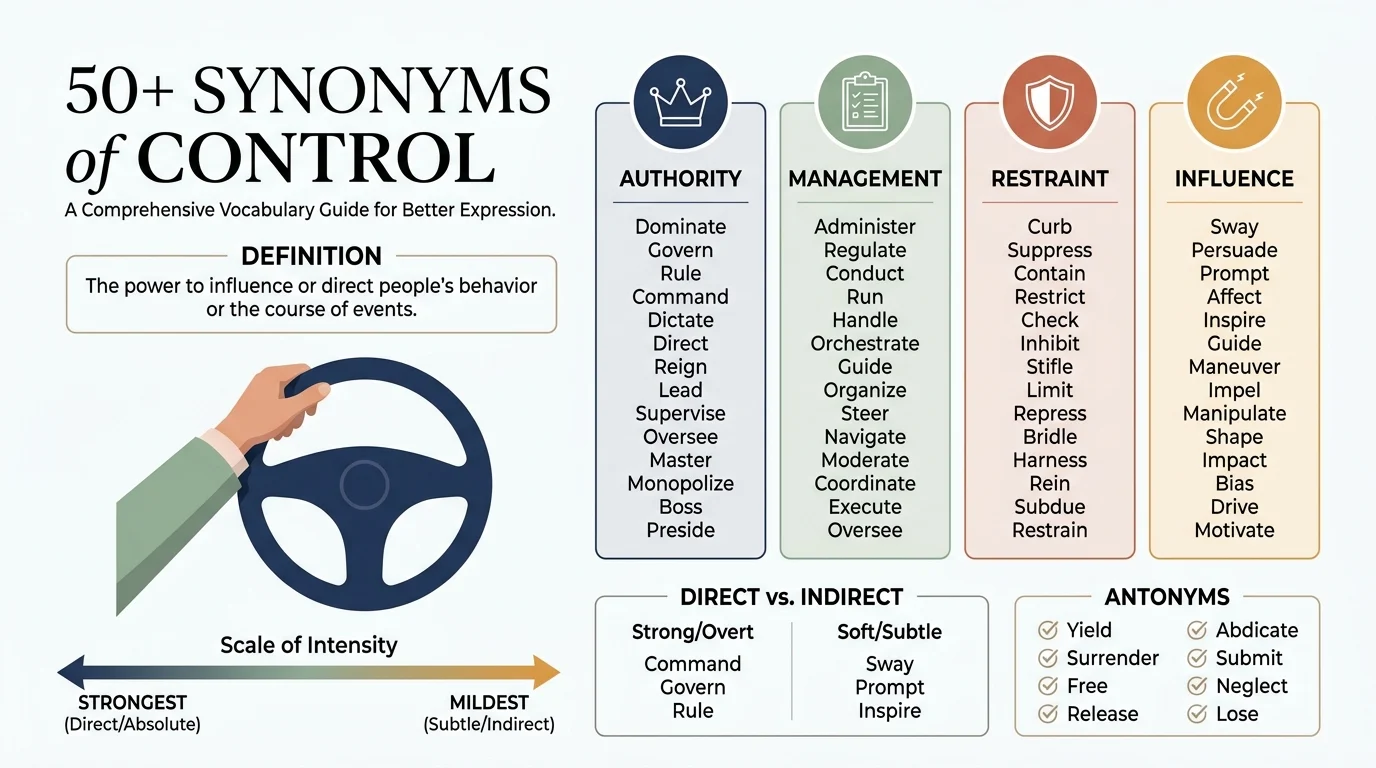
Have you ever needed to describe power, authority, or the ability to manage something but felt that “control” was too broad or repetitive? You want to capture the specific type of influence, regulation, or command, and the word “control” comes to mind. Choosing the right synonym for “control” can transform a basic statement into a precise expression of authority, management, or restraint. This guide explores the best synonyms of control, explaining exactly which word to use and when.
Quick Ans: “Control” means the power to influence or direct people’s behavior or the course of events, the ability to manage something, or restraint over one’s emotions. For authority and power, choose command or authority. For management and regulation, use management or regulation. For restraint, use restraint or self-discipline. For influence, use influence or dominance.
Meaning, Tone, and Context
Understanding the core meaning of “control” is the first step to using it effectively.
Simple Definition: The power to influence or direct people’s behavior or the course of events; the ability to manage or regulate something; restraint over one’s emotions or actions.
Part of Speech: Noun and verb.
Overall Tone: Neutral. It can indicate authority, management, or restraint depending on context.
Formality Level: Neutral to formal. The word is appropriate in most contexts.
Common Uses: Native English speakers use it in business (“quality control”), psychology (“self-control”), technology (“remote control”), and general contexts (“take control”).
Word Forms: Related words include the adjective controllable, the noun controller, and the adjective controlling.
When and How to Use “Control”
“Control” is the perfect choice when you want to describe authority, management, or restraint. Here are seven realistic examples.
Business: “The manager has control over the department’s budget.”
Psychology: “She practiced self-control during the negotiation.”
Technology: “The remote control operates the television.”
Professional: “Quality control is essential in manufacturing.”
Personal: “He lost control of his emotions.”
Academic: “The study examines parental control over children’s screen time.”
Social Media: “The government tightened control over social media platforms.”
Best Synonyms of “Control”
No synonym is identical in every situation. Here is your guide to the best replacement for “control” based on your writing context.
For Authority and Power
Most Direct: Command means authority or power. “He took command of the situation.”
Authority: Authority means the power to give orders. “She has authority over the team.”
Dominance: Dominance means power over others. “The company achieved dominance in the market.”
Rule: Rule means governing power. “The king’s rule lasted for decades.”
For Management and Regulation
Management: Management means the process of managing. “Good management is key to success.”
Regulation: Regulation means controlling by rules. “The regulation of the industry is strict.”
Supervision: Supervision means overseeing. “The project requires close supervision.”
Direction: Direction means guidance or management. “The team followed her direction.”
For Restraint and Self-Discipline
Restraint: Restraint means self-control. “He showed great restraint.”
Self-discipline: Self-discipline means controlling oneself. “Self-discipline is essential for success.”
Composure: Composure means calm self-control. “She maintained her composure.”
Willpower: Willpower means the ability to control oneself. “It takes willpower to quit smoking.”
For Influence and Power
Influence: Influence means the power to affect. “She has influence over the decisions.”
Power: Power means the ability to act. “The company has great power.”
Sway: Sway means controlling influence. “He held sway over the committee.”
Clout: Clout means influence or power. “The senator has clout in Washington.”
When Not to Use “Control”
Using “control” can sound wrong or awkward in certain situations.
When You Mean “Manage”: “Control” can sound harsh. “Manage” is neutral.
Better Choice: Manage or oversee. “She manages the team.”
When You Mean “Influence”: “Control” is stronger. “Influence” is softer.
Better Choice: Influence or affect. “The weather influenced our plans.”
When It Sounds Too Negative: “Control” can imply domination.
Better Choice: Guide or direct. “He guided the project to completion.”
Words Commonly Confused With “Control”
| Word | Difference | When to Use | Example |
|---|---|---|---|
| Manage | To handle or direct | Business and general | “She manages the team.” |
| Regulate | To control by rules | Systems and laws | “The agency regulates the industry.” |
| Influence | To affect | Personal and social | “He influenced the decision.” |
| Authority | Power to give orders | Formal and legal | “She has authority.” |
| Restraint | Self-control | Emotional contexts | “He showed restraint.” |
| Power | Ability to act | General and political | “The company has power.” |
Best Synonyms of “Control” by Context
| Context | Best Synonym | Why It Works | Example |
|---|---|---|---|
| Formal writing | Authority | Formal and precise | “She has authority over the budget.” |
| Academic writing | Regulation | Standard in research | “The regulation of the industry.” |
| Professional | Supervision | Professional and clear | “The project requires supervision.” |
| Business | Management | Business and administrative | “Good management is key.” |
| Emotional | Restraint | Emotional and personal | “He showed great restraint.” |
| Technology | Direction | Technical and mechanical | “The direction of the robot.” |
| Casual | Sway | Simple and natural | “He holds sway over the group.” |
How to Choose the Best Synonym of “Control”
Choosing the right word is a simple decision. Answer these questions.
What type of control am I describing? For authority, use command or authority. And For management, use management or regulation. For restraint, use restraint or self-discipline. For influence, use influence or sway.
What is my audience? For a formal report, use authority or regulation. For a friend, use sway or manage.
What is my purpose? Are you describing power, management, or restraint? The correct synonym depends entirely on this.
What is the emotional strength? Dominance and clout are stronger. Restraint is calmer. Pick the one that matches your message.
Real Life Examples of “Control”
School: Basic: “The teacher has control.” Improved: “The teacher has authority in the classroom.”
College: Basic: “The study examines control.” Improved: “The study examines regulation of the system.”
Workplace: Basic: “She has control over the project.” Improved: “She has supervision over the project.”
Business: Basic: “The company has control.” Improved: “The company has dominance in the market.”
Email: Basic: “Please control the process.” Improved: “Please manage the process.”
Conversation: Basic: “He lost control.” Improved: “He lost his composure.”
Storytelling: Basic: “She had control over the kingdom.” Improved: “She held sway over the kingdom.”
Top 10 Synonyms of “Control”
| Synonym | Simple Meaning | Best Used For | Example Sentence |
|---|---|---|---|
| Command | Authority or power | Formal and military | “He took command of the situation.” |
| Authority | Power to give orders | Formal and legal | “She has authority over the team.” |
| Management | Process of managing | Business and administrative | “Good management is key to success.” |
| Regulation | Controlling by rules | Systems and laws | “The regulation of the industry is strict.” |
| Restraint | Self-control | Emotional and personal | “He showed great restraint.” |
| Influence | Power to affect | Personal and social | “She has influence over the decisions.” |
| Dominance | Power over others | Business and competitive | “The company achieved dominance.” |
| Supervision | Overseeing | Professional and academic | “The project requires supervision.” |
| Composure | Calm self-control | Emotional and personal | “She maintained her composure.” |
| Sway | Controlling influence | Casual and general | “He held sway over the committee.” |
Synonyms of “Control” by Usage
Professional vs. Personal Synonyms
In the workplace, choose management, supervision, or authority. With friends, use manage, sway, or composure.
Formal vs. Conversational Synonyms
For formal writing, use authority, regulation, or supervision. For casual conversations, use sway, manage, or composure.
Academic Synonyms
For research and essays, choose regulation for systems, authority for power, and restraint for psychology.
Professional and Business Synonyms
For maximum impact, choose management for teams, dominance for markets, and supervision for projects.
Creative and Literary Synonyms
To add emotion and imagery, choose sway, dominance, or composure. These words create atmosphere.
Slang or Modern Synonyms
In modern American slang, clout, control, or sway are common. For example, “He has clout.” These are casual and should be avoided in formal writing.
Strongest to Mildest Synonyms
Mild: guidance, direction, influence
Moderate: control, management, supervision
Strong: authority, command, restraint
Very Strong: dominance, power, clout
Emotional vs. Neutral Synonyms
Emotional Synonyms: Composure, restraint, willpower. These words hint at inner strength. Use them when you want to evoke feeling.
Neutral Synonyms: Control, management, regulation. These words communicate factual information.
Antonyms of “Control”
| Antonym | Meaning | Example Sentence |
|---|---|---|
| Powerlessness | Lack of power | “He felt a sense of powerlessness.” |
| Helplessness | Unable to help oneself | “The helplessness was overwhelming.” |
| Chaos | Complete disorder | “The chaos was uncontrollable.” |
| Disorder | Lack of order | “The disorder spread quickly.” |
| Anarchy | Absence of government | “The country fell into anarchy.” |
| Freedom | Absence of control | “Freedom is precious.” |
| Liberty | State of being free | “Liberty is a fundamental right.” |
| Independence | Freedom from control | “Independence is valued.” |
| Autonomy | Self-governance | “Autonomy is important for workers.” |
| Lack of restraint | No self-control | “His lack of restraint was concerning.” |
| Impulsiveness | Acting without thought | “Impulsiveness led to mistakes.” |
| Recklessness | Lack of caution | “The recklessness was dangerous.” |
| Wildness | Uncontrolled nature | “The wildness of the party was exhausting.” |
| Abandon | Complete lack of restraint | “He danced with abandon.” |
| Surrender | Giving up control | “The surrender was complete.” |
Comparison: “Control” vs Similar Words
Control vs. Manage
Main Difference: “Control” implies power. “Manage” implies handling.
Which Is Stronger? “Control” is stronger.
Which Is More Formal? Both are neutral.
When to Use Each: Use “manage” for everyday tasks. Use “control” for power.
Examples:
Control: “She controls the budget.”
Manage: “She manages the team.”
Control vs. Regulate
Main Difference: “Control” is broader. “Regulate” is about rules.
Which Is Stronger? “Regulate” is more specific.
Which Is More Formal? Both are formal.
When to Use Each: Use “regulate” for laws. Use “control” for general contexts.
Examples:
Control: “He controls his emotions.”
Regulate: “The agency regulates the industry.”
Control vs. Influence
Main Difference: “Control” implies power. “Influence” implies effect.
Which Is Stronger? “Control” is stronger.
Which Is More Formal? Both are neutral.
When to Use Each: Use “influence” for softer effect. Use “control” for direct power.
Examples:
Control: “She controls the decision.”
Influence: “She influenced the decision.”
Control vs. Authority
Main Difference: “Control” is the exercise of power. “Authority” is the right to power.
Which Is Stronger? “Authority” is more formal.
Which Is More Formal? “Authority” is more formal.
When to Use Each: Use “authority” for official power. Use “control” for general contexts.
Examples:
Control: “He has control over the department.”
Authority: “She has authority over the team.”
Control vs. Restraint
Main Difference: “Control” is broader. “Restraint” is self-control.
Which Is Stronger? “Restraint” is more specific to self-control.
Which Is More Formal? Both are formal.
When to Use Each: Use “restraint” for emotions. Use “control” for general contexts.
Examples:
Control: “He has control over his temper.”
Restraint: “He showed great restraint.”
Control vs. Dominance
Main Difference: “Control” is broader. “Dominance” is power over others.
Which Is Stronger? “Dominance” is stronger.
Which Is More Formal? Both are formal.
When to Use Each: Use “dominance” for competitive contexts. Use “control” for general contexts.
Examples:
Control: “She has control over the project.”
Dominance: “The company achieved dominance.”
Common Phrases and Expressions with “Control”
Phrase: Quality control
Meaning: Maintaining standards.
Example Sentence: “Quality control is essential in manufacturing.”
Phrase: Self-control
Meaning: Controlling one’s emotions.
Example Sentence: “Self-control is important in stressful situations.”
Phrase: Take control
Meaning: Assume authority.
Example Sentence: “She took control of the situation.”
Phrase: Lose control
Meaning: No longer able to manage.
Example Sentence: “He lost control of the car.”
Phrase: Under control
Meaning: Being managed properly.
Example Sentence: “The situation is under control.”
Phrase: Remote control
Meaning: A device for operating from a distance.
Example Sentence: “He used the remote control to change the channel.”
Common Mistakes to Avoid
Mistake 1: Using “control” when you mean “manage”.
Incorrect: “She controls the team.”
Better: “She manages the team.”
Why: “Manage” is more appropriate for teams.
Mistake 2: Using “control” when you mean “influence”.
Incorrect: “The weather controlled our plans.”
Better: “The weather influenced our plans.”
Why: “Influence” is softer.
Mistake 3: Overusing “control” in conversation.
Incorrect: “He has control over the group.”
Better: “He has sway over the group.”
Why: “Sway” sounds more natural.
Mistake 4: Using “control” when you mean “authority”.
Incorrect: “She has control over the department.”
Better: “She has authority over the department.”
Why: “Authority” is more formal.
Mistake 5: Using “control” when you mean “restraint”.
Incorrect: “He showed control during the argument.”
Better: “He showed restraint during the argument.”
Why: “Restraint” is for self-control.
Frequently Asked Questions
1. What are the best synonyms of “control”?
The best synonyms depend on your context. For authority, choose command or authority. And For management, use management or regulation. For restraint, use restraint or self-discipline.
2. What are the best formal synonyms of “control”?
The best formal synonyms are authority, regulation, and supervision. These words are suitable for academic papers, professional reports, and business communications.
3. What are common informal synonyms of “control”?
For informal settings, use sway, manage, or composure. These alternatives sound more natural in everyday conversation.
4. What is another word for “control” in professional writing?
In professional writing, management is an excellent choice. It conveys handling and oversight. Authority is also strong for power.
5. What is the difference between “control” and “manage”?
“Control” implies power. “Manage” implies handling. Use “manage” for everyday tasks and “control” for power.
6. What is the opposite of “control”?
The most direct opposites (antonyms) of control are powerlessness, chaos, and freedom. These words describe a lack of control or restraint.
Conclusion
“Control” is a powerful and versatile word for describing authority, management, and restraint. The term is neutral and widely accepted in most contexts, yet it can sound too harsh for everyday situations or too broad for specific descriptions. The best choice among the synonyms of control depends entirely on your audience, tone, and purpose. Remember, no single synonym works perfectly in every situation. Your goal is to choose the word that communicates your message with the most clarity and impact. A practical tip for your vocabulary growth is to pay attention to how writers describe power and management and practice using different synonyms in your writing.









