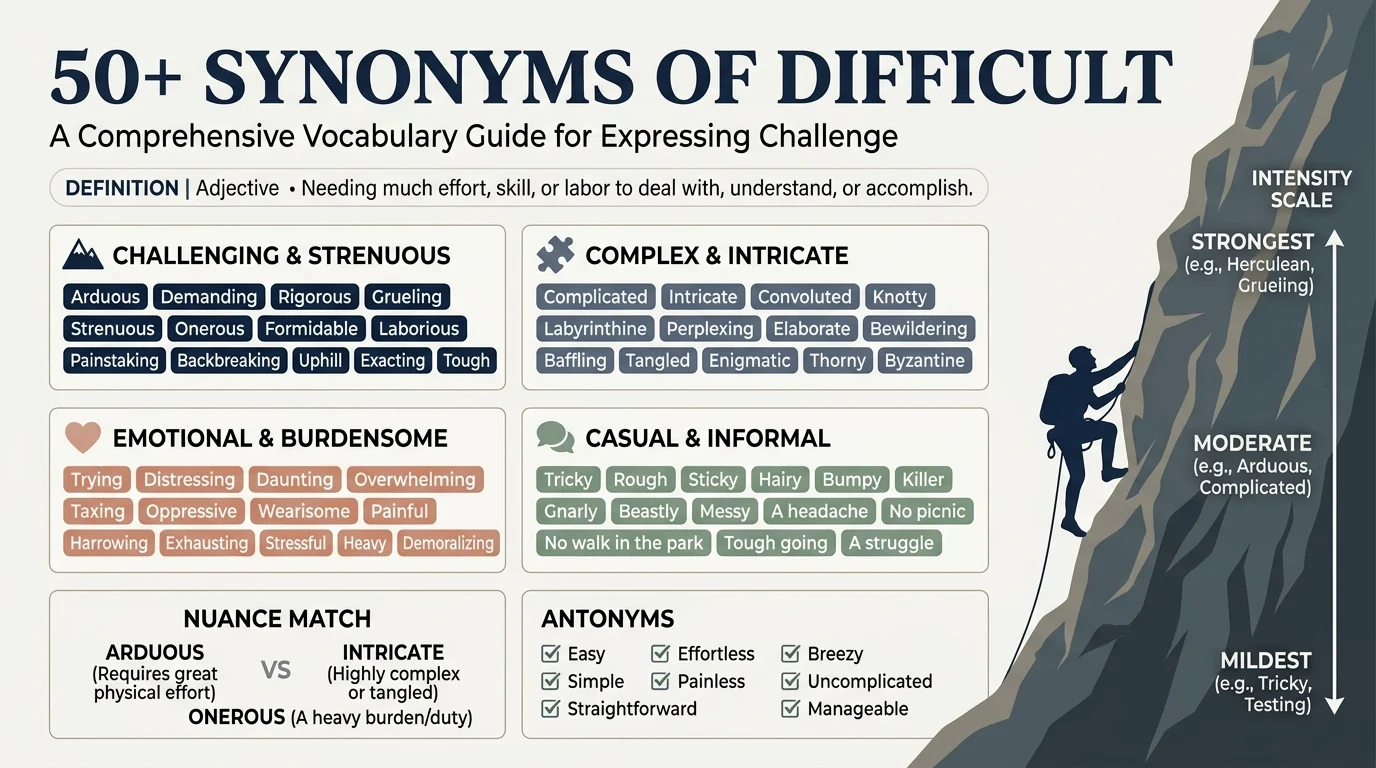
Have you ever needed to describe a task, decision, or person that is hard to handle but felt that “difficult” was too simple or repetitive? You want to capture the specific nature of the challenge, whether it is complexity, effort, or resistance, and the word “difficult” comes to mind. Choosing the right synonym for “difficult” can transform a basic statement into a precise expression of challenge, complexity, or struggle. This guide explores the best synonyms of difficult, explaining exactly which word to use and when.
Quick Ans: “Difficult” means hard to do, achieve, or understand, or hard to deal with. For formal writing, choose challenging or demanding. For complexity, use complex or intricate. For emotional contexts, use trying or taxing. For casual conversation, use tough or hard. For describing people, use demanding or uncooperative.
Meaning, Tone, and Context
Understanding the core meaning of “difficult” is the first step to using it effectively.
Simple Definition: Needing much effort or skill to accomplish, deal with, or understand; not easy.
Part of Speech: Adjective.
Overall Tone: Neutral to negative. It indicates challenge, complexity, or resistance.
Formality Level: Neutral. The word works in all contexts, from casual to formal.
Common Uses: Native English speakers use it to describe tasks (“difficult project”), people (“difficult person”), decisions (“difficult choice”), and situations (“difficult circumstances”).
Word Forms: Related words include the noun difficulty, the adverb difficultly, and the adjective difficult.
When and How to Use “Difficult”
“Difficult” is the perfect choice when you want to describe something that requires effort or is hard to handle. Here are seven realistic examples.
Professional: “The negotiation was difficult but ultimately successful.”
Academic: “The exam was difficult, requiring hours of study.”
Workplace: “She handled a difficult client with patience.”
Personal: “It was a difficult decision to move away.”
Email: “I understand this is a difficult request, but we need it by Friday.”
Resume: (Avoid in resumes) Use “challenging” instead.
Social Media: “Adulting is difficult, but we manage.”
Best Synonyms of “Difficult”
No synonym is identical in every situation. Here is your guide to the best replacement for “difficult” based on your writing context.
For Challenging Tasks and Situations
Most Direct: Challenging means testing one’s abilities. “The project was challenging but rewarding.”
Demanding: Demanding means requiring much effort. “The job is demanding but fulfilling.”
Arduous: Arduous means involving strenuous effort. “The arduous journey took weeks.”
Strenuous: Strenuous means requiring great effort. “Strenuous exercise is good for health.”
For Complex and Complicated
Complex: Complex means consisting of many parts. “The problem is complex.”
Complicated: Complicated means difficult to understand. “The instructions are complicated.”
Intricate: Intricate means very detailed. “The intricate design took months.”
Convoluted: Convoluted means extremely complex. “The convoluted plot confused viewers.”
For People and Behavior
Demanding: Demanding means requiring much attention. “The demanding boss expected perfection.”
Uncooperative: Uncooperative means unwilling to help. “The uncooperative witness refused to answer.”
Stubborn: Stubborn means refusing to change. “The stubborn child refused to listen.”
Trying: Trying means difficult to deal with. “The trying circumstances tested their patience.”
For Emotional and Personal Challenges
Trying: Trying means putting strain on someone. “The trying times brought them closer.”
Taxing: Taxing means mentally or physically draining. “The taxing job left her exhausted.”
Grueling: Grueling means extremely tiring. “The grueling schedule was unsustainable.”
Tough: Tough means strong and difficult. “It was a tough loss for the team.”
When Not to Use “Difficult”
Using “difficult” can sound wrong or awkward in certain situations.
When You Mean “Impossible”: “Difficult” implies possible. “Impossible” means not possible.
Better Choice: Impossible or unattainable. “The goal was impossible to achieve.”
When You Mean “Complex”: “Difficult” is about effort. “Complex” is about structure.
Better Choice: Complex or complicated. “The system is complex.”
When It Sounds Too Negative: “Difficult” can sound discouraging.
Better Choice: Challenging or demanding. “The task is challenging.”
Words Commonly Confused With “Difficult”
| Word | Difference | When to Use | Example |
|---|---|---|---|
| Hard | General and casual | Everyday contexts | “The test was hard.” |
| Challenging | Positive and motivating | Work and growth | “A challenging project.” |
| Complex | Many parts | Systems and problems | “A complex issue.” |
| Complicated | Hard to understand | Instructions and situations | “Complicated rules.” |
| Demanding | Requires much effort | Jobs and people | “A demanding role.” |
| Tough | Strong and difficult | Casual and general | “A tough decision.” |
Best Synonyms of “Difficult” by Context
| Context | Best Synonym | Why It Works | Example |
|---|---|---|---|
| Formal writing | Arduous | Formal and precise | “The arduous task took weeks.” |
| Academic writing | Complex | Standard in research | “The complex problem was analyzed.” |
| Professional | Demanding | Professional and clear | “The demanding schedule continued.” |
| Business | Challenging | Positive and motivating | “The challenging market required innovation.” |
| Emotional | Trying | Emotional and personal | “The trying times tested them.” |
| Casual | Tough | Simple and natural | “It was a tough day.” |
| People | Uncooperative | Behavioral and specific | “The uncooperative client was frustrating.” |
How to Choose the Best Synonym of “Difficult”
Choosing the right word is a simple decision. Answer these questions.
What type of difficulty am I describing? For tasks, use challenging or demanding. And For complexity, use complex or intricate. For people, use demanding or uncooperative. For emotions, use trying or taxing.
What is my audience? For a formal report, use arduous or demanding. For a friend, use tough or hard.
What is my purpose? Are you describing a task, a person, or a situation? The correct synonym depends entirely on this.
What is the emotional strength? Grueling and trying are stronger. Challenging is more positive. Pick the one that matches your message.
Real Life Examples of “Difficult”
School: Basic: “The homework was difficult.” Improved: “The homework was challenging but manageable.”
College: Basic: “The course was difficult.” Improved: “The course was demanding and required hours of study.”
Workplace: Basic: “The client was difficult.” Improved: “The client was demanding and uncooperative.”
Business: Basic: “The market is difficult.” Improved: “The market is challenging and competitive.”
Email: Basic: “This is a difficult request.” Improved: “This is a demanding request, but we will try.”
Conversation: Basic: “That was difficult.” Improved: “That was tough.”
Storytelling: Basic: “The journey was difficult.” Improved: “The arduous journey tested their endurance.”
Top 10 Synonyms of “Difficult”
| Synonym | Simple Meaning | Best Used For | Example Sentence |
|---|---|---|---|
| Challenging | Testing one’s abilities | Work and growth | “The challenging project was rewarding.” |
| Demanding | Requiring much effort | Jobs and people | “The demanding role required dedication.” |
| Complex | Consisting of many parts | Systems and problems | “The complex issue needed analysis.” |
| Complicated | Hard to understand | Instructions and situations | “The complicated rules confused everyone.” |
| Arduous | Involving strenuous effort | Journeys and tasks | “The arduous climb took hours.” |
| Tough | Strong and difficult | Casual and general | “It was a tough decision.” |
| Trying | Difficult to deal with | Emotions and situations | “The trying times tested their patience.” |
| Taxing | Mentally or physically draining | Work and effort | “The taxing job left her exhausted.” |
| Intricate | Very detailed and complex | Design and problems | “The intricate design took months.” |
| Grueling | Extremely tiring | Schedules and tasks | “The grueling schedule was unsustainable.” |
Synonyms of “Difficult” by Usage
Professional vs. Personal Synonyms
In the workplace, choose challenging, demanding, or complex. With friends, use tough, hard, or tricky.
Formal vs. Conversational Synonyms
For formal writing, use arduous, demanding, or intricate. For casual conversations, use tough, hard, or tricky.
Academic Synonyms
For research and essays, choose complex for problems, intricate for details, and demanding for tasks.
Professional and Business Synonyms
For maximum impact, choose challenging for projects, demanding for roles, and complex for issues.
Creative and Literary Synonyms
To add emotion and imagery, choose arduous, grueling, or trying. These words create atmosphere.
Slang or Modern Synonyms
In modern American slang, tough, hard, or brutal are common. For example, “That exam was brutal.” These are casual and should be avoided in formal writing.
Strongest to Mildest Synonyms
Mild: tricky, hard, tough
Moderate: difficult, challenging, demanding
Strong: complex, complicated, arduous
Very Strong: grueling, taxing, trying, intricate
Emotional vs. Neutral Synonyms
Emotional Synonyms: Trying, grueling, taxing. These words hint at strain and exhaustion. Use them when you want to evoke feeling.
Neutral Synonyms: Difficult, complex, demanding. These words communicate factual information.
Antonyms of “Difficult”
| Antonym | Meaning | Example Sentence |
|---|---|---|
| Easy | Not hard | “The task was easy.” |
| Simple | Not complex | “The instructions were simple.” |
| Effortless | Requiring no effort | “Her performance was effortless.” |
| Straightforward | Easy to understand | “The process was straightforward.” |
| Manageable | Able to be handled | “The workload was manageable.” |
| Undemanding | Not requiring much | “The job was undemanding.” |
| Facile | Easily achieved | “The solution was facile.” |
| Elementary | Basic and simple | “The problem was elementary.” |
| Uncomplicated | Not complicated | “The design was uncomplicated.” |
| Light | Not heavy or hard | “The workload was light.” |
| Painless | Causing no pain | “The procedure was painless.” |
| Smooth | Without problems | “The transition was smooth.” |
| Easygoing | Relaxed and not demanding | “The atmosphere was easygoing.” |
| Trouble-free | Without difficulties | “The journey was trouble-free.” |
| Cushy | Easy and comfortable | “The job was cushy.” |
Comparison: “Difficult” vs Similar Words
Difficult vs. Hard
Main Difference: “Hard” is casual. “Difficult” is more formal.
Which Is Stronger? They are similar.
Which Is More Formal? “Difficult” is more formal.
When to Use Each: Use “hard” in casual conversation. Use “difficult” in formal writing.
Examples:
Difficult: “The exam was difficult.”
Hard: “The exam was hard.”
Difficult vs. Challenging
Main Difference: “Challenging” is positive. “Difficult” is neutral.
Which Is Stronger? “Challenging” is more motivating.
Which Is More Formal? Both are formal.
When to Use Each: Use “challenging” for growth. Use “difficult” for general contexts.
Examples:
Difficult: “The task was difficult.”
Challenging: “The task was challenging.”
Difficult vs. Complex
Main Difference: “Difficult” is about effort. “Complex” is about structure.
Which Is Stronger? “Complex” is more specific.
Which Is More Formal? Both are formal.
When to Use Each: Use “complex” for systems. Use “difficult” for tasks.
Examples:
Difficult: “The problem was difficult.”
Complex: “The problem was complex.”
Difficult vs. Demanding
Main Difference: “Difficult” is general. “Demanding” is about requirements.
Which Is Stronger? “Demanding” is more specific.
Which Is More Formal? Both are formal.
When to Use Each: Use “demanding” for jobs. Use “difficult” for general contexts.
Examples:
Difficult: “The client was difficult.”
Demanding: “The client was demanding.”
Difficult vs. Arduous
Main Difference: “Difficult” is general. “Arduous” is about strenuous effort.
Which Is Stronger? “Arduous” is stronger.
Which Is More Formal? “Arduous” is more formal.
When to Use Each: Use “arduous” for journeys. Use “difficult” for general contexts.
Examples:
Difficult: “The journey was difficult.”
Arduous: “The journey was arduous.”
Difficult vs. Trying
Main Difference: “Difficult” is general. “Trying” is about emotional strain.
Which Is Stronger? “Trying” is more emotional.
Which Is More Formal? Both are formal.
When to Use Each: Use “trying” for emotions. Use “difficult” for general contexts.
Examples:
Difficult: “The situation was difficult.”
Trying: “The situation was trying.”
Common Phrases and Expressions with “Difficult”
Phrase: Difficult decision
Meaning: A hard choice.
Example Sentence: “It was a difficult decision to leave.”
Phrase: Difficult time
Meaning: A challenging period.
Example Sentence: “She went through a difficult time.”
Phrase: Difficult person
Meaning: Someone hard to deal with.
Example Sentence: “He can be a difficult person.”
Phrase: Difficult situation
Meaning: A challenging circumstance.
Example Sentence: “The difficult situation required patience.”
Phrase: Difficult task
Meaning: A hard job.
Example Sentence: “The difficult task took all day.”
Phrase: Difficult choice
Meaning: A hard decision.
Example Sentence: “She faced a difficult choice.”
Common Mistakes to Avoid
Mistake 1: Using “difficult” when you mean “impossible”.
Incorrect: “The task was difficult to finish.”
Better: “The task was impossible to finish.”
Why: “Impossible” means not possible.
Mistake 2: Using “difficult” when you mean “complex”.
Incorrect: “The system is difficult.”
Better: “The system is complex.”
Why: “Complex” is for systems.
Mistake 3: Overusing “difficult” in conversation.
Incorrect: “That was difficult.”
Better: “That was tough.”
Why: “Tough” sounds more natural.
Mistake 4: Using “difficult” when you mean “demanding”.
Incorrect: “The job is difficult.”
Better: “The job is demanding.”
Why: “Demanding” is for jobs.
Mistake 5: Using “difficult” when you mean “trying”.
Incorrect: “The times were difficult.”
Better: “The times were trying.”
Why: “Trying” is for emotions.
Frequently Asked Questions
1. What are the best synonyms of “difficult”?
The best synonyms depend on your context. For tasks, choose challenging or demanding. And For complexity, use complex or intricate. For emotions, use trying or taxing.
2. What are the best formal synonyms of “difficult”?
The best formal synonyms are arduous, demanding, and intricate. These words are suitable for academic papers, professional reports, and business communications.
3. What are common informal synonyms of “difficult”?
For informal settings, use tough, hard, or tricky. These alternatives sound more natural in everyday conversation.
4. What is another word for “difficult” in professional writing?
In professional writing, challenging is an excellent choice. It conveys difficulty with a positive tone. Demanding is also strong for roles.
5. What is the difference between “difficult” and “hard”?
“Hard” is casual. “Difficult” is more formal. They mean the same thing but are used in different contexts.
6. What is the opposite of “difficult”?
The most direct opposites (antonyms) of difficult are easy, simple, and effortless. These words describe things that are not hard.
Conclusion
“Difficult” is a versatile and essential word for describing challenges, complexity, and resistance. The term is neutral and widely accepted in all contexts, yet it can sound too simple for formal writing or too negative for motivational contexts. The best choice among the synonyms of difficult depends entirely on your audience, tone, and purpose. Remember, no single synonym works perfectly in every situation. Your goal is to choose the word that communicates your message with the most clarity and impact. A practical tip for your vocabulary growth is to pay attention to how writers describe challenges and practice using different synonyms in your writing.










1 thought on “50+ Synonyms of Difficult: Meanings, Uses, Examples, and Best Alternatives 2026”