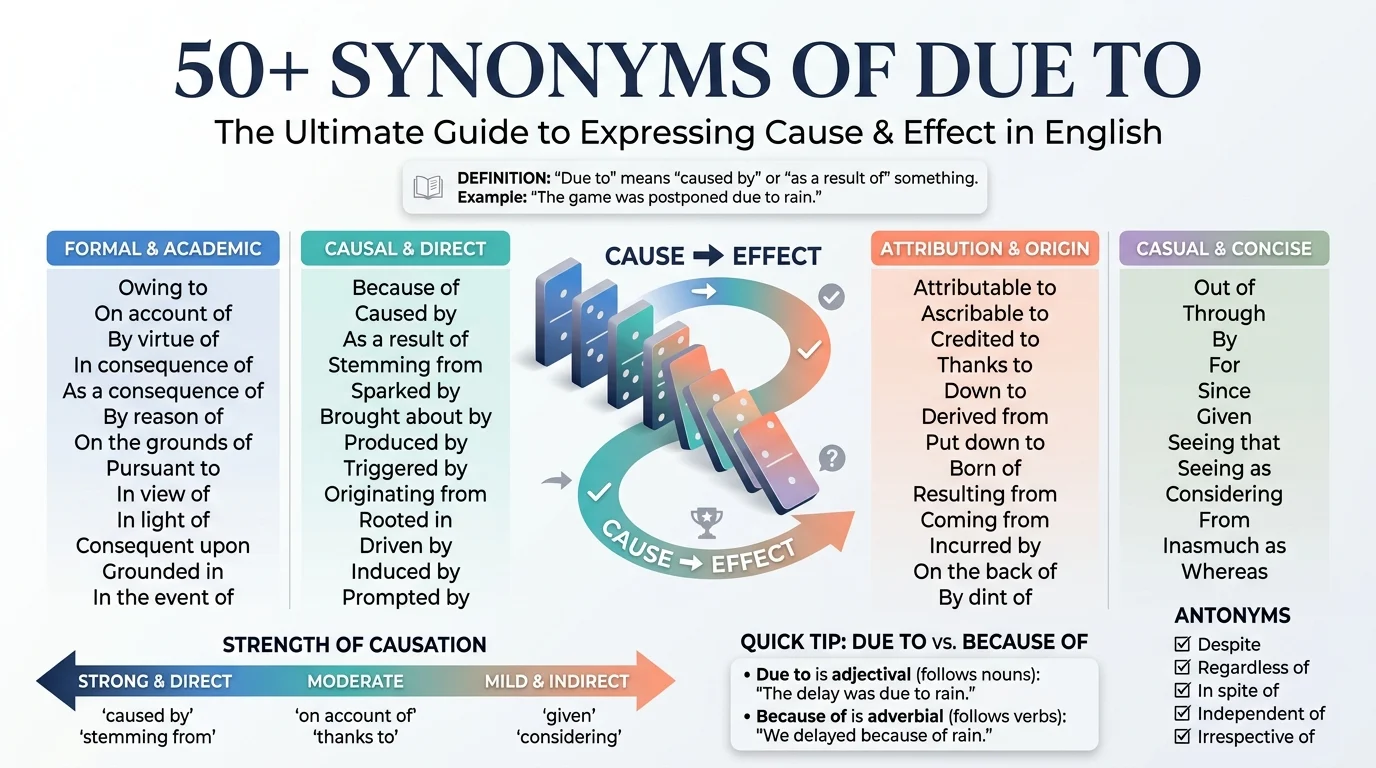
Have you ever needed to explain why something happened but felt that “due to” was repetitive or awkward in your sentence? You want to show a clear cause-and-effect relationship, and the phrase “due to” comes to mind. Choosing the right synonym for “due to” can transform a clunky sentence into a precise expression of causation, reason, or responsibility. This guide explores the best synonyms of due to, explaining exactly which phrase to use and when.
Quick Answer: “Due to” means caused by or because of. For formal writing, choose because of or owing to. For causal explanations, use as a result of or on account of. For responsibility, use attributable to or thanks to. For conversational use, choose because of or from.
Meaning, Tone, and Context
Understanding the core meaning of “due to” is the first step to using it effectively.
Simple Definition: Caused by; because of; as a result of.
Part of Speech: Prepositional phrase.
Overall Tone: Neutral to formal. It indicates causation or reason.
Formality Level: Neutral to formal. The phrase is appropriate in most contexts, though alternatives exist for different tones.
Common Uses: Native English speakers use it in business (“due to unforeseen circumstances”), science (“due to gravity”), and general contexts (“due to the weather”).
Word Forms: Related words include the adjective due and the noun dueness (rare).
When and How to Use “Due To”
“Due to” is the perfect choice when you want to explain a cause. Here are seven realistic examples.
Business: “The meeting was canceled due to scheduling conflicts.”
Academic: “The experiment failed due to equipment malfunction.”
Professional: “Sales increased due to the new marketing campaign.”
Personal: “She was late due to traffic.”
Email: “Due to the holiday, our office will be closed.”
Resume: (Avoid in resumes) Use “resulting from” instead.
Social Media: “The event was postponed due to weather.”
Best Synonyms of “Due To”
No synonym is identical in every situation. Here is your guide to the best replacement for “due to” based on your writing context.
For Formal and Academic Contexts
Most Formal: Owing to means because of. “Owing to the weather, the event was canceled.”
As a result of: As a result of means because of. “As a result of the delay, we missed the deadline.”
On account of: On account of means because of. “On account of the rain, we stayed inside.”
By virtue of: By virtue of means because of. “By virtue of his experience, he was chosen.”
For Causal Explanations
Because of: Because of means caused by. “The game was canceled because of rain.”
Through: Through means by means of. “Through hard work, she succeeded.”
From: From means as a result of. “He suffered from exhaustion.”
After: After means following. “After the storm, the roads were flooded.”
For Responsibility and Attribution
Attributable to: Attributable to means can be credited to. “The success is attributable to teamwork.”
Thanks to: Thanks to means because of (usually positive). “Thanks to her help, we finished early.”
Owing to: Owing to means because of. “Owing to his efforts, the project succeeded.”
Resulting from: Resulting from means caused by. “The damage resulting from the storm was extensive.”
For Informal and Conversational
Because of: Because of is the most common. “We stayed home because of the snow.”
From: From is simple. “He is tired from working all day.”
After: After is simple. “After the accident, traffic was backed up.”
When Not to Use “Due To”
Using “due to” can sound wrong or awkward in certain situations.
When You Mean “Because”: “Due to” is a prepositional phrase. “Because” is a conjunction.
Better Choice: Because. “Because it rained, we stayed home.”
When It Sounds Too Formal: In casual conversation, “due to” can sound stiff.
Better Choice: Because of. “We stayed home because of the rain.”
When It Is Ambiguous: “Due to” can be unclear about what is caused.
Better Choice: Caused by or resulting from. “The delay was caused by the storm.”
Words Commonly Confused With “Due To”
| Word | Difference | When to Use | Example |
|---|---|---|---|
| Because of | Direct cause | Casual and formal | “Because of the rain.” |
| Owing to | Formal cause | Formal and written | “Owing to the delay.” |
| As a result of | Result cause | Formal and analytical | “As a result of the study.” |
| On account of | Reason | Formal and written | “On account of the weather.” |
| Thanks to | Positive cause | Positive and casual | “Thanks to your help.” |
| Attributable to | Credit cause | Formal and analytical | “Attributable to hard work.” |
Best Synonyms of “Due To” by Context
| Context | Best Synonym | Why It Works | Example |
|---|---|---|---|
| Formal writing | Owing to | Formal and precise | “Owing to the delay, we missed the deadline.” |
| Academic writing | As a result of | Standard in research | “As a result of the study, new insights emerged.” |
| Professional | Because of | Professional and clear | “The meeting was canceled because of scheduling conflicts.” |
| Business | On account of | Business and formal | “On account of the holiday, we are closed.” |
| Positive context | Thanks to | Positive and warm | “Thanks to your help, we succeeded.” |
| Analytical | Attributable to | Analytical and precise | “The success is attributable to teamwork.” |
| Casual | Because of | Simple and natural | “We stayed home because of the snow.” |
How to Choose the Best Synonym of “Due To”
Choosing the right phrase is a simple decision. Answer these questions.
What type of cause am I describing? For formal, use owing to or as a result of. For casual, use because of or from. And for positive, use thanks to. For analytical, use attributable to.
What is my audience? For a formal report, use owing to or as a result of. For a friend, use because of or from.
What is my purpose? Are you explaining a cause, attributing responsibility, or giving credit? The correct synonym depends entirely on this.
What is the emotional strength? Thanks to is positive. Due to is neutral. Pick the one that matches your message.
Real Life Examples of “Due To”
School: Basic: “The class was canceled due to snow.” Improved: “The class was canceled because of snow.”
College: Basic: “The study failed due to errors.” Improved: “The study failed as a result of errors.”
Workplace: Basic: “The project was delayed due to budget issues.” Improved: “The project was delayed owing to budget issues.”
Business: Basic: “Sales increased due to the campaign.” Improved: “Sales increased thanks to the campaign.”
Email: Basic: “Due to the holiday, we are closed.” Improved: “On account of the holiday, we are closed.”
Conversation: Basic: “She was late due to traffic.” Improved: “She was late because of traffic.”
Storytelling: Basic: “The success was due to teamwork.” Improved: “The success was attributable to teamwork.”
Top 10 Synonyms of “Due To”
| Synonym | Simple Meaning | Best Used For | Example Sentence |
|---|---|---|---|
| Because of | Caused by | General and casual | “The game was canceled because of rain.” |
| Owing to | Because of | Formal and written | “Owing to the delay, we missed the deadline.” |
| As a result of | Caused by | Formal and analytical | “As a result of the study, new insights emerged.” |
| On account of | Because of | Formal and business | “On account of the holiday, we are closed.” |
| Thanks to | Because of (positive) | Positive and warm | “Thanks to your help, we succeeded.” |
| Attributable to | Credited to | Formal and analytical | “The success is attributable to teamwork.” |
| Resulting from | Caused by | Formal and legal | “The damage resulting from the storm was extensive.” |
| By virtue of | Because of | Formal and literary | “By virtue of his experience, he was chosen.” |
| Through | By means of | General and formal | “Through hard work, she succeeded.” |
| From | As a result of | Casual and simple | “He suffered from exhaustion.” |
Synonyms of “Due To” by Usage
Professional vs. Personal Synonyms
In the workplace, choose owing to, as a result of, or on account of. With friends, use because of, from, or after.
Formal vs. Conversational Synonyms
For formal writing, use owing to, as a result of, or by virtue of. For casual conversations, use because of, from, or after.
Academic Synonyms
For research and essays, choose as a result of for findings, owing to for causes, and attributable to for credit.
Professional and Business Synonyms
For maximum impact, choose owing to for delays, on account of for closures, and thanks to for positive outcomes.
Creative and Literary Synonyms
To add variety, choose by virtue of, through, or resulting from. These phrases create specificity.
Slang or Modern Synonyms
In modern American slang, because of, from, or after are common. For example, “He is tired from work.” These are casual and should be avoided in formal writing.
Strongest to Mildest Synonyms
Mild: from, after, through
Moderate: due to, because of, owing to
Strong: as a result of, on account of, attributable to
Very Strong: by virtue of, resulting from, thanks to
Emotional vs. Neutral Synonyms
Emotional Synonyms: Thanks to. This phrase hints at gratitude. Use it when you want to evoke positive feeling.
Neutral Synonyms: Due to, because of, owing to. These phrases communicate factual information.
Antonyms of “Due To”
| Antonym | Meaning | Example Sentence |
|---|---|---|
| Despite | In spite of | “Despite the rain, we went out.” |
| Regardless of | Without being affected by | “Regardless of the cost, we proceeded.” |
| Notwithstanding | In spite of | “Notwithstanding the delay, we finished.” |
| In spite of | Without being prevented by | “In spite of the obstacles, she succeeded.” |
| Irrespective of | Without consideration of | “Irrespective of the weather, the event continued.” |
| Independent of | Not influenced by | “The result is independent of the method.” |
| Unaffected by | Not influenced by | “He was unaffected by the criticism.” |
| Without regard to | Not considering | “Without regard to the consequences.” |
| Apart from | Excluding | “Apart from the delay, everything went well.” |
| Excluding | Not including | “Excluding the weather, the trip was perfect.” |
| Except for | Not including | “Except for the rain, it was a good day.” |
| But for | Without | “But for your help, we would have failed.” |
| Barring | Except for | “Barring any problems, we will finish on time.” |
| Save for | Except for | “Save for a few errors, the report was good.” |
| With the exception of | Except for | “With the exception of one item, all was delivered.” |
Comparison: “Due To” vs Similar Words
Due To vs. Because Of
Main Difference: “Due to” is often used after a noun. “Because of” is more versatile.
Which Is Stronger? They are similar.
Which Is More Formal? “Due to” is more formal.
When to Use Each: Use “because of” in casual conversation. Use “due to” in formal writing.
Examples:
Due to: “The delay was due to weather.”
Because of: “We stayed home because of the rain.”
Due To vs. Owing To
Main Difference: “Owing to” is more formal. “Due to” is common.
Which Is Stronger? “Owing to” is more formal.
Which Is More Formal? “Owing to” is more formal.
When to Use Each: Use “owing to” in formal writing. Use “due to” in general contexts.
Examples:
Due to: “The event was canceled due to rain.”
Owing to: “Owing to the rain, the event was canceled.”
Due To vs. As a Result Of
Main Difference: “As a result of” is more analytical. “Due to” is more direct.
Which Is Stronger? “As a result of” is more formal.
Which Is More Formal? “As a result of” is more formal.
When to Use Each: Use “as a result of” in research. Use “due to” in general contexts.
Examples:
Due to: “The delay was due to the storm.”
As a result of: “As a result of the storm, the event was delayed.”
Due To vs. Thanks To
Main Difference: “Thanks to” is positive. “Due to” is neutral.
Which Is Stronger? “Thanks to” is more positive.
Which Is More Formal? “Due to” is more formal.
When to Use Each: Use “thanks to” for positive outcomes. Use “due to” for neutral causes.
Examples:
Due to: “The delay was due to traffic.”
Thanks to: “Thanks to your help, we finished early.”
Due To vs. Attributable To
Main Difference: “Attributable to” is analytical. “Due to” is direct.
Which Is Stronger? “Attributable to” is more formal.
Which Is More Formal? “Attributable to” is more formal.
When to Use Each: Use “attributable to” for credit. Use “due to” for general contexts.
Examples:
Due to: “The success was due to teamwork.”
Attributable to: “The success is attributable to teamwork.”
Due To vs. On Account Of
Main Difference: “On account of” is formal. “Due to” is common.
Which Is Stronger? “On account of” is more formal.
Which Is More Formal? “On account of” is more formal.
When to Use Each: Use “on account of” in business. Use “due to” in general contexts.
Examples:
Due to: “We are closed due to the holiday.”
On account of: “On account of the holiday, we are closed.”
Common Phrases and Expressions with “Due To”
Phrase: Due to unforeseen circumstances
Meaning: Because of unexpected events.
Example Sentence: “The event was canceled due to unforeseen circumstances.”
Phrase: Due to popular demand
Meaning: Because many people want it.
Example Sentence: “The show was extended due to popular demand.”
Phrase: Due to the fact that
Meaning: Because.
Example Sentence: “Due to the fact that it rained, we stayed inside.”
Phrase: Due to time constraints
Meaning: Because of limited time.
Example Sentence: “The meeting was shortened due to time constraints.”
Phrase: Due to circumstances beyond our control
Meaning: Because of events we cannot manage.
Example Sentence: “The flight was canceled due to circumstances beyond our control.”
Common Mistakes to Avoid
Mistake 1: Using “due to” when you mean “because”.
Incorrect: “Due to it rained, we stayed home.”
Better: “Because it rained, we stayed home.”
Why: “Because” is a conjunction.
Mistake 2: Using “due to” in casual conversation.
Incorrect: “We stayed home due to rain.”
Better: “We stayed home because of rain.”
Why: “Because of” sounds more natural.
Mistake 3: Overusing “due to” in writing.
Incorrect: “The delay was due to traffic due to construction.”
Better: “The delay was caused by traffic resulting from construction.”
Why: Variety improves writing.
Mistake 4: Using “due to” when you mean “thanks to”.
Incorrect: “Due to your help, we succeeded.”
Better: “Thanks to your help, we succeeded.”
Why: “Thanks to” is positive.
Mistake 5: Using “due to” when you mean “attributable to”.
Incorrect: “The success was due to teamwork.”
Better: “The success was attributable to teamwork.”
Why: “Attributable to” is more analytical.
Frequently Asked Questions
1. What are the best synonyms of “due to”?
The best synonyms depend on your context. For formal writing, choose owing to or as a result of. For casual conversation, use because of or from. And for positive outcomes, use thanks to.
2. What are the best formal synonyms of “due to”?
The best formal synonyms are owing to, as a result of, and attributable to. These phrases are suitable for academic papers, professional reports, and business communications.
3. What are common informal synonyms of “due to”?
For informal settings, use because of, from, or after. These alternatives sound more natural in everyday conversation.
4. What is another word for “due to” in professional writing?
In professional writing, owing to is an excellent choice. It conveys formality. As a result of is also strong for analysis.
5. What is the difference between “due to” and “because of”?
“Due to” is often used after a noun. “Because of” is more versatile. Use “because of” in casual conversation and “due to” in formal writing.
6. What is the opposite of “due to”?
The most direct opposites (antonyms) of due to are despite, regardless of, and in spite of. These phrases describe things that happen without being affected by a cause.
Conclusion
“Due to” is a useful and common phrase for explaining causes and reasons. The phrase is neutral and widely accepted in most contexts, yet it can sound too formal for casual conversation or be used incorrectly as a conjunction. The best choice among the synonyms of due to depends entirely on your audience, tone, and purpose. For a formal, academic effect, use owing to or as a result of. For a practical, business context, on account of or attributable to works perfectly. Also for positive outcomes, choose thanks to. For casual conversation, use because of or from. Remember, no single synonym works perfectly in every situation. Your goal is to choose the phrase that communicates your message with the most clarity and impact. A practical tip for your vocabulary growth is to pay attention to how writers explain causes and practice using different synonyms in your writing.









