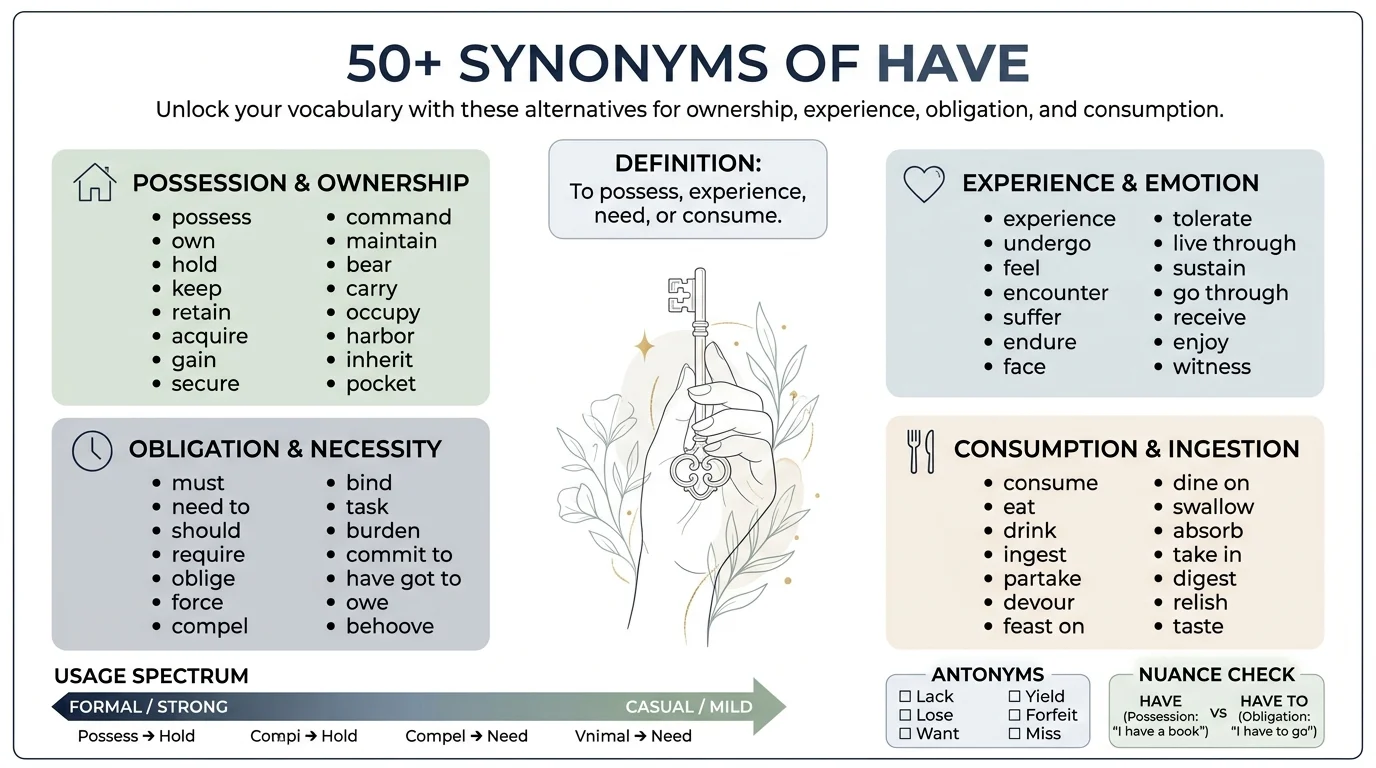
Have you ever needed to describe possession, experience, or obligation but felt that “have” was too simple or repetitive? You want to capture the specific type of ownership, experience, or necessity, and the word “have” comes to mind. Choosing the right synonym for “have” can transform a basic statement into a precise expression of possession, experience, or requirement. This guide explores the best synonyms of have, explaining exactly which word to use and when.
Quick Answer: “Have” means to possess, own, or hold something; to experience or undergo something; or to be required to do something. For possession, choose own, possess, or hold. For experience, use experience, undergo, or encounter. For obligation, use must, need to, or be required to. For consuming, use consume, eat, or drink.
Meaning, Tone, and Context
Understanding the core meaning of “have” is the first step to using it effectively.
Simple Definition: To possess, own, or hold something; to experience or undergo something; to be required or obliged to do something.
Part of Speech: Verb.
Overall Tone: Neutral. It is one of the most common and versatile verbs in English.
Formality Level: Neutral. The word works in all contexts, from casual to formal.
Common Uses: Native English speakers use it for possession (“I have a car”), experience (“I had a great time”), obligation (“I have to go”), and consumption (“I had breakfast”).
Word Forms: Related words include the noun having, the adjective havable, and the phrase have to.
When and How to Use “Have”
“Have” is the perfect choice when you want to describe possession, experience, or obligation. Here are seven realistic examples.
Possession: “I have a new phone.”
Experience: “We had a wonderful time at the party.”
Obligation: “I have to finish this report by Friday.”
Consumption: “She had a sandwich for lunch.”
Quality: “He has a great sense of humor.”
Relationship: “They have two children.”
State: “She has a headache.”
Best Synonyms of “Have”
No synonym is identical in every situation. Here is your guide to the best replacement for “have” based on your writing context.
For Possession and Ownership
Most Direct: Own means to have as property. “She owns a house.”
Possess: Possess means to have or hold. “He possesses great talent.”
Hold: Hold means to have or keep. “She holds a degree in economics.”
Retain: Retain means to continue to have. “The company retained its top employees.”
For Experience and Undergo
Experience: Experience means to undergo or feel. “She experienced great joy.”
Undergo: Undergo means to go through. “He underwent surgery.”
Encounter: Encounter means to meet or experience. “We encountered many challenges.”
Feel: Feel means to experience an emotion. “I feel happy.”
For Obligation and Necessity
Must: Must means to be required. “You must complete the form.”
Need to: Need to means to require. “I need to study.”
Be required to: Be required to means to be obligated. “Employees are required to attend.”
Ought to: Ought to means should. “You ought to apologize.”
For Consumption
Consume: Consume means to eat or drink. “She consumed a large meal.”
Eat: Eat means to take in food. “He ate breakfast.”
Drink: Drink means to take in liquid. “She drank water.”
Devour: Devour means to eat quickly. “He devoured his dinner.”
For Quality and Attribute
Bear: Bear means to have as a quality. “She bears a striking resemblance.”
Exhibit: Exhibit means to show. “He exhibits great courage.”
Display: Display means to show clearly. “She displays excellent judgment.”
Demonstrate: Demonstrate means to show by action. “He demonstrates strong leadership.”
When Not to Use “Have”
Using “have” can sound wrong or awkward in certain situations.
When You Mean “Own”: “Have” is general. “Own” is specific to property.
Better Choice: Own. “She owns a house.”
When You Mean “Experience”: “Have” can be vague. “Experience” is more vivid.
Better Choice: Experience or undergo. “She experienced great joy.”
When It Sounds Too Simple: In formal writing, “have” can sound basic.
Better Choice: Possess or hold. “He possesses great talent.”
Words Commonly Confused With “Have”
| Word | Difference | When to Use | Example |
|---|---|---|---|
| Own | Legal property | Ownership | “She owns a car.” |
| Possess | Have or hold | Formal and qualities | “He possesses talent.” |
| Hold | Have or keep | Formal and general | “She holds a degree.” |
| Experience | Undergo or feel | Emotions and events | “I experienced joy.” |
| Must | Be required | Obligation | “You must go.” |
| Need | Require | Necessity | “I need help.” |
Best Synonyms of “Have” by Context
| Context | Best Synonym | Why It Works | Example |
|---|---|---|---|
| Formal writing | Possess | Formal and precise | “He possesses great talent.” |
| Academic writing | Hold | Standard in credentials | “She holds a doctorate.” |
| Professional | Retain | Professional and clear | “The company retained its staff.” |
| Business | Own | Business and property | “The firm owns the building.” |
| Emotional | Experience | Emotional and personal | “She experienced great joy.” |
| Obligation | Must | Direct and clear | “You must attend.” |
| Casual | Got | Simple and natural | “I got a new phone.” |
How to Choose the Best Synonym of “Have”
Choosing the right word is a simple decision. Answer these questions.
What type of having am I describing? For possession, use own, possess, or hold. For experience, use experience or undergo. And for obligation, use must or need to. For consumption, use consume or eat.
What is my audience? For a formal report, use possess or hold. For a friend, use got or have.
What is my purpose? Are you describing possession, experience, or obligation? The correct synonym depends entirely on this.
What is the emotional strength? Experience and undergo are stronger. Got is casual. Pick the one that matches your message.
Real Life Examples of “Have”
School: Basic: “The student has a book.” Improved: “The student possesses a textbook.”
College: Basic: “She has a degree.” Improved: “She holds a degree in biology.”
Workplace: Basic: “We have a meeting.” Improved: “We are scheduled for a meeting.”
Business: Basic: “The company has assets.” Improved: “The company owns significant assets.”
Email: Basic: “I have a question.” Improved: “I have a question.” (No change needed)
Conversation: Basic: “I have a car.” Improved: “I got a car.”
Storytelling: Basic: “She had a great time.” Improved: “She experienced a wonderful time.”
Top 10 Synonyms of “Have”
| Synonym | Simple Meaning | Best Used For | Example Sentence |
|---|---|---|---|
| Own | Have as property | Legal and general | “She owns a house.” |
| Possess | Have or hold | Formal and qualities | “He possesses great talent.” |
| Hold | Have or keep | Formal and credentials | “She holds a degree.” |
| Experience | Undergo or feel | Emotions and events | “I experienced joy.” |
| Undergo | Go through | Medical and processes | “He underwent surgery.” |
| Must | Be required | Obligation | “You must attend.” |
| Need to | Require | Necessity | “I need to study.” |
| Consume | Eat or drink | Formal and technical | “She consumed a meal.” |
| Retain | Continue to have | Business and formal | “The company retained its staff.” |
| Exhibit | Show clearly | Qualities and behavior | “He exhibits courage.” |
Synonyms of “Have” by Usage
Professional vs. Personal Synonyms
In the workplace, choose possess, hold, or retain. With friends, use got, have, or own.
Formal vs. Conversational Synonyms
For formal writing, use possess, hold, or experience. For casual conversations, use got, have, or eat.
Academic Synonyms
For research and essays, choose hold for credentials, possess for qualities, and experience for events.
Professional and Business Synonyms
For maximum impact, choose own for assets, retain for staff, and possess for skills.
Creative and Literary Synonyms
To add emotion and imagery, choose experience, undergo, or bear. These words create atmosphere.
Slang or Modern Synonyms
In modern American slang, got, have, or hold are common. For example, “I got skills.” These are casual and should be avoided in formal writing.
Strongest to Mildest Synonyms
Mild: have, got, hold
Moderate: possess, own, experience
Strong: retain, undergo, exhibit
Very Strong: bear, demonstrate, consume
Emotional vs. Neutral Synonyms
Emotional Synonyms: Experience, undergo, bear. These words hint at feeling and endurance. Use them when you want to evoke emotion.
Neutral Synonyms: Have, own, hold. These words communicate factual information.
Antonyms of “Have”
| Antonym | Meaning | Example Sentence |
|---|---|---|
| Lack | Be without | “He lacks experience.” |
| Want | Be without | “She wants for nothing.” |
| Need | Require | “I need help.” |
| Lose | Cease to have | “He lost his keys.” |
| Relinquish | Give up | “She relinquished control.” |
| Surrender | Give up | “They surrendered the territory.” |
| Forfeit | Lose as penalty | “He forfeited his rights.” |
| Give away | Donate | “She gave away her fortune.” |
| Release | Let go | “He released his grip.” |
| Yield | Give way | “She yielded her claim.” |
| Abandon | Give up completely | “They abandoned the project.” |
| Cede | Give up power | “The country ceded territory.” |
| Dispossess | Deprive of possession | “They were dispossessed of their land.” |
| Divest | Rid of | “He divested his shares.” |
| Deprive | Prevent from having | “They were deprived of water.” |
Comparison: “Have” vs Similar Words
Have vs. Own
Main Difference: “Have” is general. “Own” is legal property.
Which Is Stronger? “Own” is stronger for property.
Which Is More Formal? Both are neutral.
When to Use Each: Use “own” for property. Use “have” for general contexts.
Examples:
Have: “I have a car.”
Own: “I own a car.”
Have vs. Possess
Main Difference: “Have” is simple. “Possess” is formal.
Which Is Stronger? “Possess” is more formal.
Which Is More Formal? “Possess” is more formal.
When to Use Each: Use “possess” in formal writing. Use “have” in casual conversation.
Examples:
Have: “She has talent.”
Possess: “She possesses talent.”
Have vs. Experience
Main Difference: “Have” is general. “Experience” is about undergoing.
Which Is Stronger? “Experience” is more vivid.
Which Is More Formal? Both are neutral.
When to Use Each: Use “experience” for emotions. Use “have” for general contexts.
Examples:
Have: “I had a great time.”
Experience: “I experienced great joy.”
Have vs. Must
Main Difference: “Have” is about possession. “Must” is about obligation.
Which Is Stronger? “Must” is stronger for obligation.
Which Is More Formal? Both are neutral.
When to Use Each: Use “must” for obligations. Use “have” for possession.
Examples:
Have: “I have to go.”
Must: “I must go.”
Have vs. Hold
Main Difference: “Have” is general. “Hold” is about keeping.
Which Is Stronger? “Hold” is more specific.
Which Is More Formal? “Hold” is more formal.
When to Use Each: Use “hold” for credentials. Use “have” for general contexts.
Examples:
Have: “She has a degree.”
Hold: “She holds a degree.”
Have vs. Consume
Main Difference: “Have” is general. “Consume” is technical.
Which Is Stronger? “Consume” is more specific.
Which Is More Formal? “Consume” is more formal.
When to Use Each: Use “consume” for food and energy. Use “have” for general contexts.
Examples:
Have: “I had breakfast.”
Consume: “I consumed a large meal.”
Common Phrases and Expressions with “Have”
Phrase: Have to
Meaning: Must or be required to.
Example Sentence: “I have to finish this report.”
Phrase: Have a good time
Meaning: Enjoy oneself.
Example Sentence: “Have a good time at the party.”
Phrase: Have a look
Meaning: Take a look.
Example Sentence: “Have a look at this document.”
Phrase: Have a say
Meaning: Have influence in a decision.
Example Sentence: “Everyone should have a say.”
Phrase: Have it out
Meaning: Resolve a dispute.
Example Sentence: “They decided to have it out.”
Phrase: Have a go
Meaning: Try something.
Example Sentence: “Have a go at solving the puzzle.”
Common Mistakes to Avoid
Mistake 1: Using “have” when you mean “own”.
Incorrect: “I have a house.”
Better: “I own a house.”
Why: “Own” is more specific for property.
Mistake 2: Using “have” when you mean “experience”.
Incorrect: “I had a great time.”
Better: “I experienced a great time.”
Why: “Experience” is more vivid.
Mistake 3: Overusing “have” in conversation.
Incorrect: “I have a question.”
Better: “I got a question.”
Why: “Got” is more casual.
Mistake 4: Using “have” when you mean “must”.
Incorrect: “I have to go.”
Better: “I must go.”
Why: “Must” is stronger for obligation.
Mistake 5: Using “have” when you mean “hold”.
Incorrect: “She has a degree.”
Better: “She holds a degree.”
Why: “Hold” is more formal for credentials.
Frequently Asked Questions
1. What are the best synonyms of “have”?
The best synonyms depend on your context. For possession, choose own or possess. For experience, use experience or undergo. And for obligation, use must or need to.
2. What are the best formal synonyms of “have”?
The best formal synonyms are possess, hold, and retain. These words are suitable for academic papers, professional reports, and business communications.
3. What are common informal synonyms of “have”?
For informal settings, use got, have, or hold. These alternatives sound more natural in everyday conversation.
4. What is another word for “have” in professional writing?
In professional writing, possess is an excellent choice. It conveys ownership of qualities. Hold is also strong for credentials.
5. What is the difference between “have” and “possess”?
“Have” is simple. “Possess” is formal. Use “possess” in formal writing and “have” in casual conversation.
6. What is the opposite of “have”?
The most direct opposites (antonyms) of have are lack, lose, and relinquish. These words describe not having or giving up.
Conclusion
“Have” is a fundamental and versatile word for describing possession, experience, and obligation. The term is neutral and widely accepted in all contexts, yet it can sound too simple for formal writing or too broad for specific descriptions. The best choice among the synonyms of have depends entirely on your audience, tone, and purpose. For a formal, professional effect, use possess or hold. For a practical, everyday context, own or experience works perfectly. And for obligation, choose must or need to. For casual conversation, use got or have. Remember, no single synonym works perfectly in every situation. Your goal is to choose the word that communicates your message with the most clarity and impact. A practical tip for your vocabulary growth is to pay attention to how writers describe possession and experience and practice using different synonyms in your writing.









