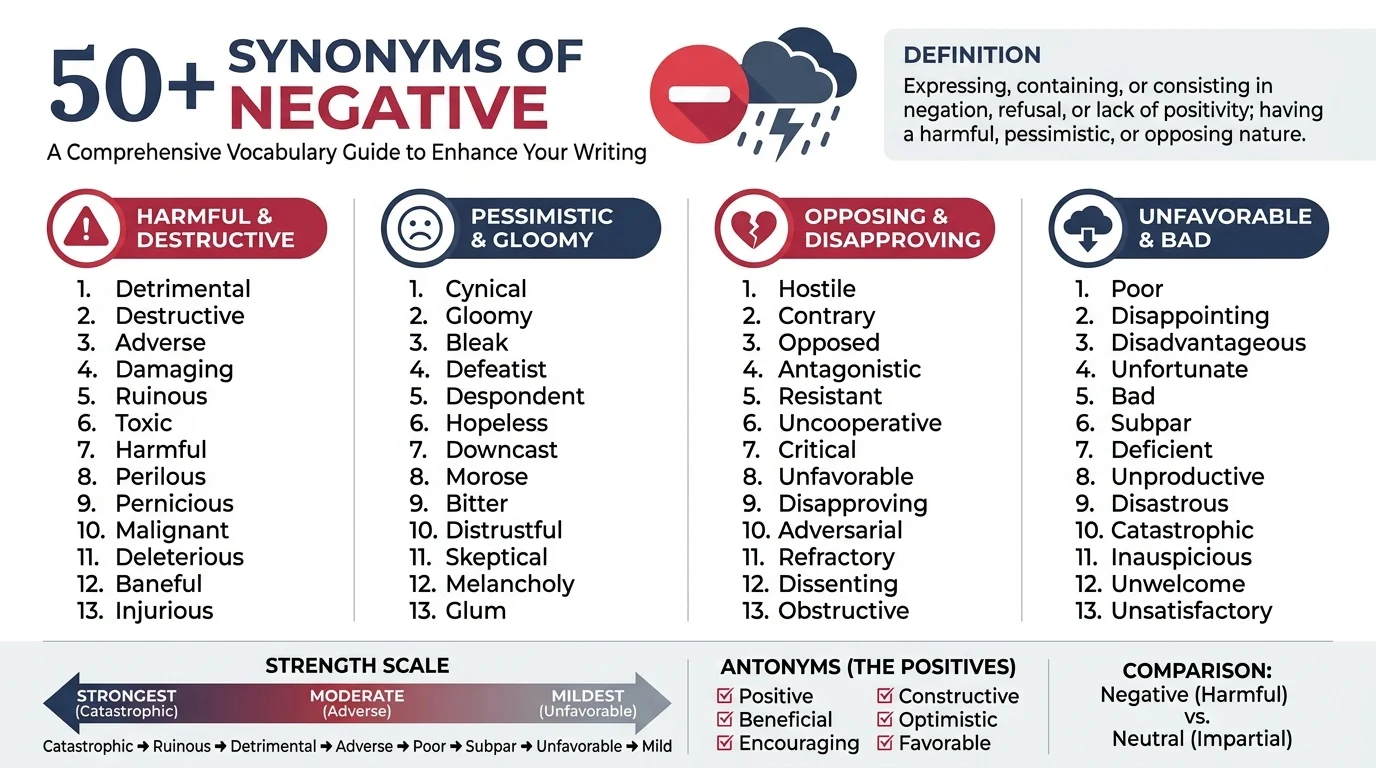
Have you ever needed to describe something bad, harmful, or opposite but felt that “negative” was too broad or repetitive? You want to capture the specific type of harm, opposition, or pessimism, and the word “negative” comes to mind. Choosing the right synonym for “negative” can transform a basic statement into a precise expression of harm, refusal, or gloom. This guide explores the best synonyms of negative, explaining exactly which word to use and when.
Quick Answer: “Negative” means expressing denial, disagreement, or pessimism, or having a harmful or undesirable quality. For harmful effects, choose detrimental, harmful, or adverse. For pessimistic attitudes, use cynical, pessimistic, or gloomy. For opposition, use contrary, opposing, or antagonistic. For test results, use unfavorable or unfortunate.
Meaning, Tone, and Context
Understanding the core meaning of “negative” is the first step to using it effectively.
Simple Definition: Expressing or consisting of a denial, refusal, or contradiction; lacking positive qualities; harmful or undesirable; pessimistic.
Part of Speech: Adjective and noun.
Overall Tone: Negative. It indicates harm, opposition, or pessimism.
Formality Level: Neutral to formal. The word is appropriate in most contexts.
Common Uses: Native English speakers use it in science (“negative result”), psychology (“negative thinking”), business (“negative impact”), and general contexts (“negative attitude”).
Word Forms: Related words include the noun negativity, the adverb negatively, and the verb negate.
When and How to Use “Negative”
“Negative” is the perfect choice when you want to describe harm, opposition, or pessimism. Here are seven realistic examples.
Scientific: “The test returned a negative result, indicating no infection.”
Business: “The policy had a negative impact on sales.”
Psychology: “Negative thinking can affect mental health.”
Professional: “We received negative feedback from several customers.”
Academic: “The study found a negative correlation between the variables.”
Personal: “He has a negative attitude toward change.”
Social Media: “Try to avoid negative comments on social media.”
Best Synonyms of “Negative”
No synonym is identical in every situation. Here is your guide to the best replacement for “negative” based on your writing context.
For Harmful and Undesirable Effects
Most Direct: Detrimental means causing harm. “The policy was detrimental to the economy.”
Harmful: Harmful means causing damage. “The chemicals are harmful to health.”
Adverse: Adverse means unfavorable or harmful. “The drug had adverse effects.”
Damaging: Damaging means causing damage. “The report was damaging to his reputation.”
For Pessimistic and Gloomy Attitudes
Pessimistic: Pessimistic means expecting bad outcomes. “He has a pessimistic view of the future.”
Cynical: Cynical means distrustful of human sincerity. “She is cynical about politics.”
Gloomy: Gloomy means dark and depressing. “The forecast is gloomy.”
Defeatist: Defeatist means expecting failure. “His defeatist attitude hurt the team.”
For Opposition and Contradiction
Contrary: Contrary means opposite in nature. “The evidence was contrary to his claim.”
Opposing: Opposing means in conflict. “The opposing teams competed fiercely.”
Antagonistic: Antagonistic means hostile. “His antagonistic remarks caused tension.”
Contradictory: Contradictory means mutually opposed. “The statements were contradictory.”
For Unfavorable Results and Outcomes
Unfavorable: Unfavorable means not advantageous. “The weather was unfavorable for the event.”
Unfortunate: Unfortunate means unlucky. “It was an unfortunate accident.”
Disadvantageous: Disadvantageous means causing disadvantage. “The location was disadvantageous for business.”
When Not to Use “Negative”
Using “negative” can sound wrong or awkward in certain situations.
When You Mean “Bad”: “Negative” is formal. “Bad” is simple.
Better Choice: Bad or poor. “The results were bad.”
When You Mean “No”: “Negative” can be formal. “No” is direct.
Better Choice: No or not. “There are no tickets left.”
When It Sounds Too Formal: In casual conversation, “negative” can sound academic.
Better Choice: Bad or tough. “That is tough news.”
Words Commonly Confused With “Negative”
| Word | Difference | When to Use | Example |
|---|---|---|---|
| Positive | The opposite | General and scientific | “A positive result.” |
| Neutral | Neither positive nor negative | General and objective | “A neutral stance.” |
| Pessimistic | Expecting bad outcomes | Attitude and outlook | “A pessimistic view.” |
| Harmful | Causing damage | Health and safety | “Harmful chemicals.” |
| Adverse | Unfavorable | Medical and formal | “Adverse effects.” |
| Contrary | Opposite | Logic and argument | “Contrary evidence.” |
Best Synonyms of “Negative” by Context
| Context | Best Synonym | Why It Works | Example |
|---|---|---|---|
| Formal writing | Adverse | Formal and precise | “Adverse effects were noted.” |
| Academic writing | Detrimental | Standard in research | “Detrimental to health.” |
| Professional | Unfavorable | Professional and clear | “Unfavorable conditions.” |
| Business | Damaging | Business and impact | “Damaging to the brand.” |
| Psychology | Pessimistic | Attitude and mental health | “A pessimistic outlook.” |
| Casual | Bad | Simple and natural | “Bad news.” |
| Scientific | Contrary | Evidence and results | “Contrary results.” |
How to Choose the Best Synonym of “Negative”
Choosing the right word is a simple decision. Answer these questions.
What type of negativity am I describing? For harm, use detrimental or harmful. For attitude, use pessimistic or cynical. And for opposition, use contrary or opposing. Also for results, use unfavorable.
What is my audience? For a formal report, use adverse or detrimental. For a friend, use bad or tough.
What is my purpose? Are you describing effects, attitudes, or results? The correct synonym depends entirely on this.
What is the emotional strength? Harmful and damaging are stronger. Unfavorable is milder. Pick the one that matches your message.
Real Life Examples of “Negative”
School: Basic: “The student has a negative attitude.” Improved: “The student has a pessimistic attitude.”
College: Basic: “The study found negative results.” Improved: “The study found contrary results.”
Workplace: Basic: “The feedback was negative.” Improved: “The feedback was unfavorable.”
Business: Basic: “The policy had a negative impact.” Improved: “The policy had a detrimental impact.”
Email: Basic: “I have negative news.” Improved: “I have bad news.”
Conversation: Basic: “Do not be negative.” Better: “Do not be pessimistic.”
Storytelling: Basic: “The atmosphere was negative.” Improved: “The atmosphere was gloomy.”
Top 10 Synonyms of “Negative”
| Synonym | Simple Meaning | Best Used For | Example Sentence |
|---|---|---|---|
| Detrimental | Causing harm | Formal and academic | “Detrimental to health.” |
| Harmful | Causing damage | Health and safety | “Harmful chemicals.” |
| Adverse | Unfavorable or harmful | Medical and formal | “Adverse effects.” |
| Pessimistic | Expecting bad outcomes | Attitude and outlook | “A pessimistic view.” |
| Cynical | Distrustful | Attitude and society | “A cynical outlook.” |
| Gloomy | Dark and depressing | Mood and weather | “A gloomy forecast.” |
| Contrary | Opposite in nature | Logic and evidence | “Contrary evidence.” |
| Unfavorable | Not advantageous | Conditions and results | “Unfavorable weather.” |
| Damaging | Causing damage | Reputation and impact | “Damaging to the brand.” |
| Opposing | In conflict | Teams and views | “Opposing teams.” |
Synonyms of “Negative” by Usage
Professional vs. Personal Synonyms
In the workplace, choose adverse, unfavorable, or detrimental. With friends, use bad, tough, or pessimistic.
Formal vs. Conversational Synonyms
For formal writing, use adverse, detrimental, or contrary. For casual conversations, use bad, tough, or gloomy.
Academic Synonyms
For research and essays, choose detrimental for effects, adverse for medical contexts, and contrary for evidence.
Professional and Business Synonyms
For maximum impact, choose damaging for reputation, adverse for effects, and unfavorable for conditions.
Creative and Literary Synonyms
To add emotion and imagery, choose gloomy, pessimistic, or cynical. These words create atmosphere.
Slang or Modern Synonyms
In modern American slang, bad, tough, or downer are common. For example, “That is a downer.” These are casual and should be avoided in formal writing.
Strongest to Mildest Synonyms
Mild: unfavorable, unfortunate, contrary
Moderate: negative, adverse, pessimistic
Strong: detrimental, harmful, damaging
Very Strong: destructive, catastrophic, ruinous
Emotional vs. Neutral Synonyms
Emotional Synonyms: Pessimistic, gloomy, cynical. These words hint at attitude and emotion. Use them when you want to evoke feeling.
Neutral Synonyms: Negative, adverse, contrary. These words communicate factual information.
Antonyms of “Negative”
| Antonym | Meaning | Example Sentence |
|---|---|---|
| Positive | Optimistic or favorable | “A positive attitude.” |
| Favorable | Advantageous | “Favorable conditions.” |
| Optimistic | Expecting good outcomes | “An optimistic outlook.” |
| Beneficial | Helpful | “Beneficial effects.” |
| Constructive | Helpful and improving | “Constructive feedback.” |
| Affirmative | Agreeing | “An affirmative answer.” |
| Supportive | Providing support | “A supportive team.” |
| Encouraging | Giving hope | “Encouraging news.” |
| Hopeful | Feeling hope | “A hopeful sign.” |
| Cheerful | Happy and optimistic | “A cheerful mood.” |
| Advantageous | Favorable | “An advantageous position.” |
| Helpful | Providing assistance | “Helpful advice.” |
| Promising | Showing potential | “A promising start.” |
| Upbeat | Cheerful and optimistic | “An upbeat tone.” |
| Fortunate | Lucky | “A fortunate outcome.” |
Comparison: “Negative” vs Similar Words
Negative vs. Pessimistic
Main Difference: “Negative” is broader. “Pessimistic” is about expecting bad outcomes.
Which Is Stronger? “Pessimistic” is more specific.
Which Is More Formal? Both are neutral.
When to Use Each: Use “pessimistic” for attitudes. Use “negative” for general contexts.
Examples:
Negative: “A negative attitude.”
Pessimistic: “A pessimistic outlook.”
Negative vs. Harmful
Main Difference: “Negative” is broader. “Harmful” is about damage.
Which Is Stronger? “Harmful” is stronger.
Which Is More Formal? Both are formal.
When to Use Each: Use “harmful” for health. Use “negative” for general contexts.
Examples:
Negative: “A negative effect.”
Harmful: “Harmful chemicals.”
Negative vs. Adverse
Main Difference: “Negative” is broader. “Adverse” is formal and medical.
Which Is Stronger? “Adverse” is more specific.
Which Is More Formal? “Adverse” is more formal.
When to Use Each: Use “adverse” in medical contexts. Use “negative” for general contexts.
Examples:
Negative: “A negative outcome.”
Adverse: “Adverse effects.”
Negative vs. Contrary
Main Difference: “Negative” is broader. “Contrary” is about opposition.
Which Is Stronger? “Contrary” is more specific.
Which Is More Formal? Both are formal.
When to Use Each: Use “contrary” for evidence. Use “negative” for general contexts.
Examples:
Negative: “A negative response.”
Contrary: “Contrary evidence.”
Negative vs. Cynical
Main Difference: “Negative” is broader. “Cynical” is about distrust.
Which Is Stronger? “Cynical” is more specific.
Which Is More Formal? Both are neutral.
When to Use Each: Use “cynical” for attitudes. Use “negative” for general contexts.
Examples:
Negative: “A negative view.”
Cynical: “A cynical outlook.”
Negative vs. Detrimental
Main Difference: “Negative” is broader. “Detrimental” is about harm.
Which Is Stronger? “Detrimental” is stronger.
Which Is More Formal? Both are formal.
When to Use Each: Use “detrimental” for effects. Use “negative” for general contexts.
Examples:
Negative: “A negative impact.”
Detrimental: “Detrimental to health.”
Common Phrases and Expressions with “Negative”
Phrase: Negative feedback
Meaning: Criticism or unfavorable response.
Example Sentence: “The negative feedback helped us improve.”
Phrase: Negative impact
Meaning: Harmful effect.
Example Sentence: “The policy had a negative impact on sales.”
Phrase: Negative attitude
Meaning: Pessimistic or uncooperative outlook.
Example Sentence: “His negative attitude affected the team.”
Phrase: Negative result
Meaning: A test showing absence of a condition.
Example Sentence: “The test returned a negative result.”
Phrase: Negative correlation
Meaning: A relationship where one variable increases as the other decreases.
Example Sentence: “There is a negative correlation between price and demand.”
Phrase: Negative space
Meaning: Empty space in art or design.
Example Sentence: “The negative space made the subject stand out.”
Common Mistakes to Avoid
Mistake 1: Using “negative” when you mean “bad”.
Incorrect: “The food was negative.”
Better: “The food was bad.”
Why: “Bad” is simpler for everyday contexts.
Mistake 2: Using “negative” when you mean “no”.
Incorrect: “The answer was negative.”
Better: “The answer was no.”
Why: “No” is more direct.
Mistake 3: Overusing “negative” in conversation.
Incorrect: “Do not be negative.”
Better: “Do not be pessimistic.”
Why: “Pessimistic” adds variety.
Mistake 4: Using “negative” when you mean “harmful”.
Incorrect: “The chemicals are negative.”
Better: “The chemicals are harmful.”
Why: “Harmful” is more specific.
Mistake 5: Using “negative” when you mean “adverse”.
Incorrect: “The negative effects were severe.”
Better: “The adverse effects were severe.”
Why: “Adverse” is more formal.
Frequently Asked Questions
1. What are the best synonyms of “negative”?
The best synonyms depend on your context. For harm, choose detrimental or harmful. For attitudes, use pessimistic or cynical. And for opposition, use contrary or opposing.
2. What are the best formal synonyms of “negative”?
The best formal synonyms are adverse, detrimental, and contrary. These words are suitable for academic papers, professional reports, and business communications.
3. What are common informal synonyms of “negative”?
For informal settings, use bad, tough, or gloomy. These alternatives sound more natural in everyday conversation.
4. What is another word for “negative” in professional writing?
In professional writing, adverse is an excellent choice. It conveys unfavorable effects. Detrimental is also strong for harm.
5. What is the difference between “negative” and “pessimistic”?
“Negative” is broader. “Pessimistic” is about expecting bad outcomes. Use “pessimistic” for attitudes.
6. What is the opposite of “negative”?
The most direct opposites (antonyms) of negative are positive, favorable, and optimistic. These words describe things that are good or hopeful.
Conclusion
“Negative” is a broad and essential word for describing harm, opposition, and pessimism. The term is neutral and widely accepted in most contexts, yet it can sound too formal for casual conversation or too vague for specific descriptions. The best choice among the synonyms of negative depends entirely on your audience, tone, and purpose. For a formal, medical effect, use adverse or detrimental. For a practical, business context, damaging or unfavorable works perfectly. And for attitudes, choose pessimistic or cynical. Also for casual conversation, use bad or tough. Remember, no single synonym works perfectly in every situation. Your goal is to choose the word that communicates your message with the most clarity and impact. A practical tip for your vocabulary growth is to pay attention to how writers describe harm and opposition and practice using different synonyms in your writing.









