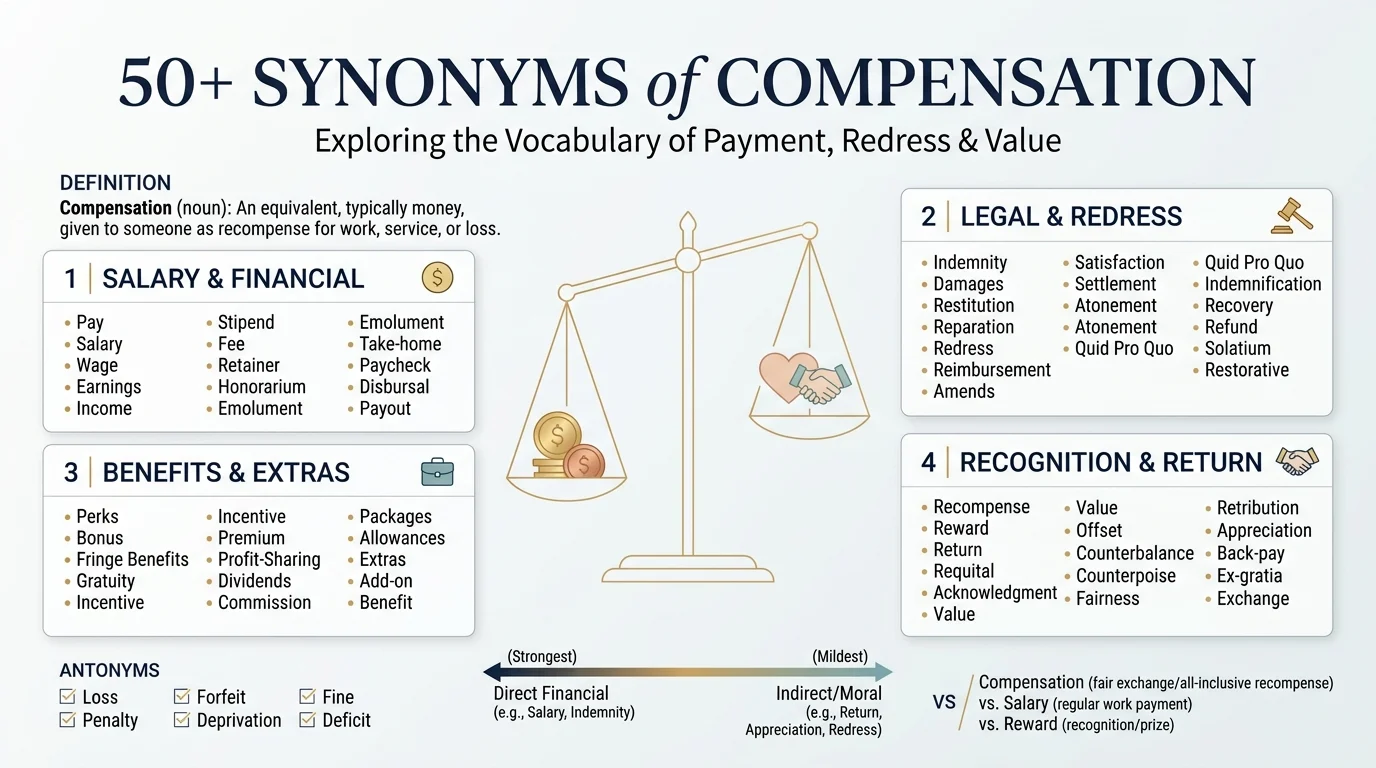
Have you ever needed to describe payment for work, a remedy for a loss, or a balancing factor but felt that “pay” or “salary” was too narrow? You want to capture the full range of what someone receives in return, and the word “compensation” comes to mind. Choosing the right synonym for “compensation” can transform a general statement into a precise description of payment, restitution, or balance. This guide explores the best synonyms of compensation, explaining exactly which word to use and when.
Quick Ans: “Compensation” means payment for work or services, something given to make up for a loss or injury, or a balancing factor. For salary and wages, choose remuneration or earnings. For legal settlements, use restitution or damages. For benefits packages, use benefits or perks. For psychological balancing, use offset or counterbalance.
Meaning, Tone, and Context
Understanding the core meaning of “compensation” is the first step to using it effectively.
Simple Definition: Something, typically money, awarded to someone for loss, injury, or as payment for work; the process of balancing or making up for something.
Part of Speech: Noun.
Overall Tone: Neutral to formal. It is a professional and legal term used across multiple fields.
Formality Level: Formal to neutral. The word is appropriate in business, legal, and HR contexts.
Common Uses: Native English speakers use it to describe salaries and benefits, legal settlements, and psychological balancing. For example, “The company offers competitive compensation,” or “He received compensation for his injury.”
Word Forms: Related words include the verb compensate, the adjective compensatory, and the adverb compensatorily.
When and How to Use “Compensation”
“Compensation” is the perfect choice when you want to describe payment, restitution, or balancing. Here are seven realistic examples.
Professional: “The job offers excellent compensation, including salary and bonuses.”
Legal: “The court awarded compensation to the victims of the accident.”
HR: “We need to review our compensation packages to stay competitive.”
Academic: “The study examined the compensation of CEOs in relation to company performance.”
Workplace: “Employees are entitled to compensation for overtime work.”
Personal: “He received compensation for the damage to his property.”
Social Media: “Fair compensation for creators is essential for a healthy digital economy.”
Best Synonyms of “Compensation”
No synonym is identical in every situation. Here is your guide to the best replacement for “compensation” based on your writing context.
For Payment and Salary
Most Formal: Remuneration is the most formal synonym for payment for work. “The remuneration package includes stock options.”
General Payment: Pay is a simple, direct synonym. “The pay is good, but the hours are long.”
Total Package: Earnings refers to total income. “His earnings increased significantly this year.”
Salary: Salary specifically refers to fixed regular payment. “The salary is negotiable.”
Wages: Wages refers to hourly or daily payment. “The wages are paid weekly.”
For Legal and Financial Restitution
Legal Remedy: Restitution means restoring what was lost. “The judge ordered restitution for the victims.”
Legal Damages: Damages is money awarded by a court. “The plaintiff was awarded damages.”
Settlement: Settlement is an agreement to resolve a dispute. “The settlement was reached out of court.”
Reimbursement: Reimbursement means repayment for expenses. “Submit your receipts for reimbursement.”
For Benefits and Perks
Total Rewards: Benefits refers to non-salary compensation. “The benefits include health insurance and retirement plans.”
Extra Perks: Perks are additional advantages. “The perks include a company car and gym membership.”
For Psychological and General Balancing
Balancing Factor: Offset means something that counterbalances. “The gains were an offset to the losses.”
Counterbalance: Counterbalance means a weight or influence that balances another. “The team’s experience was a counterbalance to their youth.”
When Not to Use “Compensation”
Using “compensation” can sound wrong or awkward in certain situations.
When You Mean Simple Payment: “Compensation” sounds formal for a simple transaction.
Better Choice: Payment or pay. “The payment is due tomorrow.”
When You Mean a Refund: “Compensation” is for damages or work. A refund is for returned goods.
Better Choice: Refund. “I received a refund for the defective product.”
When It Sounds Too Legal: In casual conversation, “compensation” can sound stiff.
Better Choice: Pay or money. “The pay is good.”
Words Commonly Confused With “Compensation”
Word: Remuneration
Difference: Formal term for payment for work. “Compensation” is broader, including benefits and legal settlements.
When to Use: Use it in formal HR and business documents.
Example: “The remuneration for the position is competitive.”
Word: Reimbursement
Difference: Repayment for expenses already incurred. “Compensation” can be for work or loss.
When to Use: Use it for expense claims.
Example: “You will receive reimbursement for travel costs.”
Word: Reparation
Difference: Making amends for a wrong, often on a national scale. “Compensation” is more individual.
When to Use: Use it for historical or large-scale wrongs.
Example: “The country demanded reparations for the war.”
Word: Restitution
Difference: Restoring something to its rightful owner. “Compensation” can include payment for injury.
When to Use: Use it in legal contexts for returning property or money.
Example: “The court ordered restitution of the stolen funds.”
Word: Benefits
Difference: Non-monetary compensation like insurance. “Compensation” is the total package.
When to Use: Use it for health insurance, retirement plans, etc.
Example: “The benefits include dental coverage.”
Word: Damages
Difference: Money awarded by a court for loss or injury. “Compensation” can be negotiated.
When to Use: Use it in legal contexts.
Example: “The jury awarded damages to the plaintiff.”
Best Synonyms of “Compensation” by Context
| Context | Best Synonym | Why It Works | Example |
|---|---|---|---|
| Salary and wages | Remuneration | Formal and comprehensive | “The remuneration package is generous.” |
| Salary and wages | Pay | Simple and direct | “The pay is competitive.” |
| Salary and wages | Earnings | Total income | “His earnings have increased.” |
| Legal settlement | Restitution | Restoring what was lost | “The judge ordered restitution.” |
| Legal settlement | Damages | Court-awarded money | “The plaintiff received damages.” |
| Expense repayment | Reimbursement | Repayment for expenses | “Submit receipts for reimbursement.” |
| Benefits | Benefits | Non-salary compensation | “The benefits are excellent.” |
| Psychological balancing | Offset | Counterbalancing factor | “The gains were an offset to losses.” |
| General balancing | Counterbalance | Balancing influence | “Experience is a counterbalance to youth.” |
How to Choose the Best Synonym of “Compensation”
Choosing the right word is a simple decision. Answer these questions.
What type of compensation am I describing? For salary, use remuneration or pay. And For legal, use restitution or damages. For benefits, use benefits or perks. For balancing, use offset or counterbalance.
What is my audience? For a formal HR document, use remuneration. And For a friend, use pay. For a legal document, use restitution or damages.
What is my purpose? Are you describing payment, restitution, or balancing? The correct synonym depends entirely on this.
What is the emotional strength? Damages and restitution are stronger for legal contexts. Pay and earnings are neutral. Pick the one that matches your message.
Real Life Examples of “Compensation”
To truly master the word, it helps to see how it behaves in the wild and how a stronger synonym can elevate the sentence.
School: Basic: “Teachers receive compensation for their work.” Improved: “Teachers receive remuneration for their dedication and expertise.”
College: Basic: “The compensation for the internship is low.” Improved: “The pay for the internship is modest, but the experience is valuable.”
Workplace: Basic: “The company offers good compensation.” Improved: “The company offers a competitive remuneration package.”
Business: Basic: “The compensation for the CEO was criticized.” Improved: “The CEO’s earnings were criticized by shareholders.”
Email: Basic: “Please process my compensation for travel.” Improved: “Please process my reimbursement for travel expenses.”
Legal: Basic: “He received compensation for the injury.” Improved: “He received damages for the injury caused by negligence.”
Storytelling: Basic: “The compensation was insufficient.” Improved: “The restitution was insufficient to heal the wounds.”
Top 10 Synonyms of “Compensation”
| Synonym | Simple Meaning | Best Used For | Example Sentence |
|---|---|---|---|
| Remuneration | Payment for work or services | Formal HR and business contexts | “The remuneration package includes bonuses.” |
| Pay | Money received for work | General and casual contexts | “The pay is good at this company.” |
| Earnings | Total income from work | Financial and business contexts | “His earnings have doubled.” |
| Salary | Fixed regular payment | Professional and job contexts | “The salary is paid monthly.” |
| Wages | Hourly or daily payment | Labor and industrial contexts | “The wages are paid weekly.” |
| Restitution | Restoring what was lost | Legal contexts | “The judge ordered restitution for the victims.” |
| Damages | Money awarded by a court | Legal contexts | “The plaintiff was awarded damages.” |
| Reimbursement | Repayment for expenses | Business and expense contexts | “Submit your receipts for reimbursement.” |
| Benefits | Non-salary compensation | HR and employment contexts | “The benefits include health insurance.” |
| Offset | A counterbalancing factor | Psychological and general contexts | “The gains were an offset to the losses.” |
Synonyms of “Compensation” by Usage
Professional vs. Personal Synonyms
In the workplace (professional), choose remuneration, salary, or benefits to describe pay packages. These words convey professionalism. “The remuneration package is competitive” is more precise than “The compensation is good.”
With friends (personal), pay, earnings, or money keep the tone relaxed and relatable.
Formal vs. Conversational Synonyms
For formal writing (reports, essays, professional emails), use remuneration, restitution, or damages. These choices maintain the sophisticated tone expected in professional documents.
For casual conversations and texting, use pay, money, or earnings. These options sound more natural.
Academic Synonyms
For research and essays, choose precise, authoritative words. Remuneration is great for HR studies, damages for legal analysis, and offset for psychological research.
Professional and Business Synonyms
For maximum impact in business writing, choose remuneration for pay packages, benefits for non-salary compensation, and reimbursement for expenses. These words demonstrate confidence and professional awareness.
Creative and Literary Synonyms
To add emotion and imagery to your writing, choose restitution or offset. These words create depth and meaning.
Strongest to Mildest Synonyms
Mild: pay, money, earnings
Moderate: compensation, salary, wages, benefits
Strong: remuneration, reimbursement, offset
Very Strong: restitution, damages, reparations
Emotional vs. Neutral Synonyms
Emotional Synonyms: Restitution, reparations. These words hint at justice and making amends. Use them when you want to evoke feeling.
Neutral Synonyms: Pay, salary, wages. These words simply communicate factual information. Use them when you want to inform without emotional coloring.
Antonyms of “Compensation”
| Antonym | Meaning | Example Sentence |
|---|---|---|
| Loss | Something that is lost | “The loss was devastating.” |
| Forfeiture | Loss of rights or property | “The forfeiture of assets was ordered.” |
| Penalty | A punishment for breaking rules | “The penalty was severe.” |
| Fine | A sum of money paid as punishment | “He had to pay a fine.” |
| Deprivation | The lack of something needed | “The deprivation was felt by all.” |
| Deduction | The act of subtracting | “The deduction reduced his salary.” |
Comparison: “Compensation” vs Similar Words
Compensation vs. Remuneration
Main Difference: “Remuneration” is specifically payment for work. “Compensation” can also mean restitution or balancing.
Which Is Stronger? “Remuneration” is more formal and specific.
Which Is More Formal? “Remuneration” is more formal.
When to Use Each: Use “remuneration” for pay. Use “compensation” for legal or broad contexts.
Examples:
Compensation: “He received compensation for his injury.”
Remuneration: “The remuneration for the position is competitive.”
Compensation vs. Reimbursement
Main Difference: “Reimbursement” is repayment for expenses. “Compensation” can be for work or loss.
Which Is Stronger? “Reimbursement” is specific to expenses.
Which Is More Formal? Both are formal.
When to Use Each: Use “reimbursement” for expense claims. Use “compensation” for salary or damages.
Examples:
Compensation: “The company offers good compensation.”
Reimbursement: “Submit your receipts for reimbursement.”
Compensation vs. Restitution
Main Difference: “Restitution” is restoring what was lost. “Compensation” can include payment for injury or work.
Which Is Stronger? “Restitution” is more specific to legal restoration.
Which Is More Formal? Both are formal and legal.
When to Use Each: Use “restitution” for legal restoration. Use “compensation” for broader contexts.
Examples:
Compensation: “He received compensation for the damage.”
Restitution: “The judge ordered restitution of the stolen funds.”
Compensation vs. Damages
Main Difference: “Damages” is court-awarded money. “Compensation” can be negotiated.
Which Is Stronger? “Damages” is more specific to legal awards.
Which Is More Formal? “Damages” is more formal and legal.
When to Use Each: Use “damages” in legal contexts. Use “compensation” in general contexts.
Examples:
Compensation: “The company paid compensation to the workers.”
Damages: “The jury awarded damages to the plaintiff.”
Compensation vs. Benefits
Main Difference: “Benefits” are non-salary perks. “Compensation” is the total package.
Which Is Stronger? “Benefits” is more specific.
Which Is More Formal? Both are formal in HR contexts.
When to Use Each: Use “benefits” for insurance and retirement. Use “compensation” for the total package.
Examples:
Compensation: “The compensation includes salary and benefits.”
Benefits: “The benefits include health insurance.”
Compensation vs. Pay
Main Difference: “Pay” is simple and direct. “Compensation” is formal and comprehensive.
Which Is Stronger? “Compensation” is more formal and broader.
Which Is More Formal? “Compensation” is more formal.
When to Use Each: Use “pay” in casual conversation. Use “compensation” in professional documents.
Examples:
Compensation: “The compensation package is excellent.”
Pay: “The pay is good.”
Common Phrases and Expressions with “Compensation”
Phrase: Compensation package
Meaning: The total pay and benefits offered.
Example Sentence: “The compensation package includes salary, bonus, and health insurance.”
Phrase: Workers’ compensation
Meaning: Insurance for work-related injuries.
Example Sentence: “He filed a workers’ compensation claim after the accident.”
Phrase: Compensation for loss
Meaning: Payment for something lost or damaged.
Example Sentence: “The insurance provided compensation for the loss.”
Phrase: Fair compensation
Meaning: Just and reasonable payment.
Example Sentence: “Employees deserve fair compensation for their work.”
Phrase: Compensation claim
Meaning: A request for payment for loss or injury.
Example Sentence: “She filed a compensation claim with the insurance company.”
Common Mistakes to Avoid
Mistake 1: Using “compensation” when you mean “reimbursement”.
Incorrect: “Submit your compensation for travel expenses.”
Better: “Submit your reimbursement for travel expenses.”
Why: “Reimbursement” is the correct term for expense repayment.
Mistake 2: Using “compensation” in casual conversation.
Incorrect: “The compensation is good at my new job.”
Better: “The pay is good at my new job.”
Why: “Pay” sounds more natural in casual conversation.
Mistake 3: Using “compensation” when you mean “damages”.
Incorrect: “The court awarded compensation to the plaintiff.”
Better: “The court awarded damages to the plaintiff.”
Why: “Damages” is the correct legal term for court-awarded money.
Mistake 4: Using “compensation” when you mean “benefits”.
Incorrect: “The compensation includes dental and vision.”
Better: “The benefits include dental and vision.”
Why: “Benefits” is more specific for non-salary perks.
Mistake 5: Using “compensation” when you mean “restitution”.
Incorrect: “The thief was ordered to pay compensation.”
Better: “The thief was ordered to pay restitution.”
Why: “Restitution” is the correct term for restoring stolen property or funds.
Frequently Asked Questions
1. What are the best synonyms of “compensation”?
The best synonyms depend on your context. For salary, choose remuneration or pay. And For legal contexts, use restitution or damages. For benefits, use benefits or perks.
2. What are the best formal synonyms of “compensation”?
The best formal synonyms are remuneration, restitution, and damages. These words are suitable for academic papers, professional reports, and legal documents.
3. What are common informal synonyms of “compensation”?
For informal settings, use pay, money, or earnings. These alternatives sound more natural in everyday conversation.
4. What is another word for “compensation” in professional writing?
In professional writing, remuneration is an excellent choice. It conveys formal payment for work. Reimbursement is also strong for expense repayment.
5. What is the difference between “compensation” and “remuneration”?
“Remuneration” specifically refers to payment for work. “Compensation” is broader, including legal settlements and psychological balancing.
6. What is the opposite of “compensation”?
The most direct opposites of “compensation” are loss, forfeiture, and penalty. These words describe things taken away rather than given.
Conclusion
“Compensation” is a versatile and essential word for describing payment, restitution, and balancing. The best choice among the synonyms of compensation depends entirely on your audience, tone, and purpose. Remember, no single synonym works perfectly in every situation. Your goal is to choose the word that communicates your message with the most clarity and impact. A practical tip for your vocabulary growth is to pay attention to how compensation is discussed in different fields and practice using different synonyms in your writing.










3 thoughts on “50+ Synonyms of Compensation: Meanings, Uses, Examples, and Best Alternatives 2026”