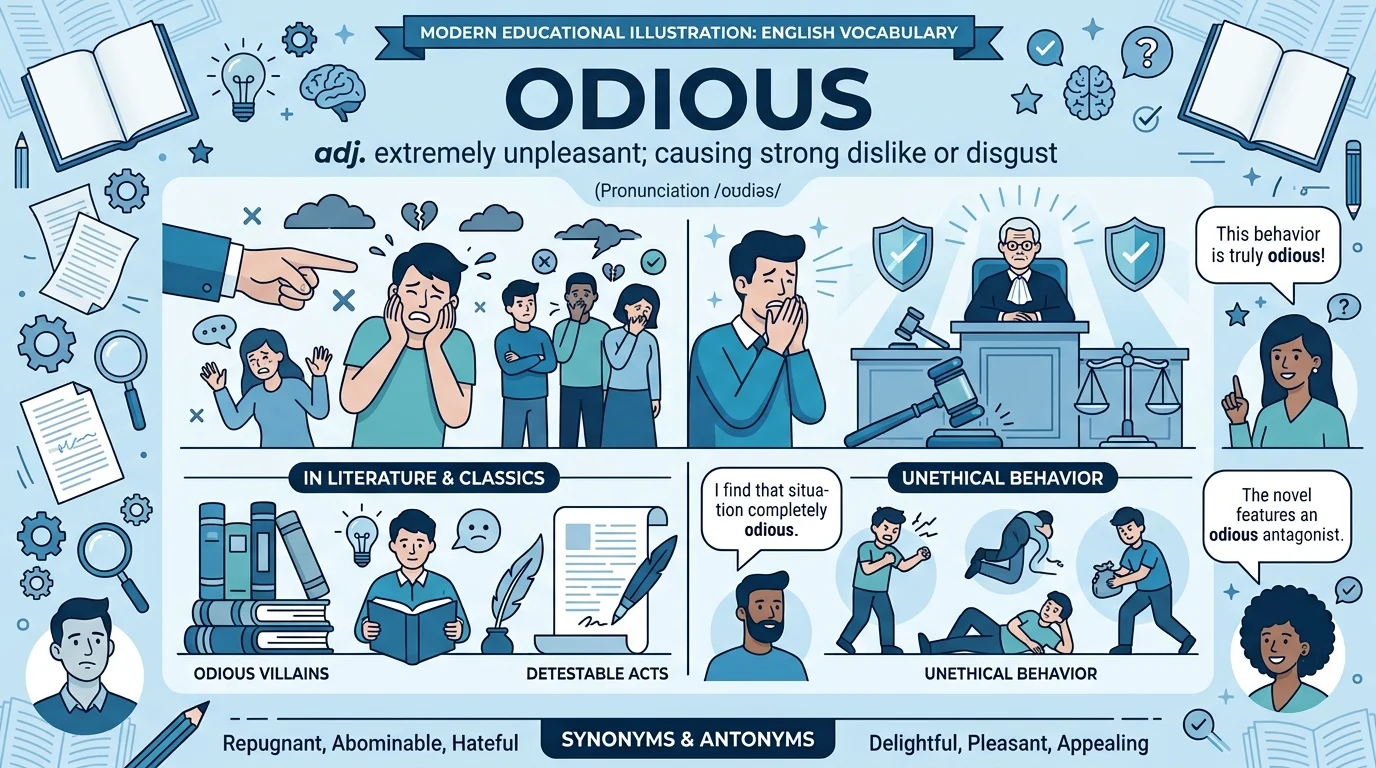
Quick Ans: Odious is an adjective that describes someone or something that is extremely unpleasant, hateful, offensive, or deserving of strong dislike. It is commonly used to describe behavior, actions, crimes, attitudes, or situations that people find morally unacceptable or deeply offensive.
The English language contains many words that express dislike, but odious is one of the strongest. When something is described as odious, it goes beyond being annoying or unpleasant—it suggests that it is so offensive, immoral, or hateful that it deserves condemnation.
Whether you’re reading novels, newspapers, legal documents, or academic writing, you may come across this word. Understanding the odious meaning will help you improve your vocabulary, express opinions more precisely, and better understand advanced English texts.
In this guide, you’ll learn the definition of odious, how it’s pronounced, when to use it, real-life examples, common phrases, synonyms, antonyms, mistakes to avoid, and frequently asked questions.
Quick Answer Box
| Topic | Answer |
|---|---|
| Word | Odious |
| Part of Speech | Adjective |
| Pronunciation | OH-dee-us |
| Meaning | Extremely unpleasant, hateful, offensive, or deserving strong dislike |
| Tone | Formal |
| Common Usage | Describing actions, behavior, crimes, ideas, attitudes, or situations |
What Does Odious Mean?
The word odious means extremely offensive, hateful, disgusting, or deserving of intense dislike.
Unlike words such as bad or annoying, odious carries a much stronger emotional meaning. It is often used when talking about actions, beliefs, or behaviors that are considered morally wrong or socially unacceptable.
Simple Definition
Odious = Extremely hateful or deserving strong dislike.
Dictionary-Style Definition
Odious (adjective): A person, action, idea, or situation that causes hatred because it is offensive, immoral, or disgusting.
Full Definition
When someone calls something odious, they are expressing more than personal dislike. They believe it is offensive enough that most reasonable people would also condemn it.
Examples include:
- An odious crime
- An odious act of discrimination
- An odious policy
- An odious lie
- An odious attitude
The word often appears in discussions involving ethics, politics, law, history, journalism, and literature.
Context and Usage
Understanding context makes it easier to know when odious is appropriate.
Describing Behavior
Someone who bullies vulnerable people may be described as displaying odious behavior.
Example:
“His treatment of the older people was truly odious.”
Discussing Crimes
Serious criminal acts are frequently described as odious.
Example:
“The community condemned the odious crime.”
Political Discussions
Writers may describe discriminatory laws or policies as odious.
Example:
“Many citizens considered the policy odious.”
Literature
Authors often use odious to describe villains or immoral actions.
Example:
“The novel’s villain committed several odious acts.”
Real-Life Examples
Example 1
“The company’s odious treatment of its workers damaged its reputation.”
Example 2
“Everyone agreed that the scam was an odious attempt to exploit vulnerable people.”
Example 3
“His odious remarks offended nearly everyone in the room.”
Example 4
“The judge described the crime as particularly odious.”
Example 5
“History remembers many odious leaders whose actions caused immense suffering.”
Common Situations Where “Odious” Is Used
News Reports
Journalists may use odious when discussing:
- Hate crimes
- Human rights abuses
- Corruption
- Acts of violence
- Serious misconduct
Academic Writing
Researchers sometimes describe historical practices as odious because they violated ethical standards.
Everyday Conversation
Although less common in casual speech, educated speakers occasionally use odious when emphasizing how unacceptable something is.
Example:
“That kind of cheating is absolutely odious.”
Literature
Classic and modern writers frequently use the word to portray evil or immoral characters.
Synonyms of Odious
Depending on the context, similar words include:
- Hateful
- Detestable
- Loathsome
- Revolting
- Offensive
- Disgusting
- Abhorrent
- Repulsive
- Despicable
- Contemptible
- Shameful
- Nasty
- Horrible
- Vile
- Wicked
Each synonym has a slightly different shade of meaning, but all express strong disapproval.
Antonyms of Odious
Opposite words include:
- Pleasant
- Admirable
- Delightful
- Honorable
- Respectable
- Attractive
- Kind
- Acceptable
- Praiseworthy
- Likeable
These words describe positive qualities instead of offensive or hateful ones.
Origin of the Word
The word odious comes from the Latin word odium, meaning hatred.
Over time, it entered Middle English through Old French and has retained its original sense of something deserving hatred or strong dislike.
Knowing its origin helps explain why the word carries such a powerful emotional impact.
Pronunciation
Odious is pronounced:
OH-dee-us
Phonetic spelling:
/ˈoʊ.di.əs/
Breaking it into syllables:
O-di-ous
Listening to native speakers and practicing aloud can help improve pronunciation.
How to Use “Odious” Correctly
Use odious when describing:
- Immoral actions
- Offensive comments
- Cruel behavior
- Corrupt practices
- Serious wrongdoing
Examples:
- “The company faced criticism for its odious practices.”
- “His odious comments shocked everyone.”
- “The community rejected the odious proposal.”
Common Mistakes
Using It for Minor Annoyances
Incorrect:
“The homework was odious.”
Unless the homework is genuinely offensive or morally wrong, this sounds exaggerated.
Better:
“The homework was difficult.”
Confusing It with “Odorous”
Although the words sound somewhat similar, they are unrelated.
- Odious = Hateful or offensive.
- Odorous = Having a smell.
Usage Tips
To use odious naturally:
- Reserve it for serious situations.
- Avoid using it for everyday inconveniences.
- Use it in formal or descriptive writing.
- Pair it with actions, behavior, policies, crimes, or attitudes.
- Consider whether “offensive” or “disgusting” better fits casual conversations.
Frequently Asked Questions
What does odious mean?
It means extremely hateful, offensive, or deserving strong dislike.
Is odious a positive word?
No. It has a strongly negative meaning.
Is odious formal?
Yes. It is more common in formal writing, journalism, literature, and academic contexts than in casual conversation.
Can a person be odious?
Yes. A person can be described as odious if their behavior or character is extremely offensive or hateful.
Can actions be odious?
Absolutely. The word often describes immoral actions or behavior.
What’s the difference between odious and annoying?
Annoying refers to something irritating, while odious describes something morally offensive or deeply hateful.
Is odious commonly used today?
Yes, though it is less common than words like offensive or disgusting. It is still widely used in books, news articles, and formal English.
What part of speech is odious?
It is an adjective.
What is the opposite of odious?
Words like pleasant, honorable, admirable, and respectable are common antonyms.
How can I remember the meaning of odious?
Think of the word odium, which means hatred. If something is odious, it deserves hatred because it is offensive or morally wrong.
Conclusion
The odious meaning refers to something that is extremely offensive, hateful, immoral, or deserving of intense dislike. It is a powerful adjective that conveys much stronger disapproval than everyday words like bad or unpleasant.
Whether you’re reading literature, following the news, studying English, or improving your vocabulary, understanding how to use odious correctly will make your writing and speech more precise. It is especially useful when discussing serious issues such as unethical behavior, injustice, discrimination, corruption, or other actions that society strongly condemns.
Remember to use the word thoughtfully. Because of its strong meaning, odious is best reserved for situations that truly deserve severe criticism. Used correctly, it adds clarity, emphasis, and sophistication to your communication.
Discover More:-
- BRB Meaning in Text: Definition, Examples & Social Media Uses 2026
- SPF Meaning in Text: Definition, Examples & Social Media Uses 2026

Amelia Brooks is a professional content writer and digital publishing specialist with a passion for creating clear, engaging, and informative content. She has extensive experience writing about technology, business, lifestyle, and online services.