Have you ever felt that a situation was unjust or that someone treated you without proper consideration? You want to describe something that is not right or equitable, and the word “unfair” comes to mind. But is it the best fit for your audience? Choosing the right synonym for “unfair” can transform a vague complaint into a precise, powerful statement. This guide explores the best synonyms of unfair, explaining exactly which word to use and when.
Quick Ans: “Unfair” means not based on or behaving according to principles of equality and justice. It is a negative adjective. For formal writing, choose inequitable or unjust. For casual conversation, use unreasonable or one-sided. In academic contexts, discriminatory and prejudiced are strong choices. For a stronger, more emotional impact, select egregious or flagrant.
Meaning, Tone, and Context
Understanding the core meaning of “unfair” is the first step to using it effectively.
Simple Definition: Not treating people in an equal way. Not based on justice or what is right.
Part of Speech: Adjective.
Overall Tone: Negative. It expresses disapproval of a situation, action, or rule.
Formality Level: Neutral. The word works in almost any context, from casual conversation to formal writing.
Common Uses: Native English speakers use it frequently to describe situations. For example, “That decision was unfair,” or “Life can be so unfair sometimes.”
Word Forms: Related words include the noun unfairness and the adverb unfairly.
When and How to Use “Unfair”
“Unfair” is the most common and direct word in its category. Here are seven realistic examples.
Professional: “The performance review process felt unfair to many employees.”
Academic: “The study examines the unfair distribution of resources in urban areas.”
Workplace: “It is unfair that some team members receive more recognition than others.”
Personal: “It seems unfair that she got all the credit for our joint work.”
Email: “I believe the decision was unfair and would like to appeal.”
Resume: “Advocated against unfair hiring practices in the organization.”
Social Media: “This new policy feels incredibly unfair to small business owners.”
Best Synonyms of “Unfair”
No synonym is identical in every situation. Here is your guide to the best replacement for “unfair” based on your writing context.
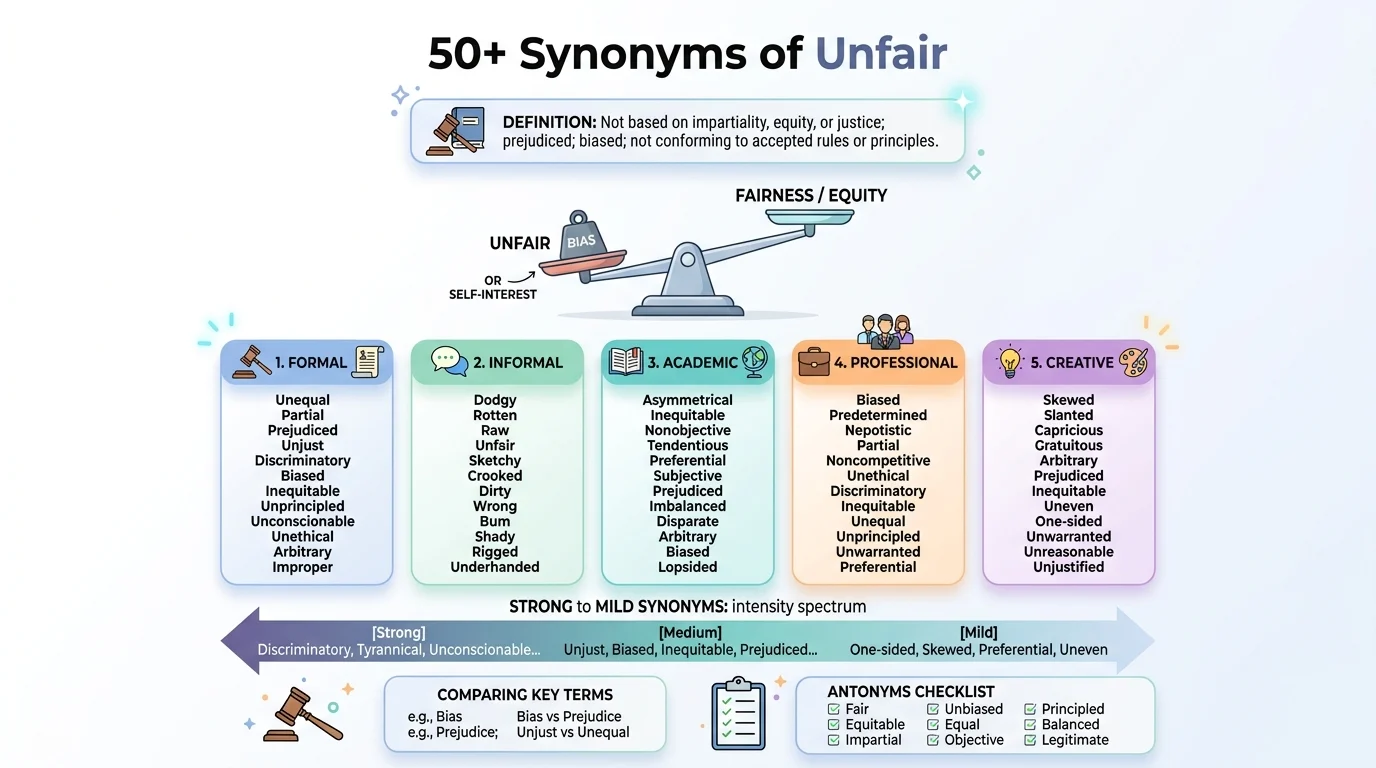
Professional Writing: Inequitable. It suggests a system that is not balanced. “The current pay structure is inequitable across departments.”
Academic Writing: Unjust. This is ideal when discussing moral or legal wrongs. “The law was widely considered unjust by civil rights leaders.”
Business Communication: Biased. A practical choice for describing partial treatment. “The selection process appeared biased in favor of internal candidates.”
Casual Conversation: Unreasonable. It tones down the severity, meaning not sensible. “His demands were completely unreasonable.”
Emotional Writing: Egregious. This word carries weight, suggesting a glaring injustice. “The egregious mistreatment of workers sparked national outrage.”
Creative Writing: Knavish. It implies dishonesty and underhandedness. “The knavish merchant cheated his customers.”
Resume Writing: Discriminatory. Use it to describe systemic bias. “Worked to eliminate discriminatory policies in the organization.”
When Not to Use “Unfair”
Using “unfair” can sound weak or imprecise in certain situations.
When It Sounds Too Vague: “Unfair” can be too general. You might need a word that conveys more specificity.
Better Choice: Discriminatory. “The company’s hiring practices were discriminatory against older workers.”
When You Need a Strong Legal Term: “Unfair” is too casual for legal or formal complaints.
Better Choice: Illegitimate. “The court ruled that the contract was illegitimate.”
When It Sounds Too Emotional: In professional settings, “unfair” can sound whiny.
Better Choice: Inequitable. “The inequitable distribution of resources needs to be addressed.”
When Describing a Rule: “Unfair” works, but arbitrary is more precise.
Better Choice: Arbitrary. “The arbitrary rule confused everyone in the department.”
Words Commonly Confused With “Unfair”
Several words are often mixed up with “unfair.” Here is how to keep them straight.
Word: Unjust
Difference: Refers specifically to a violation of justice. “Unfair” is broader and can refer to minor things.
When to Use: Use it when a law, decision, or action goes against moral or legal principles.
Example: “The verdict was unjust and contradicted all the evidence.”
Word: Inequitable
Difference: Focuses on lack of balance or fairness in distribution. “Unfair” is more general.
When to Use: Use this for resource distribution, pay, and systemic issues.
Example: “The inequitable funding between schools caused widespread protests.”
Word: Biased
Difference: Suggests prejudice or favoritism. “Unfair” is a broader term.
When to Use: Use it when someone shows favoritism based on personal preference.
Example: “The referee was biased toward the home team.”
Word: Discriminatory
Difference: Implies a specific prejudice against a group. “Unfair” is more general.
When to Use: Use this for prejudice based on race, gender, age, or other protected characteristics.
Example: “The discriminatory policy was finally overturned.”
Word: Arbitrary
Difference: Means based on random choice or personal whim. “Unfair” implies injustice.
When to Use: Use it for decisions that seem random or without good reason.
Example: “The arbitrary deadline made no sense for the project.”
Word: Prejudiced
Difference: Suggests preconceived opinions without reason. “Unfair” is a broader term.
When to Use: Use it when someone holds unreasonable negative views about a group.
Example: “His prejudiced views were not welcome in the diverse workplace.”
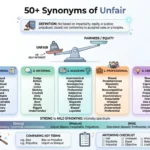
Best Synonyms of “Unfair” by Context
| Context | Best Synonym | Why It Works | Example |
|---|---|---|---|
| Formal writing | Inequitable | Suggests a system that is not balanced. | “The inequitable tax system burdened the middle class.” |
| Academic writing | Unjust | Implies a moral or legal wrong. | “The historian described the colonial policies as unjust.” |
| Professional communication | Biased | Emphasizes partial treatment. | “The biased evaluation process undermined trust.” |
| Business emails | Unreasonable | Practical and concise for business situations. | “The client’s demands were unreasonable and needed renegotiation.” |
| Resume writing | Discriminatory | Highlights systemic bias you fought against. | “Led efforts to eliminate discriminatory recruitment practices.” |
| Workplace communication | Inequitable | Emphasizes imbalance in systems. | “The inequitable workload distribution caused burnout.” |
| Casual conversation | Unreasonable | Simple, direct, and conversational. | “Her expectations were totally unreasonable.” |
| Creative writing | Knavish | Evokes dishonesty and cunning. | “The knavish lawyer exploited every loophole.” |
| Emotional writing | Egregious | Suggests a glaring, shocking injustice. | “The egregious violation of human rights could not be ignored.” |
| Strong emphasis | Flagrant | Implies blatant, obvious wrongdoing. | “The flagrant disregard for the rules angered everyone.” |
| Mild tone | Unfair | Simple and unassuming. Good for everyday references. | “It seems unfair that we have to work late.” |
| Social media captions | Unfair | The most natural, widely understood choice. | “This new policy is so unfair to freelancers.” |
How to Choose the Best Synonym of “Unfair”
Choosing the right word is a simple decision. Answer these questions.
What is my audience? For a professor or judge, inequitable or unjust is powerful. For a friend, unreasonable or unfair is more natural.
What is my purpose? Are you trying to complain, persuade, or inform? Use egregious for drama, discriminatory for precision, and inequitable for systems.
Am I describing a system or an individual action? For systems, inequitable is good. For individual actions, biased or unjust are better.
What is the emotional strength? Egregious and flagrant are stronger. Unreasonable is milder. Pick the one that matches your message.
Real Life Examples of “Unfair”
To truly master the word, it helps to see how it behaves in the wild and how a stronger synonym can elevate the sentence.
School: Basic: “The teacher’s grading was unfair.” Improved: “The teacher’s grading was biased against students who participated less.”
College: Basic: “The scholarship process was unfair to international students.” Improved: “The scholarship process was discriminatory toward international applicants.”
Workplace: Basic: “The promotion decision was unfair.” Improved: “The promotion decision was inequitable given the candidates’ qualifications.”
Business: Basic: “The contract terms were unfair to our company.” Improved: “The contract terms were unreasonable and heavily favored the vendor.”
Email: Basic: “The deadline is unfair for our team.” Improved: “The deadline is arbitrary and does not account for our current workload.”
Conversation: Basic: “That rule is so unfair.” Improved: “That rule is completely unreasonable and makes no sense.”
Storytelling: Basic: “The villain’s actions were unfair.” Improved: “The villain’s knavish behavior deceived everyone in the kingdom.”
Top 10 Synonyms of “Unfair”
| Synonym | Simple Meaning | Best Used For | Example Sentence |
|---|---|---|---|
| Unjust | Violating moral or legal principles | Formal, academic, and legal contexts. | “The court overturned the unjust conviction.” |
| Inequitable | Lacking balance or fairness | Professional, systemic, and policy contexts. | “The inequitable distribution of wealth is a major issue.” |
| Biased | Showing favoritism or prejudice | Professional, social, and judgment contexts. | “The biased judge should have recused himself.” |
| Discriminatory | Prejudiced against a specific group | Academic, legal, and human rights contexts. | “The discriminatory housing policy was finally abolished.” |
| Unreasonable | Not sensible or fair | Casual conversation and everyday complaints. | “The unreasonable fees drove customers away.” |
| Arbitrary | Based on random choice or whim | Professional, legal, and policy contexts. | “The arbitrary rule confused everyone in the organization.” |
| Egregious | Shockingly bad or unfair | Emotional, dramatic, and persuasive contexts. | “The egregious misconduct led to immediate termination.” |
| Flagrant | Blatantly obvious and shocking | Legal, emotional, and formal complaints. | “The flagrant violation of safety protocols was unacceptable.” |
| Prejudiced | Holding preconceived negative views | Social, academic, and personal contexts. | “Her prejudiced remarks offended her colleagues.” |
| Knavish | Dishonest and cunning | Creative writing and literary contexts. | “The knavish merchant sold defective goods.” |
Synonyms of “Unfair” by Usage
Professional vs. Personal Synonyms
In the workplace (professional), choose inequitable, biased, or discriminatory to describe systemic issues. These words convey seriousness and precision. “The inequitable pay structure” is more impactful than “unfair pay.”
With friends (personal), unreasonable, unfair, or not right keep the tone relaxed and relatable. These alternatives sound natural in everyday conversation.
Formal vs. Conversational Synonyms
For formal writing (reports, essays, legal documents), use unjust, inequitable, or discriminatory. These choices maintain the sophisticated tone expected in professional documents.
For casual conversations and texting, use unreasonable, unfair, or not fair. These options sound more natural and less pretentious.
Academic Synonyms
For research and essays, choose precise, authoritative words. Discriminatory is essential for social science research, unjust for legal and moral arguments, and inequitable for policy analysis. These words sound considered and scholarly.
Using precise academic vocabulary demonstrates expertise and careful thinking. Professors and reviewers expect this level of precision.
Professional and Business Synonyms
For maximum impact in business writing, choose inequitable for systems, biased for processes, and discriminatory for policies. These words demonstrate confidence and professional awareness.
Business leaders respond to language that conveys clarity and fairness. These synonyms project authority.
Creative and Literary Synonyms
To add emotion and imagery to your writing, choose knavish, egregious, or flagrant. These words create atmosphere and drama.
Literary writers use these alternatives to build character and conflict. They transform ordinary complaints into evocative prose.
Slang or Modern Synonyms
There is no direct slang synonym for “unfair” in mainstream American English. The simplest alternative in modern texting is literally just not cool or wrong. This straightforward approach works best for casual digital communication.
Strongest to Mildest Synonyms
Mild: unfair, unreasonable, not right
Moderate: biased, prejudiced, arbitrary
Strong: unjust, inequitable, discriminatory
Very Strong: egregious, flagrant, knavish
Emotional vs. Neutral Synonyms
Emotional Synonyms: Egregious, flagrant, knavish. These words often hint at anger, outrage, or dramatic significance. Use them when you want to evoke strong feeling.
Neutral Synonyms: Unfair, unreasonable, arbitrary. These words simply communicate factual information. Use them when you want to inform without emotional coloring.
Antonyms of “Unfair”
Here are 15 genuine opposites of “unfair.”
| Antonym | Meaning | Example Sentence |
|---|---|---|
| Fair | Treating people equally without favoritism | “The judge’s ruling was fair to both parties.” |
| Just | Based on or behaving according to what is right | “The just decision restored public trust.” |
| Equitable | Characterized by equality and fairness | “The equitable distribution of resources helped everyone.” |
| Impartial | Treating all rivals or disputants equally | “The mediator remained impartial throughout the negotiations.” |
| Unbiased | Showing no prejudice for or against something | “The unbiased reporter presented both sides of the story.” |
| Objective | Not influenced by personal feelings or opinions | “The objective analysis revealed the truth.” |
| Rightful | Being in accordance with what is just | “The rightful heir finally claimed the throne.” |
| Merited | Deserved or earned | “Her merited promotion was celebrated by the team.” |
| Reasonable | Based on good sense | “The reasonable proposal was accepted by all.” |
| Legitimate | Conforming to the law or to rules | “The legitimate business operated transparently.” |
| Proper | Suitable or appropriate for the circumstances | “The proper procedure was followed.” |
| Balanced | Keeping or showing a balance | “The balanced approach considered all perspectives.” |
| Equal | Being the same in quantity, size, or value | “The equal distribution of tasks was appreciated.” |
| Even-handed | Fair and impartial in treatment | “The even-handed teacher treated all students equally.” |
| Conscionable | Guided by conscience; fair and just | “The conscionable leader made ethical decisions.” |
Comparison: “Unfair” vs Similar Words
Unfair vs. Unjust
Main Difference: Unjust refers specifically to violations of justice. Unfair is broader and can refer to minor things.
Which Is Stronger? Unjust is stronger and more serious.
Which Is More Formal? Unjust is more formal and legalistic.
When to Use Each: Use unfair for everyday complaints. Use unjust for serious moral or legal issues.
Examples:
Unfair: “It is unfair that I have to work weekends.”
Unjust: “The unjust law was struck down by the court.”
Unfair vs. Inequitable
Main Difference: Inequitable focuses on lack of balance. Unfair is a broader term.
Which Is Stronger? Inequitable is more precise for systems and policies.
Which Is More Formal? Inequitable is much more formal.
When to Use Each: Use unfair for individual acts. Use inequitable for systemic issues.
Examples:
Unfair: “He was unfair to me.”
Inequitable: “The inequitable funding led to failing schools.”
Unfair vs. Biased
Main Difference: Biased suggests favoritism. Unfair is a broader term.
Which Is Stronger? Biased is more specific and often more damaging.
Which Is More Formal? Both are formal and informal depending on context.
When to Use Each: Use unfair for general situations. Use biased when favoritism is involved.
Examples:
Unfair: “The rules were unfair to newcomers.”
Biased: “The biased referee called fouls only against our team.”
Unfair vs. Discriminatory
Main Difference: Discriminatory implies prejudice against a specific group. Unfair is more general.
Which Is Stronger? Discriminatory is much stronger and legalistic.
Which Is More Formal? Discriminatory is very formal and often used in legal contexts.
When to Use Each: Use unfair for general complaints. Use discriminatory for prejudice against protected groups.
Examples:
Unfair: “The policy was unfair to part-time workers.”
Discriminatory: “The discriminatory policy targeted minority applicants.”
Unfair vs. Arbitrary
Main Difference: Arbitrary means based on random choice. Unfair implies injustice.
Which Is Stronger? Arbitrary is specific; unfair is broader.
Which Is More Formal? Both are used in formal and informal contexts.
When to Use Each: Use unfair for injustice. Use arbitrary for decisions that seem random.
Examples:
Unfair: “The decision was unfair and hurt the team.”
Arbitrary: “The arbitrary rule made no sense to anyone.”
Unfair vs. Prejudiced
Main Difference: Prejudiced suggests preconceived negative views. Unfair is broader.
Which Is Stronger? Prejudiced is stronger and more personal.
Which Is More Formal? Both are used in formal and informal contexts.
When to Use Each: Use unfair for situations. Use prejudiced for people with negative biases.
Examples:
Unfair: “The evaluation was unfair to the new employee.”
Prejudiced: “His prejudiced views made the workplace toxic.”
Common Phrases and Expressions with “Unfair”
Phrase: Life is unfair
Meaning: A resigned expression that bad things happen to good people.
Example Sentence: “She knew that life is unfair, but she kept trying anyway.”
Phrase: Unfair advantage
Meaning: An advantage that is not deserved or earned.
Example Sentence: “The top team had an unfair advantage with their superior equipment.”
Phrase: Unfair dismissal
Meaning: Being fired from a job without good reason.
Example Sentence: “She filed a claim for unfair dismissal against her former employer.”
Phrase: Unfair treatment
Meaning: Being treated differently in a negative way.
Example Sentence: “The report documented unfair treatment of minority employees.”
Phrase: Unfair competition
Meaning: Business practices that are illegal or unethical.
Example Sentence: “The company was accused of unfair competition through price fixing.”
Phrase: That’s not fair
Meaning: A common expression of protest against injustice.
Example Sentence: “That’s not fair; I worked just as hard as everyone else.”
Common Mistakes to Avoid
Mistake 1: Using “unfair” when you mean “unreasonable”.
Incorrect: “The price is unfair for this product.”
Better: “The price is unreasonable for this product.”
Why: Unreasonable refers to something being excessive or illogical, while unfair refers to a lack of justice.
Mistake 2: Using “unfair” when you mean “biased”.
Incorrect: “The judge was unfair to the defendant.”
Better: “The judge was biased against the defendant.”
Why: Biased suggests specific favoritism, which is more precise than general unfairness.
Mistake 3: Overusing “unfair” in formal writing.
Incorrect: “The unfair system needs to be changed.”
Better: “The inequitable system needs to be reformed.”
Why: Variation in vocabulary demonstrates writing sophistication.
Mistake 4: Using “discriminatory” when you mean “unfair”.
Incorrect: “It is discriminatory that I have to work late.”
Better: “It is unfair that I have to work late.”
Why: Discriminatory has legal weight and should be reserved for prejudice against protected groups.
Mistake 5: Using “arbitrary” when you mean a simple unfair action.
Incorrect: “The arbitrary boss made us work overtime.”
Better: “The unreasonable boss made us work overtime.”
Why: Arbitrary refers to randomness, not unfairness in human decisions.
Frequently Asked Questions
1. What are the best synonyms of “unfair”?
The best synonyms depend on your context. For formal writing, choose inequitable or unjust. And for casual conversation, unreasonable or unfair are ideal choices. For legal contexts, use discriminatory.
2. What are the best formal synonyms of “unfair”?
The best formal synonyms are inequitable, unjust, and discriminatory. These words are suitable for academic papers, professional reports, and business communications.
3. What are common informal synonyms of “unfair”?
For informal settings, use unreasonable, unfair, or not right. These alternatives sound more natural in everyday conversation.
4. What is another word for “unfair” in professional writing?
In professional writing, inequitable is an excellent choice. It conveys a systemic imbalance. Biased is also strong for describing processes with favoritism.
5. What is the difference between “unfair” and “unjust”?
While both refer to a lack of fairness, unjust implies a violation of moral or legal principles. Unfair is broader and can refer to minor inconveniences. Use unjust for serious matters.
6. What is the opposite of “unfair”?
The most direct opposites (antonyms) of unfair are fair, just, and equitable. These words describe actions or systems that treat people equally and with justice.
Conclusion
“Unfair” is a common and direct word for describing situations that lack justice or equality. The term is widely understood, yet it can sound vague or emotional in certain contexts. The best choice among the synonyms of unfair depends entirely on your audience, tone, and purpose. Remember, no single synonym works perfectly in every situation. Your goal is to choose the word that communicates your message with the most clarity and impact. A practical tip for your vocabulary growth is to consider the severity of the situation before selecting your word and to vary your vocabulary in professional writing.
Discover More:-

Ella Parker is a professional content writer with a passion for creating clear, engaging, and well-researched articles. She focuses on delivering valuable insights and practical information across business, technology, and lifestyle topics.