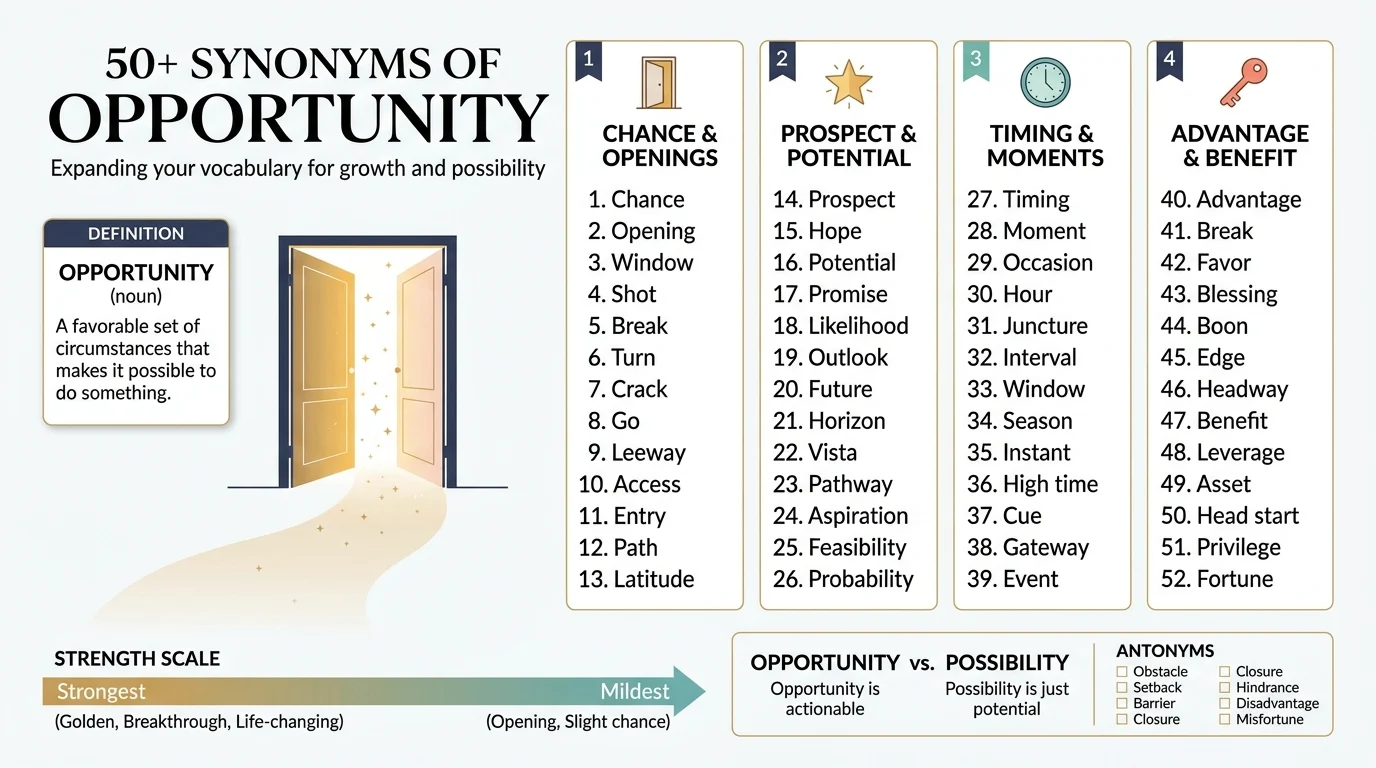
Have you ever needed to describe a chance for success, a favorable moment, or a possibility for advancement but felt that “opportunity” was too formal or repetitive? You want to capture the specific sense of possibility, timing, or advantage, and the word “opportunity” comes to mind. Choosing the right synonym for “opportunity” can transform a basic statement into a precise expression of potential, chance, or prospect. This guide explores the best synonyms of opportunity, explaining exactly which word to use and when.
Quick Answer: “Opportunity” means a set of circumstances that makes it possible to do something, a chance for advancement, or a favorable occasion. For chance, choose chance or opening. For professional contexts, use prospect or possibility. For timing, use occasion or moment. For advantage, use break or lucky break.
Meaning, Tone, and Context
Understanding the core meaning of “opportunity” is the first step to using it effectively.
Simple Definition: A set of circumstances that makes it possible to do something; a chance for advancement or success; a favorable occasion.
Part of Speech: Noun.
Overall Tone: Positive. It indicates possibility, advantage, and hope.
Formality Level: Neutral to formal. The word is appropriate in most contexts.
Common Uses: Native English speakers use it in business (“business opportunity”), education (“learning opportunity”), careers (“job opportunity”), and general contexts (“opportunity of a lifetime”).
Word Forms: Related words include the adjective opportune, the adverb opportunely, and the noun opportunism.
When and How to Use “Opportunity”
“Opportunity” is the perfect choice when you want to describe a chance or possibility. Here are seven realistic examples.
Business: “The new market presents a great opportunity for growth.”
Academic: “The scholarship is an opportunity to study abroad.”
Professional: “This role offers an opportunity to develop new skills.”
Personal: “Traveling was an opportunity to learn about different cultures.”
Email: “Thank you for the opportunity to present our proposal.”
Resume: “Seeking an opportunity to contribute to a dynamic team.”
Social Media: “Every challenge is an opportunity to grow.”
Best Synonyms of “Opportunity”
No synonym is identical in every situation. Here is your guide to the best replacement for “opportunity” based on your writing context.
For Chance and Possibility
Most Direct: Chance means a possibility of something happening. “This is a chance to prove yourself.”
Opening: Opening means a chance or opportunity. “The job opening is perfect for her.”
Prospect: Prospect means the possibility of a future event. “The prospect of promotion motivated him.”
Possibility: Possibility means a thing that may happen. “There is a possibility of success.”
For Favorable Occasion
Occasion: Occasion means a particular time or event. “The occasion called for celebration.”
Moment: Moment means a very brief period of time. “Seize the moment.”
Window: Window means a period of time for action. “The window of opportunity is closing.”
Juncture: Juncture means a particular point in time. “At this juncture, we must decide.”
For Advantage and Break
Break: Break means a fortunate opportunity. “He got his big break in Hollywood.”
Advantage: Advantage means a favorable circumstance. “The location gives us an advantage.”
Avenue: Avenue means a possible course of action. “We need to explore every avenue.”
Outlet: Outlet means a means of expression. “Art provides an outlet for creativity.”
For Professional and Formal Contexts
Prospect: Prospect means a potential opportunity. “The prospect of a merger excited investors.”
Scope: Scope means the opportunity or possibility. “There is scope for improvement.”
Means: Means means an opportunity or resource. “We have the means to succeed.”
Capacity: Capacity means the ability or opportunity. “The capacity for growth is unlimited.”
When Not to Use “Opportunity”
Using “opportunity” can sound wrong or awkward in certain situations.
When You Mean “Chance”: “Opportunity” is more formal. “Chance” is simpler.
Better Choice: Chance. “This is a chance to win.”
When You Mean “Problem”: “Opportunity” is positive. “Problem” is negative.
Better Choice: Problem or issue. “We have a problem to solve.”
When It Sounds Too Formal: In casual conversation, “opportunity” can sound stiff.
Better Choice: Chance or shot. “Give it a shot.”
Words Commonly Confused With “Opportunity”
| Word | Difference | When to Use | Example |
|---|---|---|---|
| Chance | Possibility | General and casual | “A chance to win.” |
| Opening | A vacancy or chance | Jobs and positions | “A job opening.” |
| Prospect | Future possibility | Business and career | “A prospect of promotion.” |
| Occasion | A particular time | Events and ceremonies | “A special occasion.” |
| Possibility | Something that may happen | General and formal | “A possibility of success.” |
| Break | A fortunate opportunity | Careers and entertainment | “His big break.” |
Best Synonyms of “Opportunity” by Context
| Context | Best Synonym | Why It Works | Example |
|---|---|---|---|
| Formal writing | Prospect | Formal and precise | “The prospect of growth is strong.” |
| Academic writing | Possibility | Standard in research | “The possibility of success is high.” |
| Professional | Opening | Professional and clear | “The job opening is available.” |
| Business | Avenue | Business and strategy | “We must explore every avenue.” |
| Careers | Break | Careers and entertainment | “He got his big break.” |
| Casual | Chance | Simple and natural | “This is a chance to try.” |
| Emotional | Moment | Emotional and urgent | “Seize the moment.” |
How to Choose the Best Synonym of “Opportunity”
Choosing the right word is a simple decision. Answer these questions.
What type of opportunity am I describing? For chance, use chance or opening. For prospect, use prospect or possibility. And for timing, use occasion or moment. For advantage, use break or advantage.
What is my audience? For a formal report, use prospect or possibility. For a friend, use chance or shot.
What is my purpose? Are you describing a job opportunity, a business opportunity, or a life opportunity? The correct synonym depends entirely on this.
What is the emotional strength? Break and moment are stronger. Possibility is milder. Pick the one that matches your message.
Real Life Examples of “Opportunity”
School: Basic: “The class is an opportunity to learn.” Improved: “The class is a chance to learn.”
College: Basic: “The scholarship is an opportunity.” Improved: “The scholarship is a prospect for a better future.”
Workplace: Basic: “The project is an opportunity.” Improved: “The project is an opening for advancement.”
Business: Basic: “The market is an opportunity.” Improved: “The market is an avenue for growth.”
Email: Basic: “Thank you for the opportunity.” Improved: “Thank you for the chance.”
Conversation: Basic: “This is an opportunity.” Improved: “This is a shot.”
Storytelling: Basic: “He took the opportunity.” Improved: “He seized the moment.”
Top 10 Synonyms of “Opportunity”
| Synonym | Simple Meaning | Best Used For | Example Sentence |
|---|---|---|---|
| Chance | Possibility of something happening | General and casual | “This is a chance to prove yourself.” |
| Opening | A vacancy or chance | Jobs and positions | “The job opening is perfect for her.” |
| Prospect | Future possibility | Business and career | “The prospect of promotion motivated him.” |
| Possibility | Something that may happen | General and formal | “There is a possibility of success.” |
| Occasion | A particular time | Events and ceremonies | “The occasion called for celebration.” |
| Break | A fortunate opportunity | Careers and entertainment | “He got his big break.” |
| Avenue | A possible course of action | Business and strategy | “We need to explore every avenue.” |
| Moment | A brief period of time | Emotional and urgent | “Seize the moment.” |
| Window | A period for action | Timing and strategy | “The window of opportunity is closing.” |
| Scope | Opportunity or possibility | Formal and professional | “There is scope for improvement.” |
Synonyms of “Opportunity” by Usage
Professional vs. Personal Synonyms
In the workplace, choose opening, prospect, or avenue. With friends, use chance, shot, or moment.
Formal vs. Conversational Synonyms
For formal writing, use prospect, possibility, or occasion. For casual conversations, use chance, shot, or break.
Academic Synonyms
For research and essays, choose possibility for outcomes, prospect for future events, and scope for research.
Professional and Business Synonyms
For maximum impact, choose opening for jobs, avenue for strategy, and prospect for growth.
Creative and Literary Synonyms
To add emotion and imagery, choose moment, window, or juncture. These words create urgency.
Slang or Modern Synonyms
In modern American slang, shot, break, or window are common. For example, “Give it a shot.” These are casual and should be avoided in formal writing.
Strongest to Mildest Synonyms
Mild: possibility, chance, scope
Moderate: opportunity, opening, prospect
Strong: break, avenue, occasion
Very Strong: moment, window, juncture
Emotional vs. Neutral Synonyms
Emotional Synonyms: Moment, window, break. These words hint at urgency and luck. Use them when you want to evoke feeling.
Neutral Synonyms: Opportunity, possibility, prospect. These words communicate factual information.
Antonyms of “Opportunity”
| Antonym | Meaning | Example Sentence |
|---|---|---|
| Obstacle | Something that blocks progress | “The obstacle prevented success.” |
| Barrier | A hindrance | “The barrier was difficult to overcome.” |
| Hindrance | Something that delays | “The hindrance slowed progress.” |
| Setback | A reversal of progress | “The setback was disappointing.” |
| Difficulty | A problem | “The difficulty was unexpected.” |
| Misfortune | Bad luck | “The misfortune was devastating.” |
| Crisis | A time of danger | “The crisis required immediate action.” |
| Problem | A difficult situation | “The problem needs a solution.” |
| Failure | Lack of success | “The failure was a setback.” |
| Loss | Losing something | “The loss was significant.” |
| Dead end | No hope of progress | “The dead end forced us to turn back.” |
| Block | An obstruction | “The block prevented advancement.” |
| Impediment | A hindrance | “The impediment slowed the process.” |
| Drawback | A disadvantage | “The drawback was significant.” |
| Disadvantage | An unfavorable condition | “The disadvantage put us behind.” |
Comparison: “Opportunity” vs Similar Words
Opportunity vs. Chance
Main Difference: “Opportunity” is more formal. “Chance” is casual.
Which Is Stronger? They are similar.
Which Is More Formal? “Opportunity” is more formal.
When to Use Each: Use “chance” in casual conversation. Use “opportunity” in formal writing.
Examples:
Opportunity: “The opportunity for growth is significant.”
Chance: “This is a chance to win.”
Opportunity vs. Opening
Main Difference: “Opportunity” is broader. “Opening” is a specific vacancy.
Which Is Stronger? “Opening” is more specific.
Which Is More Formal? Both are formal.
When to Use Each: Use “opening” for jobs. Use “opportunity” for general contexts.
Examples:
Opportunity: “A business opportunity.”
Opening: “A job opening.”
Opportunity vs. Prospect
Main Difference: “Opportunity” is about chance. “Prospect” is about future possibility.
Which Is Stronger? “Prospect” is more future-oriented.
Which Is More Formal? Both are formal.
When to Use Each: Use “prospect” for future events. Use “opportunity” for general contexts.
Examples:
Opportunity: “A learning opportunity.”
Prospect: “The prospect of promotion.”
Opportunity vs. Occasion
Main Difference: “Opportunity” is about chance. “Occasion” is about timing.
Which Is Stronger? “Occasion” is more specific to time.
Which Is More Formal? Both are formal.
When to Use Each: Use “occasion” for events. Use “opportunity” for general contexts.
Examples:
Opportunity: “An opportunity to travel.”
Occasion: “A special occasion.”
Opportunity vs. Break
Main Difference: “Opportunity” is formal. “Break” is casual.
Which Is Stronger? “Break” is more casual and lucky.
Which Is More Formal? “Opportunity” is more formal.
When to Use Each: Use “break” in casual conversation. Use “opportunity” in formal writing.
Examples:
Opportunity: “A career opportunity.”
Break: “His big break.”
Opportunity vs. Moment
Main Difference: “Opportunity” is broader. “Moment” is about timing.
Which Is Stronger? “Moment” is more urgent.
Which Is More Formal? Both are neutral.
When to Use Each: Use “moment” for urgency. Use “opportunity” for general contexts.
Examples:
Opportunity: “An opportunity to improve.”
Moment: “Seize the moment.”
Common Phrases and Expressions with “Opportunity”
Phrase: Opportunity of a lifetime
Meaning: A once-in-a-lifetime chance.
Example Sentence: “The trip was the opportunity of a lifetime.”
Phrase: Equal opportunity
Meaning: Fair treatment for all.
Example Sentence: “The company is an equal opportunity employer.”
Phrase: Seize the opportunity
Meaning: Take advantage of a chance.
Example Sentence: “She seized the opportunity to study abroad.”
Phrase: Window of opportunity
Meaning: A limited time for action.
Example Sentence: “The window of opportunity is closing.”
Phrase: Golden opportunity
Meaning: A perfect chance.
Example Sentence: “This is a golden opportunity for growth.”
Phrase: Missed opportunity
Meaning: A chance that was lost.
Example Sentence: “The missed opportunity was regrettable.”
Common Mistakes to Avoid
Mistake 1: Using “opportunity” when you mean “chance”.
Incorrect: “Give me an opportunity to try.”
Better: “Give me a chance to try.”
Why: “Chance” is more natural in casual contexts.
Mistake 2: Using “opportunity” when you mean “opening”.
Incorrect: “There is an opportunity at the company.”
Better: “There is an opening at the company.”
Why: “Opening” is specific to jobs.
Mistake 3: Overusing “opportunity” in conversation.
Incorrect: “This is a great opportunity.”
Better: “This is a great chance.”
Why: “Chance” sounds more natural.
Mistake 4: Using “opportunity” when you mean “possibility”.
Incorrect: “There is an opportunity of rain.”
Better: “There is a possibility of rain.”
Why: “Possibility” is for outcomes.
Mistake 5: Using “opportunity” when you mean “break”.
Incorrect: “He got his opportunity in Hollywood.”
Better: “He got his break in Hollywood.”
Why: “Break” is for careers.
Frequently Asked Questions
1. What are the best synonyms of “opportunity”?
The best synonyms depend on your context. For chance, choose chance or opening. For prospect, use prospect or possibility. And for timing, use occasion or moment.
2. What are the best formal synonyms of “opportunity”?
The best formal synonyms are prospect, possibility, and occasion. These words are suitable for academic papers, professional reports, and business communications.
3. What are common informal synonyms of “opportunity”?
For informal settings, use chance, shot, or break. These alternatives sound more natural in everyday conversation.
4. What is another word for “opportunity” in professional writing?
In professional writing, opening is an excellent choice. It conveys a vacancy or chance. Prospect is also strong for future possibilities.
5. What is the difference between “opportunity” and “chance”?
“Opportunity” is more formal. “Chance” is casual. Use “chance” in conversation and “opportunity” in formal writing.
6. What is the opposite of “opportunity”?
The most direct opposites (antonyms) of opportunity are obstacle, barrier, and setback. These words describe things that block progress.
Conclusion
“Opportunity” is a powerful and positive word for describing chances, possibilities, and favorable circumstances. The term is formal and widely accepted in professional, academic, and personal contexts, yet it can sound too formal for casual conversation or too broad for specific descriptions. The best choice among the synonyms of opportunity depends entirely on your audience, tone, and purpose. For a formal, professional effect, use prospect or opening. For a practical, everyday context, chance or shot works perfectly. And for timing, choose occasion or moment. For careers, use break or avenue. Remember, no single synonym works perfectly in every situation. Your goal is to choose the word that communicates your message with the most clarity and impact. A practical tip for your vocabulary growth is to pay attention to how writers describe chances and possibilities and practice using different synonyms in your writing.










1 thought on “50+ Synonyms of Opportunity: Meanings, Uses, Examples, and Best Alternatives”