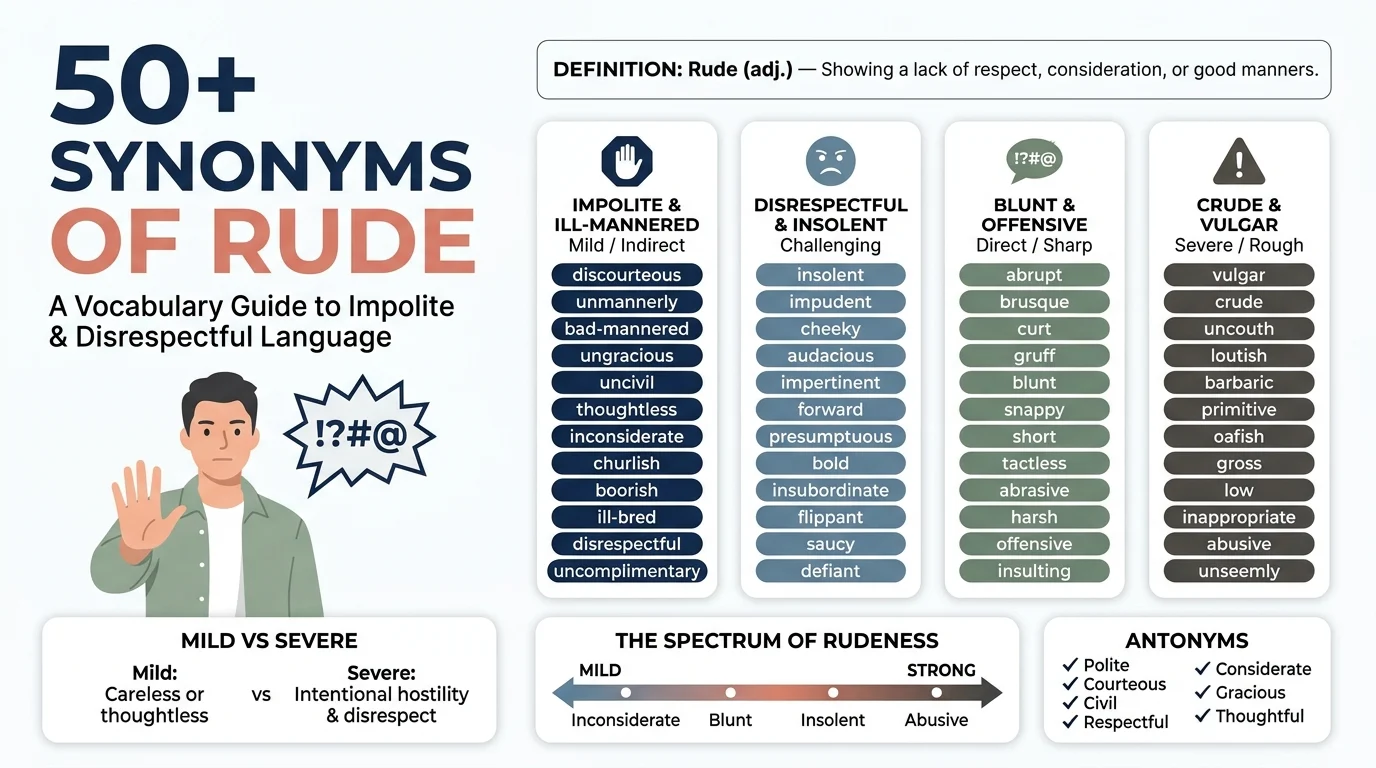
Have you ever needed to describe behavior that is impolite, disrespectful, or offensive but felt that “rude” was too simple or repetitive? You want to capture the specific type of bad manners, whether it is intentional disrespect, lack of consideration, or bluntness, and the word “rude” comes to mind. Choosing the right synonym for “rude” can transform a basic complaint into a precise expression of discourtesy, insolence, or incivility. This guide explores the best synonyms of rude, explaining exactly which word to use and when.
Quick Ans: “Rude” means offensively impolite or ill-mannered, abrupt in manner, or roughly made. For formal writing, choose discourteous or impolite. For strong disrespect, use insolent or disrespectful. For bluntness, use brusque or curt. For lack of consideration, use inconsiderate or thoughtless. For crudeness, use crude or vulgar.
Meaning, Tone, and Context
Understanding the core meaning of “rude” is the first step to using it effectively.
Simple Definition: Offensively impolite or ill-mannered; abrupt or unrefined in manner; roughly made or done.
Part of Speech: Adjective.
Overall Tone: Negative. It indicates disrespect, bad manners, or lack of refinement.
Formality Level: Neutral. The word works in most contexts.
Common Uses: Native English speakers use it to describe behavior (“rude behavior”), speech (“rude comment”), people (“rude waiter”), and objects (“rude shelter”).
Word Forms: Related words include the adverb rudely, the noun rudeness, and the adjective ruder (comparative).
When and How to Use “Rude”
“Rude” is the perfect choice when you want to describe impolite or disrespectful behavior. Here are seven realistic examples.
Social: “His rude comment offended everyone at the table.”
Professional: “The customer was rude to the staff.”
Workplace: “Rude behavior in the office is not tolerated.”
Personal: “She was rude to her parents.”
Email: “I apologize for the rude response you received.”
Academic: “The study examines the effects of rude behavior in classrooms.”
Social Media: “Being rude online has real consequences.”
Best Synonyms of “Rude”
No synonym is identical in every situation. Here is your guide to the best replacement for “rude” based on your writing context.
For Impolite and Discourteous
Most Formal: Discourteous means lacking courtesy. “His discourteous behavior was noted.”
Impolite: Impolite means not polite. “It is impolite to interrupt.”
Uncivil: Uncivil means lacking civility. “The uncivil exchange shocked onlookers.”
Ill-mannered: Ill-mannered means having bad manners. “The ill-mannered child embarrassed his parents.”
For Disrespectful and Insolent
Disrespectful: Disrespectful means showing lack of respect. “His disrespectful tone angered the teacher.”
Insolent: Insolent means boldly disrespectful. “The insolent student talked back.”
Impertinent: Impertinent means rude and disrespectful. “Her impertinent question surprised him.”
Impudent: Impudent means showing bold disrespect. “The impudent remark was unacceptable.”
For Blunt and Abrupt
Brusque: Brusque means abrupt in manner. “The waiter was brusque but efficient.”
Curt: Curt means rudely brief. “His curt reply ended the conversation.”
Blunt: Blunt means direct to the point of rudeness. “Her blunt comment hurt his feelings.”
Terse: Terse means using few words. “His terse response indicated annoyance.”
For Crude and Vulgar
Crude: Crude means offensively coarse. “The crude joke offended many.”
Vulgar: Vulgar means lacking sophistication. “The vulgar language was inappropriate.”
Coarse: Coarse means rough in manner. “His coarse humor did not go over well.”
Boorish: Boorish means rough and bad-mannered. “The boorish behavior ruined the evening.”
When Not to Use “Rude”
Using “rude” can sound wrong or awkward in certain situations.
When You Mean “Blunt”: “Rude” implies disrespect. “Blunt” is about directness.
Better Choice: Blunt or direct. “He was blunt but honest.”
When You Mean “Simple”: “Rude” can mean roughly made. “Simple” is neutral.
Better Choice: Simple or basic. “The shelter was simple.”
When It Sounds Too Harsh: For minor breaches of etiquette, “rude” can be strong.
Better Choice: Impolite or inconsiderate. “It was impolite not to say thank you.”
Words Commonly Confused With “Rude”
| Word | Difference | When to Use | Example |
|---|---|---|---|
| Impolite | Not polite | General and mild | “It is impolite to stare.” |
| Disrespectful | Lacking respect | Authority and elders | “Disrespectful behavior.” |
| Brusque | Abrupt in manner | Professional and social | “The brusque waiter.” |
| Blunt | Direct to the point | Honesty and feedback | “A blunt assessment.” |
| Vulgar | Lacking refinement | Language and jokes | “Vulgar language.” |
| Insolent | Boldly disrespectful | Authority and rules | “An insolent reply.” |
Best Synonyms of “Rude” by Context
| Context | Best Synonym | Why It Works | Example |
|---|---|---|---|
| Formal writing | Discourteous | Formal and precise | “The discourteous response was noted.” |
| Academic writing | Uncivil | Standard in research | “Uncivil discourse was studied.” |
| Professional | Impolite | Professional and clear | “Impolite behavior is unacceptable.” |
| Workplace | Disrespectful | Clear and direct | “Disrespectful conduct was reported.” |
| Casual | Mean | Simple and natural | “That was mean.” |
| Emotional | Insolent | Strong and emotional | “The insolent child talked back.” |
| Descriptive | Brusque | Evokes abruptness | “The brusque waiter.” |
How to Choose the Best Synonym of “Rude”
Choosing the right word is a simple decision. Answer these questions.
What type of rudeness am I describing? For impoliteness, use discourteous or impolite. And For disrespect, use insolent or disrespectful. For bluntness, use brusque or curt. For crudeness, use vulgar or crude.
What is my audience? For a formal report, use discourteous or uncivil. For a friend, use mean or impolite.
What is my purpose? Are you describing behavior, speech, or attitude? The correct synonym depends entirely on this.
What is the emotional strength? Insolent and vulgar are stronger. Impolite is milder. Pick the one that matches your message.
Real Life Examples of “Rude”
School: Basic: “The student was rude.” Improved: “The student was disrespectful to the teacher.”
College: Basic: “The comment was rude.” Improved: “The comment was insolent and offensive.”
Workplace: Basic: “The email was rude.” Improved: “The email was curt and unprofessional.”
Business: Basic: “The customer was rude.” Improved: “The customer was discourteous to the staff.”
Email: Basic: “Sorry for the rude reply.” Improved: “Sorry for the brusque reply.”
Conversation: Basic: “That was rude.” Improved: “That was mean.”
Storytelling: Basic: “The man was rude.” Improved: “The man was boorish and offensive.”
Top 10 Synonyms of “Rude”
| Synonym | Simple Meaning | Best Used For | Example Sentence |
|---|---|---|---|
| Impolite | Not polite | General and mild | “It is impolite to interrupt.” |
| Discourteous | Lacking courtesy | Formal and professional | “His discourteous behavior was noted.” |
| Disrespectful | Lacking respect | Authority and social | “Disrespectful conduct is unacceptable.” |
| Insolent | Boldly disrespectful | Strong disrespect | “The insolent student talked back.” |
| Brusque | Abrupt in manner | Professional and social | “The brusque waiter rushed us.” |
| Curt | Rudely brief | Communication | “His curt reply ended the discussion.” |
| Blunt | Direct to the point | Honesty and feedback | “Her blunt comment hurt his feelings.” |
| Vulgar | Lacking refinement | Language and jokes | “Vulgar language is not allowed.” |
| Uncivil | Lacking civility | Formal and political | “Uncivil discourse hinders progress.” |
| Boorish | Rough and bad-mannered | Descriptive and social | “The boorish behavior ruined the evening.” |
Synonyms of “Rude” by Usage
Professional vs. Personal Synonyms
In the workplace, choose discourteous, disrespectful, or unprofessional. With friends, use mean, impolite, or jerky.
Formal vs. Conversational Synonyms
For formal writing, use discourteous, uncivil, or insolent. For casual conversations, use mean, impolite, or jerky.
Academic Synonyms
For research and essays, choose uncivil for discourse, disrespectful for behavior, and boorish for social contexts.
Professional and Business Synonyms
For maximum impact, choose discourteous for customer service, unprofessional for workplace conduct, and brusque for communication.
Creative and Literary Synonyms
To add emotion and imagery, choose insolent, boorish, or vulgar. These words create atmosphere.
Slang or Modern Synonyms
In modern American slang, mean, jerky, disrespectful, or out of line are common. For example, “That was out of line.” These are casual and should be avoided in formal writing.
Strongest to Mildest Synonyms
Mild: impolite, inconsiderate, curt
Moderate: rude, disrespectful, brusque
Strong: discourteous, insolent, uncivil
Very Strong: vulgar, boorish, impertinent
Emotional vs. Neutral Synonyms
Emotional Synonyms: Insolent, boorish, vulgar. These words hint at strong disapproval. Use them when you want to evoke feeling.
Neutral Synonyms: Rude, impolite, discourteous. These words communicate factual information.
Antonyms of “Rude”
| Antonym | Meaning | Example Sentence |
|---|---|---|
| Polite | Showing good manners | “She was polite to everyone.” |
| Courteous | Respectful and considerate | “His courteous manner impressed her.” |
| Respectful | Showing respect | “The respectful student listened.” |
| Civil | Polite and courteous | “The civil discussion was productive.” |
| Considerate | Thinking of others | “He was considerate of her feelings.” |
| Mannerly | Having good manners | “The mannerly child said please.” |
| Gracious | Courteous and kind | “She was gracious to her guests.” |
| Tactful | Showing sensitivity | “His tactful response avoided offense.” |
| Diplomatic | Handling situations sensitively | “The diplomatic answer pleased everyone.” |
| Refined | Cultured and polite | “Her refined manners were admired.” |
| Well-mannered | Having good manners | “The well-mannered guests impressed us.” |
| Gentle | Kind and mild | “His gentle tone calmed her.” |
| Cordial | Friendly and warm | “The cordial greeting was welcoming.” |
| Chivalrous | Courteous and honorable | “His chivalrous act was appreciated.” |
| Attentive | Paying attention to others | “The attentive waiter anticipated our needs.” |
Comparison: “Rude” vs Similar Words
Rude vs. Impolite
Main Difference: “Rude” is stronger. “Impolite” is milder.
Which Is Stronger? “Rude” is stronger.
Which Is More Formal? Both are neutral.
When to Use Each: Use “impolite” for minor breaches. Use “rude” for clear disrespect.
Examples:
Rude: “His rude comment offended everyone.”
Impolite: “It is impolite to interrupt.”
Rude vs. Disrespectful
Main Difference: “Rude” is about manners. “Disrespectful” is about respect.
Which Is Stronger? “Disrespectful” is stronger.
Which Is More Formal? Both are neutral.
When to Use Each: Use “disrespectful” for authority. Use “rude” for general contexts.
Examples:
Rude: “The rude waiter ignored us.”
Disrespectful: “The disrespectful student talked back.”
Rude vs. Brusque
Main Difference: “Rude” is broader. “Brusque” is abrupt.
Which Is Stronger? “Rude” is stronger.
Which Is More Formal? Both are formal.
When to Use Each: Use “brusque” for manner. Use “rude” for general contexts.
Examples:
Rude: “The rude customer yelled.”
Brusque: “The brusque waiter rushed us.”
Rude vs. Blunt
Main Difference: “Rude” is about respect. “Blunt” is about directness.
Which Is Stronger? “Rude” is stronger.
Which Is More Formal? Both are neutral.
When to Use Each: Use “blunt” for honesty. Use “rude” for disrespect.
Examples:
Rude: “His rude remark hurt her.”
Blunt: “Her blunt comment was honest.”
Rude vs. Vulgar
Main Difference: “Rude” is about manners. “Vulgar” is about refinement.
Which Is Stronger? “Vulgar” is stronger.
Which Is More Formal? Both are neutral.
When to Use Each: Use “vulgar” for language. Use “rude” for general contexts.
Examples:
Rude: “The rude gesture was inappropriate.”
Vulgar: “The vulgar joke offended everyone.”
Rude vs. Insolent
Main Difference: “Rude” is broader. “Insolent” is boldly disrespectful.
Which Is Stronger? “Insolent” is stronger.
Which Is More Formal? Both are formal.
When to Use Each: Use “insolent” for bold disrespect. Use “rude” for general contexts.
Examples:
Rude: “The rude child ignored his mother.”
Insolent: “The insolent child talked back.”
Common Phrases and Expressions with “Rude”
Phrase: Rude awakening
Meaning: A sudden unpleasant realization.
Example Sentence: “The news was a rude awakening.”
Phrase: Rude gesture
Meaning: An offensive gesture.
Example Sentence: “He made a rude gesture at the driver.”
Phrase: Rude comment
Meaning: An offensive remark.
Example Sentence: “Her rude comment upset him.”
Phrase: Rude behavior
Meaning: Impolite conduct.
Example Sentence: “Rude behavior is not tolerated here.”
Phrase: Rude shock
Meaning: A sudden unpleasant surprise.
Example Sentence: “The price increase was a rude shock.”
Phrase: Rude health
Meaning: Good health.
Example Sentence: “He is in rude health.”
Common Mistakes to Avoid
Mistake 1: Using “rude” when you mean “blunt”.
Incorrect: “He was rude but honest.”
Better: “He was blunt but honest.”
Why: “Blunt” is about directness.
Mistake 2: Using “rude” when you mean “simple”.
Incorrect: “The rude shelter was basic.”
Better: “The simple shelter was basic.”
Why: “Simple” is neutral.
Mistake 3: Overusing “rude” in conversation.
Incorrect: “That was rude.”
Better: “That was mean.”
Why: “Mean” sounds more natural.
Mistake 4: Using “rude” when you mean “disrespectful”.
Incorrect: “The rude student ignored the teacher.”
Better: “The disrespectful student ignored the teacher.”
Why: “Disrespectful” is for authority.
Mistake 5: Using “rude” when you mean “vulgar”.
Incorrect: “The rude joke offended everyone.”
Better: “The vulgar joke offended everyone.”
Why: “Vulgar” is for language.
Frequently Asked Questions
1. What are the best synonyms of “rude”?
The best synonyms depend on your context. For impoliteness, choose discourteous or impolite. And For disrespect, use insolent or disrespectful. For bluntness, use brusque or curt.
2. What are the best formal synonyms of “rude”?
The best formal synonyms are discourteous, uncivil, and insolent. These words are suitable for academic papers, professional reports, and business communications.
3. What are common informal synonyms of “rude”?
For informal settings, use mean, jerky, or out of line. These alternatives sound more natural in everyday conversation.
4. What is another word for “rude” in professional writing?
In professional writing, discourteous is an excellent choice. It conveys lack of courtesy. Unprofessional is also strong for conduct.
5. What is the difference between “rude” and “impolite”?
“Rude” is stronger. “Impolite” is milder. Use “impolite” for minor breaches and “rude” for clear disrespect.
6. What is the opposite of “rude”?
The most direct opposites (antonyms) of rude are polite, courteous, and respectful. These words describe good manners.
Conclusion
“Rude” is a powerful and versatile word for describing impoliteness, disrespect, and bad manners. The term is neutral and widely accepted in most contexts, yet it can sound too strong for minor breaches or too mild for extreme disrespect. The best choice among the synonyms of rude depends entirely on your audience, tone, and purpose. Remember, no single synonym works perfectly in every situation. Your goal is to choose the word that communicates your message with the most clarity and impact. A practical tip for your vocabulary growth is to pay attention to how writers describe bad manners and practice using different synonyms in your writing.










2 thoughts on “50+ Synonyms of Rude: Meanings, Uses, Examples, and Best Alternatives 2026”