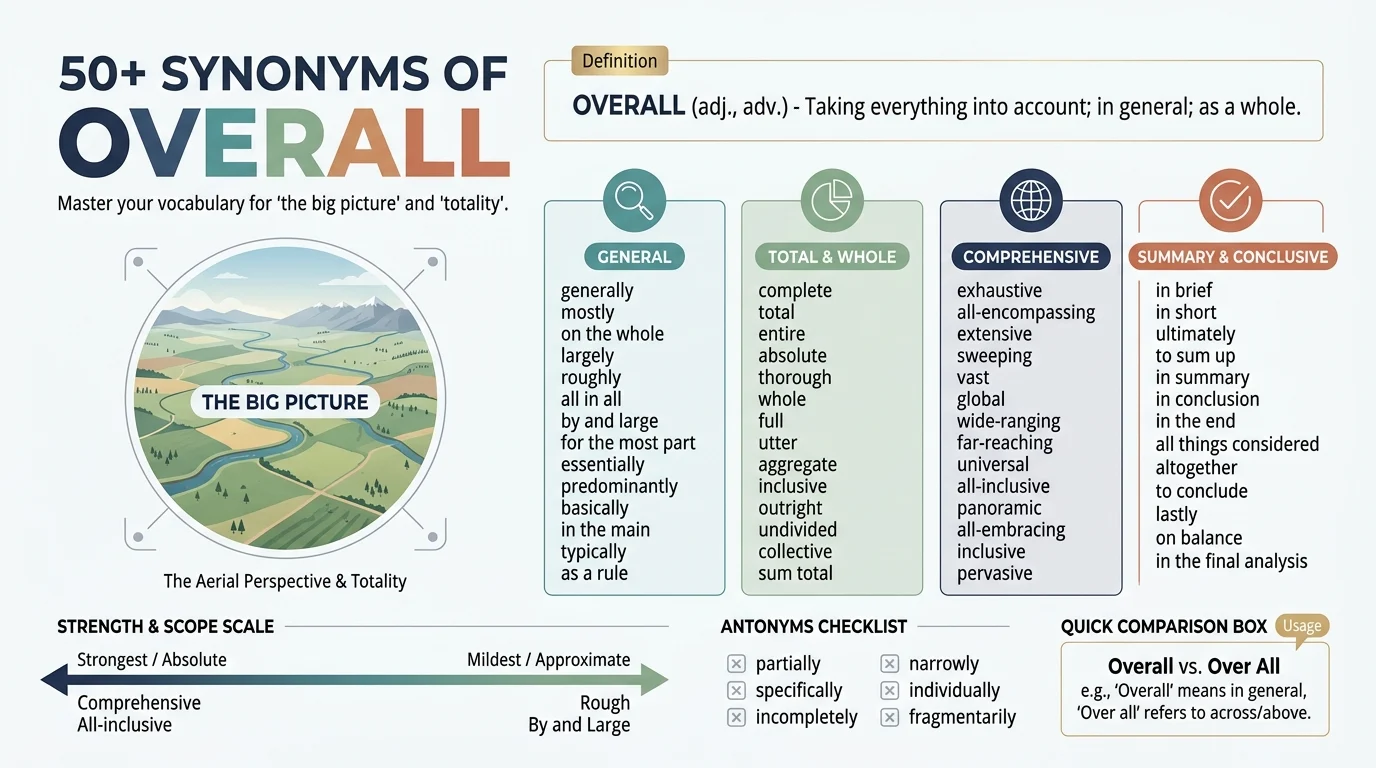
Have you ever needed to describe something as a whole, general, or all-encompassing but felt that “overall” was too simple or repetitive? You want to capture the big picture, the general impression, or the total effect, and the word “overall” comes to mind. Choosing the right synonym for “overall” can transform a basic summary into a precise expression of totality, generality, or final assessment. This guide explores the best synonyms of overall, explaining exactly which word to use and when.
Quick Answer: “Overall” means considering everything, general, or total. For general impressions, choose general or broad. For total assessments, use total or aggregate. For comprehensive views, use comprehensive or all-encompassing. For final summaries, use in summary or on the whole. For casual conversation, use in general or mostly.
Meaning, Tone, and Context
Understanding the core meaning of “overall” is the first step to using it effectively.
Simple Definition: Considering everything; general; total; including all parts.
Part of Speech: Adjective and adverb.
Overall Tone: Neutral. It is a summary word used to describe the big picture.
Formality Level: Neutral to formal. The word works in most contexts, from casual to professional.
Common Uses: Native English speakers use it in business (“overall performance”), academic (“overall results”), and general contexts (“overall, it was a good day”).
Word Forms: Related words include the noun overall (a garment) and the adverb overall.
When and How to Use “Overall”
“Overall” is the perfect choice when you want to summarize or describe the big picture. Here are seven realistic examples.
Professional: “The overall performance of the team was excellent.”
Academic: “The overall results support the hypothesis.”
Business: “Overall, the company had a profitable year.”
Personal: “Overall, it was a wonderful vacation.”
Email: “Overall, the project is on track.”
Resume: “Improved overall efficiency by 20%.”
Social Media: “Overall, this was the best concert of the year.”
Best Synonyms of “Overall”
No synonym is identical in every situation. Here is your guide to the best replacement for “overall” based on your writing context.
For General and Broad Views
Most Direct: General means affecting all or most. “The general consensus was positive.”
Broad: Broad means covering a wide range. “The broad outline of the plan is clear.”
Comprehensive: Comprehensive means including everything. “The comprehensive report covers all aspects.”
All-encompassing: All-encompassing means including everything. “The all-encompassing review was thorough.”
For Total and Aggregate Assessments
Total: Total means complete. “The total cost was higher than expected.”
Aggregate: Aggregate means formed by combining. “The aggregate score determined the winner.”
Cumulative: Cumulative means increasing by accumulation. “The cumulative effect was significant.”
Collective: Collective means shared by all. “The collective effort paid off.”
For Final Summaries and Conclusions
In summary: In summary means to conclude. “In summary, the project was a success.”
On the whole: On the whole means generally. “On the whole, the feedback was positive.”
All in all: All in all means considering everything. “All in all, it was a good experience.”
By and large: By and large means generally. “By and large, the event went smoothly.”
For Casual and Conversational Contexts
In general: In general means usually. “In general, people are kind.”
Mostly: Mostly means mainly. “The weather was mostly sunny.”
For the most part: For the most part means generally. “For the most part, I agree.”
Basically: Basically means fundamentally. “Basically, the plan is sound.”
When Not to Use “Overall”
Using “overall” can sound wrong or awkward in certain situations.
When You Mean “Specific”: “Overall” is general. “Specific” is precise.
Better Choice: Specific or particular. “The specific details are important.”
When You Mean “Detailed”: “Overall” is big picture. “Detailed” is in-depth.
Better Choice: Detailed or thorough. “The detailed analysis revealed issues.”
When It Sounds Too Vague: “Overall” can be unclear.
Better Choice: Total or comprehensive. “The total cost is $500.”
Words Commonly Confused With “Overall”
| Word | Difference | When to Use | Example |
|---|---|---|---|
| General | Affecting most | General impressions | “The general idea.” |
| Total | Complete | Sums and amounts | “The total cost.” |
| Comprehensive | Including everything | Reports and reviews | “A comprehensive study.” |
| Collective | Shared by all | Group efforts | “Collective effort.” |
| Aggregate | Combined | Statistics and scores | “The aggregate score.” |
| Summary | Brief statement | Conclusions | “In summary.” |
Best Synonyms of “Overall” by Context
| Context | Best Synonym | Why It Works | Example |
|---|---|---|---|
| Formal writing | Comprehensive | Formal and thorough | “The comprehensive review.” |
| Academic writing | Aggregate | Standard in research | “The aggregate results.” |
| Professional | General | Professional and clear | “The general performance.” |
| Business | Total | Business and financial | “The total revenue.” |
| Casual | In general | Simple and natural | “In general, it was good.” |
| Summary | All in all | Conclusive and clear | “All in all, a success.” |
| Emotional | On the whole | Balanced and fair | “On the whole, it was positive.” |
How to Choose the Best Synonym of “Overall”
Choosing the right word is a simple decision. Answer these questions.
What type of overall am I describing? For general, use general or broad. For total, use total or aggregate. And for comprehensive, use comprehensive or all-encompassing. Alos for summary, use in summary or on the whole.
What is my audience? For a formal report, use comprehensive or aggregate. For a friend, use in general or mostly.
What is my purpose? Are you summarizing, describing, or concluding? The correct synonym depends entirely on this.
What is the emotional strength? Comprehensive is stronger. Mostly is milder. Pick the one that matches your message.
Real Life Examples of “Overall”
School: Basic: “The overall grade was good.” Improved: “The total grade was good.”
College: Basic: “The overall results were positive.” Improved: “The aggregate results were positive.”
Workplace: Basic: “The overall performance improved.” Improved: “The general performance improved.”
Business: Basic: “Overall, the year was profitable.” Improved: “On the whole, the year was profitable.”
Email: Basic: “Overall, the project is on track.” Improved: “In summary, the project is on track.”
Conversation: Basic: “Overall, it was fun.” Improved: “All in all, it was fun.”
Storytelling: Basic: “The overall effect was stunning.” Improved: “The comprehensive effect was stunning.”
Top 10 Synonyms of “Overall”
| Synonym | Simple Meaning | Best Used For | Example Sentence |
|---|---|---|---|
| General | Affecting all or most | General impressions | “The general consensus was positive.” |
| Total | Complete | Sums and amounts | “The total cost was higher.” |
| Comprehensive | Including everything | Reports and reviews | “The comprehensive report covers all.” |
| Aggregate | Combined | Statistics and scores | “The aggregate score determined the winner.” |
| Collective | Shared by all | Group efforts | “The collective effort paid off.” |
| Broad | Covering a wide range | General outlines | “The broad outline is clear.” |
| Cumulative | Increasing by accumulation | Effects and results | “The cumulative effect was significant.” |
| In summary | To conclude | Summaries and conclusions | “In summary, the project was a success.” |
| On the whole | Generally | Balanced assessments | “On the whole, the feedback was positive.” |
| All in all | Considering everything | Casual summaries | “All in all, it was a good experience.” |
Synonyms of “Overall” by Usage
Professional vs. Personal Synonyms
In the workplace, choose general, total, or comprehensive. With friends, use in general, mostly, or all in all.
Formal vs. Conversational Synonyms
For formal writing, use comprehensive, aggregate, or collective. For casual conversations, use in general, mostly, or basically.
Academic Synonyms
For research and essays, choose aggregate for results, cumulative for effects, and comprehensive for reviews.
Professional and Business Synonyms
For maximum impact, choose total for revenue, general for performance, and comprehensive for reports.
Creative and Literary Synonyms
To add emotion and imagery, choose all-encompassing, collective, or on the whole. These words create atmosphere.
Slang or Modern Synonyms
In modern American slang, basically, mostly, or all in all are common. For example, “Basically, it was great.” These are casual and should be avoided in formal writing.
Strongest to Mildest Synonyms
Mild: mostly, basically, in general
Moderate: overall, general, broad
Strong: total, comprehensive, collective
Very Strong: aggregate, cumulative, all-encompassing
Emotional vs. Neutral Synonyms
Emotional Synonyms: On the whole, all in all. These words hint at balanced assessment. Use them when you want to evoke feeling.
Neutral Synonyms: Overall, general, total. These words communicate factual information.
Antonyms of “Overall”
| Antonym | Meaning | Example Sentence |
|---|---|---|
| Specific | Precise and detailed | “The specific details are important.” |
| Particular | Individual | “This particular case is different.” |
| Detailed | In-depth | “The detailed analysis revealed issues.” |
| Individual | Single | “Each individual case is unique.” |
| Partial | Not complete | “The partial report was incomplete.” |
| Local | Specific area | “The local impact was minimal.” |
| Narrow | Limited in scope | “The narrow focus missed the big picture.” |
| Limited | Restricted | “The limited review was insufficient.” |
| Specific | Clearly defined | “The specific requirements are listed.” |
| Exclusive | Not including all | “The exclusive focus was on profit.” |
| Isolated | Separate | “The isolated incident was not representative.” |
| Restricted | Limited | “The restricted access was a problem.” |
| Fragmentary | Incomplete | “The fragmentary evidence was insufficient.” |
| Incomplete | Not finished | “The incomplete data was unreliable.” |
| Selective | Carefully chosen | “The selective review missed key points.” |
Comparison: “Overall” vs Similar Words
Overall vs. General
Main Difference: “Overall” is about the whole. “General” is about most.
Which Is Stronger? “Overall” is more comprehensive.
Which Is More Formal? Both are neutral.
When to Use Each: Use “general” for impressions. Use “overall” for summaries.
Examples:
Overall: “Overall, the project was a success.”
General: “The general consensus was positive.”
Overall vs. Total
Main Difference: “Overall” is broader. “Total” is about sums.
Which Is Stronger? “Total” is more specific.
Which Is More Formal? Both are formal.
When to Use Each: Use “total” for amounts. Use “overall” for assessments.
Examples:
Overall: “Overall, the performance was good.”
Total: “The total cost was higher.”
Overall vs. Comprehensive
Main Difference: “Overall” is a summary. “Comprehensive” is thorough.
Which Is Stronger? “Comprehensive” is stronger.
Which Is More Formal? Both are formal.
When to Use Each: Use “comprehensive” for reports. Use “overall” for general contexts.
Examples:
Overall: “Overall, the results were positive.”
Comprehensive: “The comprehensive report covers all aspects.”
Overall vs. Aggregate
Main Difference: “Overall” is a summary. “Aggregate” is combined.
Which Is Stronger? “Aggregate” is more technical.
Which Is More Formal? Both are formal.
When to Use Each: Use “aggregate” for statistics. Use “overall” for general contexts.
Examples:
Overall: “Overall, the team performed well.”
Aggregate: “The aggregate score determined the winner.”
Overall vs. In summary
Main Difference: “Overall” is an adjective or adverb. “In summary” is a phrase.
Which Is Stronger? They are similar.
Which Is More Formal? Both are formal.
When to Use Each: Use “in summary” to conclude. Use “overall” for general assessments.
Examples:
Overall: “Overall, the event was successful.”
In summary: “In summary, the project met its goals.”
Overall vs. On the whole
Main Difference: “Overall” is more common. “On the whole” is more formal.
Which Is Stronger? They are similar.
Which Is More Formal? “On the whole” is more formal.
When to Use Each: Use “on the whole” in formal writing. Use “overall” in general contexts.
Examples:
Overall: “Overall, the feedback was positive.”
On the whole: “On the whole, the feedback was positive.”
Common Phrases and Expressions with “Overall”
Phrase: Overall performance
Meaning: General performance.
Example Sentence: “The overall performance of the team was excellent.”
Phrase: Overall results
Meaning: Total results.
Example Sentence: “The overall results support the hypothesis.”
Phrase: Overall cost
Meaning: Total cost.
Example Sentence: “The overall cost was higher than expected.”
Phrase: Overall picture
Meaning: The big picture.
Example Sentence: “The overall picture is positive.”
Phrase: Overall impression
Meaning: General impression.
Example Sentence: “My overall impression was favorable.”
Phrase: Overall effect
Meaning: Total effect.
Example Sentence: “The overall effect was stunning.”
Common Mistakes to Avoid
Mistake 1: Using “overall” when you mean “specific”.
Incorrect: “The overall details are important.”
Better: “The specific details are important.”
Why: “Overall” is general.
Mistake 2: Using “overall” when you mean “detailed”.
Incorrect: “The overall analysis was thorough.”
Better: “The detailed analysis was thorough.”
Why: “Overall” is big picture.
Mistake 3: Overusing “overall” in conversation.
Incorrect: “Overall, it was good.”
Better: “All in all, it was good.”
Why: “All in all” adds variety.
Mistake 4: Using “overall” when you mean “total”.
Incorrect: “The overall cost was $500.”
Better: “The total cost was $500.”
Why: “Total” is for amounts.
Mistake 5: Using “overall” when you mean “comprehensive”.
Incorrect: “The overall report covers everything.”
Better: “The comprehensive report covers everything.”
Why: “Comprehensive” is for thoroughness.
Frequently Asked Questions
1. What are the best synonyms of “overall”?
The best synonyms depend on your context. For general, choose general or broad. For total, use total or aggregate. And for comprehensive, use comprehensive or all-encompassing.
2. What are the best formal synonyms of “overall”?
The best formal synonyms are comprehensive, aggregate, and collective. These words are suitable for academic papers, professional reports, and business communications.
3. What are common informal synonyms of “overall”?
For informal settings, use in general, mostly, or all in all. These alternatives sound more natural in everyday conversation.
4. What is another word for “overall” in professional writing?
In professional writing, comprehensive is an excellent choice. It conveys thoroughness. Total is also strong for amounts.
5. What is the difference between “overall” and “general”?
“Overall” is about the whole. “General” is about most. Use “general” for impressions and “overall” for summaries.
6. What is the opposite of “overall”?
The most direct opposites (antonyms) of overall are specific, particular, and detailed. These words describe things that are precise and individual.
Conclusion
“Overall” is a versatile and essential word for describing the big picture, general impressions, and total assessments. The term is neutral and widely accepted in most contexts, yet it can sound too vague for specific descriptions or too simple for formal writing. The best choice among the synonyms of overall depends entirely on your audience, tone, and purpose. For a formal, comprehensive effect, use comprehensive or aggregate. And for a practical, business context, total or general works perfectly. For summaries, choose in summary or on the whole. Also for casual conversation, use in general or all in all. Remember, no single synonym works perfectly in every situation. Your goal is to choose the word that communicates your message with the most clarity and impact. A practical tip for your vocabulary growth is to pay attention to how writers summarize and assess and practice using different synonyms in your writing.









