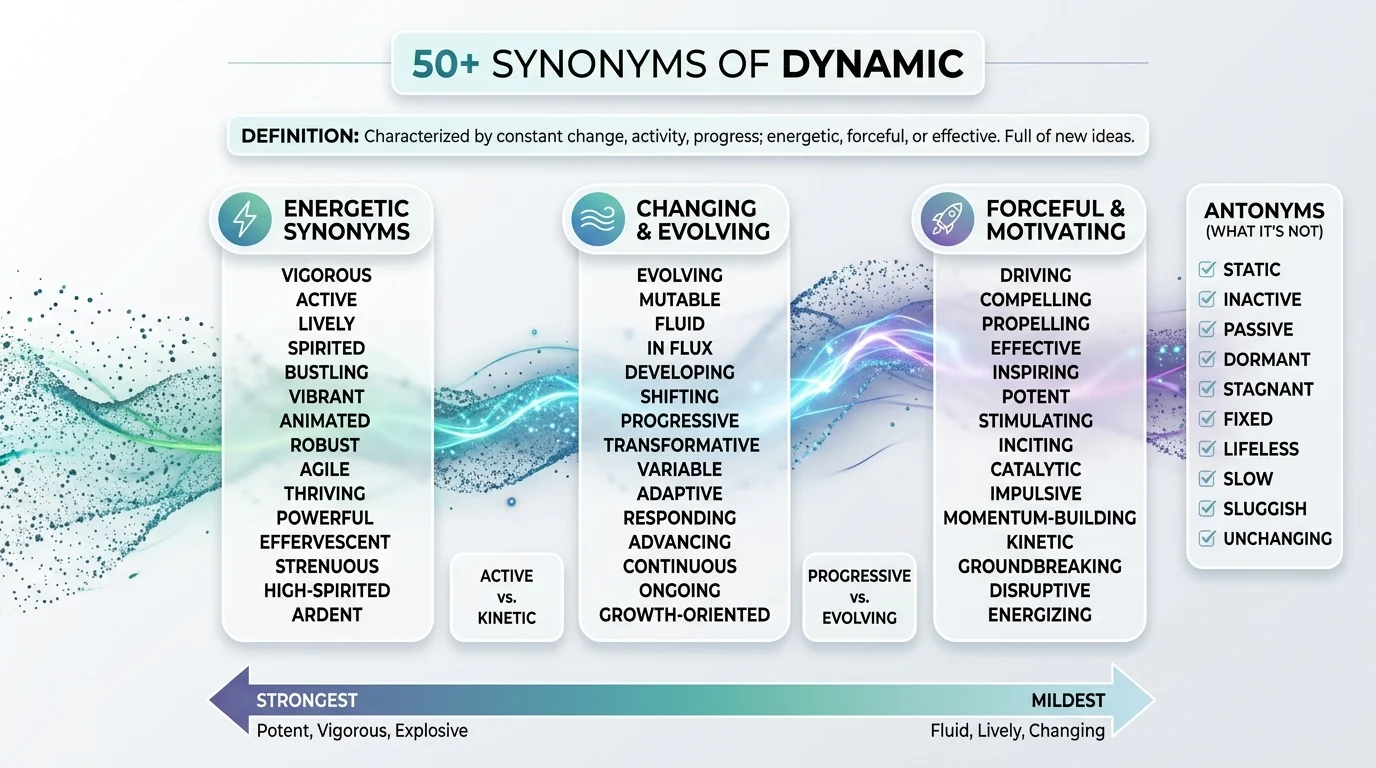
Have you ever needed to describe a situation that is constantly changing, a leader who is full of energy, or a system that adapts and grows but felt that “active” or “energetic” did not fully capture the nuance? You want to highlight continuous change, powerful energy, or the ability to adapt, and the word “dynamic” comes to mind. Choosing the right synonym for “dynamic” can transform a simple description into a precise characterization of movement, energy, or adaptability. This guide explores the best synonyms of dynamic, explaining exactly which word to use and when.
Quick Ans: “Dynamic” has three primary meanings: being full of energy and force, being constantly changing or active, and relating to motivating forces. For energetic contexts, choose energetic, vigorous, or driving. For describing change, use fluid, adaptable, or evolving. For motivational force, select propulsive or compelling. For formal writing, kinetic or proactive are strong choices.
Meaning, Tone, and Context
Understanding the core meaning of “dynamic” is the first step to using it effectively.
Simple Definition: Characterized by constant change, activity, or progress; full of energy and new ideas; or relating to forces that produce motion.
Part of Speech: Adjective (also a noun).
Overall Tone: Positive. It indicates energy, progress, adaptability, and forcefulness.
Formality Level: Neutral to formal. The word is appropriate in professional, academic, and casual contexts.
Common Uses: Native English speakers use it to describe personalities, markets, relationships, and systems. For example, “She has a dynamic personality,” “The market is dynamic,” or “They studied the dynamics of the conflict.”
Word Forms: Related words include the noun dynamics, the adverb dynamically, and the noun dynamism.
When and How to Use “Dynamic”
“Dynamic” is the perfect choice when you want to emphasize energy, change, or motivating force. Here are seven realistic examples.
Professional: “The company needs a dynamic leader who can adapt to changing markets.”
Academic: “The study examines the dynamic relationship between economic growth and environmental policy.”
Workplace: “Our team thrives in a dynamic environment where new challenges arise daily.”
Personal: “She has a dynamic personality that lights up every room.”
Email: “We are entering a dynamic phase of the project and need to stay flexible.”
Resume: “Dynamic project manager with a proven track record of driving innovation.”
Social Media: “Dynamic views from the top of the mountain. Change is the only constant.”
Best Synonyms of “Dynamic”
No synonym is identical in every situation. Here is your guide to the best replacement for “dynamic” based on your writing context.
For Energy and Forcefulness
Professional Writing: Driving. It suggests powerful forward momentum. “Her driving ambition propelled the company forward.”
Academic Writing: Kinetic. This is ideal when discussing motion and energy. “The kinetic energy of the system was measured.”
Business Communication: Energetic. A practical and clear choice. “We need an energetic team leader.”
Casual Conversation: Lively. It tones down the formality and sounds natural. “He is a lively speaker.”
Emotional Writing: Vibrant. This word carries weight, suggesting life and intensity. “Her vibrant personality was magnetic.”
Creative Writing: Electric. It implies thrilling energy and excitement. “The electric atmosphere was palpable.”
Resume Writing: Proactive. Use it to describe someone who takes initiative. “Proactive problem-solver with a record of success.”
For Change and Adaptability
Professional Writing: Adaptable. It suggests flexibility and readiness. “We need an adaptable strategy for changing markets.”
Academic Writing: Fluid. It suggests smooth, continuous change. “The fluid nature of the situation requires careful study.”
Business Communication: Agile. A modern term for quick adaptation. “Our agile approach allows us to respond quickly.”
Casual Conversation: Ever-changing. It is descriptive and natural. “The ever-changing weather is hard to predict.”
Creative Writing: Mutable. It implies a capacity for transformation. “The mutable sky shifted from blue to grey.”
For Motivating Forces
Professional Writing: Propulsive. It suggests a strong forward-driving force. “The propulsive energy of the startup was infectious.”
Academic Writing: Motivating. It is clear and descriptive. “The motivating factors behind the decision were complex.”
Business Communication: Compelling. It suggests strong persuasion. “The compelling argument won over the board.”
When Not to Use “Dynamic”
Using “dynamic” can sound wrong or awkward in certain situations.
When It Sounds Too Vague: “Dynamic” can be overused and lose its meaning.
Better Choice: Specific adjective. “The marketing campaign was innovative and targeted.”
When You Mean “Active” in a Simple Way: “Dynamic” is too strong for simple activity.
Better Choice: Active or busy. “She is an active member of the community.”
When Describing Static Things: “Dynamic” implies change and energy.
Better Choice: Stable or constant. “The stable environment was ideal for focus.”
When It Sounds Too Informal: In academic writing, “dynamic” can sound vague.
Better Choice: Adaptive or variable. “The adaptive nature of the system was studied.”
Words Commonly Confused With “Dynamic”
Several words are often mixed up with “dynamic.” Here is how to keep them straight.
Word: Energetic
Difference: Focuses on personal energy and activity. “Dynamic” also includes change and adaptability.
When to Use: Use it when describing people with high energy.
Example: “She is an energetic worker who gets things done.”
Word: Active
Difference: Means doing things or moving. “Dynamic” implies forcefulness and change.
When to Use: Use this for simple involvement or motion.
Example: “He is active in community affairs.”
Word: Driving
Difference: Means forceful and determined. “Dynamic” is broader.
When to Use: Use this for ambition and motivation.
Example: “She has a driving ambition to succeed.”
Word: Agile
Difference: Means able to move quickly and easily. “Dynamic” is broader.
When to Use: Use this for physical movement or business agility.
Example: “The agile team responded quickly to feedback.”
Word: Fluid
Difference: Means smooth and likely to change. “Dynamic” includes energy and force.
When to Use: Use this for smooth, continuous change.
Example: “The fluid situation required constant monitoring.”
Word: Static
Difference: Means not moving or changing. This is the opposite of dynamic.
When to Use: Use this for unchanging situations.
Example: “The static display was informative but dull.”
Best Synonyms of “Dynamic” by Context
| Context | Best Synonym | Why It Works | Example |
|---|---|---|---|
| Formal writing | Kinetic | Precise and scientific. | “The kinetic energy of the system was measured.” |
| Academic writing | Fluid | Describes smooth, continuous change. | “The fluid dynamics of the situation were complex.” |
| Professional communication | Driving | Suggests forward momentum. | “Her driving force kept the project moving.” |
| Business emails | Energetic | Professional and clear. | “We need an energetic approach to marketing.” |
| Resume writing | Proactive | Highlights initiative and action. | “Proactive problem-solver with a record of success.” |
| Workplace communication | Agile | Modern and business-focused. | “We need an agile response to market changes.” |
| Casual conversation | Lively | Simple, natural, and conversational. | “He is a lively and engaging speaker.” |
| Creative writing | Electric | Evokes thrilling energy. | “The electric atmosphere was unforgettable.” |
| Emotional writing | Vibrant | Suggests life and intensity. | “Her vibrant personality was magnetic.” |
| Strong emphasis | Propulsive | Suggests strong forward motion. | “The propulsive energy of the speech inspired everyone.” |
| Mild tone | Active | Simple and unassuming. | “She is an active participant in discussions.” |
| Social media captions | Ever-changing | Descriptive and relatable. | “The ever-changing skyline is always fascinating.” |
How to Choose the Best Synonym of “Dynamic”
Choosing the right word is a simple decision. Answer these questions.
What aspect of “dynamic” am I describing? For personal energy, use energetic, driving, or vibrant. And for change, use fluid, adaptable, or evolving. For motivating force, use compelling or propulsive. For simple motion, use kinetic or active.
What is my audience? For a professor or CEO, kinetic or propulsive is powerful. For a friend, lively or energetic is more natural.
What is my purpose? Are you trying to describe energy, change, or adaptability? The correct synonym depends entirely on this.
What is the emotional strength? Electric and vibrant are stronger. Active and lively are mild. Pick the one that matches your message.
Real Life Examples of “Dynamic”
To truly master the word, it helps to see how it behaves in the wild and how a stronger synonym can elevate the sentence.
School: Basic: “The teacher has a dynamic personality.” Improved: “The teacher has an energetic personality that engages students.”
College: Basic: “The market is dynamic.” Improved: “The market is fluid and constantly evolving.”
Workplace: Basic: “We need a dynamic approach.” Improved: “We need an agile approach that adapts to new challenges.”
Business: Basic: “The CEO is dynamic.” Improved: “The CEO is a driving force behind the company’s success.”
Email: Basic: “The situation is dynamic.” Improved: “The situation is ever-changing, so we must stay flexible.”
Conversation: Basic: “She is dynamic.” Improved: “She has a vibrant personality that everyone enjoys.”
Storytelling: Basic: “The dynamic crowd cheered.” Improved: “The electric crowd cheered with unbridled enthusiasm.”
Top 10 Synonyms of “Dynamic”
| Synonym | Simple Meaning | Best Used For | Example Sentence |
|---|---|---|---|
| Energetic | Full of energy and enthusiasm | People, workplaces, and lively contexts. | “She is an energetic and inspiring leader.” |
| Driving | Powerful, ambitious, and motivating | Business, ambition, and leadership contexts. | “His driving ambition led to great success.” |
| Fluid | Smooth and likely to change | Situations, plans, and evolving contexts. | “Our travel plans are fluid because of the airline strike.” |
| Agile | Able to move quickly and adapt | Business, tech, and modern contexts. | “The agile team responded quickly to feedback.” |
| Kinetic | Relating to motion or active movement | Scientific, formal, and descriptive contexts. | “The kinetic energy of the particles was measured.” |
| Vibrant | Full of life, energy, and enthusiasm | Personalities, cultures, and creative contexts. | “The vibrant culture of the city attracted tourists.” |
| Propulsive | Driving forward or forcing motion | Strong, dramatic, and motivational contexts. | “The propulsive energy of the speech inspired the audience.” |
| Adaptable | Able to change to suit new conditions | Personal qualities, systems, and strategies. | “We need adaptable employees who can handle change.” |
| Proactive | Taking action and creating change | Resumes, business, and leadership contexts. | “She is a proactive problem-solver.” |
| Magnetic | Having a strong, attractive presence | Personalities, leaders, and charismatic contexts. | “His magnetic charisma won over the crowd.” |
Synonyms of “Dynamic” by Usage
Professional vs. Personal Synonyms
In the workplace (professional), choose driving, agile, or proactive to describe leadership and strategies. These words convey professionalism and precision. “Her driving force kept the project moving” is more precise than “She is dynamic.”
With friends (personal), lively, energetic, or vibrant keep the tone relaxed and relatable. These alternatives sound natural in everyday conversation.
Formal vs. Conversational Synonyms
For formal writing (reports, essays, professional emails), use kinetic, propulsive, or fluid. These choices maintain the sophisticated tone expected in professional documents.
For casual conversations and texting, use lively, energetic, or ever-changing. These options sound more natural and less pretentious.
Academic Synonyms
For research and essays, choose precise, authoritative words. Fluid is great for continuous change, kinetic for motion, and adaptive for systems. These words sound considered and scholarly.
Professional and Business Synonyms
For maximum impact in business writing, choose driving for ambition, agile for adaptability, and proactive for initiative. These words demonstrate confidence and professional awareness.
Creative and Literary Synonyms
To add emotion and imagery to your writing, choose electric, vibrant, or magnetic. These words create atmosphere and evoke feeling.
Slang or Modern Synonyms
In modern American slang, electric, hyped-up, or go-getting can be used as casual alternatives. For example, “He is an electric speaker” or “She is a real go-getter.” These are acceptable in casual contexts but should be avoided in professional or academic writing.
Strongest to Mildest Synonyms
Mild: active, lively, busy
Moderate: energetic, vibrant, dynamic
Strong: driving, kinetic, propulsive
Very Strong: electric, magnetic, forceful
Emotional vs. Neutral Synonyms
Emotional Synonyms: Electric, vibrant, magnetic. These words often hint at excitement, admiration, or charisma. Use them when you want to evoke feeling.
Neutral Synonyms: Active, changing, fluid. These words simply communicate factual information. Use them when you want to inform without emotional coloring.
Antonyms of “Dynamic”
Here are 15 genuine opposites of “dynamic.”
| Antonym | Meaning | Example Sentence |
|---|---|---|
| Static | Not moving or changing | “Oil prices have remained static for weeks.” |
| Inactive | Not active or moving | “The inactive volcano posed no threat.” |
| Stagnant | Showing no activity or growth | “The business was stagnant due to poor leadership.” |
| Fixed | Not changing or movable | “The rate of change is fixed at 2.3 percent.” |
| Constant | Unchanging over time | “Her constant dedication was admired.” |
| Listless | Lacking energy or enthusiasm | “The listless performance disappointed the audience.” |
| Unchanging | Remaining the same | “She was not admitted into his unchanging circle.” |
| Lethargic | Sluggish and lacking energy | “The lethargic response frustrated the manager.” |
| Sluggish | Slow, lacking energy | “The sluggish economy worried investors.” |
| Immutable | Unchangeable over time | “The immutable laws of physics are fascinating.” |
| Lifeless | Lacking energy or vitality | “The lifeless presentation put everyone to sleep.” |
| Passive | Accepting what happens without response | “The passive response was inadequate.” |
| Torpid | Mentally or physically inactive | “The torpid animal barely moved.” |
| Inert | Lacking ability to move or act | “The inert gas was harmless.” |
| Stable | Not likely to change | “The stable economy was reassuring.” |
Comparison: “Dynamic” vs Similar Words
Dynamic vs. Energetic
Main Difference: “Dynamic” includes change and adaptability. “Energetic” focuses on personal energy .
Which Is Stronger? They are similar. “Dynamic” is broader.
Which Is More Formal? Both are used in various contexts.
When to Use Each: Use “energetic” for people with high energy. Use “dynamic” for systems, markets, and personalities.
Examples:
Dynamic: “The dynamic market requires constant adaptation.”
Energetic: “She is an energetic worker.”
Dynamic vs. Fluid
Main Difference: “Fluid” emphasizes smooth, continuous change. “Dynamic” includes energy and force .
Which Is Stronger? “Dynamic” is broader. “Fluid” is more specific.
Which Is More Formal? Both are formal.
When to Use Each: Use “fluid” for smooth, changing situations. Use “dynamic” for forceful, energetic contexts.
Examples:
Dynamic: “She has a dynamic personality.”
Fluid: “The fluid situation requires careful monitoring.”
Dynamic vs. Driving
Main Difference: “Driving” emphasizes ambition and forward momentum. “Dynamic” is broader.
Which Is Stronger? “Driving” is stronger for ambition and motivation.
Which Is More Formal? Both are formal.
When to Use Each: Use “driving” for ambition and leadership. Use “dynamic” for general energy and change.
Examples:
Dynamic: “The dynamic atmosphere was exciting.”
Driving: “His driving ambition led to success.”
Dynamic vs. Agile
Main Difference: “Agile” emphasizes quick and easy movement or adaptation. “Dynamic” is broader .
Which Is Stronger? They are similar. “Agile” is more specific to adaptability.
Which Is More Formal? Both are formal, but “agile” is more modern.
When to Use Each: Use “agile” for business, tech, and physical adaptability. Use “dynamic” for general energy.
Examples:
Dynamic: “The dynamic speaker inspired everyone.”
Agile: “The agile team adapted to new requirements quickly.”
Dynamic vs. Static
Main Difference: “Static” is the direct opposite of dynamic, meaning not moving or changing.
Which Is Stronger? They are opposites, serving different purposes.
Which Is More Formal? Both are formal.
When to Use Each: Use “static” for unchanging situations. Use “dynamic” for change and energy.
Examples:
Dynamic: “The dynamic environment was exciting.”
Static: “The static display was boring.”
Common Phrases and Expressions with “Dynamic”
Phrase: Dynamic personality
Meaning: A forceful, energetic character .
Example Sentence: “She has a dynamic personality that draws people to her.”
Phrase: Dynamic market
Meaning: A market with constant change and activity.
Example Sentence: “The tech industry is a dynamic market requiring constant innovation.”
Phrase: Dynamic speaker
Meaning: An energetic and persuasive speaker .
Example Sentence: “He was a dynamic speaker who captivated the audience.”
Phrase: Dynamic relationship
Meaning: A relationship characterized by change and interaction.
Example Sentence: “The dynamic relationship between supply and demand affects prices.”
Phrase: Dynamic environment
Meaning: An environment with constant change.
Example Sentence: “Our team thrives in a dynamic environment.”
Phrase: Team dynamics
Meaning: The interactions and forces within a team.
Example Sentence: “We studied the team dynamics to improve collaboration.”
Common Mistakes to Avoid
Mistake 1: Using “dynamic” when you mean “energetic”.
Incorrect: “She is a dynamic worker with high energy.”
Better: “She is an energetic worker with high energy.”
Why: “Energetic” is more precise for personal energy.
Mistake 2: Using “dynamic” for static situations.
Incorrect: “The static display was dynamic.”
Better: “The static display was unchanging and dull.”
Why: “Dynamic” implies change and activity.
Mistake 3: Overusing “dynamic” in casual conversation.
Incorrect: “The movie was dynamic.” (for a movie)
Better: “The movie was exciting.”
Why: “Dynamic” is often overused as a buzzword.
Mistake 4: Confusing “dynamic” with “active”.
Incorrect: “He is dynamic in the community.”
Better: “He is active in the community.”
Why: “Active” is a simpler, more natural word for participation.
Mistake 5: Using “dynamic” when you mean “adaptable”.
Incorrect: “The dynamic employee handles change well.”
Better: “The adaptable employee handles change well.”
Why: “Adaptable” is more precise for flexibility.
Frequently Asked Questions
1. What are the best synonyms of “dynamic”?
The best synonyms depend on your context. For energetic contexts, choose energetic, vigorous, or driving. And for change, use fluid, adaptable, or evolving. For force, select propulsive or compelling.
2. What are the best formal synonyms of “dynamic”?
The best formal synonyms are kinetic, propulsive, and fluid. These words are suitable for academic papers, professional reports, and business communications.
3. What are common informal synonyms of “dynamic”?
For informal settings, use lively, energetic, or ever-changing. These alternatives sound more natural in everyday conversation.
4. What is another word for “dynamic” in professional writing?
In professional writing, driving is an excellent choice. It conveys ambition and forward momentum. Proactive is also strong for taking initiative.
5. What is the difference between “dynamic” and “energetic”?
While both indicate energy, “dynamic” is broader and includes change and adaptability. “Energetic” focuses on personal energy. Use “energetic” for people and “dynamic” for systems, markets, and personalities.
6. What is the opposite of “dynamic”?
The most direct opposites (antonyms) of dynamic are static, inactive, and stagnant. These words describe things that are not moving or changing.
Conclusion
“Dynamic” is a powerful and versatile word for describing energy, change, and motivating force. The term is widely accepted in most contexts, yet it can be overused and lose its impact. The best choice among the synonyms of dynamic depends entirely on your audience, tone, and purpose. Remember, no single synonym works perfectly in every situation. Your goal is to choose the word that communicates your message with the most clarity and impact. A practical tip for your vocabulary growth is to pay attention to how “dynamic” is used in your reading and practice using these specific alternatives in your writing.










5 thoughts on “50+ Synonyms of Dynamic: Meanings, Uses, Examples, and Best Alternatives 2026”