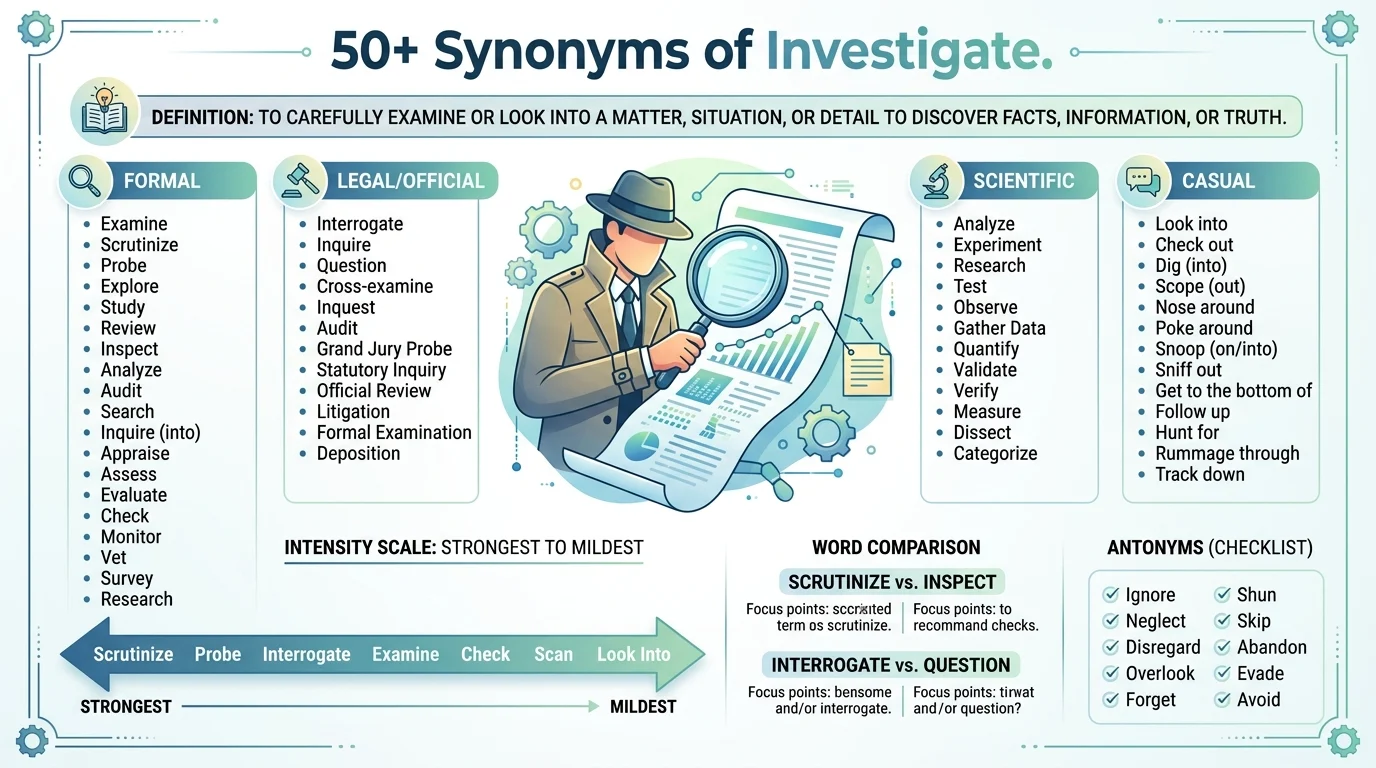
Have you ever needed to describe the act of examining a situation, solving a mystery, or looking into a problem but felt that “investigate” was too formal or repetitive? You want to capture the systematic search for truth or information, and the word “investigate” comes to mind. Choosing the right synonym for “investigate” can transform a basic statement into a precise description of inquiry, examination, or exploration. This guide explores the best synonyms of investigate, explaining exactly which word to use and when.
Quick Ans: “Investigate” means to carry out a systematic inquiry to discover facts or solve a problem. For formal writing, choose examine or probe. For legal contexts, use inquire or interrogate. For scientific contexts, use research or analyze. For casual conversation, use look into or check out.
Meaning, Tone, and Context
Understanding the core meaning of “investigate” is the first step to using it effectively.
Simple Definition: To observe or study by close examination and systematic inquiry; to look into something to discover the truth.
Part of Speech: Verb.
Overall Tone: Neutral to serious. It implies a purposeful and methodical search for information.
Formality Level: Neutral to formal. The word is appropriate in professional, academic, and casual contexts.
Common Uses: Native English speakers use it to describe police work, scientific research, journalism, and everyday problem-solving. For example, “The police are investigating the crime,” or “I need to investigate my options.”
Word Forms: Related words include the noun investigation, the adjective investigative, and the noun investigator.
When and How to Use “Investigate”
“Investigate” is the perfect choice when you want to describe a systematic search for facts or truth. Here are seven realistic examples.
Professional: “We need to investigate the cause of the decline in sales.”
Academic: “The study investigates the effects of climate change on coastal regions.”
Legal: “The police are investigating the robbery.”
Workplace: “HR will investigate the complaint thoroughly.”
Personal: “I am investigating different career options.”
Email: “We are investigating the issue and will update you soon.”
Social Media: “Journalists are investigating the leaked documents.”
Best Synonyms of “Investigate”
No synonym is identical in every situation. Here is your guide to the best replacement for “investigate” based on your writing context.
For Formal and Professional Contexts
Most Formal: Examine means to inspect or study in detail. “The committee examined the evidence carefully.”
Probe: Probe means to investigate deeply. “The reporter probed into the company’s finances.”
Inquire: Inquire means to ask for information. “We inquired about the delay.”
Research: Research means to study systematically. “She researched the topic extensively.”
For Legal and Official Contexts
Interrogate: Interrogate means to question formally. “The suspect was interrogated for hours.”
Inspect: Inspect means to look at closely. “The building was inspected for safety violations.”
Audit: Audit means to examine officially. “The accounts were audited last year.”
Review: Review means to examine again. “The case was reviewed by the appeals court.”
For Scientific and Technical Contexts
Analyze: Analyze means to examine methodically. “The data was analyzed for patterns.”
Study: Study means to observe and learn. “Scientists study the behavior of animals.”
Explore: Explore means to investigate systematically. “The researchers explored new possibilities.”
Scrutinize: Scrutinize means to examine closely. “The contract was scrutinized for errors.”
For Casual and Everyday Contexts
Look into: Look into means to investigate informally. “I will look into the matter.”
Check out: Check out means to examine casually. “Check out this new restaurant.”
Dig into: Dig into means to investigate thoroughly. “Let us dig into the details.”
When Not to Use “Investigate”
Using “investigate” can sound wrong or awkward in certain situations.
When You Mean “Ask”: “Investigate” is formal. “Ask” is casual.
Better Choice: Ask or inquire. “I will ask about the schedule.”
When You Mean “Find”: “Investigate” is the process. “Find” is the result.
Better Choice: Find or discover. “I found the answer.”
When It Sounds Too Serious: In casual conversation, “investigate” can sound overly formal.
Better Choice: Look into or check out. “I will look into it.”
Words Commonly Confused With “Investigate”
| Word | Difference | When to Use | Example |
|---|---|---|---|
| Examine | Inspect in detail | Formal and medical | “The doctor examined the patient.” |
| Research | Study systematically | Academic and scientific | “She researched the topic.” |
| Inquire | Ask for information | Formal and polite | “I inquired about the position.” |
| Probe | Investigate deeply | Journalism and investigation | “The reporter probed the issue.” |
| Analyze | Examine methodically | Scientific and technical | “The data was analyzed.” |
| Scrutinize | Examine closely | Critical and formal | “The report was scrutinized.” |
Best Synonyms of “Investigate” by Context
| Context | Best Synonym | Why It Works | Example |
|---|---|---|---|
| Formal writing | Examine | Formal and precise | “The committee examined the evidence.” |
| Academic writing | Research | Standard in academia | “She researched the topic extensively.” |
| Legal context | Interrogate | Formal and specific | “The suspect was interrogated.” |
| Professional | Analyze | Professional and clear | “The data was analyzed for trends.” |
| Journalism | Probe | Investigative and deep | “The reporter probed into the scandal.” |
| Casual conversation | Look into | Simple and natural | “I will look into it.” |
| Scientific | Scrutinize | Close and detailed | “The results were scrutinized.” |
How to Choose the Best Synonym of “Investigate”
Choosing the right word is a simple decision. Answer these questions.
What type of investigation am I describing? For formal, use examine or probe. And For legal, use interrogate or audit. For scientific, use analyze or research. For casual, use look into or check out.
What is my audience? For a formal report, use examine or analyze. For a friend, use look into or check out.
What is my purpose? Are you searching for facts, solving a problem, or studying a topic? The correct synonym depends entirely on this.
What is the emotional strength? Interrogate and scrutinize are stronger. Check out is milder. Pick the one that matches your message.
Real Life Examples of “Investigate”
School: Basic: “The teacher investigated the incident.” Improved: “The teacher examined the incident carefully.”
College: Basic: “The student investigated the topic.” Improved: “The student researched the topic extensively.”
Workplace: Basic: “We will investigate the complaint.” Improved: “We will look into the complaint immediately.”
Business: Basic: “The company investigated the fraud.” Improved: “The company audited the accounts for fraud.”
Email: Basic: “I am investigating the issue.” Improved: “I am looking into the issue.”
Conversation: Basic: “I will investigate.” Improved: “I will check it out.”
Storytelling: Basic: “The detective investigated the case.” Improved: “The detective probed the mystery relentlessly.”
Top 10 Synonyms of “Investigate”
| Synonym | Simple Meaning | Best Used For | Example Sentence |
|---|---|---|---|
| Examine | Inspect or study in detail | Formal and medical | “The doctor examined the patient.” |
| Research | Study systematically | Academic and scientific | “She researched the topic.” |
| Analyze | Examine methodically | Scientific and technical | “The data was analyzed.” |
| Probe | Investigate deeply | Journalism and investigation | “The reporter probed the issue.” |
| Inquire | Ask for information | Formal and polite | “I inquired about the position.” |
| Interrogate | Question formally | Legal and police | “The suspect was interrogated.” |
| Scrutinize | Examine closely | Critical and formal | “The report was scrutinized.” |
| Inspect | Look at closely | Official and safety | “The building was inspected.” |
| Audit | Examine officially | Financial and legal | “The accounts were audited.” |
| Look into | Investigate informally | Casual and everyday | “I will look into it.” |
Synonyms of “Investigate” by Usage
Professional vs. Personal Synonyms
In the workplace, choose examine, analyze, or audit. With friends, use look into, check out, or dig into.
Formal vs. Conversational Synonyms
For formal writing, use examine, research, probe, or scrutinize. For casual conversations, use look into, check out, or dig into.
Academic Synonyms
For research and essays, choose research for systematic study, analyze for data, and examine for detailed inspection.
Professional and Business Synonyms
For maximum impact, choose analyze for data, audit for finances, and examine for processes.
Creative and Literary Synonyms
To add emotion and imagery, choose probe, scrutinize, or delve into. These words create atmosphere.
Slang or Modern Synonyms
In modern American slang, look into, check out, or dig into are common. For example, “I will dig into it.” These are casual and should be avoided in formal writing.
Strongest to Mildest Synonyms
Mild: check out, look into, ask
Moderate: investigate, examine, inquire
Strong: research, analyze, probe
Very Strong: interrogate, scrutinize, audit
Emotional vs. Neutral Synonyms
Emotional Synonyms: Probe, scrutinize, delve into. These words hint at intensity and depth. Use them when you want to evoke feeling.
Neutral Synonyms: Investigate, examine, research. These words communicate factual information.
Antonyms of “Investigate”
| Antonym | Meaning | Example Sentence |
|---|---|---|
| Ignore | Pay no attention to | “He ignored the warning signs.” |
| Neglect | Fail to care for | “They neglected the investigation.” |
| Overlook | Fail to notice | “She overlooked the error.” |
| Dismiss | Reject as unimportant | “The claim was dismissed.” |
| Disregard | Pay no attention to | “He disregarded the rules.” |
| Abandon | Give up completely | “The search was abandoned.” |
| Conceal | Hide from view | “They concealed the evidence.” |
| Suppress | Prevent from being known | “The report was suppressed.” |
| Cover up | Hide the truth | “They tried to cover up the scandal.” |
| Avoid | Keep away from | “He avoided the question.” |
| Evade | Escape or avoid | “She evaded the inquiry.” |
| Sidestep | Avoid dealing with | “He sidestepped the issue.” |
| Bypass | Go around | “They bypassed the official process.” |
| Skip | Omit or pass over | “He skipped the details.” |
| Forget | Fail to remember | “I forgot to check.” |
Comparison: “Investigate” vs Similar Words
Investigate vs. Examine
Main Difference: “Examine” is about inspecting in detail. “Investigate” is broader.
Which Is Stronger? “Examine” is more specific to inspection.
Which Is More Formal? Both are formal.
When to Use Each: Use “examine” for detailed inspection. Use “investigate” for general inquiry.
Examples:
Investigate: “The police are investigating.”
Examine: “The doctor examined the patient.”
Investigate vs. Research
Main Difference: “Research” is systematic study. “Investigate” is broader.
Which Is Stronger? “Research” is more academic.
Which Is More Formal? Both are formal.
When to Use Each: Use “research” for academic study. Use “investigate” for general inquiry.
Examples:
Investigate: “We are investigating the issue.”
Research: “She researched the topic.”
Investigate vs. Probe
Main Difference: “Probe” is deeper and more intense. “Investigate” is broader.
Which Is Stronger? “Probe” is stronger for depth.
Which Is More Formal? Both are formal.
When to Use Each: Use “probe” for deep investigation. Use “investigate” for general inquiry.
Examples:
Investigate: “The case is being investigated.”
Probe: “The reporter probed the scandal.”
Investigate vs. Analyze
Main Difference: “Analyze” is methodical examination of data. “Investigate” is broader.
Which Is Stronger? “Analyze” is more technical.
Which Is More Formal? Both are formal.
When to Use Each: Use “analyze” for data. Use “investigate” for general inquiry.
Examples:
Investigate: “We will investigate the cause.”
Analyze: “The data was analyzed.”
Investigate vs. Scrutinize
Main Difference: “Scrutinize” is close and critical examination. “Investigate” is broader.
Which Is Stronger? “Scrutinize” is stronger for close examination.
Which Is More Formal? Both are formal.
When to Use Each: Use “scrutinize” for critical review. Use “investigate” for general inquiry.
Examples:
Investigate: “The committee investigated the matter.”
Scrutinize: “The contract was scrutinized.”
Investigate vs. Look Into
Main Difference: “Look into” is casual. “Investigate” is formal.
Which Is Stronger? “Investigate” is more formal and serious.
Which Is More Formal? “Investigate” is more formal.
When to Use Each: Use “look into” in casual conversation. Use “investigate” in formal writing.
Examples:
Investigate: “We are investigating the complaint.”
Look into: “I will look into it.”
Common Phrases and Expressions with “Investigate”
Phrase: Investigate a crime
Meaning: Examine a criminal case.
Example Sentence: “The police are investigating the crime.”
Phrase: Investigate a complaint
Meaning: Look into a formal complaint.
Example Sentence: “HR will investigate the complaint.”
Phrase: Investigate the cause
Meaning: Determine the reason.
Example Sentence: “We need to investigate the cause of the failure.”
Phrase: Investigate thoroughly
Meaning: Examine completely.
Example Sentence: “The matter was investigated thoroughly.”
Phrase: Investigate the possibility
Meaning: Explore a potential option.
Example Sentence: “We are investigating the possibility of expansion.”
Common Mistakes to Avoid
Mistake 1: Using “investigate” when you mean “ask”.
Incorrect: “I will investigate about the schedule.”
Better: “I will ask about the schedule.”
Why: “Investigate” is formal and systematic.
Mistake 2: Using “investigate” when you mean “find”.
Incorrect: “I investigated the answer.”
Better: “I found the answer.”
Why: “Investigate” is the process, not the result.
Mistake 3: Overusing “investigate” in conversation.
Incorrect: “I will investigate that restaurant.”
Better: “I will check out that restaurant.”
Why: “Check out” sounds more natural.
Mistake 4: Using “investigate” when you mean “examine”.
Incorrect: “The doctor investigated the patient.”
Better: “The doctor examined the patient.”
Why: “Examine” is for medical inspection.
Mistake 5: Using “investigate” when you mean “research”.
Incorrect: “She investigated the topic for her paper.”
Better: “She researched the topic for her paper.”
Why: “Research” is for academic study.
Frequently Asked Questions
1. What are the best synonyms of “investigate”?
The best synonyms depend on your context. For formal writing, choose examine or probe. And For legal contexts, use interrogate or audit. For scientific contexts, use research or analyze. For casual conversation, use look into or check out.
2. What are the best formal synonyms of “investigate”?
The best formal synonyms are examine, probe, and scrutinize. These words are suitable for academic papers, professional reports, and legal documents.
3. What are common informal synonyms of “investigate”?
For informal settings, use look into, check out, or dig into. These alternatives sound more natural in everyday conversation.
4. What is another word for “investigate” in professional writing?
In professional writing, examine is an excellent choice. It conveys detailed inspection. Analyze is also strong for data.
5. What is the difference between “investigate” and “examine”?
“Investigate” is broader and implies a systematic inquiry. “Examine” is more specific to detailed inspection. Use “examine” for medical or detailed inspection.
6. What is the opposite of “investigate”?
The most direct opposites (antonyms) of investigate are ignore, neglect, and overlook. These words describe failing to examine or pay attention.
Conclusion
“Investigate” is a powerful and purposeful word for describing systematic inquiry and examination. The term is neutral and widely accepted in most contexts, yet it can sound too formal for casual conversation or too serious for simple questions. The best choice among the synonyms of investigate depends entirely on your audience, tone, and purpose. Remember, no single synonym works perfectly in every situation. Your goal is to choose the word that communicates your message with the most clarity and impact. A practical tip for your vocabulary growth is to pay attention to how writers describe inquiry and examination and practice using different synonyms in your writing.










1 thought on “50+ Synonyms of Investigate: Meanings, Uses, Examples, and Best Alternatives 2026”