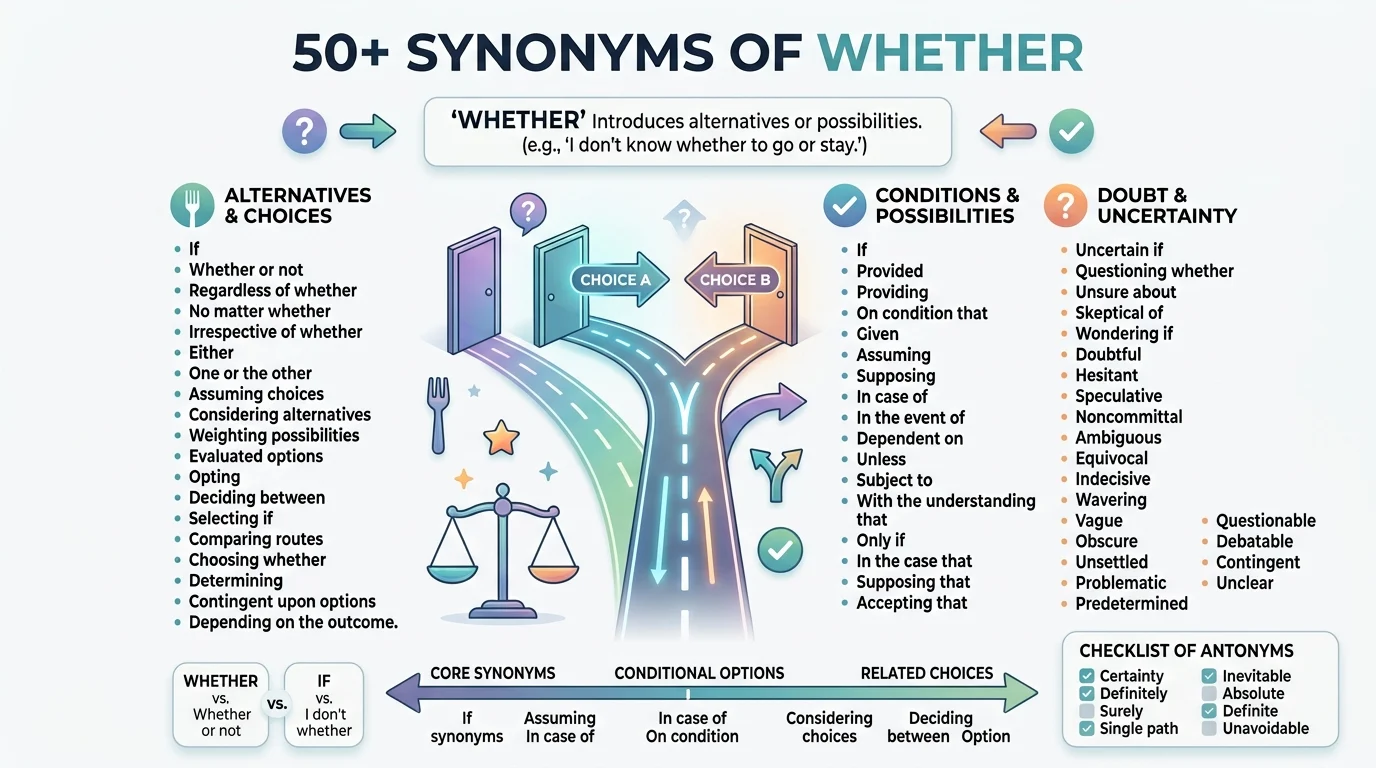
Have you ever needed to introduce a choice between two possibilities but felt that “whether” was repetitive or awkward in certain sentences? You want to express doubt, choice, or condition clearly, and the word “whether” comes to mind. Choosing the right synonym or alternative for “whether” can transform a clunky sentence into a precise expression of doubt, choice, or condition. This guide explores the best synonyms of whether, explaining exactly which word to use and when.
Quick Ans: “Whether” is a conjunction used to introduce a choice between alternatives or to express doubt. For formal writing, choose if or in case. For expressing alternatives, use either or whether or not. For conditional contexts, use provided that or on the condition that. For doubt, use doubt or uncertainty.
Meaning, Tone, and Context
Understanding the core meaning of “whether” is the first step to using it effectively.
Simple Definition: A conjunction used to introduce a choice between two or more alternatives, or to express doubt or uncertainty.
Part of Speech: Conjunction.
Overall Tone: Neutral. It is a functional word used to introduce alternatives or conditions.
Formality Level: Neutral to formal. The word is appropriate in most contexts.
Common Uses: Native English speakers use it to introduce alternatives (“I do not know whether to stay or go”), express doubt (“Whether he will come is uncertain”), and introduce conditions (“Whether you like it or not”).
Word Forms: Related phrases include whether or not, whether to, and whether by.
When and How to Use “Whether”
“Whether” is the perfect choice when you want to introduce alternatives or express doubt. Here are seven realistic examples.
Introducing Alternatives: “I cannot decide whether to take the job or stay at my current position.”
Expressing Doubt: “Whether the plan will succeed is still unclear.”
Introducing Conditions: “Whether you agree or not, the decision has been made.”
Formal Writing: “The committee will decide whether to approve the proposal.”
Academic: “The study examines whether there is a correlation between the variables.”
Professional: “Please let me know whether you will attend the meeting.”
Email: “I am writing to inquire whether the position is still available.”
Best Synonyms of “Whether”
No synonym is identical in every situation. Here is your guide to the best replacement or alternative for “whether” based on your writing context.
For Introducing Alternatives
If: If is the most common alternative for introducing a condition or choice. “I do not know if I should go.”
Either: Either is used with “or” to present alternatives. “Either you stay or you leave.”
Whether or not: Whether or not emphasizes the two possibilities. “Whether or not you agree, the decision stands.”
For Expressing Doubt
Doubt: Doubt means uncertainty. “There is doubt about whether he will come.”
Uncertainty: Uncertainty means lack of certainty. “There is uncertainty about the outcome.”
Question: Question means a matter of doubt. “The question is whether we can afford it.”
For Conditional Contexts
Provided that: Provided that means on the condition that. “Provided that you finish on time, you can leave.”
On the condition that: On the condition that means only if. “On the condition that you apologize, I will forgive you.”
In case: In case means if it happens. “In case you are wondering, the answer is yes.”
For Expressing Alternatives in a Sentence
Whether by: Whether by means by either method. “Whether by luck or skill, he won.”
Whether through: Whether through means through either means. “Whether through hard work or talent, she succeeded.”
When Not to Use “Whether”
Using “whether” can sound wrong or awkward in certain situations.
When You Mean “If” in a Simple Condition: “Whether” is for alternatives. “If” is for conditions.
Better Choice: If. “If it rains, we will stay inside.”
When You Mean “That”: “Whether” introduces doubt. “That” introduces a fact.
Better Choice: That. “I know that he is coming.”
When It Sounds Too Formal: In casual conversation, “whether” can sound stiff.
Better Choice: If. “I do not know if I can come.”
Words Commonly Confused With “Whether”
| Word | Difference | When to Use | Example |
|---|---|---|---|
| If | Introduces a condition | Simple conditions | “If it rains, we stay.” |
| That | Introduces a fact | Statements of fact | “I know that he is here.” |
| Either | Presents alternatives | Two options | “Either you or he must go.” |
| Provided that | States a condition | Formal conditions | “Provided that you agree.” |
| In case | Prepares for possibility | Precautions | “Take an umbrella in case.” |
| Whether or not | Emphasizes both possibilities | Emphasis | “Whether or not you agree.” |
Best Synonyms of “Whether” by Context
| Context | Best Synonym | Why It Works | Example |
|---|---|---|---|
| Formal writing | If | Formal and standard | “Please indicate if you will attend.” |
| Academic writing | Whether | Standard in research | “The study examines whether there is a link.” |
| Professional | Whether or not | Emphasizes alternatives | “Whether or not you agree, the policy stands.” |
| Conditional | Provided that | Formal condition | “Provided that you finish, you can leave.” |
| Doubt | Whether | Expresses uncertainty | “Whether he will come is unclear.” |
| Casual conversation | If | Simple and natural | “I do not know if I can go.” |
| Precaution | In case | Prepares for possibility | “In case you need help, call me.” |
How to Choose the Best Synonym of “Whether”
Choosing the right word is a simple decision. Answer these questions.
What type of choice am I presenting? For alternatives, use whether or either. For conditions, use if or provided that. For doubt, use whether or question.
What is my audience? For a formal report, use whether or provided that. For a friend, use if.
What is my purpose? Are you introducing alternatives, expressing doubt, or stating conditions? The correct synonym depends entirely on this.
What is the emotional strength? Whether or not is emphatic. If is neutral. Pick the one that matches your message.
Real Life Examples of “Whether”
School: Basic: “I do not know whether to study or sleep.” Improved: “I do not know if I should study or sleep.”
College: Basic: “The study examines whether there is a link.” Improved: “The study examines if there is a link.”
Workplace: Basic: “Please let me know whether you can attend.” Improved: “Please let me know if you can attend.”
Business: Basic: “Whether we expand depends on funding.” Improved: “If we expand, it depends on funding.”
Email: Basic: “I am writing to inquire whether the position is available.” Improved: “I am writing to inquire if the position is available.”
Conversation: Basic: “I wonder whether it will rain.” Improved: “I wonder if it will rain.”
Storytelling: Basic: “Whether by fate or choice, he left.” Improved: “Either by fate or choice, he left.”
Top 10 Synonyms of “Whether”
| Synonym | Simple Meaning | Best Used For | Example Sentence |
|---|---|---|---|
| If | Introduces a condition | Simple conditions | “If it rains, we stay.” |
| Either | Presents alternatives | Two options | “Either you or he must go.” |
| Whether or not | Emphasizes both possibilities | Emphasis | “Whether or not you agree.” |
| Provided that | States a condition | Formal conditions | “Provided that you agree.” |
| On the condition that | States a condition | Formal agreements | “On the condition that you apologize.” |
| In case | Prepares for possibility | Precautions | “Take an umbrella in case.” |
| Doubt | Uncertainty | Expressing doubt | “There is doubt about the outcome.” |
| Uncertainty | Lack of certainty | Formal doubt | “There is uncertainty about the plan.” |
| Question | A matter of doubt | Formal and philosophical | “The question is whether we can.” |
| Whether by | By either method | Alternatives | “Whether by luck or skill.” |
Synonyms of “Whether” by Usage
Professional vs. Personal Synonyms
In the workplace, choose whether, if, or provided that. With friends, use if or whether.
Formal vs. Conversational Synonyms
For formal writing, use whether, provided that, or on the condition that. For casual conversations, use if.
Academic Synonyms
For research and essays, choose whether for hypotheses, if for conditions, and question for philosophical contexts.
Professional and Business Synonyms
For maximum impact, choose whether for alternatives, provided that for conditions, and in case for precautions.
Creative and Literary Synonyms
To add emotion and imagery, choose whether by or whether through. These phrases create atmosphere.
Slang or Modern Synonyms
There is no direct slang synonym for “whether.” In modern usage, if is the most common alternative.
Strongest to Mildest Synonyms
Mild: if, in case
Moderate: whether, whether or not
Strong: provided that, on the condition that
Very Strong: doubt, uncertainty, question
Emotional vs. Neutral Synonyms
Emotional Synonyms: Doubt, uncertainty, question. These words hint at unease. Use them when you want to evoke feeling.
Neutral Synonyms: Whether, if, provided that. These words communicate factual information.
Antonyms of “Whether”
| Antonym | Meaning | Example Sentence |
|---|---|---|
| Certainty | State of being certain | “There is certainty about the outcome.” |
| Assurance | Confidence | “He gave assurance of his support.” |
| Conviction | Strong belief | “She spoke with conviction.” |
| Confidence | Self-assurance | “He has confidence in the plan.” |
| Determination | Firm decision | “Her determination was clear.” |
| Resolution | Firm decision | “The resolution was final.” |
| Decision | A choice made | “The decision is final.” |
| Conclusion | A judgment | “The conclusion is clear.” |
| Fact | Something certain | “It is a fact.” |
| Reality | Actual state | “The reality is different.” |
| Truth | Something true | “The truth is evident.” |
| Sureness | State of being sure | “His sureness was reassuring.” |
| Positivity | State of being positive | “Her positivity was inspiring.” |
| Clarity | State of being clear | “The clarity was refreshing.” |
| Definiteness | State of being definite | “The definiteness was helpful.” |
Comparison: “Whether” vs Similar Words
Whether vs. If
Main Difference: “Whether” is for alternatives. “If” is for conditions.
Which Is Stronger? “Whether” is more formal.
Which Is More Formal? “Whether” is more formal.
When to Use Each: Use “whether” for alternatives. Use “if” for conditions.
Examples:
Whether: “I do not know whether to go.”
If: “If it rains, we stay.”
Whether vs. Either
Main Difference: “Either” presents two options. “Whether” introduces a choice.
Which Is Stronger? “Either” is more direct.
Which Is More Formal? Both are neutral.
When to Use Each: Use “either” for two options. Use “whether” for alternatives.
Examples:
Whether: “I do not know whether to stay.”
Either: “Either you stay or you leave.”
Whether vs. Provided That
Main Difference: “Provided that” states a condition. “Whether” introduces a choice.
Which Is Stronger? “Provided that” is more conditional.
Which Is More Formal? “Provided that” is more formal.
When to Use Each: Use “provided that” for conditions. Use “whether” for alternatives.
Examples:
Whether: “I do not know whether to go.”
Provided that: “Provided that you finish, you can leave.”
Whether vs. In Case
Main Difference: “In case” prepares for possibility. “Whether” introduces a choice.
Which Is Stronger? “In case” is more precautionary.
Which Is More Formal? Both are neutral.
When to Use Each: Use “in case” for precautions. Use “whether” for alternatives.
Examples:
Whether: “I do not know whether to bring an umbrella.”
In case: “Bring an umbrella in case it rains.”
Whether vs. Doubt
Main Difference: “Doubt” is a noun. “Whether” is a conjunction.
Which Is Stronger? “Doubt” is stronger for uncertainty.
Which Is More Formal? Both are formal.
When to Use Each: Use “doubt” for uncertainty. Use “whether” for alternatives.
Examples:
Whether: “I do not know whether he will come.”
Doubt: “There is doubt about his arrival.”
Whether vs. Question
Main Difference: “Question” is a noun. “Whether” is a conjunction.
Which Is Stronger? “Question” is stronger for doubt.
Which Is More Formal? Both are formal.
When to Use Each: Use “question” for doubt. Use “whether” for alternatives.
Examples:
Whether: “I do not know whether to accept.”
Question: “The question is whether we can afford it.”
Common Phrases and Expressions with “Whether”
Phrase: Whether or not
Meaning: Regardless of whether.
Example Sentence: “Whether or not you agree, the decision stands.”
Phrase: Whether to
Meaning: Introducing a choice.
Example Sentence: “I do not know whether to go.”
Phrase: Whether by
Meaning: By either method.
Example Sentence: “Whether by luck or skill, he won.”
Phrase: Whether through
Meaning: Through either means.
Example Sentence: “Whether through hard work or talent, she succeeded.”
Phrase: Whether you like it or not
Meaning: Regardless of preference.
Example Sentence: “Whether you like it or not, the change is happening.”
Common Mistakes to Avoid
Mistake 1: Using “whether” when you mean “if” in a simple condition.
Incorrect: “Whether it rains, we will stay inside.”
Better: “If it rains, we will stay inside.”
Why: “Whether” is for alternatives. “If” is for conditions.
Mistake 2: Using “whether” when you mean “that”.
Incorrect: “I know whether he is coming.”
Better: “I know that he is coming.”
Why: “Whether” introduces doubt. “That” introduces a fact.
Mistake 3: Overusing “whether” in casual conversation.
Incorrect: “I wonder whether it will rain.”
Better: “I wonder if it will rain.”
Why: “If” sounds more natural.
Mistake 4: Using “whether” when you mean “either”.
Incorrect: “Whether you stay or leave, I do not care.”
Better: “Either you stay or you leave, I do not care.”
Why: “Either” is more direct for two options.
Mistake 5: Using “whether” when you mean “provided that”.
Incorrect: “Whether you finish, you can leave.”
Better: “Provided that you finish, you can leave.”
Why: “Provided that” is for conditions.
Frequently Asked Questions
1. What are the best synonyms of “whether”?
The best synonyms depend on your context. For conditions, choose if or provided that. For alternatives, use either or whether or not. For doubt, use doubt or question.
2. What are the best formal synonyms of “whether”?
The best formal synonyms are whether, provided that, and on the condition that. These words are suitable for academic papers, professional reports, and business communications.
3. What are common informal synonyms of “whether”?
For informal settings, use if. This alternative sounds more natural in everyday conversation.
4. What is another word for “whether” in professional writing?
In professional writing, whether is the standard choice. If is also acceptable in less formal contexts.
5. What is the difference between “whether” and “if”?
“Whether” introduces alternatives. “If” introduces conditions. Use “whether” for choices and “if” for conditions.
6. What is the opposite of “whether”?
The most direct opposites (antonyms) of whether are certainty, assurance, and conviction. These words describe a state of being sure.
Conclusion
“Whether” is a functional and essential conjunction for introducing alternatives, expressing doubt, and stating conditions. The term is neutral and widely accepted in most contexts, yet it can sound too formal for casual conversation or be confused with “if.” The best choice among the synonyms of whether depends entirely on your audience, tone, and purpose. For a formal, professional effect, use whether or provided that. For a practical, everyday context, if works perfectly. For emphasizing alternatives, use whether or not or either. For expressing doubt, choose doubt or uncertainty. Remember, no single synonym works perfectly in every situation. Your goal is to choose the word that communicates your message with the most clarity and impact. A practical tip for your vocabulary growth is to pay attention to how writers introduce choices and conditions and practice using different synonyms in your writing.









