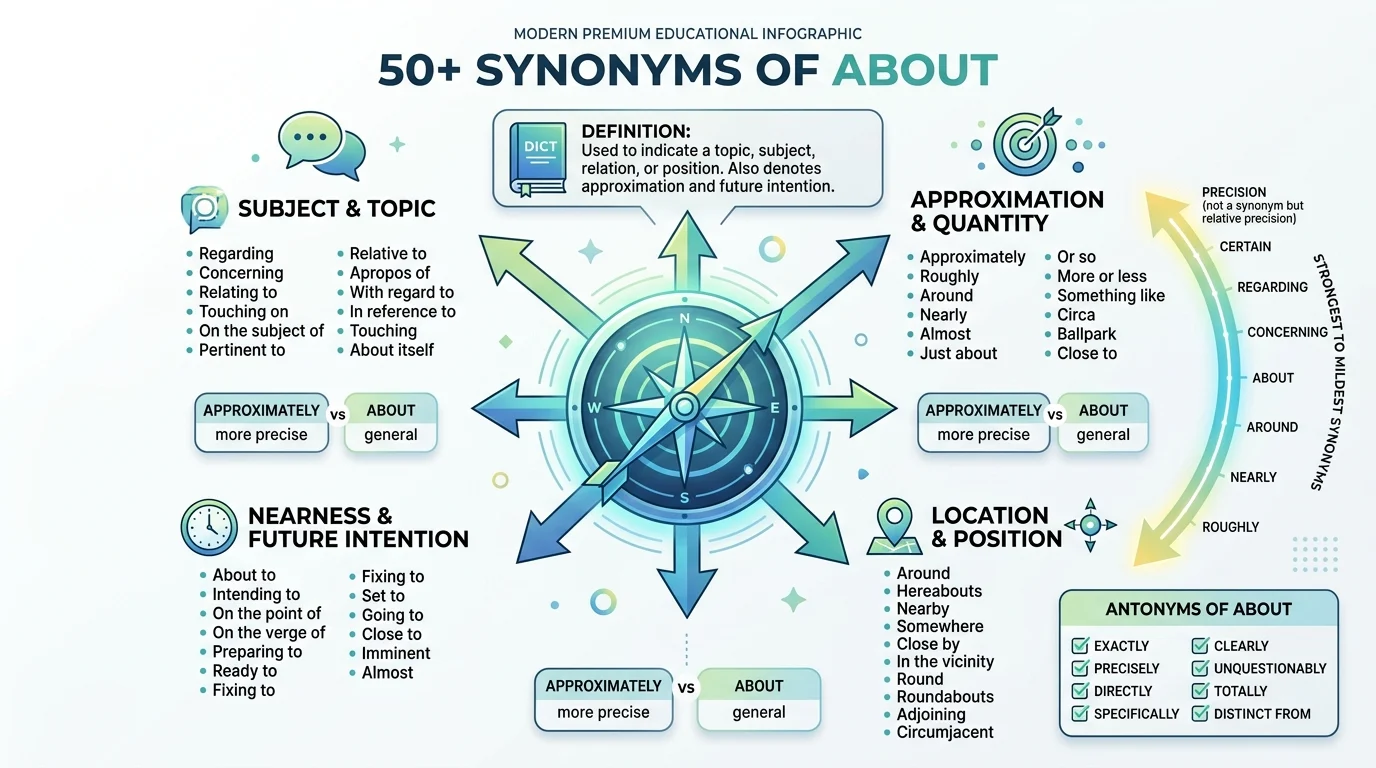
Ever found yourself writing an email, essay, or report and relying on the same word to express a subject, an approximation, or a direction? You want to show what something relates to, how much something might be, or where something is, and the word “about” comes to mind. Choosing the right synonym for “about” can transform a vague expression into a precise and professional statement. This guide explores the best synonyms of about, explaining exactly which word to use and when.
Quick Ans: “About” has multiple uses: it can mean concerning (on the subject of), approximately (roughly), or nearly (almost) . For subject matter, choose concerning or regarding . For approximation, use approximately or roughly . For nearness to completion, use almost or nearly . For movement or location, use around .
Meaning, Tone, and Context
Understanding the core meaning of “about” is the first step to using it effectively.
Simple Definition: As a preposition, it means on the subject of or relating to. As an adverb, it means approximately or nearly. It can also indicate movement or location .
Part of Speech: Preposition, adverb, and adjective (e.g., “up and about”).
Overall Tone: Neutral. It is a versatile word used in both formal and informal contexts.
Formality Level: Neutral. However, some synonyms are more formal (e.g., concerning, regarding) while others are more casual (e.g., roughly, around) .
Common Uses: Native English speakers use it to introduce a subject (“a book about history”), estimate an amount (“about 20 people”), and describe movement (“walking about the city”).
When and How to Use “About”
“About” is a flexible word that fits many contexts. Here are seven realistic examples demonstrating its different functions.
Introducing a Subject (Preposition): “We had a long conversation about the new project.”
Approximating a Number (Adverb): “The repair will take about three hours.”
Indicating Nearness (Adverb): “I am about ready to leave.”
Describing Movement (Adverb): “He was wandering about the town looking for a cafe.”
Describing Location (Adverb): “Is there a doctor about?”
Professional: “The report discusses the findings about consumer behavior.”
Social Media: “I’ve been thinking about this a lot lately.”
Best Synonyms of “About”
No synonym is identical in every situation. Here is your guide to the best replacement for “about” based on your writing context.
For Subject Matter (Concerning)
Strongest & Formal: Concerning. It is a direct synonym for introducing a topic. “The regulations concerning safety must be updated” .
Professional & Clear: Regarding. An excellent choice for professional communication. “I am writing to you regarding the status of your account” .
Formal & Specific: With regard to. A formal phrase suitable for business writing .
Formal & Legal: In connection with. It suggests a link between matters. “He is wanted for questioning in connection with the incident” .
Casual & Concise: On. A very short and common preposition. “She is writing a book on feminism” .
For Approximation (Approximately)
Formal & Precise: Approximately. The most direct formal synonym for an estimate. “The event will be attended by approximately 200 people” .
Neutral & Common: Roughly. Suggests a simple, rounded estimate. “There were roughly 50 guests” .
Casual & Natural: Around. A very common conversational synonym. “I will meet you around four o’clock” .
Formal & Specific: In the region of. Used for larger numbers. “The project cost in the region of $1 million” .
Casual: Or so. A less formal and conversational choice. “The repair will cost $200 or so” .
For Nearness to Completion (Almost)
Direct & Clear: Almost. The best direct replacement for “about ready” or “about finished.” “I’m almost ready to leave” .
Common & Natural: Nearly. Another direct synonym for nearness. “The glass was nearly full” .
Formal & Strong: Virtually. It means practically or almost entirely. “The work is virtually complete” .
Formal & Emphatic: Practically. Very similar to virtually. “The project is practically finished” .
For Movement / Location (Around)
Natural & Common: Around. The most common synonym for all sides. “The children were running around the garden” .
Formal (UK): Round. Often used in British English. “I looked round the room” .
Meaning “Nearby”: Nearby. “She looked about the room for her glasses.”
When Not to Use “About”
Using “about” can sound ambiguous or informal in certain situations.
When You Need a Direct Cause: “About” often introduces a topic, not a cause. Use because .
Better Choice: Because. “The delay was because of the storm.”
When It Sounds Too Vague: “About” can be imprecise for exact figures. Use exactly or the specific number .
Better Choice: Exactly. “The total came to exactly $637” .
When It Is Too Informal: In formal reports, use concerning or approximately .
Better Choice: Concerning. “The memo concerning the policy was sent.”
Words Commonly Confused With “About”
Several words are often mixed up with “about.” Here is how to keep them straight.
Word: Concerning
Difference: Formally introduces a subject. “About” is neutral. Use “concerning” in formal writing .
When to Use: When subject matter is the focus.
Example: “A letter concerning the meeting was distributed.”
Word: Approximately
Difference: Formally introduces an estimate. “About” is more casual. Use “approximately” for precise estimates .
When to Use: For important numbers or estimates .
Example: “The population is approximately 1.5 million.”
Word: Almost / Nearly
Difference: Specific to nearness to completion. “About” can be vague. Use “almost” or “nearly” for finishing something .
When to Use: For progress or readiness.
Example: “It is almost midnight” .
Word: Around
Difference: Means on all sides or approximately. “About” is similar but “around” emphasizes circularity. “About” is more formal for subjects .
When to Use: For physical location or movement .
Example: “They walked around the park.”
Best Synonyms of “About” by Context
| Context | Best Synonym | Why It Works | Example |
|---|---|---|---|
| Subject (Formal) | Concerning | Precise and professional. | “Complaints have been made concerning the new policy.” |
| Subject (Professional) | Regarding | Clear and common in emails. | “I am writing regarding your inquiry.” |
| Subject (Formal) | With regard to | Highly formal and specific. | “With regard to your request, we need more information.” |
| Subject (Casual) | On | Short and conversational. | “I read a great article on climate change.” |
| Amount (Formal) | Approximately | Precise and accurate. | “The project will cost approximately $10,000.” |
| Amount (Neutral) | Roughly | Common and straightforward. | “Roughly 80% of the surveys were returned.” |
| Amount (Casual) | Around | Natural and conversational. | “We will arrive around noon.” |
| Amount (Casual) | Or so | Very informal and imprecise. | “The party starts at 8 or so.” |
| Nearness | Almost / Nearly | Direct and clear. | “The work is nearly finished.” |
| Location/Movement | Around | Natural for directions. | “Please put your bags around the corner.” |
How to Choose the Best Synonym of “About”
Choosing the right word is a simple decision. Answer these questions.
What is the meaning in the sentence? Am I introducing a topic (subject), giving an estimate, showing movement, or indicating completion? This determines the category you need.
What is my audience? For a formal audience, use concerning, approximately, or virtually. For a casual audience, use on, around, or almost .
What is the level of precision? If you need an exact estimate, use approximately. If a rough guess is fine, use roughly or around .
Is there any ambiguity? “About” can confuse. If it could be interpreted as either time or cause, use concerning or approximately.
Top 10 Synonyms of “About”
| Synonym | Simple Meaning | Best Used For | Example Sentence |
|---|---|---|---|
| Concerning | On the subject of; relating to | Formal subject introduction. | “The meeting was concerning the new policy.” |
| Regarding | On the subject of; relating to | Professional subject introduction. | “I have a question regarding the schedule.” |
| Approximately | Close to a value but not exact | Formal estimates and numbers. | “The journey takes approximately 3 hours.” |
| Roughly | Close to a value but not exact | Neutral estimates. | “The stadium holds roughly 50,000 people.” |
| Around | Close to a value; on all sides | Casual estimates and location. | “There were around 30 people there.” |
| Almost | Very nearly but not completely | Nearness to completion. | “The building is almost finished.” |
| Nearly | Very nearly but not completely | Nearness to completion. | “It is nearly midnight.” |
| Virtually | Almost, practically | Formal strong nearness. | “The work is virtually complete.” |
| On | Concerning | Casual subject introduction. | “There is a fascinating book on history.” |
| Circa | Approximately (for dates) | Formal dates in academic/historical contexts. | “The artifact dates back to circa 1400 BC.” |
Synonyms of “About” by Usage
Professional vs. Personal Synonyms
In professional contexts, choose concerning, regarding, or approximately to sound precise and formal. “We need to discuss the policy regarding compliance” is more professional than “We need to talk about compliance.”
In personal contexts, around, on, or almost keep the tone relaxed. These alternatives sound natural in everyday conversation .
Formal vs. Conversational Synonyms
For formal writing, use concerning, approximately, in the region of, or virtually. In casual conversations, use on, around, roughly, or so, and almost.
Academic Synonyms
For research and essays, choose concerning, regarding, approximately, circa (for dates), and in connection with . These words sound considered and scholarly.
Professional and Business Synonyms
For maximum impact, choose regarding for subject introductions and approximately for estimates. These words demonstrate confidence and professional awareness.
Strongest to Mildest Synonyms
Mild (Vague/Casual): like, around, roughly, or so
Moderate (Neutral): about, around, nearly, almost
Strong (Formal/Precise): concerning, regarding, approximately, virtually
Very Strong (Highly Formal): in connection with, with regard to, in the region of, circa
Antonyms of “About”
Here are the genuine opposites for “about” :
| Antonym | Meaning | Example Sentence |
|---|---|---|
| Exactly | Precisely, not approximately | “The bill came to exactly $637.” |
| Precisely | In exact terms | “The instructions were followed precisely.” |
Comparison: “About” vs Similar Words
About vs. Concerning
Main Difference: “Concerning” is a formal, specific preposition for introducing a subject. “About” is more general .
Which Is Stronger? “Concerning” is more formal and precise.
Which Is More Formal? “Concerning” is highly formal .
When to Use Each: Use “concerning” in formal writing or when you want to be very clear you are introducing a subject .
Examples:
About: “We talked about the budget.”
Concerning: “The regulations concerning safety were updated.”
About vs. Approximately
Main Difference: “Approximately” is a formal synonym for giving an estimate. “About” is a more casual alternative .
Which Is Stronger? “Approximately” is more precise.
Which Is More Formal? “Approximately” is highly formal .
When to Use Each: Use “approximately” for important figures or in formal reports .
Examples:
About: “There were about 20 people.”
Approximately: “The survey was completed by approximately 200 people.”
About vs. Almost
Main Difference: “Almost” directly means “not quite.” “About” can also mean “approximately” or “concerning.” To avoid confusion, use “almost” to mean “nearly” .
Which Is Stronger? “Almost” is more direct and specific.
Which Is More Formal? “Almost” is neutral, “about” is more vague.
When to Use Each: Use “almost” to mean “nearly finished” or “nearly ready” .
Examples:
About: “I am about ready to go.”
Almost: “I am almost ready to go.”
Common Phrases and Expressions with “About”
Phrase: Bring about
Meaning: To cause something to happen.
Example Sentence: “The new technology brought about significant changes.”
Phrase: Come about
Meaning: To happen or occur.
Example Sentence: “How did this situation come about?”
Phrase: About to
Meaning: On the verge of doing something.
Example Sentence: “I am about to leave for work.”
Phrase: Up and about
Meaning: Active, out of bed.
Example Sentence: “She is feeling much better and is up and about.”
Phrase: Go about
Meaning: To begin or carry on with something.
Example Sentence: “He went about his daily routine.”
Common Mistakes to Avoid
Mistake 1: Using “about” when you mean “approximately” in a formal document.
Incorrect: “The meeting was attended by about 100 people.”
Better: “The meeting was attended by approximately 100 people.”
Mistake 2: Using “about” when “concerning” is more precise.
Incorrect: “I have a question about the policy.”
Better: “I have a question regarding the policy.”
Mistake 3: Using “about” to mean “almost” in a sentence with ambiguity.
Incorrect: “I am about ready, about to go.”
Better: “I am almost ready, and I am about to go.”
Mistake 4: Using “circa” for non-dates.
Incorrect: “There were circa 20 people.”
Better: “There were approximately 20 people.”
Mistake 5: Using “about” instead of “around” for a physical location.
Incorrect: “Let’s look about the room for the keys.”
Better: “Let’s look around the room for the keys.”
Frequently Asked Questions
1. What are the best synonyms of “about”?
The best synonyms depend on the context. For subject matter, use concerning or regarding. And for approximation, use approximately or roughly. For nearness, use almost or nearly.
2. What are the best formal synonyms of “about”?
The best formal synonyms are concerning, regarding, approximately, virtually, and in the region of .
3. What are common informal synonyms of “about”?
For informal settings, use on, around, roughly, or so, and almost .
4. What is another word for “about” in professional writing?
In professional writing, concerning and regarding are excellent for subject introductions. Approximately is strong for estimates .
5. What is the difference between “about” and “approximately”?
“Approximately” is a formal synonym for giving an exact-sounding estimate. “About” is a more casual alternative .
6. What is the opposite of “about”?
The most direct antonym for “about” as an approximation is exactly .
Conclusion
“About” is a versatile and useful word, but its many meanings can make your writing vague. The best choice among the synonyms of about depends entirely on your audience, tone, and purpose. Remember, no single synonym works perfectly in every situation. Your goal is to choose the word that communicates your message with the most clarity and impact. A practical tip for your vocabulary growth is to analyze your sentences for “about” and decide which specific meaning (subject, amount, or time) you intend to convey, then select the most precise replacement.









