Have you ever needed to describe a situation that was deeply disappointing, regrettable, or even tragic but felt that “bad” or “sad” did not fully capture the depth of the emotion? You want to highlight misfortune, distress, or something worthy of grief, and the word “lamentable” comes to mind. But is it the best fit for your audience? Choosing the right synonym for “lamentable” can transform a simple complaint into a powerful expression of disappointment, sorrow, or strong disapproval. This guide explores the best synonyms of lamentable, explaining exactly which word to use and when.
Quick Ans: “Lamentable” means very unfortunate, disappointing, or deserving of regret; it can also mean expressing sorrow or grief . It is a formal, often negative adjective. For formal writing, choose deplorable or regrettable. For emotional contexts, use grievous or heartbreaking. In academic settings, distressing and unfortunate are strong choices. For describing situations of extreme sorrow, select tragic or woeful .
Meaning, Tone, and Context
Understanding the core meaning of “lamentable” is the first step to using it effectively.
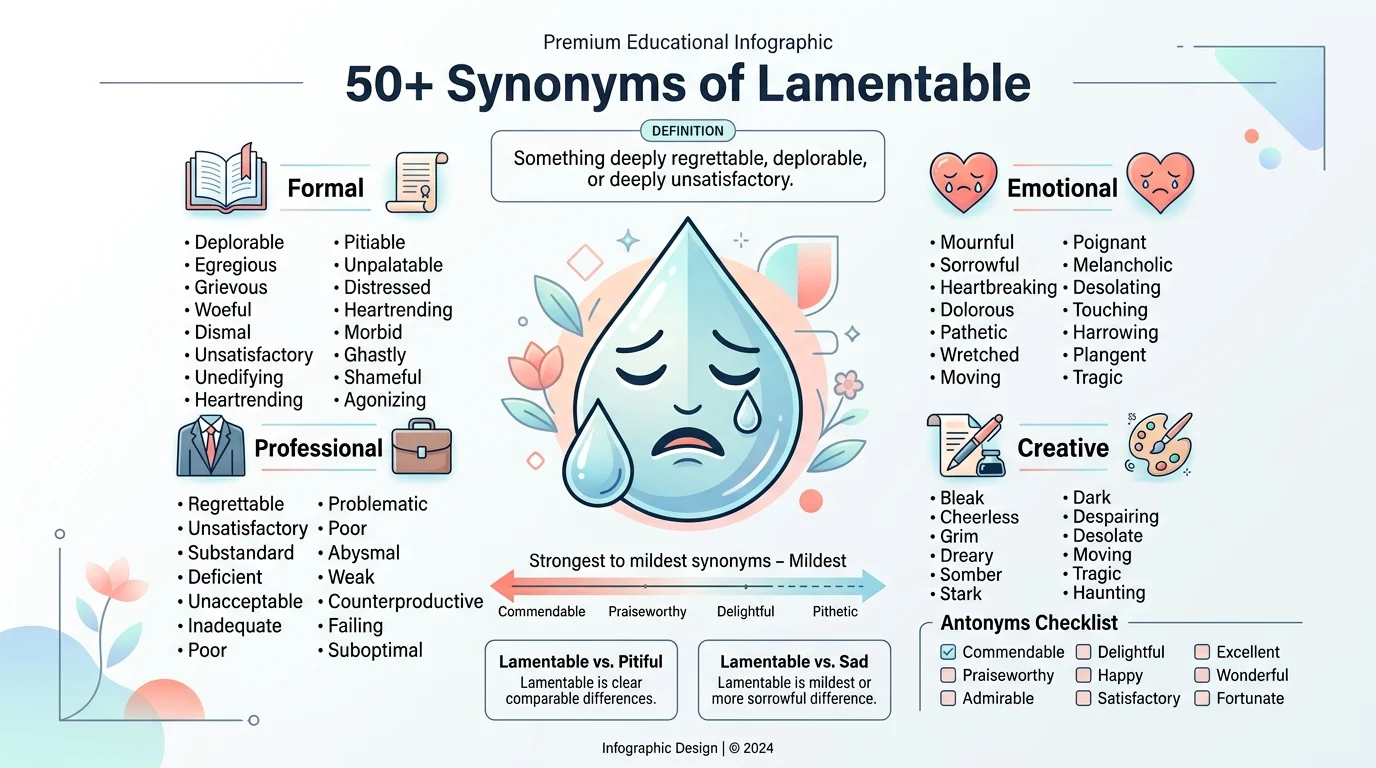
Simple Definition: Deserving to be lamented or regretted; very unfortunate and disappointing . It can also mean expressing grief or sorrow .
Part of Speech: Adjective .
Overall Tone: Negative. It indicates strong disappointment, disapproval, or sadness .
Formality Level: Formal. The word is most appropriate in professional, academic, and literary contexts .
Common Uses: Native English speakers use it to describe situations, decisions, performances, or states of affairs that are deeply regrettable or cause distress . For example, “The team’s lamentable performance led to their defeat,” or “It is lamentable that the event had to be canceled” .
Word Forms: Related words include the noun lamentableness, the adverb lamentably, and the verb lament .
When and How to Use “Lamentable”
“Lamentable” is the perfect choice when you want to express strong disappointment or sorrow about a situation . Here are seven realistic examples.
Professional: “The project’s failure was a lamentable outcome for the entire team.”
Academic: “The study highlighted the lamentable conditions in which many workers find themselves” .
Workplace: “His lamentable lack of attention to detail cost the company a major client.”
Personal: “It is lamentable that so many people lack access to basic healthcare.”
Email: “We must address the lamentable state of our current customer service metrics.”
Resume: (Rarely used for self-description) “Addressed the lamentable inefficiencies in the department’s workflow.”
Social Media: “A lamentable turn of events. Our hearts go out to all affected.”
Best Synonyms of “Lamentable”
No synonym is identical in every situation. Here is your guide to the best replacement for “lamentable” based on your writing context .
Professional Writing: Regrettable. It is a formal synonym that emphasizes disappointment without being overly dramatic . “The decision was a regrettable one, but we must move forward.”
Emotional Writing: Heartbreaking or Grievous. These words convey deep sorrow and serious harm . “The loss was a grievous blow to the community” .
Academic Writing: Distressing. It is precise for describing data or situations that cause anxiety . “The distressing findings prompted a new investigation.”
Business Communication: Deplorable. This is a strong word for condemning unacceptable conditions or actions . “The company’s labor practices were deplorable.”
Casual Conversation: Unfortunate. It tones down the formality and sounds more natural . “That was an unfortunate way to handle the situation.”
Creative Writing: Woeful. It implies deep sorrow and misery . “The woeful ballad told a story of lost love” .
Resume Writing: (Avoid in resumes) Use challenging or difficult instead.
When Not to Use “Lamentable”
Using “lamentable” can sound wrong or awkward in certain situations.
When It Sounds Too Formal: In casual conversation, “lamentable” sounds overly formal and literary.
Better Choice: Unfortunate or too bad. “It is too bad we missed the deadline.”
When You Mean “Bad” in a Simple Way: “Lamentable” is too strong for minor inconveniences.
Better Choice: Poor or unsatisfactory. “The service was unsatisfactory” .
When You Mean “Mournful”: This is an archaic use. In modern English, it is mainly used to describe regrettable events .
Better Choice: Sorrowful or mournful. “The mournful music filled the room” .
When It Sounds Too Judgmental: “Lamentable” can sound overly harsh and judgmental.
Better Choice: Disappointing. “The results were disappointing.”
Words Commonly Confused With “Lamentable”
Several words are often mixed up with “lamentable.” Here is how to keep them straight .
Word: Regrettable
Difference: Focuses on disappointment and wishing something had not happened. “Lamentable” is broader and can imply more profound sorrow or grief.
When to Use: Use it for events or decisions that cause regret.
Example: “It is regrettable that we could not attend.”
Word: Deplorable
Difference: Means shockingly bad and deserving strong condemnation. “Lamentable” can mean regrettable, but deplorable emphasizes outrage .
When to Use: Use this for conditions or actions that are morally unacceptable.
Example: “The prisoners lived in deplorable conditions” .
Word: Grievous
Difference: Means causing great suffering or sorrow, often very serious. “Lamentable” is a bit milder .
When to Use: Use this for serious injuries, losses, or wrongs.
Example: “His death is a grievous loss.”
Word: Unfortunate
Difference: Means unlucky or regrettable. “Lamentable” is more formal and indicates a stronger emotional response.
When to Use: Use this for minor mishaps and general bad luck.
Example: “It is unfortunate that it rained” .
Word: Sorrowful
Difference: Means feeling or showing grief. “Lamentable” describes an event, while sorrowful describes an emotion.
When to Use: Use this for people’s feelings or mournful appearances .
Example: “Her sorrowful expression revealed her grief.”
Word: Woeful
Difference: Means full of woe or very bad. “Lamentable” emphasizes regret, while woeful emphasizes misery .
When to Use: Use this for sorrowful events or awful performances.
Example: “The team’s woeful performance lost them the game” .
Best Synonyms of “Lamentable” by Context
| Context | Best Synonym | Why It Works | Example |
|---|---|---|---|
| Formal writing | Deplorable | Strong condemnation of bad situations. | “The investigation exposed the deplorable conditions in the factory” . |
| Academic writing | Distressing | Precise for alarming data or events. | “The distressing statistics prompted immediate action” . |
| Professional communication | Regrettable | Formal and clear for disappointing outcomes. | “The regrettable decision led to a loss of business” . |
| Business emails | Unfortunate | Professional yet accessible. | “This is an unfortunate setback, but we will adapt” . |
| Resume writing | (Avoid) | — | “Addressed challenges to improve team performance.” |
| Workplace communication | Disappointing | Neutral and clear. | “The disappointing results require a new approach.” |
| Casual conversation | Too bad | Simple, natural, and conversational. | “That is too bad. Maybe next time.” |
| Creative writing | Woeful | Evokes deep sadness and misery. | “The woeful cries echoed through the night” . |
| Emotional writing | Heart-rending | Suggests extreme emotional distress. | “The heart-rending scenes left everyone in tears” . |
| Strong emphasis | Atrocious | Suggests outrageous and unacceptable quality. | “The atrocious conditions sparked a protest” . |
| Mild tone | Poor | Simple and unassuming for low quality. | “The poor performance was noted.” |
| Social media captions | Heartbreaking | Widely understood and relatable. | “This is heartbreaking news.” |
How to Choose the Best Synonym of “Lamentable”
Choosing the right word is a simple decision. Answer these questions .
What is my audience? For a professor or CEO, deplorable or regrettable is powerful. For a friend, unfortunate or too bad is more natural.
What is my purpose? Are you trying to express sorrow, condemnation, or mild disappointment? Use tragic for sorrow, deplorable for condemnation, and unfortunate for mild disappointment .
What is the severity of the situation? For extreme tragedy, grievous or heartbreaking works. For simple errors, regrettable or unfortunate are better .
What is the emotional strength? Atrocious and heart-rending are stronger. Unfortunate and poor are mild. Pick the one that matches your message .
Real Life Examples of “Lamentable”
To truly master the word, it helps to see how it behaves in the wild and how a stronger synonym can elevate the sentence.
School: Basic: “The student’s performance was lamentable.” Improved: “The student’s performance was disappointing, but we believe he can improve.”
College: Basic: “The lamentable lack of funding caused the closure.” Improved: “The deplorable lack of funding forced the community center to close” .
Workplace: Basic: “The lamentable oversight cost us the contract.” Improved: “The regrettable oversight cost us the contract” .
Business: Basic: “The lamentable state of the market hurt sales.” Improved: “The distressing state of the market hurt sales” .
Email: Basic: “This is a lamentable situation.” Improved: “This is an unfortunate situation, and we are working to resolve it” .
Conversation: Basic: “It is lamentable that we lost.” Improved: “It is too bad we lost.”
Storytelling: Basic: “The lamentable death affected everyone.” Improved: “The grievous death affected everyone in the village” .
Top 10 Synonyms of “Lamentable”
| Synonym | Simple Meaning | Best Used For | Example Sentence |
|---|---|---|---|
| Deplorable | Shockingly bad and unacceptable | Condemning poor conditions or actions. | “The prisoners lived in deplorable conditions” . |
| Regrettable | Causing disappointment and regret | Formal contexts for poor decisions or outcomes. | “The regrettable decision had severe consequences” . |
| Grievous | Causing great suffering, serious | Tragedy, serious loss, or severe wrongs. | “Their loss would be a grievous blow to our team” . |
| Distressing | Causing anxiety and upset | Academic, medical, or alarming contexts. | “The distressing symptoms required immediate attention” . |
| Unfortunate | Unlucky and regrettable | Casual conversation and general bad luck. | “It was an unfortunate incident” . |
| Woeful | Full of woe, very bad or sorrowful | Creative and descriptive contexts. | “The woeful ballad told a story of loss” . |
| Heartbreaking | Causing immense sadness | Emotional and personal contexts. | “The heartbreaking news left everyone stunned.” |
| Sorrowful | Feeling or showing grief | Describing people, appearance, or sounds. | “His face looked suddenly soft and sorrowful” . |
| Pitiable | Deserving pity or contempt | Evoking sympathy for misfortunes. | “Her grandmother seemed a pitiable figure” . |
| Mournful | Expressing or suggesting mourning | Describing sounds or appearances. | “The mournful wail of the bagpipes could be heard” . |
Synonyms of “Lamentable” by Usage
Professional vs. Personal Synonyms
In the workplace (professional), choose regrettable or deplorable to describe serious errors or conditions. These words convey professionalism and seriousness. “The regrettable oversight cost us the contract” is more precise than “The bad oversight cost us the contract.”
With friends (personal), unfortunate or too bad keep the tone relaxed and relatable. These alternatives sound natural in everyday conversation.
Formal vs. Conversational Synonyms
For formal writing (reports, essays, professional emails), use regrettable, deplorable, or grievous. These choices maintain the sophisticated tone expected in professional documents .
For casual conversations and texting, use unfortunate, too bad, or awful. These options sound more natural and less pretentious.
Academic Synonyms
For research and essays, choose precise, authoritative words. Distressing is great for alarming data, regrettable for methodological shortcomings, and deplorable for social conditions . These words sound considered and scholarly.
Using precise academic vocabulary demonstrates expertise and careful thinking.
Professional and Business Synonyms
For maximum impact in business writing, choose regrettable for outcomes, deplorable for unacceptable practices, and distressing for concerning trends. These words demonstrate confidence and professional awareness .
Business leaders respond to language that conveys clarity and seriousness. These synonyms project authority.
Creative and Literary Synonyms
To add emotion and imagery to your writing, choose woeful, mournful, or heart-rending. These words create atmosphere and evoke deep feelings .
Literary writers use these alternatives to build mood and tragedy. They transform ordinary descriptions into evocative prose.
Slang or Modern Synonyms
In modern American slang, awful, terrible, or a bummer can be used for casual alternatives. For example, “The game was awful,” or “It is a bummer we missed it.” These are acceptable in casual contexts. Avoid them in professional or academic writing.
Strongest to Mildest Synonyms
Mild: unfortunate, poor, unsatisfactory
Moderate: regrettable, disappointing, distressing
Strong: deplorable, woeful, grievous
Very Strong: heart-rending, atrocious, tragic
Emotional vs. Neutral Synonyms
Emotional Synonyms: Grievous, heartbreaking, mournful, sorrowful. These words often hint at deep sorrow or grief. Use them when you want to evoke strong feelings .
Neutral Synonyms: Regrettable, unfortunate, unsatisfactory. These words simply communicate factual information. Use them when you want to inform without emotional coloring .
Antonyms of “Lamentable”
Here are 15 genuine opposites of “lamentable.”
| Antonym | Meaning | Example Sentence |
|---|---|---|
| Admirable | Deserving respect and approval | “Her admirable work earned recognition.” |
| Blessed | Highly favored and fortunate | “They led a blessed life.” |
| Cheerful | Noticeably happy and optimistic | “The cheerful news lifted our spirits.” |
| Comforting | Providing consolation | “The comforting words eased their worries.” |
| Delightful | Greatly pleasing | “The delightful surprise made everyone smile.” |
| Excellent | Extremely good | “The excellent performance was praised.” |
| Fortunate | Favored by good luck | “It is fortunate that no one was hurt.” |
| Heartening | Giving hope and encouragement | “The heartening news motivated the team.” |
| Joyful | Feeling great happiness | “The joyful celebration was a success.” |
| Laudable | Deserving praise | “The laudable efforts were recognized.” |
| Praiseworthy | Commendable | “Her praiseworthy work set a high standard.” |
| Satisfactory | Acceptable and adequate | “The satisfactory results met our expectations.” |
| Splendid | Magnificent and impressive | “The splendid achievement was a milestone.” |
| Successful | Having achieved success | “The successful campaign was a triumph.” |
| Uplifting | Making someone feel happier | “The uplifting story inspired the community.” |
Comparison: “Lamentable” vs Similar Words
Lamentable vs. Regrettable
Main Difference: Regrettable focuses on disappointment and wishing something had not happened. Lamentable can imply more profound sorrow and grief .
Which Is Stronger? Lamentable is stronger and more formal.
Which Is More Formal? Both are formal, but lamentable is more literary .
When to Use Each: Use regrettable for professional mistakes. Use lamentable for serious tragedies or failures.
Examples:
Lamentable: “The lamentable state of affairs lasted for years” .
Regrettable: “The regrettable incident was quickly resolved” .
Lamentable vs. Deplorable
Main Difference: Deplorable means shockingly bad and deserving strong condemnation. Lamentable can mean regrettable, but deplorable emphasizes outrage .
Which Is Stronger? Deplorable is stronger in terms of condemnation.
Which Is More Formal? Both are formal.
When to Use Each: Use deplorable for morally unacceptable conditions. Use lamentable for unfortunate situations.
Examples:
Lamentable: “The lamentable decision was made by the board.”
Deplorable: “Many of them work under deplorable conditions” .
Lamentable vs. Grievous
Main Difference: Grievous means causing great suffering or sorrow, often very serious. Lamentable is a bit milder .
Which Is Stronger? Grievous is stronger and more serious.
Which Is More Formal? Both are very formal.
When to Use Each: Use grievous for serious injuries, losses, or wrongs. Use lamentable for unfortunate events.
Examples:
Lamentable: “The lamentable lack of funding hurt the program.”
Grievous: “Their loss would be a grievous blow” .
Lamentable vs. Unfortunate
Main Difference: Unfortunate means unlucky or regrettable. Lamentable is more formal and indicates a stronger emotional response .
Which Is Stronger? Lamentable is stronger and more dramatic.
Which Is More Formal? Lamentable is formal. Unfortunate is neutral.
When to Use Each: Use unfortunate in casual conversation. Use lamentable in formal writing.
Examples:
Lamentable: “The lamentable situation required intervention.”
Unfortunate: “It is unfortunate that the event was canceled” .
Lamentable vs. Woeful
Main Difference: Woeful means full of woe or very bad. Lamentable emphasizes regret, while woeful emphasizes misery .
Which Is Stronger? Woeful is stronger for emotional distress.
Which Is More Formal? Both are formal.
When to Use Each: Use woeful for creative writing. Use lamentable for formal reports.
Examples:
Lamentable: “The lamentable performance was criticized.”
Woeful: “The team’s recent woeful performance lost them the game” .
Lamentable vs. Mournful
Main Difference: Mournful means expressing or suggesting mourning. Lamentable describes an event, while mournful describes a sound or appearance .
Which Is Stronger? They are different in application. Mournful is for sounds and expressions.
Which Is More Formal? Both are formal.
When to Use Each: Use lamentable for regrettable events. Use mournful for sounds or appearances.
Examples:
Lamentable: “This lamentable state of affairs lasted until 1947” .
Mournful: “The mournful wail of bagpipes could be heard” .
Common Phrases and Expressions with “Lamentable”
Phrase: Lamentable state of affairs
Meaning: A very bad and unfortunate situation.
Example Sentence: “This lamentable state of affairs lasted until 1947” .
Phrase: Lamentable decision
Meaning: A decision that is regrettable and disappointing .
Example Sentence: “The board made a lamentable decision that cost them the contract” .
Phrase: Lamentable performance
Meaning: An extremely poor and disappointing performance .
Example Sentence: “The team’s lamentable performance was a shock to their fans” .
Phrase: Lamentable lack of
Meaning: A very disappointing absence of something.
Example Sentence: “She shows a lamentable lack of understanding” .
Phrase: Lamentable act
Meaning: A regrettable or deplorable action.
Example Sentence: “It is a lamentable act that must be investigated” .
Common Mistakes to Avoid
Mistake 1: Using “lamentable” when you mean “regrettable”.
Incorrect: “The regrettable state of affairs was resolved.”
Better: “The lamentable state of affairs was resolved.”
Why: Lamentable is stronger for severe situations .
Mistake 2: Using “lamentable” in casual conversation.
Incorrect: “It is lamentable that we missed the bus.”
Better: “It is unfortunate that we missed the bus” .
Why: Lamentable sounds too formal for everyday situations.
Mistake 3: Using “lamentable” for minor disappointments.
Incorrect: “The lamentable coffee was cold.”
Better: “The unsatisfactory coffee was cold” .
Why: Lamentable is too strong for minor things.
Mistake 4: Confusing “lamentable” with “mournful”.
Incorrect: “The mournful decision was made.”
Better: “The lamentable decision was made” .
Why: Mournful is for expressions of grief, not decisions.
Mistake 5: Using “lamentable” for simple sadness.
Incorrect: “She felt lamentable.”
Better: “She felt sorrowful” .
Why: Lamentable describes events, not emotions.
Frequently Asked Questions
1. What are the best synonyms of “lamentable”?
The best synonyms depend on your context. For formal writing, choose deplorable or regrettable. And for emotional contexts, use grievous or heartbreaking. For casual conversation, unfortunate is an ideal choice .
2. What are the best formal synonyms of “lamentable”?
The best formal synonyms are deplorable, regrettable, and grievous. These words are suitable for academic papers, professional reports, and business communications .
3. What are common informal synonyms of “lamentable”?
For informal settings, use unfortunate, too bad, or awful. These alternatives sound more natural in everyday conversation .
4. What is another word for “lamentable” in professional writing?
In professional writing, regrettable is an excellent choice. It conveys disappointment without being overly dramatic. Deplorable is also strong for condemning conditions .
5. What is the difference between “lamentable” and “deplorable”?
While both indicate something bad, lamentable emphasizes regret and sorrow. Deplorable emphasizes outrage and condemnation. Use deplorable for morally unacceptable situations .
6. What is the opposite of “lamentable”?
The most direct opposites (antonyms) of lamentable are admirable, fortunate, and cheerful . These words describe positive situations.
Conclusion
“Lamentable” is a powerful and formal word for describing situations that are deeply regrettable, distressing, or worthy of sorrow . The term is formal and widely accepted in sophisticated contexts, yet it can sound too dramatic or pretentious in casual conversation. The best choice among the synonyms of lamentable depends entirely on your audience, tone, and purpose. Remember, no single synonym works perfectly in every situation. Your goal is to choose the word that communicates your message with the most clarity and impact. A practical tip for your vocabulary growth is to pay attention to how writers express disappointment and sorrow and practice using different synonyms in your writing.
Discover More:
- 50+ Synonyms of Impactful: Meanings, Uses, Examples, and Best Alternatives 2026
- 50+ Synonyms of Conduct: Meanings, Uses, Examples, and Best Alternatives 2026

Ella Parker is a professional content writer with a passion for creating clear, engaging, and well-researched articles. She focuses on delivering valuable insights and practical information across business, technology, and lifestyle topics.