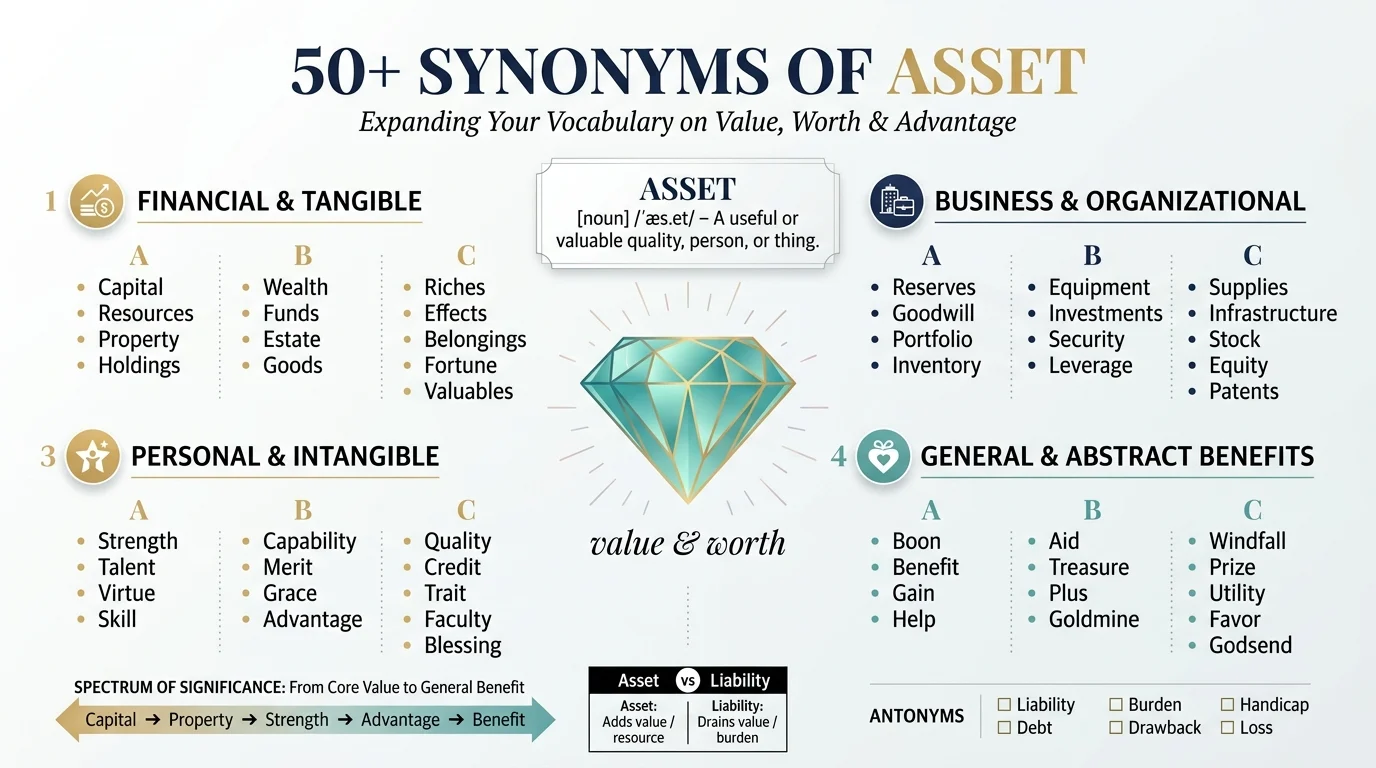
Have you ever needed to describe something valuable, useful, or beneficial but felt that “asset” was too financial or repetitive? You want to capture the specific worth of a person, quality, or resource, and the word “asset” comes to mind. Choosing the right synonym for “asset” can transform a basic statement into a precise expression of value, advantage, or strength. This guide explores the best synonyms of asset, explaining exactly which word to use and when.
Quick Ans: “Asset” means a valuable thing, person, or quality that provides an advantage. For financial contexts, choose property, holding, or resource. For personal qualities, use strength, advantage, or talent. For business contexts, use resource, capital, or investment. For general value, use benefit, boon, or godsend.
Meaning, Tone, and Context
Understanding the core meaning of “asset” is the first step to using it effectively.
Simple Definition: A useful or valuable thing, person, or quality; property owned by a person or company.
Part of Speech: Noun.
Overall Tone: Positive. It indicates value, usefulness, and advantage.
Formality Level: Neutral to formal. The word is appropriate in business, finance, and general contexts.
Common Uses: Native English speakers use it in finance (“company assets”), business (“valuable asset”), personal descriptions (“she is an asset to the team”), and general contexts (“patience is an asset”).
Word Forms: Related words include the adjective asset (rare) and the noun asset (singular and plural).
When and How to Use “Asset”
“Asset” is the perfect choice when you want to describe something valuable or advantageous. Here are seven realistic examples.
Financial: “The company’s assets include real estate and equipment.”
Professional: “Her language skills are a valuable asset to the firm.”
Personal: “His patience is his greatest asset.”
Business: “We need to protect our intellectual assets.”
Academic: “The library is a vital asset for research.”
Workplace: “Teamwork is an asset in any organization.”
Social Media: “Confidence is your best asset.”
Best Synonyms of “Asset”
No synonym is identical in every situation. Here is your guide to the best replacement for “asset” based on your writing context.
For Financial and Material Value
Most Direct: Property means owned possessions. “The property includes two buildings.”
Holding: Holding means owned investments. “The company’s holdings are diverse.”
Resource: Resource means a useful possession. “The country’s natural resources are abundant.”
Capital: Capital means financial assets. “The business needs more capital.”
For Personal Qualities and Strengths
Strength: Strength means a strong attribute. “Her greatest strength is empathy.”
Advantage: Advantage means a beneficial factor. “His experience is a major advantage.”
Talent: Talent means natural ability. “Her musical talent is an asset.”
Virtue: Virtue means a good quality. “Patience is a virtue.”
For Business and Organizational Value
Resource: Resource means a useful asset. “Human resources are the company’s best asset.”
Investment: Investment means something that yields returns. “Education is an investment in the future.”
Benefit: Benefit means an advantage. “The new system is a benefit to the team.”
Boon: Boon means a helpful thing. “The grant was a boon to the research.”
For General Value and Advantage
Advantage: Advantage means a favorable condition. “Speed is an advantage in this market.”
Benefit: Benefit means a positive effect. “The policy is a benefit to all.”
Godsend: Godsend means a welcome surprise. “The donation was a godsend.”
Blessing: Blessing means a beneficial thing. “Her support was a blessing.”
When Not to Use “Asset”
Using “asset” can sound wrong or awkward in certain situations.
When You Mean “Good Quality”: “Asset” is about value. “Quality” is about characteristics.
Better Choice: Quality or trait. “Honesty is a good quality.”
When You Mean “Skill”: “Asset” is broader. “Skill” is specific.
Better Choice: Skill or ability. “Coding is a valuable skill.”
When It Sounds Too Financial: In casual conversation, “asset” can sound corporate.
Better Choice: Strength or talent. “Her talent is amazing.”
Words Commonly Confused With “Asset”
| Word | Difference | When to Use | Example |
|---|---|---|---|
| Property | Owned possessions | Real estate and finance | “The property is valuable.” |
| Resource | Useful possession | Natural and business | “Water is a vital resource.” |
| Strength | Strong attribute | Personal qualities | “Patience is her strength.” |
| Advantage | Beneficial factor | Competition and strategy | “Speed is an advantage.” |
| Talent | Natural ability | Arts and skills | “Her talent is extraordinary.” |
| Investment | Money put in for returns | Finance and education | “Education is an investment.” |
Best Synonyms of “Asset” by Context
| Context | Best Synonym | Why It Works | Example |
|---|---|---|---|
| Formal writing | Resource | Formal and versatile | “The resource is valuable.” |
| Academic writing | Capital | Standard in economics | “Human capital is essential.” |
| Professional | Strength | Personal and professional | “Her strength is leadership.” |
| Business | Holding | Financial and specific | “The company’s holdings are diverse.” |
| Finance | Property | Legal and financial | “The property is an asset.” |
| Casual | Talent | Simple and natural | “Her talent is a gift.” |
| Emotional | Blessing | Emotional and warm | “Her support was a blessing.” |
How to Choose the Best Synonym of “Asset”
Choosing the right word is a simple decision. Answer these questions.
What type of asset am I describing? For financial, use property or holding. And For personal, use strength or talent. For business, use resource or capital. For general, use benefit or advantage.
What is my audience? For a formal report, use resource or capital. For a friend, use strength or talent.
What is my purpose? Are you describing financial value, personal quality, or business advantage? The correct synonym depends entirely on this.
What is the emotional strength? Blessing and godsend are warmer. Holding is neutral. Pick the one that matches your message.
Real Life Examples of “Asset”
School: Basic: “The student is an asset.” Improved: “The student is a strength to the class.”
College: Basic: “The library is an asset.” Improved: “The library is a vital resource.”
Workplace: Basic: “She is an asset to the team.” Improved: “She is a valuable asset to the team.”
Business: Basic: “The company has assets.” Improved: “The company’s holdings are diverse.”
Email: Basic: “Your skills are an asset.” Improved: “Your skills are a strength.”
Conversation: Basic: “He is an asset.” Improved: “He is a talent.”
Storytelling: Basic: “Her support was an asset.” Improved: “Her support was a blessing.”
Top 10 Synonyms of “Asset”
| Synonym | Simple Meaning | Best Used For | Example Sentence |
|---|---|---|---|
| Resource | A useful possession | Business and general | “Water is a vital resource.” |
| Strength | A strong attribute | Personal qualities | “Patience is her strength.” |
| Advantage | A beneficial factor | Competition and strategy | “Speed is an advantage.” |
| Property | Owned possessions | Real estate and finance | “The property is valuable.” |
| Holding | Owned investments | Finance and business | “The company’s holdings are diverse.” |
| Capital | Financial assets | Economics and finance | “The business needs more capital.” |
| Talent | Natural ability | Arts and skills | “Her talent is extraordinary.” |
| Benefit | A positive effect | General and business | “The policy is a benefit.” |
| Boon | A helpful thing | Formal and literary | “The grant was a boon.” |
| Blessing | A beneficial thing | Emotional and warm | “Her support was a blessing.” |
Synonyms of “Asset” by Usage
Professional vs. Personal Synonyms
In the workplace, choose resource, strength, or capital. With friends, use talent, strength, or gift.
Formal vs. Conversational Synonyms
For formal writing, use resource, capital, or holding. For casual conversations, use strength, talent, or gift.
Academic Synonyms
For research and essays, choose capital for economics, resource for general, and advantage for strategy.
Professional and Business Synonyms
For maximum impact, choose resource for teams, holding for finance, and strength for individuals.
Creative and Literary Synonyms
To add emotion and imagery, choose blessing, boon, or godsend. These words create atmosphere.
Slang or Modern Synonyms
In modern American slang, gift, talent, or superpower are common. For example, “Her superpower is empathy.” These are casual and should be avoided in formal writing.
Strongest to Mildest Synonyms
Mild: benefit, advantage, quality
Moderate: asset, resource, strength
Strong: talent, capital, holding
Very Strong: boon, blessing, godsend
Emotional vs. Neutral Synonyms
Emotional Synonyms: Blessing, godsend, boon. These words hint at gratitude and warmth. Use them when you want to evoke feeling.
Neutral Synonyms: Asset, resource, property. These words communicate factual information.
Antonyms of “Asset”
| Antonym | Meaning | Example Sentence |
|---|---|---|
| Liability | A disadvantage or debt | “The old building is a liability.” |
| Disadvantage | An unfavorable condition | “His lack of experience is a disadvantage.” |
| Burden | A heavy load | “The debt became a burden.” |
| Weakness | A lack of strength | “Her weakness is impatience.” |
| Drawback | A disadvantage | “The high cost is a drawback.” |
| Obstacle | Something that blocks | “The lack of funds is an obstacle.” |
| Detriment | Something harmful | “The policy was a detriment.” |
| Drain | Something that uses resources | “The project was a drain on resources.” |
| Deficit | A shortage | “The budget deficit is a problem.” |
| Debt | Money owed | “The debt is a liability.” |
| Flaw | A fault | “The flaw weakened the argument.” |
| Shortcoming | A failure to meet standards | “The shortcoming was obvious.” |
| Vulnerability | Exposure to harm | “The vulnerability was exploited.” |
| Weak point | A point of weakness | “The weak point was exposed.” |
Comparison: “Asset” vs Similar Words
Asset vs. Resource
Main Difference: “Asset” is valuable. “Resource” is useful.
Which Is Stronger? “Asset” is more specific to value.
Which Is More Formal? Both are formal.
When to Use Each: Use “asset” for finance. Use “resource” for general.
Examples:
Asset: “The building is an asset.”
Resource: “Water is a resource.”
Asset vs. Strength
Main Difference: “Asset” is broader. “Strength” is a personal quality.
Which Is Stronger? “Strength” is more personal.
Which Is More Formal? Both are neutral.
When to Use Each: Use “strength” for people. Use “asset” for general.
Examples:
Asset: “She is an asset to the team.”
Strength: “Her strength is leadership.”
Asset vs. Advantage
Main Difference: “Asset” is a valuable thing. “Advantage” is a beneficial factor.
Which Is Stronger? They are similar.
Which Is More Formal? Both are neutral.
When to Use Each: Use “advantage” for competition. Use “asset” for value.
Examples:
Asset: “The patent is an asset.”
Advantage: “Speed is an advantage.”
Asset vs. Property
Main Difference: “Asset” is broader. “Property” is owned possessions.
Which Is Stronger? “Property” is more specific.
Which Is More Formal? Both are formal.
When to Use Each: Use “property” for real estate. Use “asset” for general.
Examples:
Asset: “The company’s assets are diverse.”
Property: “The property is valuable.”
Asset vs. Talent
Main Difference: “Asset” is broader. “Talent” is natural ability.
Which Is Stronger? “Talent” is more specific.
Which Is More Formal? Both are neutral.
When to Use Each: Use “talent” for abilities. Use “asset” for general.
Examples:
Asset: “Her skills are an asset.”
Talent: “Her talent is extraordinary.”
Asset vs. Blessing
Main Difference: “Asset” is neutral. “Blessing” is emotional.
Which Is Stronger? “Blessing” is warmer.
Which Is More Formal? Both are neutral.
When to Use Each: Use “blessing” for gratitude. Use “asset” for general.
Examples:
Asset: “The donation is an asset.”
Blessing: “The donation was a blessing.”
Common Phrases and Expressions with “Asset”
Phrase: Valuable asset
Meaning: Something very useful or valuable.
Example Sentence: “She is a valuable asset to the company.”
Phrase: Asset management
Meaning: The process of managing assets.
Example Sentence: “Asset management is a growing field.”
Phrase: Fixed assets
Meaning: Long-term tangible property.
Example Sentence: “The company’s fixed assets include buildings.”
Phrase: Intangible assets
Meaning: Non-physical assets like patents.
Example Sentence: “Intangible assets are hard to value.”
Phrase: Asset allocation
Meaning: Distributing investments.
Example Sentence: “Asset allocation is key to a balanced portfolio.”
Phrase: Human assets
Meaning: People as valuable resources.
Example Sentence: “Human assets are the company’s greatest strength.”
Common Mistakes to Avoid
Mistake 1: Using “asset” when you mean “quality”.
Incorrect: “Honesty is an asset.”
Better: “Honesty is a quality.”
Why: “Quality” is for characteristics.
Mistake 2: Using “asset” when you mean “skill”.
Incorrect: “Coding is an asset.”
Better: “Coding is a skill.”
Why: “Skill” is specific.
Mistake 3: Overusing “asset” in conversation.
Incorrect: “She is an asset.”
Better: “She is a strength.”
Why: “Strength” sounds more natural.
Mistake 4: Using “asset” when you mean “advantage”.
Incorrect: “Speed is an asset.”
Better: “Speed is an advantage.”
Why: “Advantage” is for competition.
Mistake 5: Using “asset” when you mean “blessing”.
Incorrect: “Her support was an asset.”
Better: “Her support was a blessing.”
Why: “Blessing” is emotional.
Frequently Asked Questions
1. What are the best synonyms of “asset”?
The best synonyms depend on your context. For financial, choose property or holding. And For personal, use strength or talent. For business, use resource or capital.
2. What are the best formal synonyms of “asset”?
The best formal synonyms are resource, capital, and holding. These words are suitable for academic papers, professional reports, and business communications.
3. What are common informal synonyms of “asset”?
For informal settings, use strength, talent, or gift. These alternatives sound more natural in everyday conversation.
4. What is another word for “asset” in professional writing?
In professional writing, resource is an excellent choice. It conveys usefulness. Strength is also strong for individuals.
5. What is the difference between “asset” and “resource”?
“Asset” is valuable. “Resource” is useful. Use “asset” for finance and “resource” for general contexts.
6. What is the opposite of “asset”?
The most direct opposites (antonyms) of asset are liability, disadvantage, and burden. These words describe things that are harmful or costly.
Conclusion
“Asset” is a positive and versatile word for describing value, usefulness, and advantage. The term is widely accepted in financial, business, and personal contexts, yet it can sound too corporate for casual conversation or too broad for specific descriptions. The best choice among the synonyms of asset depends entirely on your audience, tone, and purpose. Remember, no single synonym works perfectly in every situation. Your goal is to choose the word that communicates your message with the most clarity and impact. A practical tip for your vocabulary growth is to pay attention to how writers describe value and advantage and practice using different synonyms in your writing.









