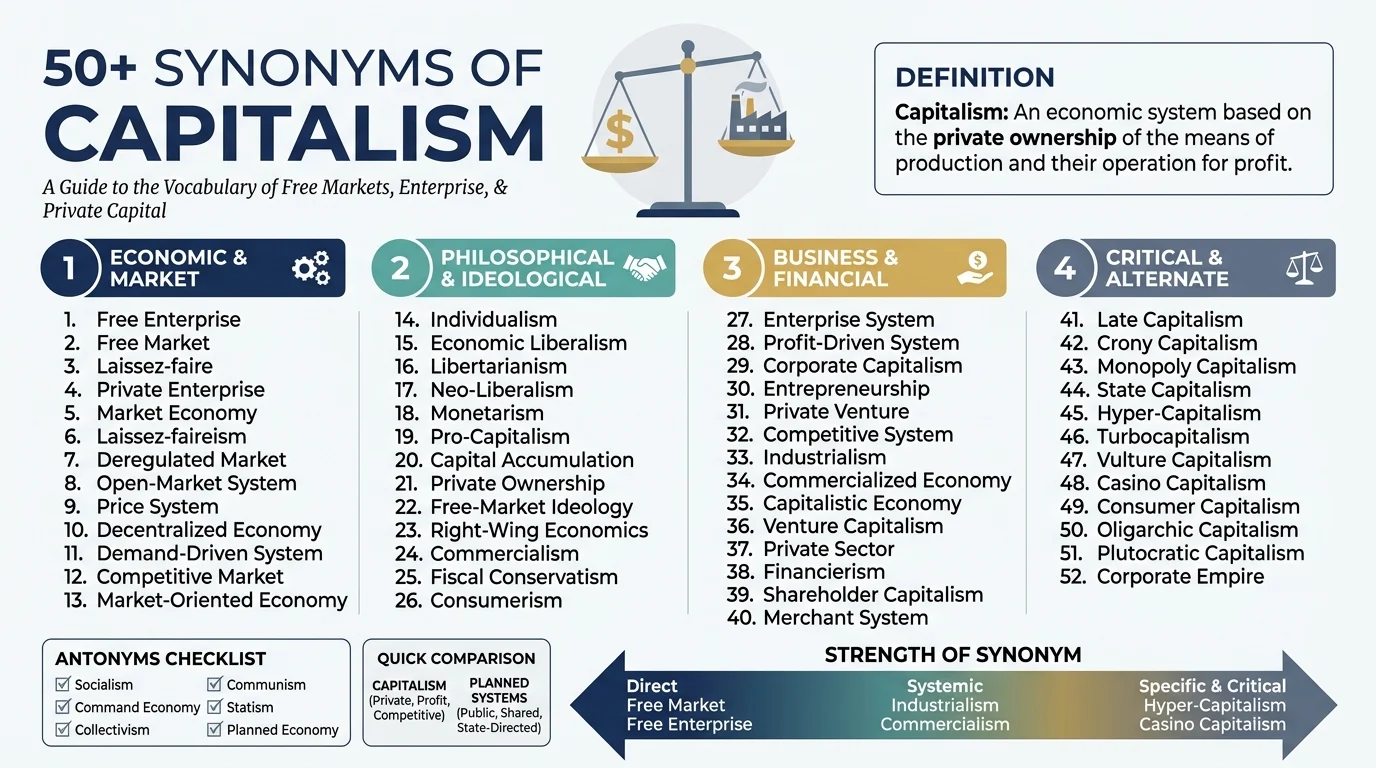
Have you ever needed to describe an economic system based on private ownership and free markets but felt that “capitalism” was too broad or politically charged? You want to capture the specific mechanisms of trade, profit, and private enterprise, and the word “capitalism” comes to mind. Choosing the right synonym for “capitalism” can transform a general statement into a precise description of economic organization, market dynamics, or business philosophy. This guide explores the best synonyms of capitalism, explaining exactly which word to use and when.
Quick Ans: “Capitalism” means an economic system based on private ownership of the means of production and the pursuit of profit. For formal writing, choose free enterprise or market economy. For academic contexts, use laissez-faire or private enterprise. For business contexts, use commercial system or profit system. For casual conversation, use free market or big business.
Meaning, Tone, and Context
Understanding the core meaning of “capitalism” is the first step to using it effectively.
Simple Definition: An economic and political system in which a country’s trade and industry are controlled by private owners for profit, rather than by the state.
Part of Speech: Noun.
Overall Tone: Neutral to politically charged. It can be used descriptively or as a term of praise or criticism.
Formality Level: Formal to neutral. The word is appropriate in academic, business, and political contexts.
Common Uses: Native English speakers use it in economics (“capitalism vs socialism”), business (“capitalism drives innovation”), and political discourse (“the future of capitalism”).
Word Forms: Related words include the noun capitalist, the adjective capitalist or capitalistic, and the verb capitalize.
When and How to Use “Capitalism”
“Capitalism” is the perfect choice when you want to describe an economic system based on private ownership. Here are seven realistic examples.
Academic: “The study compares capitalism and socialism in developing economies.”
Business: “Capitalism encourages competition and innovation.”
Political: “The debate over capitalism versus socialism continues.”
Historical: “The rise of capitalism transformed Europe in the 19th century.”
Professional: “The company operates within a capitalist framework.”
Personal: “I believe capitalism creates opportunities for everyone.”
Social Media: “Capitalism has lifted millions out of poverty.”
Best Synonyms of “Capitalism”
No synonym is identical in every situation. Here is your guide to the best replacement for “capitalism” based on your writing context.
For Economic Systems
Most Direct: Free enterprise means private business operating without government control. “Free enterprise is the foundation of the economy.”
Market economy: Market economy means an economy based on supply and demand. “The country transitioned to a market economy.”
Private enterprise: Private enterprise means businesses owned by individuals. “Private enterprise drives innovation.”
Commercial system: Commercial system means an economy based on trade. “The commercial system flourished.”
For Philosophical and Political Contexts
Laissez-faire: Laissez-faire means minimal government intervention. “Laissez-faire economics dominated the 19th century.”
Individualism: Individualism means prioritizing individual rights. “Individualism is central to capitalism.”
Libertarianism: Libertarianism means maximizing individual freedom. “Libertarianism advocates for free markets.”
Neoliberalism: Neoliberalism means market-oriented reform. “Neoliberalism shaped economic policy in the 1980s.”
For Business and Profit Contexts
Profit system: Profit system means an economy driven by profit. “The profit system rewards efficiency.”
Corporate system: Corporate system means an economy dominated by corporations. “The corporate system has critics and defenders.”
Big business: Big business means large corporations. “Big business influences politics.”
Consumerism: Consumerism means an economy focused on consumption. “Consumerism drives economic growth.”
For Critiques and Alternatives
Exploitative system: Exploitative system means a system that takes advantage of workers. “Critics call it an exploitative system.”
Oligarchy: Oligarchy means rule by a small elite. “Some argue capitalism leads to oligarchy.”
Plutocracy: Plutocracy means rule by the wealthy. “Plutocracy is a criticism of capitalism.”
When Not to Use “Capitalism”
Using “capitalism” can sound wrong or awkward in certain situations.
When You Mean “Economy”: “Capitalism” is a specific system. “Economy” is broader.
Better Choice: Economy or market. “The economy is growing.”
When It Sounds Too Political: In neutral contexts, “capitalism” can be charged.
Better Choice: Free market or private sector. “The private sector is expanding.”
When You Mean “Business”: “Capitalism” is a system. “Business” is an activity.
Better Choice: Business or commerce. “Business is booming.”
Words Commonly Confused With “Capitalism”
| Word | Difference | When to Use | Example |
|---|---|---|---|
| Free market | Economic system with minimal regulation | Economics and policy | “The free market regulates itself.” |
| Socialism | Public ownership of production | Political and economic | “Socialism advocates for equality.” |
| Communism | State ownership of production | Political and historical | “Communism was the official ideology.” |
| Mercantilism | Trade-based economic policy | Historical and economic | “Mercantilism dominated colonial trade.” |
| Feudalism | Land-based economic system | Historical and social | “Feudalism preceded capitalism.” |
| Consumerism | Focus on consumption | Cultural and economic | “Consumerism drives demand.” |
Best Synonyms of “Capitalism” by Context
| Context | Best Synonym | Why It Works | Example |
|---|---|---|---|
| Formal writing | Free enterprise | Formal and precise | “Free enterprise is essential to growth.” |
| Academic writing | Market economy | Standard in economics | “The market economy outperformed.” |
| Professional | Private enterprise | Professional and clear | “Private enterprise drives innovation.” |
| Business | Profit system | Business and economic | “The profit system rewards efficiency.” |
| Political | Laissez-faire | Political and philosophical | “Laissez-faire policies were adopted.” |
| Historical | Mercantilism | Historical and economic | “Mercantilism was the earlier system.” |
| Casual | Free market | Simple and natural | “The free market is thriving.” |
How to Choose the Best Synonym of “Capitalism”
Choosing the right word is a simple decision. Answer these questions.
What type of capitalism am I describing? For economic systems, use free enterprise or market economy. And For philosophical contexts, use laissez-faire or individualism. For business, use profit system or corporate system. For critiques, use exploitative system or plutocracy.
What is my audience? For a formal report, use free enterprise or market economy. For a friend, use free market or big business.
What is my purpose? Are you describing an economic system, a philosophy, or a critique? The correct synonym depends entirely on this.
What is the emotional strength? Exploitative system and plutocracy are negative. Free enterprise is positive. Pick the one that matches your message.
Real Life Examples of “Capitalism”
School: Basic: “Capitalism is an economic system.” Improved: “Free enterprise is an economic system.”
College: Basic: “The course examines capitalism.” Improved: “The course examines market economies.”
Workplace: Basic: “We operate under capitalism.” Improved: “We operate within a free enterprise system.”
Business: Basic: “Capitalism drives innovation.” Improved: “Private enterprise drives innovation.”
Email: Basic: “The report discusses capitalism.” Improved: “The report discusses market economics.”
Conversation: Basic: “I support capitalism.” Improved: “I support the free market.”
Storytelling: Basic: “The novel critiques capitalism.” Improved: “The novel critiques the exploitative system.”
Top 10 Synonyms of “Capitalism”
| Synonym | Simple Meaning | Best Used For | Example Sentence |
|---|---|---|---|
| Free enterprise | Private business without government control | Formal and economic | “Free enterprise is the foundation.” |
| Market economy | Economy based on supply and demand | Academic and economic | “The market economy thrived.” |
| Private enterprise | Businesses owned by individuals | Professional and business | “Private enterprise drives growth.” |
| Laissez-faire | Minimal government intervention | Political and philosophical | “Laissez-faire policies were adopted.” |
| Profit system | Economy driven by profit | Business and economic | “The profit system rewards efficiency.” |
| Commercial system | Economy based on trade | Historical and economic | “The commercial system expanded.” |
| Free market | Market with minimal regulation | Casual and economic | “The free market is thriving.” |
| Individualism | Prioritizing individual rights | Philosophical and political | “Individualism is central to capitalism.” |
| Corporate system | Economy dominated by corporations | Business and critique | “The corporate system has critics.” |
| Consumerism | Economy focused on consumption | Cultural and economic | “Consumerism drives demand.” |
Synonyms of “Capitalism” by Usage
Professional vs. Personal Synonyms
In the workplace, choose free enterprise, private enterprise, or market economy. With friends, use free market, big business, or capitalism.
Formal vs. Conversational Synonyms
For formal writing, use free enterprise, market economy, or laissez-faire. For casual conversations, use free market, big business, or the system.
Academic Synonyms
For research and essays, choose market economy for economics, laissez-faire for policy, and individualism for philosophy.
Professional and Business Synonyms
For maximum impact, choose free enterprise for business, profit system for economics, and private enterprise for innovation.
Creative and Literary Synonyms
To add emotion and imagery, choose plutocracy, oligarchy, or exploitative system. These words create tension.
Slang or Modern Synonyms
In modern American slang, the system, big business, or free market are common. For example, “The system is rigged.” These are casual and should be avoided in formal writing.
Strongest to Mildest Synonyms
Mild: free market, commercial system
Moderate: capitalism, free enterprise, private enterprise
Strong: market economy, profit system, laissez-faire
Very Strong: plutocracy, oligarchy, exploitative system
Emotional vs. Neutral Synonyms
Emotional Synonyms: Plutocracy, oligarchy, exploitative system. These words hint at criticism. Use them when you want to evoke feeling.
Neutral Synonyms: Capitalism, free enterprise, market economy. These words communicate factual information.
Antonyms of “Capitalism”
| Antonym | Meaning | Example Sentence |
|---|---|---|
| Socialism | Public ownership of production | “Socialism advocates for equality.” |
| Communism | State ownership of production | “Communism was the official ideology.” |
| Feudalism | Land-based economic system | “Feudalism preceded capitalism.” |
| Mercantilism | Trade-based economic policy | “Mercantilism dominated colonial trade.” |
| Collectivism | Group ownership | “Collectivism prioritizes the community.” |
| State capitalism | State-controlled capitalism | “State capitalism blends public and private.” |
| Cooperativism | Worker-owned enterprises | “Cooperativism empowers workers.” |
| Mutualism | Mutual benefit economic system | “Mutualism emphasizes cooperation.” |
| Syndicalism | Worker-controlled production | “Syndicalism advocates for worker control.” |
| Autarky | Self-sufficient economy | “Autarky limits trade.” |
| Barter | Trade without money | “Barter was used before currency.” |
| Subsistence | Self-sufficient farming | “Subsistence farming supports families.” |
| Planned economy | Government-controlled economy | “The planned economy failed.” |
| Command economy | Centralized economic control | “The command economy was inefficient.” |
| Gift economy | Economy based on giving | “The gift economy builds community.” |
Comparison: “Capitalism” vs Similar Words
Capitalism vs. Free Market
Main Difference: “Capitalism” is the system. “Free market” is the mechanism.
Which Is Stronger? “Capitalism” is broader.
Which Is More Formal? Both are formal.
When to Use Each: Use “capitalism” for the system. Use “free market” for the mechanism.
Examples:
Capitalism: “Capitalism drives innovation.”
Free market: “The free market regulates prices.”
Capitalism vs. Socialism
Main Difference: “Capitalism” is private ownership. “Socialism” is public ownership.
Which Is Stronger? They are opposites.
Which Is More Formal? Both are formal.
When to Use Each: Use “capitalism” for private enterprise. Use “socialism” for public ownership.
Examples:
Capitalism: “Capitalism encourages competition.”
Socialism: “Socialism promotes equality.”
Capitalism vs. Communism
Main Difference: “Capitalism” is private ownership. “Communism” is state ownership.
Which Is Stronger? They are opposites.
Which Is More Formal? Both are formal.
When to Use Each: Use “capitalism” for market economies. Use “communism” for state-controlled economies.
Examples:
Capitalism: “Capitalism is the dominant system.”
Communism: “Communism was the official ideology.”
Capitalism vs. Mercantilism
Main Difference: “Capitalism” is modern. “Mercantilism” is historical.
Which Is Stronger? “Capitalism” is more current.
Which Is More Formal? Both are formal.
When to Use Each: Use “capitalism” for modern economies. Use “mercantilism” for historical contexts.
Examples:
Capitalism: “Capitalism dominates the global economy.”
Mercantilism: “Mercantilism shaped colonial policy.”
Capitalism vs. Free Enterprise
Main Difference: “Capitalism” is broader. “Free enterprise” is specific to business.
Which Is Stronger? “Capitalism” is broader.
Which Is More Formal? Both are formal.
When to Use Each: Use “capitalism” for the system. Use “free enterprise” for business.
Examples:
Capitalism: “Capitalism has critics and defenders.”
Free enterprise: “Free enterprise drives growth.”
Capitalism vs. Consumerism
Main Difference: “Capitalism” is the system. “Consumerism” is the culture.
Which Is Stronger? “Capitalism” is broader.
Which Is More Formal? Both are formal.
When to Use Each: Use “capitalism” for economics. Use “consumerism” for culture.
Examples:
Capitalism: “Capitalism encourages production.”
Consumerism: “Consumerism drives demand.”
Common Phrases and Expressions with “Capitalism”
Phrase: Crony capitalism
Meaning: Capitalism where success depends on close relationships with government officials.
Example Sentence: “Crony capitalism undermines free markets.”
Phrase: Late capitalism
Meaning: The current stage of capitalism, often criticized.
Example Sentence: “Late capitalism is characterized by inequality.”
Phrase: Casino capitalism
Meaning: Capitalism characterized by risky financial speculation.
Example Sentence: “Casino capitalism led to the financial crisis.”
Phrase: State capitalism
Meaning: Capitalism where the state plays a dominant role.
Example Sentence: “State capitalism is common in some countries.”
Phrase: Turbo capitalism
Meaning: An extreme form of capitalism.
Example Sentence: “Turbo capitalism prioritizes profit above all.”
Common Mistakes to Avoid
Mistake 1: Using “capitalism” when you mean “economy”.
Incorrect: “The capitalism is growing.”
Better: “The economy is growing.”
Why: “Capitalism” is a system.
Mistake 2: Using “capitalism” in neutral contexts.
Incorrect: “The company operates under capitalism.”
Better: “The company operates in a free market.”
Why: “Free market” is less charged.
Mistake 3: Overusing “capitalism” in conversation.
Incorrect: “I support capitalism.”
Better: “I support the free market.”
Why: “Free market” sounds more natural.
Mistake 4: Using “capitalism” when you mean “business”.
Incorrect: “Capitalism is booming.”
Better: “Business is booming.”
Why: “Business” is the activity.
Mistake 5: Using “capitalism” when you mean “consumerism”.
Incorrect: “Capitalism drives demand.”
Better: “Consumerism drives demand.”
Why: “Consumerism” is the culture.
Frequently Asked Questions
1. What are the best synonyms of “capitalism”?
The best synonyms depend on your context. For formal writing, choose free enterprise or market economy. And For academic contexts, use laissez-faire or private enterprise. For casual conversation, use free market or big business.
2. What are the best formal synonyms of “capitalism”?
The best formal synonyms are free enterprise, market economy, and private enterprise. These words are suitable for academic papers, professional reports, and business communications.
3. What are common informal synonyms of “capitalism”?
For informal settings, use free market, big business, or the system. These alternatives sound more natural in everyday conversation.
4. What is another word for “capitalism” in professional writing?
In professional writing, free enterprise is an excellent choice. It conveys private business. Market economy is also strong for economic contexts.
5. What is the difference between “capitalism” and “free market”?
“Capitalism” is the system. “Free market” is the mechanism. Use “capitalism” for the system and “free market” for the mechanism.
6. What is the opposite of “capitalism”?
The most direct opposites (antonyms) of capitalism are socialism, communism, and collectivism. These words describe systems of public or collective ownership.
Conclusion
“Capitalism” is a foundational and politically significant word for describing an economic system based on private ownership and profit. The term is formal and widely used in academic, business, and political contexts, yet it can be politically charged or too broad for specific descriptions. The best choice among the synonyms of capitalism depends entirely on your audience, tone, and purpose. Remember, no single synonym works perfectly in every situation. Your goal is to choose the word that communicates your message with the most clarity and impact. A practical tip for your vocabulary growth is to pay attention to how writers describe economic systems and practice using different synonyms in your writing.










2 thoughts on “50+ Synonyms of Capitalism: Meanings, Uses, Examples, and Best Alternatives 2026”