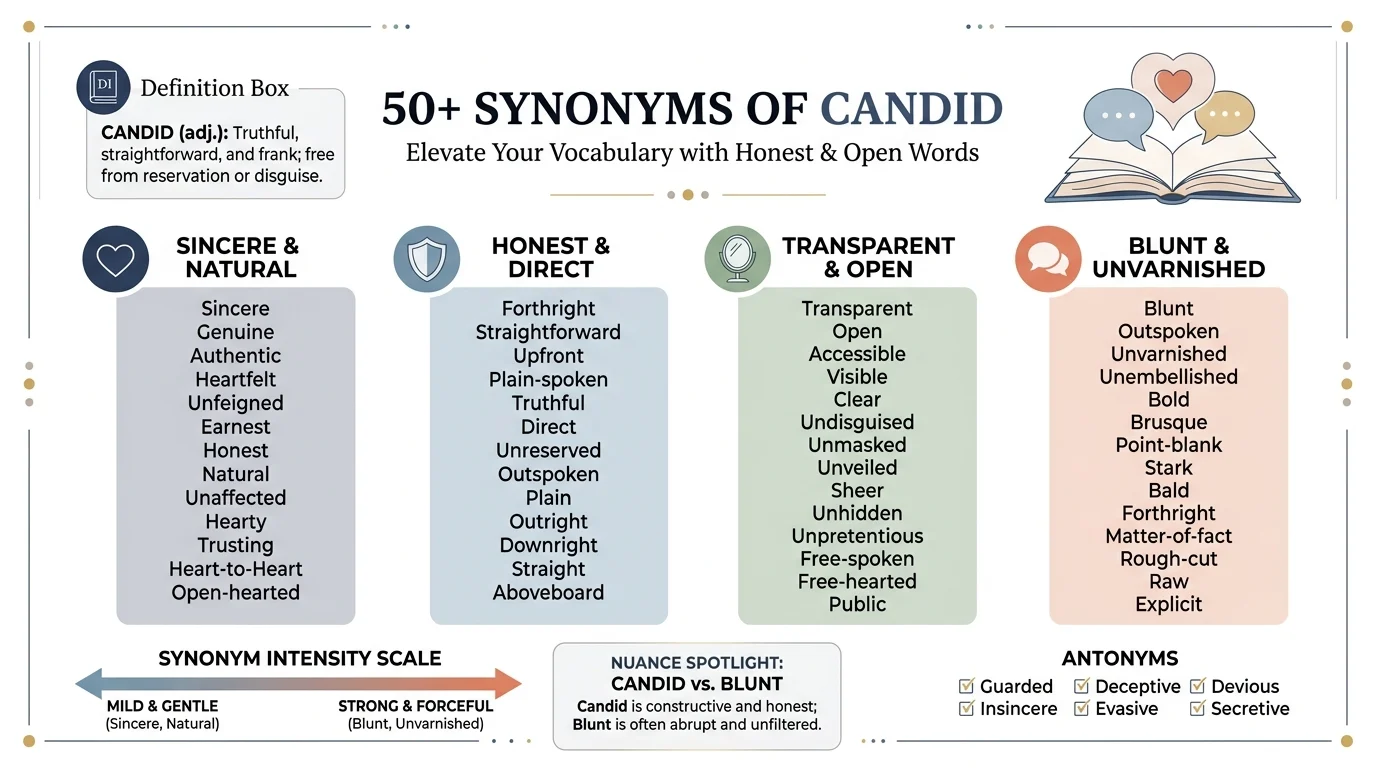
Have you ever needed to describe someone who speaks honestly and directly but felt that “honest” or “frank” was too simple? You want to capture the openness, sincerity, and lack of pretense in their communication, and the word “candid” comes to mind. Choosing the right synonym for “candid” can transform a basic compliment into a precise expression of truthfulness, transparency, or bluntness. This guide explores the best synonyms of candid, explaining exactly which word to use and when.
Quick Ans: “Candid” means honest, straightforward, and direct in speech or expression. For formal writing, choose forthright or unequivocal. For casual conversation, use upfront or straight. For emotional contexts, use sincere or heartfelt. For a stronger, blunter tone, use blunt or brusque. For a positive, open tone, use transparent or open.
Meaning, Tone, and Context
Understanding the core meaning of “candid” is the first step to using it effectively.
Simple Definition: Truthful and straightforward; frank; open and sincere in expression.
Part of Speech: Adjective.
Overall Tone: Positive to neutral. It indicates honesty and openness, though it can sometimes imply bluntness.
Formality Level: Neutral to formal. The word is appropriate in professional, academic, and personal contexts.
Common Uses: Native English speakers use it to describe interviews (“candid interview”), photos (“candid photo”), conversations (“candid conversation”), and people (“candid friend”).
Word Forms: Related words include the noun candor, the adverb candidly, and the noun candidness.
When and How to Use “Candid”
“Candid” is the perfect choice when you want to describe honest, direct communication. Here are seven realistic examples.
Professional: “The CEO gave a candid assessment of the company’s challenges.”
Academic: “The study offers a candid analysis of the policy’s failures.”
Workplace: “We need candid feedback to improve our processes.”
Personal: “She appreciated his candid advice about her career.”
Email: “To be candid, I think we need to revise the entire proposal.”
Resume: (Rarely used) “Known for candid communication with clients and colleagues.”
Social Media: “Just had a candid conversation about mental health, and it was liberating.”
Best Synonyms of “Candid”
No synonym is identical in every situation. Here is your guide to the best replacement for “candid” based on your writing context.
For Honest and Direct Communication
Most Formal: Forthright means direct and outspoken. “She was forthright in her criticism of the plan.”
Unequivocal: Unequivocal means leaving no doubt. “His answer was unequivocal.”
Direct: Direct means straightforward. “He gave a direct response.”
Straightforward: Straightforward means honest and easy to understand. “The explanation was straightforward.”
For Open and Transparent
Transparent: Transparent means open and honest. “The company is transparent about its finances.”
Open: Open means willing to share. “She was open about her struggles.”
Sincere: Sincere means genuine and honest. “His apology was sincere.”
Genuine: Genuine means authentic. “Her interest was genuine.”
For Blunt and Blunt Communication
Blunt: Blunt means direct to the point of rudeness. “His blunt remark offended her.”
Brusque: Brusque means abrupt and blunt. “The waiter was brusque.”
Frank: Frank means open and honest. “To be frank, I disagree.”
Outspoken: Outspoken means expressing opinions openly. “She is an outspoken critic.”
For Emotional and Personal Contexts
Heartfelt: Heartfelt means deeply felt. “His heartfelt confession moved her.”
Earnest: Earnest means sincere and serious. “He made an earnest appeal.”
Honest: Honest is the simplest synonym. “She gave an honest answer.”
Truthful: Truthful means telling the truth. “He was truthful about his mistakes.”
When Not to Use “Candid”
Using “candid” can sound wrong or awkward in certain situations.
When You Mean “Rude”: “Candid” is positive. “Rude” is negative.
Better Choice: Rude or blunt. “His comment was rude.”
When You Mean “Casual”: “Candid” is about honesty. “Casual” is about style.
Better Choice: Casual or informal. “The photo was casual.”
When It Sounds Too Formal: In casual conversation, “candid” can sound formal.
Better Choice: Honest or upfront. “I will be honest with you.”
Words Commonly Confused With “Candid”
| Word | Difference | When to Use | Example |
|---|---|---|---|
| Frank | Open and honest | General and direct | “To be frank.” |
| Honest | Truthful | General and moral | “An honest answer.” |
| Sincere | Genuine | Emotional and personal | “A sincere apology.” |
| Blunt | Direct to the point of rudeness | Critical and harsh | “A blunt remark.” |
| Transparent | Open and honest | Business and governance | “Transparent communication.” |
| Forthright | Direct and outspoken | Formal and assertive | “A forthright leader.” |
Best Synonyms of “Candid” by Context
| Context | Best Synonym | Why It Works | Example |
|---|---|---|---|
| Formal writing | Forthright | Formal and assertive | “She was forthright in her opinion.” |
| Academic writing | Unequivocal | Precise and clear | “The conclusion was unequivocal.” |
| Professional | Transparent | Business and trust | “The company is transparent.” |
| Business | Direct | Clear and professional | “We need direct feedback.” |
| Emotional | Sincere | Emotional and genuine | “His apology was sincere.” |
| Casual | Upfront | Simple and natural | “I will be upfront with you.” |
| Dramatic | Blunt | Strong and harsh | “Her blunt words shocked everyone.” |
How to Choose the Best Synonym of “Candid”
Choosing the right word is a simple decision. Answer these questions.
What type of candor am I describing? For honest communication, use forthright or direct. And For transparency, use transparent or open. For bluntness, use blunt or brusque. For sincerity, use sincere or earnest.
What is my audience? For a formal report, use forthright or unequivocal. For a friend, use honest or upfront.
What is my purpose? Are you describing feedback, a conversation, or a personality? The correct synonym depends entirely on this.
What is the emotional strength? Blunt is stronger and harsher. Sincere is warmer. Pick the one that matches your message.
Real Life Examples of “Candid”
School: Basic: “The teacher was candid.” Improved: “The teacher was forthright in her feedback.”
College: Basic: “The study was candid.” Improved: “The study offered an unequivocal analysis.”
Workplace: Basic: “We need candid feedback.” Improved: “We need direct feedback.”
Business: Basic: “The CEO was candid.” Improved: “The CEO was transparent about the challenges.”
Email: Basic: “To be candid, I disagree.” Improved: “To be frank, I disagree.”
Conversation: Basic: “She was candid.” Improved: “She was honest with me.”
Storytelling: Basic: “His candid confession moved her.” Improved: “His heartfelt confession moved her.”
Top 10 Synonyms of “Candid”
| Synonym | Simple Meaning | Best Used For | Example Sentence |
|---|---|---|---|
| Forthright | Direct and outspoken | Formal and assertive | “She was forthright in her criticism.” |
| Frank | Open and honest | General and direct | “To be frank, I disagree.” |
| Direct | Straightforward | Professional and clear | “He gave a direct answer.” |
| Transparent | Open and honest | Business and governance | “The company is transparent.” |
| Sincere | Genuine and honest | Emotional and personal | “His apology was sincere.” |
| Blunt | Direct to the point of rudeness | Critical and harsh | “Her blunt remark offended him.” |
| Honest | Truthful | General and moral | “She gave an honest answer.” |
| Open | Willing to share | Personal and social | “He was open about his past.” |
| Earnest | Sincere and serious | Emotional and formal | “He made an earnest appeal.” |
| Upfront | Honest and direct | Casual and business | “I will be upfront with you.” |
Synonyms of “Candid” by Usage
Professional vs. Personal Synonyms
In the workplace, choose forthright, transparent, or direct. With friends, use honest, upfront, or open.
Formal vs. Conversational Synonyms
For formal writing, use forthright, unequivocal, or transparent. For casual conversations, use honest, upfront, or straight.
Academic Synonyms
For research and essays, choose unequivocal for conclusions, forthright for analysis, and transparent for methodology.
Professional and Business Synonyms
For maximum impact, choose transparent for communication, direct for feedback, and forthright for leadership.
Creative and Literary Synonyms
To add emotion and imagery, choose heartfelt, earnest, or sincere. These words create atmosphere.
Slang or Modern Synonyms
In modern American slang, straight up, real, or no filter are common. For example, “I will be real with you.” These are casual and should be avoided in formal writing.
Strongest to Mildest Synonyms
Mild: open, honest, straightforward
Moderate: candid, frank, direct, sincere
Strong: forthright, transparent, earnest
Very Strong: blunt, brusque, unequivocal
Emotional vs. Neutral Synonyms
Emotional Synonyms: Sincere, heartfelt, earnest. These words hint at genuine feeling. Use them when you want to evoke emotion.
Neutral Synonyms: Candid, direct, honest. These words communicate factual information.
Antonyms of “Candid”
| Antonym | Meaning | Example Sentence |
|---|---|---|
| Evasive | Avoiding a direct answer | “His evasive response frustrated her.” |
| Deceptive | Misleading | “The deceptive report was exposed.” |
| Dishonest | Not truthful | “The dishonest employee was fired.” |
| Guarded | Cautious and reserved | “She was guarded about her feelings.” |
| Secretive | Keeping secrets | “He was secretive about his plans.” |
| Insincere | Not genuine | “His insincere apology was rejected.” |
| Two-faced | Deceitful | “The two-faced colleague was untrustworthy.” |
| Hypocritical | Pretending to have morals | “The hypocritical politician was criticized.” |
| Indirect | Not direct | “His indirect answer confused everyone.” |
| Vague | Unclear | “The vague statement raised questions.” |
| Ambiguous | Open to interpretation | “The ambiguous response was unhelpful.” |
| Cryptic | Mysterious | “The cryptic message puzzled them.” |
| Reserved | Slow to reveal feelings | “She was reserved with strangers.” |
| Cautious | Careful | “He was cautious in his remarks.” |
| Diplomatic | Tactful | “The diplomatic answer avoided offense.” |
Comparison: “Candid” vs Similar Words
Candid vs. Frank
Main Difference: “Frank” is open and honest. “Candid” is similar but often implies more thoughtfulness.
Which Is Stronger? They are similar.
Which Is More Formal? Both are neutral.
When to Use Each: Use “frank” for directness. Use “candid” for open honesty.
Examples:
Candid: “She gave a candid interview.”
Frank: “To be frank, I disagree.”
Candid vs. Honest
Main Difference: “Honest” is broader. “Candid” implies openness.
Which Is Stronger? “Candid” is more specific.
Which Is More Formal? Both are neutral.
When to Use Each: Use “honest” for truthfulness. Use “candid” for openness.
Examples:
Candid: “He was candid about his mistakes.”
Honest: “She gave an honest answer.”
Candid vs. Sincere
Main Difference: “Sincere” is genuine feeling. “Candid” is about honesty in expression.
Which Is Stronger? “Sincere” is warmer.
Which Is More Formal? Both are neutral.
When to Use Each: Use “sincere” for apologies. Use “candid” for feedback.
Examples:
Candid: “The feedback was candid.”
Sincere: “His apology was sincere.”
Candid vs. Blunt
Main Difference: “Blunt” is direct to the point of rudeness. “Candid” is generally positive.
Which Is Stronger? “Blunt” is stronger and harsher.
Which Is More Formal? Both are neutral.
When to Use Each: Use “blunt” for harsh truths. Use “candid” for open honesty.
Examples:
Candid: “She was candid about the challenges.”
Blunt: “His blunt remark offended her.”
Candid vs. Transparent
Main Difference: “Transparent” is about openness in systems. “Candid” is about personal honesty.
Which Is Stronger? “Transparent” is more specific to organizations.
Which Is More Formal? “Transparent” is more formal.
When to Use Each: Use “transparent” for business. Use “candid” for personal contexts.
Examples:
Candid: “He was candid about his feelings.”
Transparent: “The company is transparent about its finances.”
Candid vs. Forthright
Main Difference: “Forthright” is direct and outspoken. “Candid” is open and honest.
Which Is Stronger? “Forthright” is more assertive.
Which Is More Formal? “Forthright” is more formal.
When to Use Each: Use “forthright” for leadership. Use “candid” for general contexts.
Examples:
Candid: “The discussion was candid.”
Forthright: “She was forthright in her criticism.”
Common Phrases and Expressions with “Candid”
Phrase: Candid camera
Meaning: A hidden camera capturing unposed reactions.
Example Sentence: “The show used a candid camera to prank people.”
Phrase: Candid conversation
Meaning: An honest and open discussion.
Example Sentence: “We had a candid conversation about our future.”
Phrase: Candid feedback
Meaning: Honest and direct feedback.
Example Sentence: “The manager gave candid feedback on the project.”
Phrase: Candid photo
Meaning: An unposed, natural photograph.
Example Sentence: “The candid photo captured her laughter.”
Phrase: To be candid
Meaning: To speak honestly.
Example Sentence: “To be candid, I think we should start over.”
Common Mistakes to Avoid
Mistake 1: Using “candid” when you mean “rude”.
Incorrect: “His candid remark was offensive.”
Better: “His blunt remark was offensive.”
Why: “Candid” is positive. “Blunt” can be negative.
Mistake 2: Using “candid” when you mean “casual”.
Incorrect: “The candid outfit was comfortable.”
Better: “The casual outfit was comfortable.”
Why: “Candid” is about honesty.
Mistake 3: Overusing “candid” in conversation.
Incorrect: “I will be candid with you.”
Better: “I will be honest with you.”
Why: “Honest” sounds more natural.
Mistake 4: Using “candid” when you mean “sincere”.
Incorrect: “His candid apology was accepted.”
Better: “His sincere apology was accepted.”
Why: “Sincere” is for feelings.
Mistake 5: Using “candid” when you mean “transparent”.
Incorrect: “The company was candid about its finances.”
Better: “The company was transparent about its finances.”
Why: “Transparent” is for organizations.
Frequently Asked Questions
1. What are the best synonyms of “candid”?
The best synonyms depend on your context. For formal writing, choose forthright or unequivocal. And For casual conversation, use honest or upfront. For sincerity, use sincere or earnest.
2. What are the best formal synonyms of “candid”?
The best formal synonyms are forthright, unequivocal, and transparent. These words are suitable for academic papers, professional reports, and business communications.
3. What are common informal synonyms of “candid”?
For informal settings, use honest, upfront, or straight. These alternatives sound more natural in everyday conversation.
4. What is another word for “candid” in professional writing?
In professional writing, transparent is an excellent choice. It conveys openness and trust. Direct is also strong for feedback.
5. What is the difference between “candid” and “frank”?
“Candid” and “frank” are very similar. “Frank” is often more direct. “Candid” implies thoughtful honesty. Use “frank” for bluntness and “candid” for openness.
6. What is the opposite of “candid”?
The most direct opposites (antonyms) of candid are evasive, deceptive, and guarded. These words describe a lack of openness.
Conclusion
“Candid” is a powerful and positive word for describing honesty, openness, and direct communication. The term is neutral and widely accepted in professional, academic, and personal contexts, yet it can sound too formal for casual conversation or too mild for harsh truths. The best choice among the synonyms of candid depends entirely on your audience, tone, and purpose. Remember, no single synonym works perfectly in every situation. Your goal is to choose the word that communicates your message with the most clarity and impact. A practical tip for your vocabulary growth is to pay attention to how writers express honesty and openness and practice using different synonyms in your writing.









