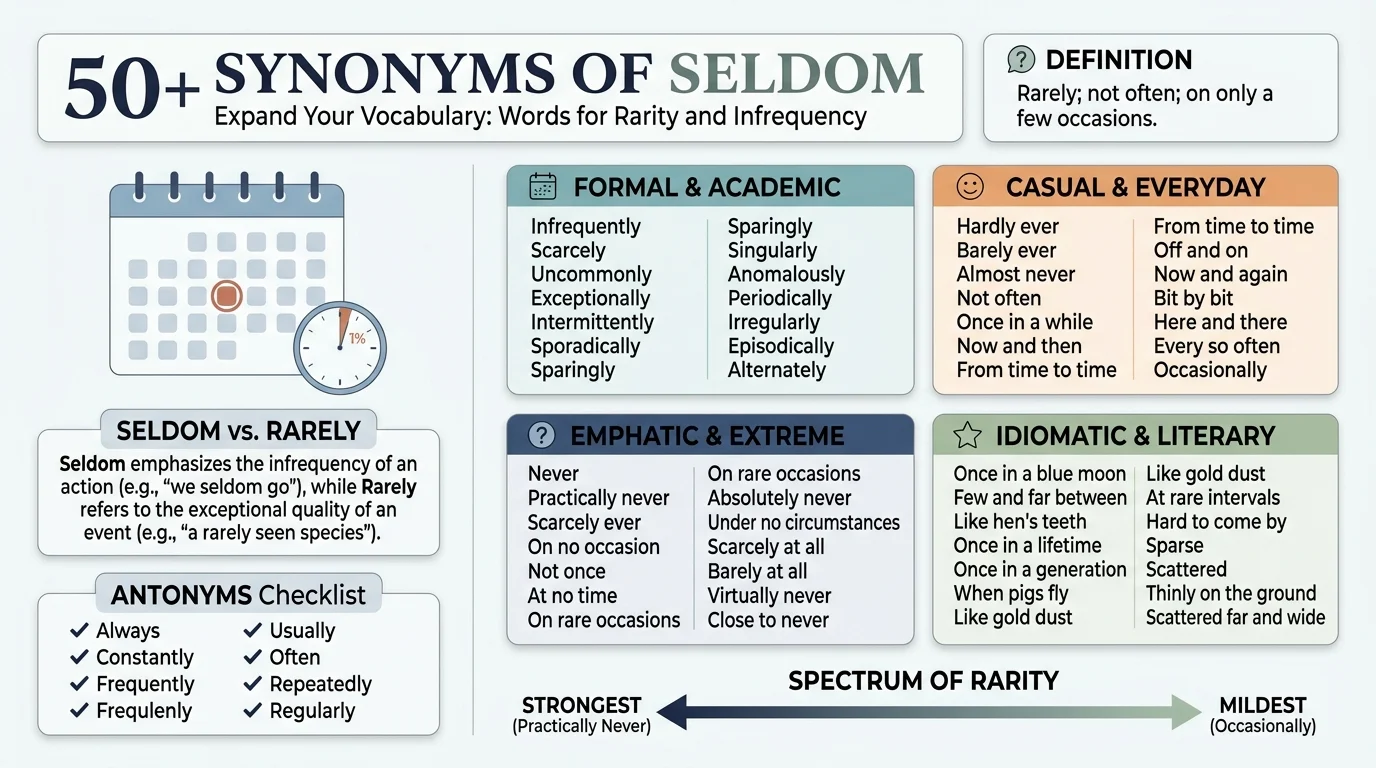
Have you ever needed to describe something that rarely happens but felt that “sometimes” or “not often” was too vague or wordy? You want to capture the infrequency of an event or action, and the word “seldom” comes to mind. Choosing the right synonym for “seldom” can transform a basic statement into a precise expression of rarity, infrequency, or exception. This guide explores the best synonyms of seldom, explaining exactly which word to use and when.
Quick Ans: “Seldom” means not often, rarely, or infrequently. For formal writing, choose rarely or infrequently. For casual conversation, use hardly ever or once in a blue moon. For emphasis, use scarcely or almost never. For literary effect, use sparingly or occasionally (when implying less frequency).
Meaning, Tone, and Context
Understanding the core meaning of “seldom” is the first step to using it effectively.
Simple Definition: Not often; rarely; on few occasions.
Part of Speech: Adverb.
Overall Tone: Neutral. It indicates low frequency without strong emotion.
Formality Level: Neutral to formal. The word is appropriate in most contexts, though more common in writing than speech.
Common Uses: Native English speakers use it to describe infrequent events, behaviors, or conditions. For example, “He seldom visits,” or “Seldom have I seen such courage.”
Word Forms: Related words include the adjective seldom (rare usage) and the phrase seldom if ever.
When and How to Use “Seldom”
“Seldom” is the perfect choice when you want to emphasize that something happens rarely. Here are seven realistic examples.
Professional: “The manager seldom misses a deadline.”
Academic: “This phenomenon is seldom observed in nature.”
Workplace: “She seldom takes time off work.”
Personal: “I seldom eat fast food.”
Email: “We seldom receive complaints about this product.”
Resume: (Rarely used) “Seldom missed a target in five years.”
Social Media: “I seldom post, but when I do, it matters.”
Best Synonyms of “Seldom”
No synonym is identical in every situation. Here is your guide to the best replacement for “seldom” based on your writing context.
For Formal and Academic Contexts
Most Direct: Rarely is the most common synonym. “The species is rarely seen.”
Infrequently: Infrequently means not often. “He infrequently attends meetings.”
Scarcely: Scarcely means almost not at all. “She scarcely spoke during the event.”
Sparingly: Sparingly means in small amounts. “Use the resource sparingly.”
For Casual and Conversational Contexts
Hardly ever: Hardly ever means almost never. “I hardly ever watch TV.”
Once in a blue moon: Once in a blue moon means very rarely. “He visits once in a blue moon.”
Not often: Not often is simple and direct. “I do not often go there.”
Rarely ever: Rarely ever emphasizes rarity. “She rarely ever complains.”
For Emphatic and Literary Contexts
Almost never: Almost never is strong. “He almost never loses.”
Hardly: Hardly means barely. “I hardly know him.”
Scarcely ever: Scarcely ever is formal. “Scarcely ever did they agree.”
Only occasionally: Only occasionally means sometimes but not often. “She only occasionally indulges.”
When Not to Use “Seldom”
Using “seldom” can sound wrong or awkward in certain situations.
When You Mean “Never”: “Seldom” means rarely, not never.
Better Choice: Never. “He never calls.”
When You Mean “Sometimes”: “Seldom” is less frequent than sometimes.
Better Choice: Sometimes or occasionally. “I sometimes go.”
When It Sounds Too Formal: In casual conversation, “seldom” can sound stiff.
Better Choice: Hardly ever or not often. “I hardly ever go.”
Words Commonly Confused With “Seldom”
| Word | Difference | When to Use | Example |
|---|---|---|---|
| Rarely | Not often | General and formal | “She rarely visits.” |
| Never | Not at all | Absolute | “He never lies.” |
| Sometimes | Occasionally | Moderate frequency | “I sometimes run.” |
| Often | Frequently | High frequency | “She often calls.” |
| Occasionally | Now and then | Low frequency | “We occasionally meet.” |
| Hardly ever | Almost never | Casual emphasis | “I hardly ever travel.” |
Best Synonyms of “Seldom” by Context
| Context | Best Synonym | Why It Works | Example |
|---|---|---|---|
| Formal writing | Rarely | Formal and precise | “The event rarely occurs.” |
| Academic writing | Infrequently | Standard in research | “The condition infrequently appears.” |
| Professional | Sparingly | Professional and precise | “Use resources sparingly.” |
| Literary | Scarcely | Literary and dramatic | “Scarcely had he spoken.” |
| Casual conversation | Hardly ever | Simple and natural | “I hardly ever eat out.” |
| Emphatic | Almost never | Strong emphasis | “He almost never fails.” |
| Idiomatic | Once in a blue moon | Colorful and casual | “She visits once in a blue moon.” |
How to Choose the Best Synonym of “Seldom”
Choosing the right word is a simple decision. Answer these questions.
What type of frequency am I describing? For rare events, use rarely or infrequently. And For almost never, use hardly ever or scarcely. For very rare, use once in a blue moon.
What is my audience? For a formal report, use rarely or infrequently. For a friend, use hardly ever or not often.
What is my purpose? Are you emphasizing rarity, formality, or casual conversation? The correct synonym depends entirely on this.
What is the emotional strength? Scarcely and almost never are stronger. Occasionally is milder. Pick the one that matches your message.
Real Life Examples of “Seldom”
School: Basic: “He seldom does homework.” Improved: “He rarely does homework.”
College: Basic: “The professor seldom gives extensions.” Improved: “The professor infrequently gives extensions.”
Workplace: Basic: “She seldom takes breaks.” Improved: “She hardly ever takes breaks.”
Business: Basic: “The company seldom fails.” Improved: “The company almost never fails.”
Email: Basic: “We seldom get complaints.” Improved: “We rarely get complaints.”
Conversation: Basic: “I seldom go there.” Improved: “I hardly ever go there.”
Storytelling: Basic: “He seldom showed emotion.” Improved: “He scarcely showed emotion.”
Top 10 Synonyms of “Seldom”
| Synonym | Simple Meaning | Best Used For | Example Sentence |
|---|---|---|---|
| Rarely | Not often | Formal and general | “She rarely visits.” |
| Infrequently | Not often | Academic and formal | “The condition infrequently appears.” |
| Hardly ever | Almost never | Casual and emphatic | “I hardly ever watch TV.” |
| Scarcely | Almost not at all | Literary and formal | “Scarcely had he arrived.” |
| Sparingly | In small amounts | Resource and formal | “Use it sparingly.” |
| Almost never | Very rarely | Strong emphasis | “He almost never fails.” |
| Once in a blue moon | Very rarely | Idiomatic and casual | “She visits once in a blue moon.” |
| Not often | Low frequency | General and casual | “I do not often go.” |
| Occasionally | Now and then | Moderate frequency | “We occasionally meet.” |
| Rarely ever | Almost never | Emphatic and casual | “She rarely ever complains.” |
Synonyms of “Seldom” by Usage
Professional vs. Personal Synonyms
In the workplace, choose rarely, infrequently, or sparingly. With friends, use hardly ever, not often, or once in a blue moon.
Formal vs. Conversational Synonyms
For formal writing, use rarely, infrequently, or scarcely. For casual conversations, use hardly ever, not often, or once in a blue moon.
Academic Synonyms
For research and essays, choose rarely for general rarity, infrequently for statistical frequency, and sparingly for resource usage.
Professional and Business Synonyms
For maximum impact, choose rarely for performance, infrequently for occurrences, and sparingly for resource allocation.
Creative and Literary Synonyms
To add emotion and imagery, choose scarcely, almost never, or once in a blue moon. These words create atmosphere.
Slang or Modern Synonyms
In modern American slang, hardly ever, once in a blue moon, or rarely are common. For example, “I barely go there.” These are casual and should be avoided in formal writing.
Strongest to Mildest Synonyms
Mild: occasionally, sometimes, now and then
Moderate: seldom, rarely, not often
Strong: infrequently, hardly ever, scarcely
Very Strong: almost never, once in a blue moon
Emotional vs. Neutral Synonyms
Emotional Synonyms: Scarcely, almost never, once in a blue moon. These words hint at surprise or emphasis. Use them when you want to evoke feeling.
Neutral Synonyms: Seldom, rarely, infrequently. These words communicate factual information.
Antonyms of “Seldom”
| Antonym | Meaning | Example Sentence |
|---|---|---|
| Often | Frequently | “She often visits.” |
| Frequently | Many times | “He frequently calls.” |
| Regularly | At regular intervals | “They regularly meet.” |
| Always | Every time | “He always arrives early.” |
| Usually | Most of the time | “She usually works late.” |
| Commonly | Usually | “It is commonly seen.” |
| Generally | In most cases | “He generally agrees.” |
| Typically | In most cases | “She typically drives.” |
| Repeatedly | Over and over | “He repeatedly failed.” |
| Constantly | All the time | “She constantly checks her phone.” |
| Continually | Repeatedly | “He continually interrupts.” |
| Perpetually | Forever | “She is perpetually late.” |
| Habitually | By habit | “He habitually bites his nails.” |
| Invariably | Always | “She invariably smiles.” |
| Consistently | In the same way | “He consistently performs well.” |
Comparison: “Seldom” vs Similar Words
Seldom vs. Rarely
Main Difference: They are nearly identical. “Rarely” is more common in speech.
Which Is Stronger? They are equal.
Which Is More Formal? “Seldom” is slightly more formal.
When to Use Each: Use “seldom” in formal writing. Use “rarely” in general contexts.
Examples:
Seldom: “He seldom speaks.”
Rarely: “He rarely speaks.”
Seldom vs. Never
Main Difference: “Seldom” means rarely. “Never” means not at all.
Which Is Stronger? “Never” is absolute.
Which Is More Formal? Both are neutral.
When to Use Each: Use “never” for absolute absence. Use “seldom” for rarity.
Examples:
Seldom: “She seldom complains.”
Never: “She never complains.”
Seldom vs. Sometimes
Main Difference: “Seldom” is less frequent than sometimes.
Which Is Stronger? “Seldom” is stronger for rarity.
Which Is More Formal? Both are neutral.
When to Use Each: Use “sometimes” for moderate frequency. Use “seldom” for low frequency.
Examples:
Seldom: “I seldom eat out.”
Sometimes: “I sometimes eat out.”
Seldom vs. Hardly Ever
Main Difference: “Hardly ever” is casual and emphatic. “Seldom” is more formal.
Which Is Stronger? “Hardly ever” is stronger in casual contexts.
Which Is More Formal? “Seldom” is more formal.
When to Use Each: Use “hardly ever” in conversation. Use “seldom” in writing.
Examples:
Seldom: “He seldom visits.”
Hardly ever: “He hardly ever visits.”
Seldom vs. Scarcely
Main Difference: “Scarcely” means almost not at all. “Seldom” means rarely.
Which Is Stronger? “Scarcely” is stronger.
Which Is More Formal? Both are formal.
When to Use Each: Use “scarcely” for emphasis. Use “seldom” for general rarity.
Examples:
Seldom: “She seldom speaks.”
Scarcely: “She scarcely speaks.”
Seldom vs. Occasionally
Main Difference: “Occasionally” is more frequent than seldom.
Which Is Stronger? “Seldom” is stronger for rarity.
Which Is More Formal? Both are formal.
When to Use Each: Use “occasionally” for now and then. Use “seldom” for rare events.
Examples:
Seldom: “We seldom meet.”
Occasionally: “We occasionally meet.”
Common Phrases and Expressions with “Seldom”
Phrase: Seldom if ever
Meaning: Almost never.
Example Sentence: “He seldom if ever misses a meeting.”
Phrase: Seldom seen
Meaning: Rarely observed.
Example Sentence: “The bird is seldom seen in this area.”
Phrase: Seldom does
Meaning: Rarely happens (inverted structure).
Example Sentence: “Seldom does he raise his voice.”
Phrase: Seldom available
Meaning: Rarely accessible.
Example Sentence: “The manager is seldom available.”
Phrase: Seldom wrong
Meaning: Rarely incorrect.
Example Sentence: “She is seldom wrong about these things.”
Phrase: Seldom used
Meaning: Rarely utilized.
Example Sentence: “The old road is seldom used.”
Common Mistakes to Avoid
Mistake 1: Using “seldom” when you mean “never”.
Incorrect: “He seldom never lies.”
Better: “He never lies.”
Why: “Seldom” and “never” are different.
Mistake 2: Using “seldom” when you mean “sometimes”.
Incorrect: “I seldom go to the gym twice a week.”
Better: “I sometimes go to the gym twice a week.”
Why: “Seldom” implies less frequency.
Mistake 3: Overusing “seldom” in conversation.
Incorrect: “I seldom watch TV.”
Better: “I hardly ever watch TV.”
Why: “Hardly ever” sounds more natural.
Mistake 4: Using “seldom” when you mean “rarely”.
Incorrect: “She seldom visits.”
Better: “She rarely visits.”
Why: Both are correct, but “rarely” is more common.
Mistake 5: Using “seldom” when you mean “scarcely”.
Incorrect: “She seldom spoke.”
Better: “She scarcely spoke.”
Why: “Scarcely” is stronger for emphasis.
Frequently Asked Questions
1. What are the best synonyms of “seldom”?
The best synonyms depend on your context. For formal writing, choose rarely or infrequently. And For casual conversation, use hardly ever or not often. For emphasis, use scarcely or almost never.
2. What are the best formal synonyms of “seldom”?
The best formal synonyms are rarely, infrequently, and scarcely. These words are suitable for academic papers, professional reports, and business communications.
3. What are common informal synonyms of “seldom”?
For informal settings, use hardly ever, not often, or once in a blue moon. These alternatives sound more natural in everyday conversation.
4. What is another word for “seldom” in professional writing?
In professional writing, rarely is an excellent choice. It conveys low frequency. Infrequently is also strong for statistical contexts.
5. What is the difference between “seldom” and “rarely”?
They are nearly identical. “Seldom” is slightly more formal. “Rarely” is more common in speech.
6. What is the opposite of “seldom”?
The most direct opposites (antonyms) of seldom are often, frequently, and regularly. These words describe high frequency.
Conclusion
“Seldom” is a precise and formal word for describing rarity and infrequency. The term is widely accepted in writing but can sound stiff in casual conversation. The best choice among the synonyms of seldom depends entirely on your audience, tone, and purpose. Remember, no single synonym works perfectly in every situation. Your goal is to choose the word that communicates your message with the most clarity and impact. A practical tip for your vocabulary growth is to pay attention to how writers describe frequency and practice using different synonyms in your writing.









