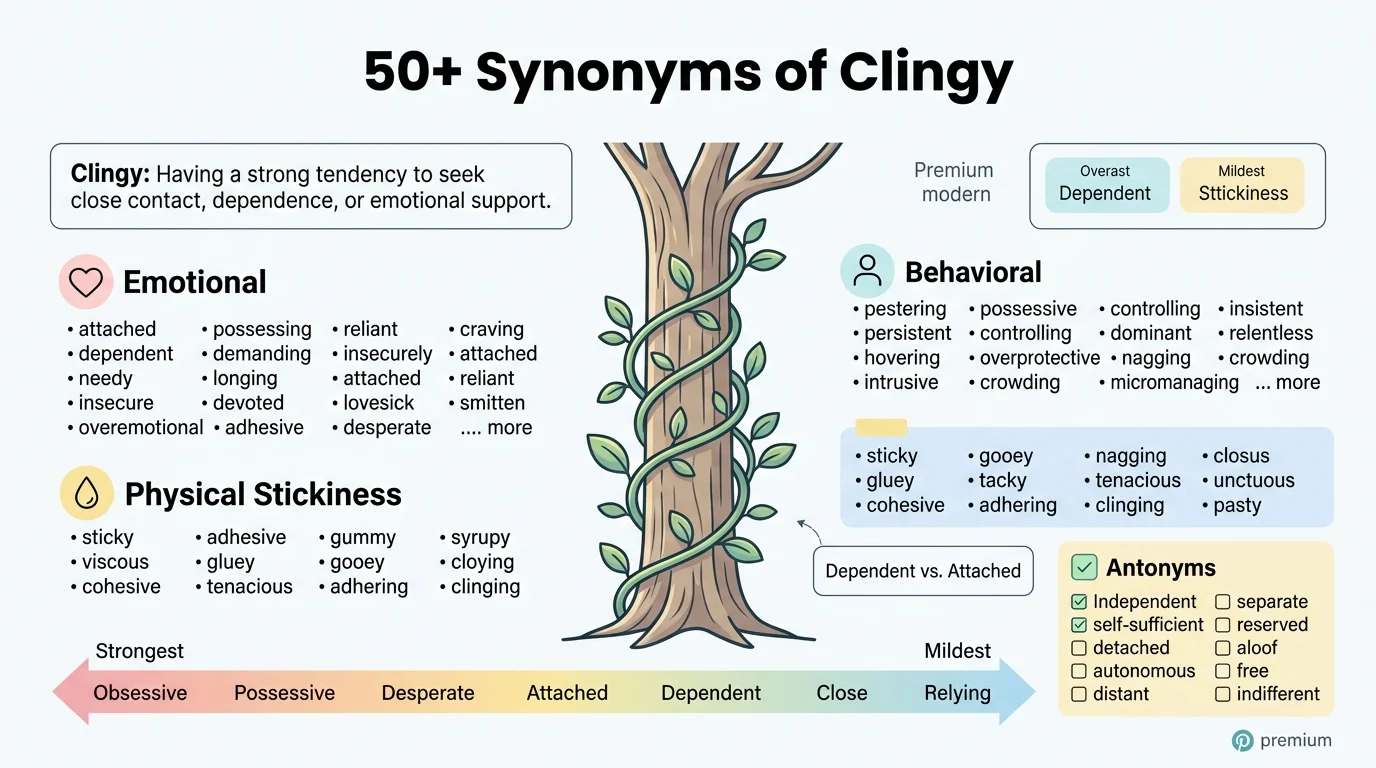
Have you ever needed to describe someone who holds on too tightly, whether emotionally or physically, but felt that “needy” or “attached” was too simple? You want to capture the suffocating dependence, the reluctance to let go, or the excessive need for reassurance, and the word “clingy” comes to mind. Choosing the right synonym for “clingy” can transform a vague complaint into a precise description of dependent behavior. This guide explores the best synonyms of clingy, explaining exactly which word to use and when.
Quick Ans: “Clingy” means overly dependent on someone, emotionally or physically, or tending to stick closely to things. For emotional dependence, choose needy or dependent. For physical stickiness, use adhesive or sticky. For a desperate attachment, use possessive or insecure. For a child’s behavior, use demanding or attention-seeking.
Meaning, Tone, and Context
Understanding the core meaning of “clingy” is the first step to using it effectively.
Simple Definition: Overly dependent on someone and unwilling to be apart; tending to stick closely to a surface or object.
Part of Speech: Adjective.
Overall Tone: Negative to neutral. It often implies criticism, but can sometimes be affectionate when describing children.
Formality Level: Informal to neutral. The word is most common in casual conversation and relationships.
Common Uses: Native English speakers use it to describe romantic partners, children, friends, and even clothing. For example, “He is too clingy,” or “The fabric is clingy.”
Word Forms: Related words include the verb cling, the noun clinginess, and the adverb clingily.
When and How to Use “Clingy”
“Clingy” is the perfect choice when you want to describe excessive dependence or attachment. Here are seven realistic examples.
Relationship: “Her boyfriend is too clingy and wants to spend every moment together.”
Parenting: “The toddler is very clingy today and won’t leave my side.”
Friendship: “I need some space; you are being a bit clingy.”
Fashion: “This dress is clingy and uncomfortable.”
Professional: (Rarely used) “The client was clingy and required constant reassurance.”
Personal: “I feel clingy when I am anxious.”
Social Media: “Is it clingy to text someone twice in a row?”
Best Synonyms of “Clingy”
No synonym is identical in every situation. Here is your guide to the best replacement for “clingy” based on your writing context.
For Emotional Dependence
Most Common: Needy means requiring a lot of attention and reassurance. “He is needy and calls me constantly.”
Clinical/Psychological: Dependent means relying on someone for support. “She is overly dependent on her partner.”
Possessive: Possessive means wanting to control or own someone. “His possessive behavior is concerning.”
Insecure: Insecure means lacking confidence and needing reassurance. “She is insecure and seeks constant validation.”
Clinging: Clinging means holding on tightly. “The clinging child would not let go.”
For Attention-Seeking Behavior
Demanding: Demanding means requiring much attention. “The demanding puppy followed her everywhere.”
Attention-seeking: Attention-seeking means behaving to get notice. “His attention-seeking behavior is exhausting.”
Clinging vine: Clinging vine is an idiom for a dependent person. “She is a clinging vine who cannot be alone.”
For Physical Stickiness
Sticky: Sticky means tending to adhere. “The sticky tape left residue.”
Adhesive: Adhesive means able to stick. “The adhesive bandage stayed on.”
Tacky: Tacky means slightly sticky. “The paint is still tacky.”
Viscous: Viscous means thick and sticky. “The viscous liquid was hard to pour.”
For Clothing and Fabric
Tight-fitting: Tight-fitting means close to the body. “The tight-fitting dress was elegant.”
Form-fitting: Form-fitting means conforming to the body. “The form-fitting suit looked sharp.”
Snug: Snug means fitting closely and comfortably. “The snug sweater kept her warm.”
When Not to Use “Clingy”
Using “clingy” can sound wrong or awkward in certain situations.
When You Mean “Affectionate”: “Clingy” is negative. “Affectionate” is positive.
Better Choice: Affectionate or loving. “The child is very affectionate.”
When You Mean “Close”: “Clingy” implies too much. “Close” is positive.
Better Choice: Close or devoted. “They are a close family.”
When It Sounds Too Harsh: In professional settings, “clingy” can be offensive.
Better Choice: Requiring support or needing guidance. “The new employee requires support.”
Words Commonly Confused With “Clingy”
| Word | Difference | When to Use | Example |
|---|---|---|---|
| Needy | Requires constant reassurance | Emotional dependence | “He is very needy.” |
| Dependent | Relies on someone for support | Clinical and formal | “She is financially dependent.” |
| Possessive | Wants to control or own | Relationships | “His possessive behavior is a problem.” |
| Insecure | Lacks confidence | Self-esteem contexts | “She is insecure about the relationship.” |
| Sticky | Tends to adhere | Physical objects | “The candy is sticky.” |
| Adhesive | Able to stick | Technical contexts | “The adhesive is strong.” |
Best Synonyms of “Clingy” by Context
| Context | Best Synonym | Why It Works | Example |
|---|---|---|---|
| Relationships | Needy | Common and relatable | “He is too needy.” |
| Clinical | Dependent | Formal and precise | “She is overly dependent.” |
| Relationships | Possessive | Specific to control | “His possessive behavior.” |
| Self-esteem | Insecure | Emotional and psychological | “She is insecure.” |
| Parenting | Demanding | Describes children | “The demanding toddler.” |
| Physical | Sticky | Common and clear | “The sticky label.” |
| Technical | Adhesive | Precise and professional | “The adhesive properties.” |
| Fashion | Tight-fitting | Descriptive and clear | “The tight-fitting dress.” |
How to Choose the Best Synonym of “Clingy”
Choosing the right word is a simple decision. Answer these questions.
What type of clinginess am I describing? For emotional dependence, use needy or dependent. And For control, use possessive. For attention, use demanding. For physical stickiness, use sticky or adhesive.
What is my audience? For a formal document, use dependent or requiring support. For a friend, use needy or clingy.
What is my purpose? Are you describing a person, a behavior, or an object? The correct synonym depends entirely on this.
What is the emotional strength? Possessive is stronger for control. Sticky is neutral for physical objects. Pick the one that matches your message.
Real Life Examples of “Clingy”
School: Basic: “The child is clingy.” Improved: “The child is needy and requires constant attention.”
College: Basic: “Her boyfriend is clingy.” Improved: “Her boyfriend is possessive and wants to know her every move.”
Workplace: Basic: “The new hire is clingy.” Improved: “The new hire requires support and guidance.”
Business: Basic: “The client is clingy.” Improved: “The client needs frequent reassurance.”
Email: Basic: “I don’t want to seem clingy.” Better: “I don’t want to seem needy.”
Conversation: Basic: “Stop being clingy.” Improved: “Give me some space; you are being possessive.”
Storytelling: Basic: “The vine was clingy.” Improved: “The adhesive vine wrapped around the tree.”
Top 10 Synonyms of “Clingy”
| Synonym | Simple Meaning | Best Used For | Example Sentence |
|---|---|---|---|
| Needy | Requiring constant reassurance | Relationships and emotional contexts | “He is too needy.” |
| Dependent | Relying on someone for support | Clinical and formal contexts | “She is financially dependent.” |
| Possessive | Wanting to control or own | Relationships and jealousy | “His possessive behavior is concerning.” |
| Insecure | Lacking confidence | Self-esteem and psychology | “She is insecure about the relationship.” |
| Demanding | Requiring much attention | Parenting and attention-seeking | “The demanding child.” |
| Attention-seeking | Behaving to get notice | Social and behavioral contexts | “His attention-seeking behavior.” |
| Sticky | Tending to adhere | Physical objects | “The sticky candy.” |
| Adhesive | Able to stick | Technical and industrial | “The adhesive tape.” |
| Tacky | Slightly sticky | Paint and surfaces | “The paint is still tacky.” |
| Tight-fitting | Close to the body | Fashion and clothing | “The tight-fitting dress.” |
Synonyms of “Clingy” by Usage
Professional vs. Personal Synonyms
In professional settings, choose dependent, requiring support, or needs guidance. With friends, use needy, clingy, or possessive.
Formal vs. Conversational Synonyms
For formal writing, use dependent, possessive, or adhesive. For casual conversations, use needy, clingy, or sticky.
Academic Synonyms
For research and essays, choose dependent for psychology, insecure for attachment theory, and adhesive for chemistry.
Professional and Business Synonyms
For maximum impact, choose requiring support for employees, needs reassurance for clients, and adhesive for products.
Creative and Literary Synonyms
To add emotion and imagery, choose clinging vine, possessive, or insecure. These words create atmosphere.
Slang or Modern Synonyms
In modern American slang, stage 5 clinger, cling-on, or Velcro are common. For example, “He is a stage 5 clinger.” These are casual and should be avoided in formal writing.
Strongest to Mildest Synonyms
Mild: affectionate, close, devoted
Moderate: needy, dependent, clingy
Strong: possessive, insecure, demanding
Very Strong: attention-seeking, clinging vine, stage 5 clinger
Emotional vs. Neutral Synonyms
Emotional Synonyms: Needy, insecure, possessive. These words hint at emotional distress. Use them when you want to evoke feeling.
Neutral Synonyms: Dependent, adhesive, sticky. These words simply communicate factual information.
Antonyms of “Clingy”
| Antonym | Meaning | Example Sentence |
|---|---|---|
| Independent | Not relying on others | “She is fiercely independent.” |
| Self-sufficient | Able to provide for oneself | “He is self-sufficient.” |
| Detached | Emotionally distant | “He is emotionally detached.” |
| Aloof | Distant and uninvolved | “She remained aloof.” |
| Autonomous | Acting independently | “The region is autonomous.” |
| Secure | Confident and not anxious | “She is secure in the relationship.” |
| Free | Not restricted | “He is free and unencumbered.” |
| Non-sticky | Not adhesive | “The surface is non-sticky.” |
| Loose | Not tight | “The loose clothing was comfortable.” |
| Distant | Far away emotionally | “He is distant.” |
| Self-reliant | Relying on oneself | “She is self-reliant.” |
| Unattached | Not emotionally involved | “He is unattached.” |
| Detached | Not connected | “She is detached.” |
| Slippery | Not adhesive | “The surface is slippery.” |
| Cool | Emotionally reserved | “He is cool toward her.” |
Comparison: “Clingy” vs Similar Words
Clingy vs. Needy
Main Difference: “Clingy” implies physical closeness. “Needy” implies emotional reassurance.
Which Is Stronger? “Needy” is often more emotionally intense.
Which Is More Formal? Both are informal.
When to Use Each: Use “clingy” for physical dependence. Use “needy” for emotional dependence.
Examples:
Clingy: “The child is clingy.”
Needy: “He is emotionally needy.”
Clingy vs. Dependent
Main Difference: “Clingy” is informal and often critical. “Dependent” is clinical and neutral.
Which Is Stronger? “Clingy” is more judgmental.
Which Is More Formal? “Dependent” is more formal.
When to Use Each: Use “dependent” in formal contexts. Use “clingy” in casual contexts.
Examples:
Clingy: “She is too clingy.”
Dependent: “She is emotionally dependent.”
Clingy vs. Possessive
Main Difference: “Clingy” is about closeness. “Possessive” is about control.
Which Is Stronger? “Possessive” is stronger and more negative.
Which Is More Formal? Both are informal.
When to Use Each: Use “possessive” for control. Use “clingy” for closeness.
Examples:
Clingy: “He is clingy.”
Possessive: “He is possessive and jealous.”
Clingy vs. Insecure
Main Difference: “Clingy” is about behavior. “Insecure” is about feelings.
Which Is Stronger? “Insecure” is more psychological.
Which Is More Formal? Both are informal.
When to Use Each: Use “insecure” for feelings. Use “clingy” for behavior.
Examples:
Clingy: “She is clingy.”
Insecure: “She is insecure.”
Clingy vs. Sticky
Main Difference: “Clingy” is for people. “Sticky” is for objects.
Which Is Stronger? They serve different purposes.
Which Is More Formal? Both are informal.
When to Use Each: Use “sticky” for objects. Use “clingy” for people.
Examples:
Clingy: “The child is clingy.”
Sticky: “The candy is sticky.”
Clingy vs. Adhesive
Main Difference: “Clingy” is for people or fabric. “Adhesive” is technical.
Which Is Stronger? “Adhesive” is more formal and technical.
Which Is More Formal? “Adhesive” is more formal.
When to Use Each: Use “adhesive” in technical contexts. Use “clingy” in everyday contexts.
Examples:
Clingy: “The dress is clingy.”
Adhesive: “The adhesive bandage.”
Common Phrases and Expressions with “Clingy”
Phrase: Clingy behavior
Meaning: Acting overly dependent.
Example Sentence: “His clingy behavior pushed her away.”
Phrase: Clingy vine
Meaning: A person who is overly dependent.
Example Sentence: “She is a clinging vine.”
Phrase: Stage 5 clinger
Meaning: An extremely clingy person.
Example Sentence: “He is a stage 5 clinger.”
Phrase: Clingy fabric
Meaning: Fabric that sticks to the body.
Example Sentence: “The clingy fabric was uncomfortable.”
Phrase: Clingy child
Meaning: A child who won’t leave a parent.
Example Sentence: “The clingy child cried when his mother left.”
Common Mistakes to Avoid
Mistake 1: Using “clingy” when you mean “affectionate”.
Incorrect: “She is clingy and loving.”
Better: “She is affectionate and loving.”
Why: “Clingy” is negative. “Affectionate” is positive.
Mistake 2: Using “clingy” in professional settings.
Incorrect: “The new employee is clingy.”
Better: “The new employee requires support.”
Why: “Clingy” is unprofessional.
Mistake 3: Using “clingy” for objects.
Incorrect: “The tape is clingy.”
Better: “The tape is sticky.”
Why: “Sticky” is the correct word for objects.
Mistake 4: Overusing “clingy” in casual conversation.
Incorrect: “My dog is so clingy.”
Better: “My dog is so affectionate.”
Why: “Affectionate” is more positive for pets.
Mistake 5: Using “clingy” when you mean “possessive”.
Incorrect: “He is clingy and controlling.”
Better: “He is possessive and controlling.”
Why: “Possessive” is the correct word for control.
Frequently Asked Questions
1. What are the best synonyms of “clingy”?
The best synonyms depend on your context. For emotional dependence, choose needy or dependent. And For control, use possessive. For attention, use demanding. For physical stickiness, use sticky.
2. What are the best formal synonyms of “clingy”?
The best formal synonyms are dependent, possessive, and adhesive. These words are suitable for academic papers, professional reports, and technical documents.
3. What are common informal synonyms of “clingy”?
For informal settings, use needy, stage 5 clinger, or Velcro. These alternatives sound more natural in everyday conversation.
4. What is another word for “clingy” in professional writing?
In professional writing, dependent or requiring support is an excellent choice. It conveys the meaning without being judgmental.
5. What is the difference between “clingy” and “needy”?
“Clingy” implies physical closeness and dependence. “Needy” implies emotional dependence and a need for reassurance. Use “clingy” for physical behavior and “needy” for emotional behavior.
6. What is the opposite of “clingy”?
The most direct opposites (antonyms) of clingy are independent, self-sufficient, and detached. These words describe someone who does not rely on others.
Conclusion
“Clingy” is a vivid and often critical word for describing excessive dependence, whether emotional or physical. The term is informal and widely understood, yet it can sound harsh in professional or sensitive contexts. The best choice among the synonyms of clingy depends entirely on your audience, tone, and purpose. Remember, no single synonym works perfectly in every situation. Your goal is to choose the word that communicates your message with the most clarity and impact. A practical tip for your vocabulary growth is to pay attention to how writers describe dependence and attachment and practice using different synonyms in your writing.










1 thought on “50+ Synonyms of Clingy: Meanings, Uses, Examples, and Best Alternatives 2026”