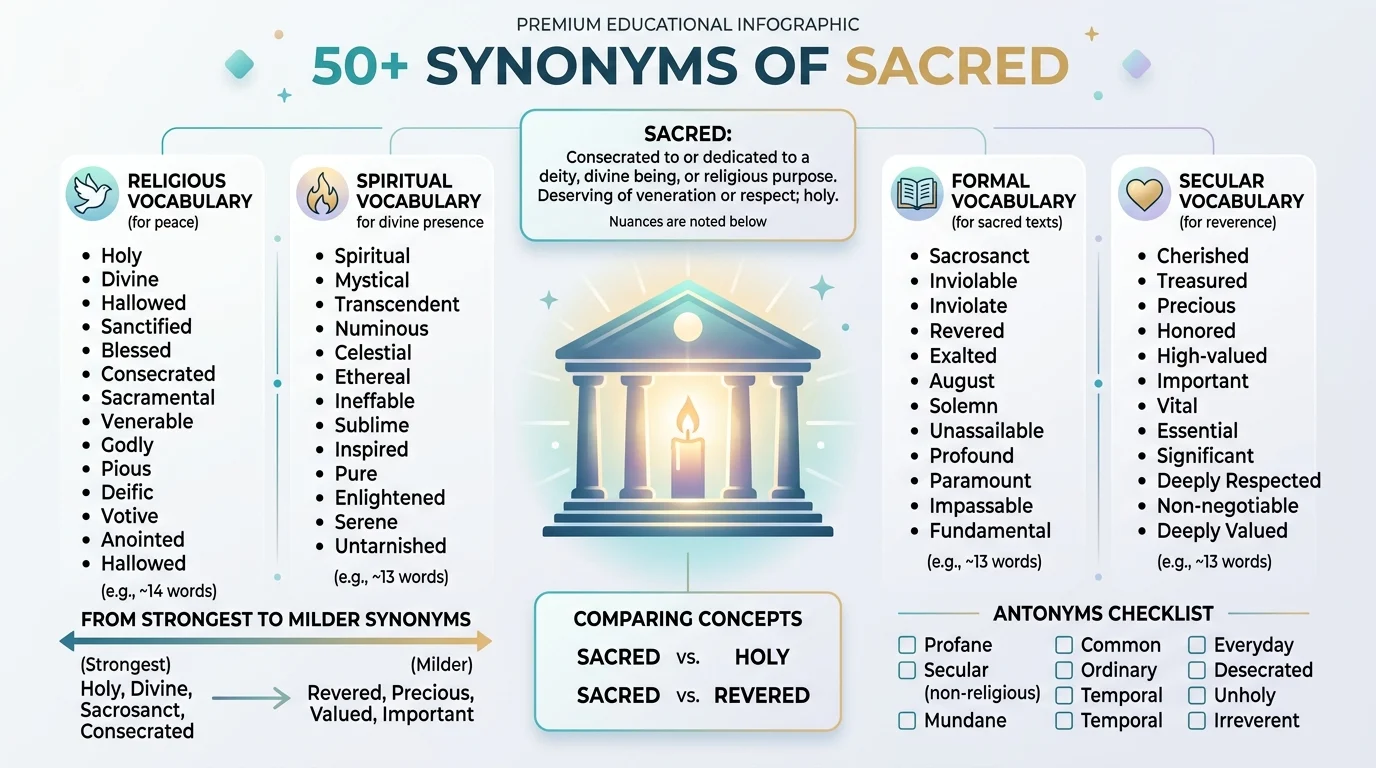
Have you ever needed to describe something holy, deeply revered, or set apart from the ordinary but felt that “holy” or “special” was too narrow or too vague? You want to capture the reverence, the spiritual significance, or the inviolable nature of something, and the word “sacred” comes to mind. Choosing the right synonym for “sacred” can transform a simple description into a powerful expression of devotion, respect, or sanctity. This guide explores the best synonyms of sacred, explaining exactly which word to use and when.
Quick Ans: “Sacred” means connected with God or a god, dedicated to a religious purpose, or regarded with great respect and reverence. For religious contexts, choose holy, divine, or blessed. For secular reverence, use hallowed, consecrated, or inviolable. For deep respect, use revered or venerable.
Meaning, Tone, and Context
Understanding the core meaning of “sacred” is the first step to using it effectively.
Simple Definition: Connected with God or a god; dedicated to a religious purpose; regarded with great respect and reverence; not to be violated or disregarded.
Part of Speech: Adjective.
Overall Tone: Positive and reverent. It indicates deep respect, spirituality, and inviolability.
Formality Level: Formal to neutral. The word is appropriate in religious, academic, and literary contexts.
Common Uses: Native English speakers use it to describe religious objects, places, texts, and rituals, as well as secular things held in high esteem. For example, “The temple is a sacred site,” or “They have a sacred duty to protect the land.”
Word Forms: Related words include the noun sacredness, the adverb sacredly, and the verb sacralize.
When and How to Use “Sacred”
“Sacred” is the perfect choice when you want to emphasize holiness, reverence, or inviolability. Here are seven realistic examples.
Religious: “The church considered a sacred place of worship.”
Cultural: “The land is sacred to the indigenous people.”
Personal: “Family dinners are a sacred tradition in our home.”
Professional: “The confidentiality agreement treated as sacred.”
Academic: “The study examines the role of sacred texts in society.”
Literary: “He made a sacred vow to protect her.”
Social Media: “Respecting sacred spaces is essential for cultural understanding.”
Best Synonyms of “Sacred”
No synonym is identical in every situation. Here is your guide to the best replacement for “sacred” based on your writing context.
For Religious and Spiritual Contexts
Most Common: Holy is the most direct synonym, meaning dedicated to God or a religious purpose. “The holy book is revered by millions.”
Divine: Divine means relating to God or a god. “The divine presence was felt in the room.”
Blessed: Blessed means made holy or consecrated. “The blessed water used in the ceremony.”
Consecrated: Consecrated means made or declared sacred. “The consecrated ground reserved for prayer.”
Hallowed: Hallowed means made holy or honored as sacred. “The hallowed halls of the university.”
Sanctified: Sanctified means set apart as holy. “The sanctified altar was the center of the church.”
For Secular Reverence and Respect
Revered: Revered means deeply respected. “The revered leader honored by all.”
Venerable: Venerable means accorded great respect. “The venerable tradition continues today.”
Inviolable: Inviolable means never to get broken or dishonored. “The right to privacy is inviolable.”
Untouchable: Untouchable means not to interfered with. “The policy considered untouchable.”
Sacrosanct: Sacrosanct means regarded as too important to be change. “The weekend is sacrosanct in our family.”
For Dedication and Devotion
Devoted: Devoted means very loving or loyal. “She devoted to her faith.”
Dedicated: Dedicated means devoted to a task or purpose. “The dedicated shrine attracts pilgrims.”
Cherished: Cherished means protected and cared for lovingly. “The cherished memories remain.”
When Not to Use “Sacred”
Using “sacred” can sound wrong or awkward in certain situations.
When You Mean “Special”: “Sacred” implies reverence, not just importance.
Better Choice: Special or important. “This is a special occasion.”
When You Mean “Religious”: “Sacred” is broader than “religious.”
Better Choice: Religious. “The religious ceremony was beautiful.”
When It Sounds Too Formal: In casual conversation, “sacred” can sound stiff.
Better Choice: Special or important. “This is my special spot.”
Words Commonly Confused With “Sacred”
| Word | Difference | When to Use | Example |
|---|---|---|---|
| Holy | Dedicated to God or a religious purpose | Religious contexts | “The holy ground is respected.” |
| Divine | Relating to God or a god | Spiritual and literary | “The divine light shone.” |
| Blessed | Made holy or consecrated | Religious and ceremonial | “The blessed water was used.” |
| Hallowed | Made holy or honored | Literary and formal | “The hallowed halls.” |
| Consecrated | Made or declared sacred | Religious and formal | “The consecrated ground.” |
| Sacrosanct | Too important to be changed | Secular reverence | “The tradition is sacrosanct.” |
Best Synonyms of “Sacred” by Context
| Context | Best Synonym | Why It Works | Example |
|---|---|---|---|
| Religious writing | Holy | Direct and clear | “The holy site is visited by pilgrims.” |
| Spiritual writing | Divine | Elevated and spiritual | “The divine presence filled the room.” |
| Formal writing | Consecrated | Formal and precise | “The consecrated ground.” |
| Literary writing | Hallowed | Poetic and reverent | “The hallowed halls.” |
| Secular reverence | Sacrosanct | Inviolable and respected | “The weekend is sacrosanct.” |
| Deep respect | Revered | Respectful and formal | “The revered leader.” |
| Cultural context | Venerable | Respected and traditional | “The venerable tradition.” |
How to Choose the Best Synonym of “Sacred”
Choosing the right word is a simple decision. Answer these questions.
What type of sacred am I describing? For religious, use holy or divine. And For secular reverence, use sacrosanct or inviolable. For deep respect, use revered or venerable.
What is my audience? For a religious text, use holy or blessed. And For a formal report, use consecrated or inviolable. For a friend, use special or important.
What is my purpose? Are you describing a place, an object, or a concept? The correct synonym depends entirely on this.
What is the emotional strength? Sacrosanct and inviolable are stronger for inviolability. Special is milder. Pick the one that matches your message.
Real Life Examples of “Sacred”
School: Basic: “The flag is sacred.” Improved: “The flag is revered as a symbol of freedom.”
College: Basic: “The library is sacred.” Improved: “The library is a hallowed place of learning.”
Workplace: Basic: “The meeting time is sacred.” Improved: “The meeting time is sacrosanct.”
Business: Basic: “The contract is sacred.” Improved: “The contract is inviolable.”
Email: Basic: “This is a sacred tradition.” Improved: “This is a cherished tradition.”
Conversation: Basic: “That spot is sacred to me.” Improved: “That spot is special to me.”
Storytelling: Basic: “The temple was sacred.” Improved: “The temple consecrated ground.”
Top 10 Synonyms of “Sacred”
| Synonym | Simple Meaning | Best Used For | Example Sentence |
|---|---|---|---|
| Holy | Dedicated to God or a religious purpose | Religious contexts | “The holy book is revered.” |
| Divine | Relating to God or a god | Spiritual and literary | “The divine light shone.” |
| Blessed | Made holy or consecrated | Religious and ceremonial | “The blessed water was used.” |
| Consecrated | Made or declared sacred | Religious and formal | “The consecrated ground was reserved.” |
| Hallowed | Made holy or honored | Literary and formal | “The hallowed halls of learning.” |
| Sacrosanct | Too important to be changed | Secular reverence | “The tradition is sacrosanct.” |
| Inviolable | Never to be broken or dishonored | Legal and formal | “The right is inviolable.” |
| Revered | Deeply respected | General and formal | “The revered leader.” |
| Venerable | Accorded great respect | Traditional and formal | “The venerable institution.” |
| Cherished | Protected and cared for lovingly | Personal and emotional | “The cherished memories.” |
Synonyms of “Sacred” by Usage
Professional vs. Personal Synonyms
In the workplace, choose inviolable, consecrated, or sacrosanct. With friends, use special, cherished, or important.
Formal vs. Conversational Synonyms
For formal writing, use holy, divine, consecrated, or inviolable. For casual conversations, use special, important, or cherished.
Academic Synonyms
For research and essays, choose sacred for religious studies, divine for theology, and inviolable for legal contexts.
Professional and Business Synonyms
For maximum impact, choose inviolable for contracts, sacrosanct for policies, and consecrated for formal declarations.
Creative and Literary Synonyms
To add emotion and imagery, choose hallowed, divine, or revered. These words create atmosphere.
Slang or Modern Synonyms
There is no direct slang synonym for “sacred.” In modern usage, untouchable or off-limits can convey similar meanings in casual contexts.
Strongest to Mildest Synonyms
Mild: special, important, cherished
Moderate: sacred, holy, revered
Strong: divine, blessed, consecrated
Very Strong: hallowed, sacrosanct, inviolable
Emotional vs. Neutral Synonyms
Emotional Synonyms: Revered, cherished, divine. These words hint at deep respect and love. Use them when you want to evoke feeling.
Neutral Synonyms: Sacred, consecrated, inviolable. These words simply communicate factual information.
Antonyms of “Sacred”
| Antonym | Meaning | Example Sentence |
|---|---|---|
| Profane | Not relating to religion; secular | “The profane music was not allowed in the temple.” |
| Secular | Not connected with religion | “The secular ceremony was held at city hall.” |
| Unholy | Not holy; wicked | “The unholy alliance was condemned.” |
| Desecrated | Treated with disrespect | “The desecrated shrine was restored.” |
| Ordinary | Not special or sacred | “The ordinary object had no significance.” |
| Common | Not sacred; everyday | “The common area was open to all.” |
| Worldly | Concerned with material things | “He rejected worldly possessions.” |
| Mundane | Lacking interest or excitement | “The mundane tasks filled her day.” |
| Blasphemous | Showing disrespect for God | “The blasphemous remarks offended many.” |
| Impious | Lacking reverence | “The impious behavior was shocking.” |
| Sacrilegious | Violating something sacred | “The sacrilegious act was condemned.” |
| Unhallowed | Not made holy | “The unhallowed ground was avoided.” |
| Temporal | Relating to worldly affairs | “The temporal power of the king.” |
| Material | Concerned with physical things | “He focused on material wealth.” |
| Corporeal | Relating to the body | “The corporeal world is temporary.” |
Comparison: “Sacred” vs Similar Words
Sacred vs. Holy
Main Difference: “Holy” is specifically religious. “Sacred” can be religious or secular.
Which Is Stronger? They are similar. “Holy” is more specific to religion.
Which Is More Formal? Both are formal.
When to Use Each: Use “holy” for religious contexts. Use “sacred” for broader reverence.
Examples:
Sacred: “The land is sacred to the crew.”
Holy: “The holy book is revered.”
Sacred vs. Divine
Main Difference: “Divine” means relating to God. “Sacred” means dedicated or revered.
Which Is Stronger? “Divine” is stronger for spiritual power.
Which Is More Formal? Both are formal.
When to Use Each: Use “divine” for God or gods. Use “sacred” for dedicated things.
Examples:
Sacred: “The sacred ritual was performed.”
Divine: “The divine presence was felt.”
Sacred vs. Hallowed
Main Difference: “Hallowed” is literary and means made holy. “Sacred” is more general.
Which Is Stronger? “Hallowed” is more poetic.
Which Is More Formal? “Hallowed” is more formal.
When to Use Each: Use “hallowed” in literary contexts. Use “sacred” in general contexts.
Examples:
Sacred: “The sacred site is protected.”
Hallowed: “The hallowed halls of learning.”
Sacred vs. Sacrosanct
Main Difference: “Sacrosanct” means too important to be changed. “Sacred” means revered.
Which Is Stronger? “Sacrosanct” is stronger for inviolability.
Which Is More Formal? Both are formal.
When to Use Each: Use “sacrosanct” for traditions and rules. Use “sacred” for religious and revered things.
Examples:
Sacred: “The sacred text is studied.”
Sacrosanct: “The tradition is sacrosanct.”
Sacred vs. Inviolable
Main Difference: “Inviolable” means never to be broken. “Sacred” means revered.
Which Is Stronger? “Inviolable” is stronger for rules and rights.
Which Is More Formal? “Inviolable” is more legal and formal.
When to Use Each: Use “inviolable” for rights and laws. Use “sacred” for religious and revered things.
Examples:
Sacred: “The sacred vow was made.”
Inviolable: “The right is inviolable.”
Sacred vs. Revered
Main Difference: “Revered” means deeply respected. “Sacred” means holy or dedicated.
Which Is Stronger? “Sacred” is stronger for holiness.
Which Is More Formal? Both are formal.
When to Use Each: Use “revered” for people. Use “sacred” for objects and places.
Examples:
Sacred: “The sacred ground was protected.”
Revered: “The revered leader was honored.”
Common Phrases and Expressions with “Sacred”
Phrase: Sacred ground
Meaning: Holy or revered land.
Example Sentence: “The battlefield is considered sacred ground.”
Phrase: Sacred text
Meaning: A religious writing.
Example Sentence: “The sacred text is studied by scholars.”
Phrase: Sacred cow
Meaning: A belief or custom that is not questioned.
Example Sentence: “The policy is a sacred cow in the department.”
Phrase: Sacred duty
Meaning: A solemn responsibility.
Example Sentence: “Protecting the environment is a sacred duty.”
Phrase: Sacred vow
Meaning: A solemn promise.
Example Sentence: “They made a sacred vow to each other.”
Phrase: Sacred tradition
Meaning: A revered custom.
Example Sentence: “The sacred tradition is passed down through generations.”
Common Mistakes to Avoid
Mistake 1: Using “sacred” when you mean “scared”.
Incorrect: “I am sacred of the dark.”
Better: “I am scared of the dark.”
Why: “Sacred” means holy. “Scared” means afraid.
Mistake 2: Using “sacred” when you mean “special”.
Incorrect: “This is a sacred day for me.”
Better: “This is a special day for me.”
Why: “Sacred” implies reverence. “Special” is more general.
Mistake 3: Using “sacred” in casual conversation.
Incorrect: “My phone is sacred.”
Better: “My phone is important to me.”
Why: “Sacred” is too formal for casual contexts.
Mistake 4: Using “sacred” when you mean “religious”.
Incorrect: “The sacred ceremony was held.”
Better: “The religious ceremony was held.”
Why: “Religious” is more specific.
Mistake 5: Using “sacred” when you mean “sacrosanct”.
Incorrect: “The rule is sacred.”
Better: “The rule is sacrosanct.”
Why: “Sacrosanct” is more specific for rules and traditions.
Frequently Asked Questions
1. What are the best synonyms of “sacred”?
The best synonyms depend on your context. For religious contexts, choose holy or divine. And For secular reverence, use sacrosanct or inviolable. For deep respect, use revered or venerable.
2. What are the best formal synonyms of “sacred”?
The best formal synonyms are consecrated, hallowed, and inviolable. These words are suitable for academic papers, professional reports, and legal documents.
3. What are common informal synonyms of “sacred”?
For informal settings, use special, important, or cherished. These alternatives sound more natural in everyday conversation.
4. What is another word for “sacred” in professional writing?
In professional writing, inviolable is an excellent choice for rules and rights. Consecrated is also strong for formal declarations.
5. What is the difference between “sacred” and “holy”?
“Holy” is specifically religious. “Sacred” can be religious or secular. Use “holy” for God and religion. Use “sacred” for anything deeply revered.
6. What is the opposite of “sacred”?
The most direct opposites (antonyms) of sacred are profane, secular, and unholy. These words describe things that are not sacred.
Conclusion
“Sacred” is a powerful and reverent word for describing holiness, deep respect, and inviolability. The term is formal and widely accepted in religious, academic, and literary contexts, yet it can sound too formal for casual conversation or too general for specific types of reverence. The best choice among the synonyms of sacred depends entirely on your audience, tone, and purpose. Remember, no single synonym works perfectly in every situation. Your goal is to choose the word that communicates your message with the most clarity and impact. A practical tip for your vocabulary growth is to pay attention to how writers express reverence and practice using different synonyms in your writing.









