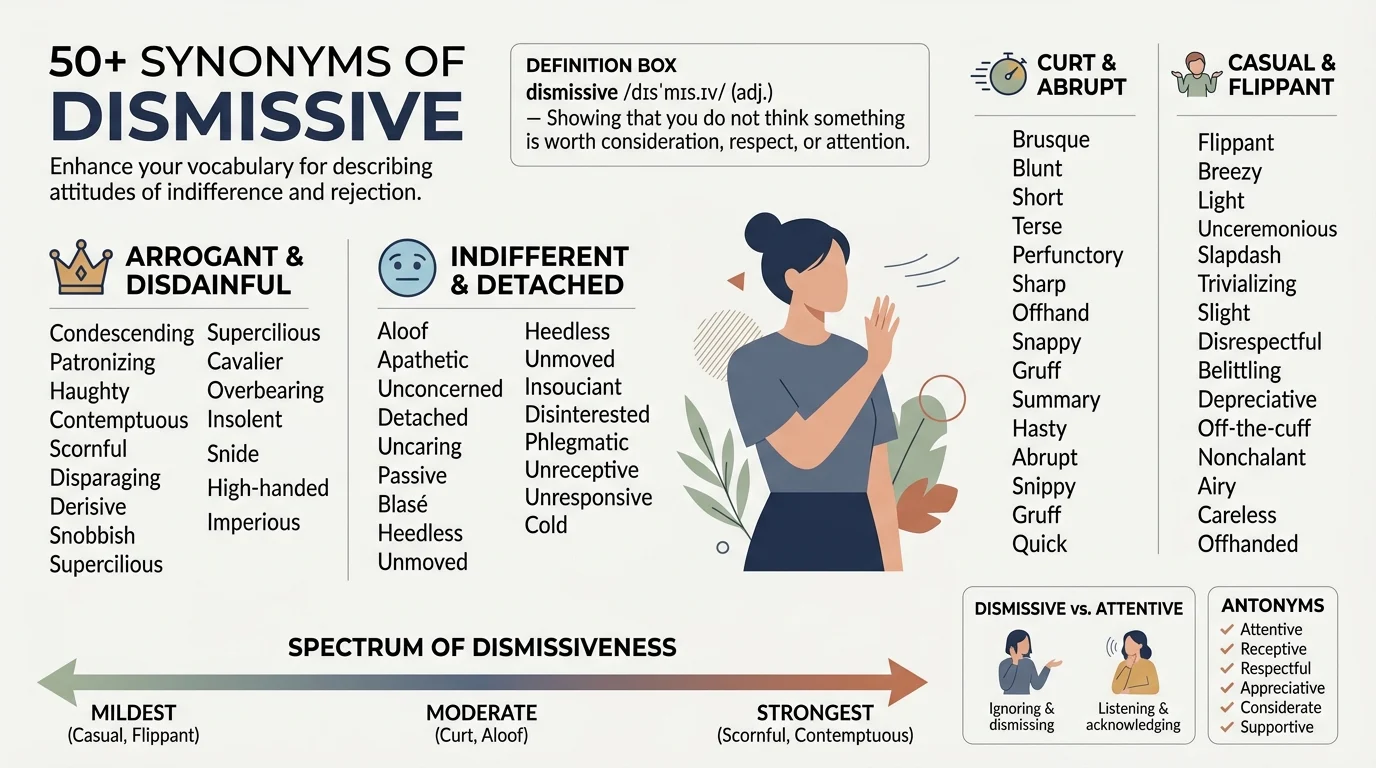
Have you ever needed to describe an attitude that brushes things off, treats them as unimportant, or refuses to engage? You want to capture that cold, uncaring, or superior tone, and the word “dismissive” comes to mind. Choosing the right synonym for “dismissive” can transform a vague complaint into a precise description of arrogance, indifference, or contempt. This guide explores the best synonyms of dismissive, explaining exactly which word to use and when.
Quick Ans: “Dismissive” means showing that something or someone is unworthy of attention or consideration. For formal writing, choose contemptuous or disdainful. For casual conversation, use blowing off or brushing off. For professional contexts, use curt or offhand. For emotional writing, use scornful or derisive.
Meaning, Tone, and Context
Understanding the core meaning of “dismissive” is the first step to using it effectively.
Simple Definition: Showing that you do not think someone or something is important, valuable, or worthy of attention.
Part of Speech: Adjective.
Overall Tone: Negative. It indicates disrespect, indifference, or a sense of superiority.
Formality Level: Neutral to formal. The word is appropriate in most contexts.
Common Uses: Native English speakers use it to describe tones, gestures, comments, and attitudes. For example, “She gave a dismissive wave,” or “He was dismissive of my concerns.”
Word Forms: Related words include the verb dismiss, the noun dismissiveness, and the adverb dismissively.
When and How to Use “Dismissive”
“Dismissive” is the perfect choice when you want to describe an attitude that belittles or ignores. Here are seven realistic examples.
Professional: “The manager was dismissive of the team’s suggestions.”
Academic: “The professor was dismissive of alternative theories.”
Workplace: “His dismissive tone offended his colleagues.”
Personal: “She was dismissive of my feelings.”
Email: “I did not mean to sound dismissive in my last message.”
Resume: (Avoid in resumes) Use “decisive” or “efficient” instead.
Social Media: “Being dismissive of others’ experiences is never okay.”
Best Synonyms of “Dismissive”
No synonym is identical in every situation. Here is your guide to the best replacement for “dismissive” based on your writing context.
For Arrogant or Superior Attitudes
Most Formal: Contemptuous means showing contempt. “He gave a contemptuous laugh.”
Disdainful: Disdainful means showing scorn. “She was disdainful of the offer.”
Scornful: Scornful means feeling or expressing contempt. “His scornful remark hurt her.”
Supercilious: Supercilious means behaving as if superior. “The supercilious waiter ignored us.”
For Indifferent or Uncaring Attitudes
Indifferent: Indifferent means having no interest. “He was indifferent to the outcome.”
Unconcerned: Unconcerned means not worried or interested. “She seemed unconcerned about the delay.”
Nonchalant: Nonchalant means casually calm and indifferent. “He gave a nonchalant shrug.”
Apathetic: Apathetic means showing no interest. “The audience was apathetic.”
For Curt or Brief Responses
Curt: Curt means rudely brief. “She gave a curt reply.”
Offhand: Offhand means casual and unthinking. “He made an offhand comment.”
Brusque: Brusque means abrupt or blunt. “His brusque manner offended many.”
Blunt: Blunt means direct and unceremonious. “She was blunt about his chances.”
For Casual and Idiomatic Expressions
Blowing off: Blowing off means ignoring or treating as unimportant. “He was blowing off my questions.”
Brushing off: Brushing off means dismissing lightly. “She brushed off my concerns.”
Pooh-poohing: Pooh-poohing means dismissing as unimportant. “He pooh-poohed the idea.”
Writing off: Writing off means dismissing as worthless. “They wrote off the project as a failure.”
When Not to Use “Dismissive”
Using “dismissive” can sound wrong or awkward in certain situations.
When You Mean “Decisive”: “Dismissive” is negative. “Decisive” is positive.
Better Choice: Decisive or firm. “She was decisive in her response.”
When You Mean “Brief”: “Dismissive” implies rudeness. “Brief” is neutral.
Better Choice: Brief or concise. “He gave a brief answer.”
When It Sounds Too Strong: For mild cases, “dismissive” can be too harsh.
Better Choice: Curt or offhand. “She was a bit curt.”
Words Commonly Confused With “Dismissive”
| Word | Difference | When to Use | Example |
|---|---|---|---|
| Contemptuous | Showing contempt | Strong dislike | “A contemptuous look.” |
| Disdainful | Showing scorn | Superior attitude | “A disdainful sniff.” |
| Indifferent | Having no interest | Lack of concern | “He was indifferent.” |
| Curt | Rudely brief | Short responses | “A curt reply.” |
| Offhand | Casual and unthinking | Casual remarks | “An offhand comment.” |
| Brusque | Abrupt and blunt | Harsh manner | “A brusque tone.” |
Best Synonyms of “Dismissive” by Context
| Context | Best Synonym | Why It Works | Example |
|---|---|---|---|
| Formal writing | Contemptuous | Formal and strong | “A contemptuous gesture.” |
| Professional | Curt | Professional and clear | “A curt response.” |
| Academic | Disdainful | Formal and critical | “A disdainful review.” |
| Casual conversation | Brushing off | Simple and natural | “She brushed off my concerns.” |
| Emotional writing | Scornful | Strong emotion | “A scornful laugh.” |
| Workplace | Offhand | Casual but dismissive | “An offhand remark.” |
| Storytelling | Supercilious | Evocative and descriptive | “A supercilious smile.” |
How to Choose the Best Synonym of “Dismissive”
Choosing the right word is a simple decision. Answer these questions.
What type of dismissive attitude am I describing? For arrogant, use contemptuous or disdainful. And For indifferent, use indifferent or apathetic. For curt, use curt or brusque. For casual, use brushing off or blowing off.
What is my audience? For a formal report, use contemptuous or disdainful. For a friend, use brushing off or blowing off.
What is my purpose? Are you criticizing, observing, or warning? The correct synonym depends entirely on this.
What is the emotional strength? Contemptuous is strong. Offhand is milder. Pick the one that matches your message.
Real Life Examples of “Dismissive”
School: Basic: “The teacher was dismissive.” Improved: “The teacher was disdainful of the question.”
College: Basic: “The professor was dismissive.” Improved: “The professor was contemptuous of the alternative theory.”
Workplace: Basic: “The manager was dismissive.” Improved: “The manager gave a curt reply.”
Business: Basic: “The client was dismissive.” Improved: “The client was indifferent to the proposal.”
Email: Basic: “Sorry for being dismissive.” Improved: “Sorry for the offhand response.”
Conversation: Basic: “He was dismissive.” Improved: “He brushed off my concerns.”
Storytelling: Basic: “She was dismissive.” Improved: “She gave a supercilious smile.”
Top 10 Synonyms of “Dismissive”
| Synonym | Simple Meaning | Best Used For | Example Sentence |
|---|---|---|---|
| Contemptuous | Showing contempt | Formal and strong | “A contemptuous gesture.” |
| Disdainful | Showing scorn | Formal and critical | “A disdainful review.” |
| Scornful | Feeling or expressing contempt | Emotional and literary | “A scornful laugh.” |
| Indifferent | Having no interest | General and neutral | “He was indifferent.” |
| Curt | Rudely brief | Professional and clear | “A curt reply.” |
| Offhand | Casual and unthinking | Casual and professional | “An offhand remark.” |
| Brusque | Abrupt and blunt | Harsh manner | “A brusque tone.” |
| Apathetic | Showing no interest | General and formal | “The audience was apathetic.” |
| Supercilious | Behaving as if superior | Literary and descriptive | “A supercilious smile.” |
| Nonchalant | Casually calm and indifferent | Casual and descriptive | “A nonchalant shrug.” |
Synonyms of “Dismissive” by Usage
Professional vs. Personal Synonyms
In the workplace, choose curt, offhand, or brusque. With friends, use brushing off, blowing off, or indifferent.
Formal vs. Conversational Synonyms
For formal writing, use contemptuous, disdainful, or supercilious. For casual conversations, use brushing off, blowing off, or nonchalant.
Academic Synonyms
For research and essays, choose disdainful for critical reviews, contemptuous for strong dismissal, and indifferent for neutral observation.
Professional and Business Synonyms
For maximum impact, choose curt for replies, offhand for remarks, and brusque for manner.
Creative and Literary Synonyms
To add emotion and imagery, choose scornful, supercilious, or contemptuous. These words create atmosphere.
Slang or Modern Synonyms
In modern American slang, blowing off, brushing off, or shading are common. For example, “She was totally shading me.” These are casual and should be avoided in formal writing.
Strongest to Mildest Synonyms
Mild: offhand, curt, nonchalant
Moderate: dismissive, indifferent, apathetic
Strong: disdainful, brusque, scornful
Very Strong: contemptuous, supercilious, derisive
Emotional vs. Neutral Synonyms
Emotional Synonyms: Contemptuous, scornful, disdainful. These words hint at strong negative emotion. Use them when you want to evoke feeling.
Neutral Synonyms: Dismissive, indifferent, curt. These words communicate factual information.
Antonyms of “Dismissive”
| Antonym | Meaning | Example Sentence |
|---|---|---|
| Attentive | Paying close attention | “She was attentive to his needs.” |
| Considerate | Showing careful thought | “He was considerate of her feelings.” |
| Respectful | Showing respect | “The students were respectful.” |
| Engaged | Involved and interested | “The audience was engaged.” |
| Interested | Showing curiosity | “She was interested in the topic.” |
| Concerned | Worried and caring | “He was concerned about the delay.” |
| Thoughtful | Showing consideration | “Her thoughtful response was appreciated.” |
| Mindful | Conscious and aware | “He was mindful of the impact.” |
| Receptive | Willing to consider | “She was receptive to feedback.” |
| Open-minded | Willing to consider new ideas | “He is open-minded.” |
| Supportive | Providing encouragement | “The team was supportive.” |
| Sympathetic | Showing sympathy | “She was sympathetic to his plight.” |
| Warm | Friendly and kind | “Her warm welcome was appreciated.” |
| Caring | Showing concern | “He was caring and kind.” |
| Solicitous | Showing interest or concern | “She was solicitous of his comfort.” |
Comparison: “Dismissive” vs Similar Words
Dismissive vs. Contemptuous
Main Difference: “Contemptuous” is stronger and shows active contempt. “Dismissive” is about ignoring.
Which Is Stronger? “Contemptuous” is stronger.
Which Is More Formal? Both are formal.
When to Use Each: Use “contemptuous” for strong dislike. Use “dismissive” for ignoring.
Examples:
Dismissive: “She was dismissive of his ideas.”
Contemptuous: “He gave a contemptuous laugh.”
Dismissive vs. Indifferent
Main Difference: “Indifferent” is lack of interest. “Dismissive” is actively ignoring.
Which Is Stronger? “Dismissive” is stronger for active dismissal.
Which Is More Formal? Both are formal.
When to Use Each: Use “indifferent” for neutrality. Use “dismissive” for active rejection.
Examples:
Dismissive: “He was dismissive of the proposal.”
Indifferent: “He was indifferent to the outcome.”
Dismissive vs. Curt
Main Difference: “Curt” is rudely brief. “Dismissive” is about attitude.
Which Is Stronger? “Dismissive” is broader.
Which Is More Formal? Both are formal.
When to Use Each: Use “curt” for responses. Use “dismissive” for attitudes.
Examples:
Dismissive: “She was dismissive of my concerns.”
Curt: “She gave a curt reply.”
Dismissive vs. Offhand
Main Difference: “Offhand” is casual and unthinking. “Dismissive” is deliberate.
Which Is Stronger? “Dismissive” is stronger.
Which Is More Formal? Both are formal.
When to Use Each: Use “offhand” for casual remarks. Use “dismissive” for deliberate ignoring.
Examples:
Dismissive: “He was dismissive of her feelings.”
Offhand: “He made an offhand comment.”
Dismissive vs. Scornful
Main Difference: “Scornful” is stronger and more emotional. “Dismissive” is about ignoring.
Which Is Stronger? “Scornful” is stronger.
Which Is More Formal? Both are formal.
When to Use Each: Use “scornful” for strong emotion. Use “dismissive” for ignoring.
Examples:
Dismissive: “She was dismissive of the idea.”
Scornful: “She gave a scornful laugh.”
Dismissive vs. Apathetic
Main Difference: “Apathetic” is lack of interest. “Dismissive” is active rejection.
Which Is Stronger? “Dismissive” is stronger for rejection.
Which Is More Formal? Both are formal.
When to Use Each: Use “apathetic” for lack of interest. Use “dismissive” for active ignoring.
Examples:
Dismissive: “He was dismissive of the warning.”
Apathetic: “The audience was apathetic.”
Common Phrases and Expressions with “Dismissive”
Phrase: Dismissive wave
Meaning: A hand gesture showing something is unimportant.
Example Sentence: “She gave a dismissive wave.”
Phrase: Dismissive tone
Meaning: A tone that belittles.
Example Sentence: “His dismissive tone offended her.”
Phrase: Dismissive attitude
Meaning: An attitude of superiority.
Example Sentence: “His dismissive attitude alienated the team.”
Phrase: Dismissive of
Meaning: Showing disregard for.
Example Sentence: “He was dismissive of her concerns.”
Phrase: Dismissive remark
Meaning: A comment that belittles.
Example Sentence: “The dismissive remark hurt his feelings.”
Common Mistakes to Avoid
Mistake 1: Using “dismissive” when you mean “decisive”.
Incorrect: “She was dismissive in her leadership.”
Better: “She was decisive in her leadership.”
Why: “Dismissive” is negative. “Decisive” is positive.
Mistake 2: Using “dismissive” when you mean “brief”.
Incorrect: “He gave a dismissive answer.”
Better: “He gave a brief answer.”
Why: “Brief” is neutral.
Mistake 3: Overusing “dismissive” in casual conversation.
Incorrect: “She was dismissive.”
Better: “She brushed me off.”
Why: “Brushed me off” is more natural.
Mistake 4: Using “dismissive” when you mean “indifferent”.
Incorrect: “He was dismissive to the outcome.”
Better: “He was indifferent to the outcome.”
Why: “Indifferent” is for lack of interest.
Mistake 5: Using “dismissive” when you mean “contemptuous”.
Incorrect: “She was dismissive of the offer.”
Better: “She was contemptuous of the offer.”
Why: “Contemptuous” is stronger.
Frequently Asked Questions
1. What are the best synonyms of “dismissive”?
The best synonyms depend on your context. For arrogant attitudes, choose contemptuous or disdainful. And For indifference, use indifferent or apathetic. For curt responses, use curt or brusque.
2. What are the best formal synonyms of “dismissive”?
The best formal synonyms are contemptuous, disdainful, and supercilious. These words are suitable for academic papers, professional reports, and business communications.
3. What are common informal synonyms of “dismissive”?
For informal settings, use brushing off, blowing off, or shading. These alternatives sound more natural in everyday conversation.
4. What is another word for “dismissive” in professional writing?
In professional writing, curt is an excellent choice. It conveys rudely brief. Disdainful is also strong for critical contexts.
5. What is the difference between “dismissive” and “contemptuous”?
“Dismissive” means ignoring or treating as unimportant. “Contemptuous” means showing active contempt. Use “contemptuous” for stronger dislike.
6. What is the opposite of “dismissive”?
The most direct opposites (antonyms) of dismissive are attentive, considerate, and respectful. These words describe a caring and engaged attitude.
Conclusion
“Dismissive” is a useful and expressive word for describing attitudes that belittle, ignore, or reject. The term is neutral and widely accepted in most contexts, yet it can sound too mild for strong contempt or too formal for casual conversation. The best choice among the synonyms of dismissive depends entirely on your audience, tone, and purpose. Remember, no single synonym works perfectly in every situation. Your goal is to choose the word that communicates your message with the most clarity and impact. A practical tip for your vocabulary growth is to pay attention to how writers describe attitudes and practice using different synonyms in your writing.









