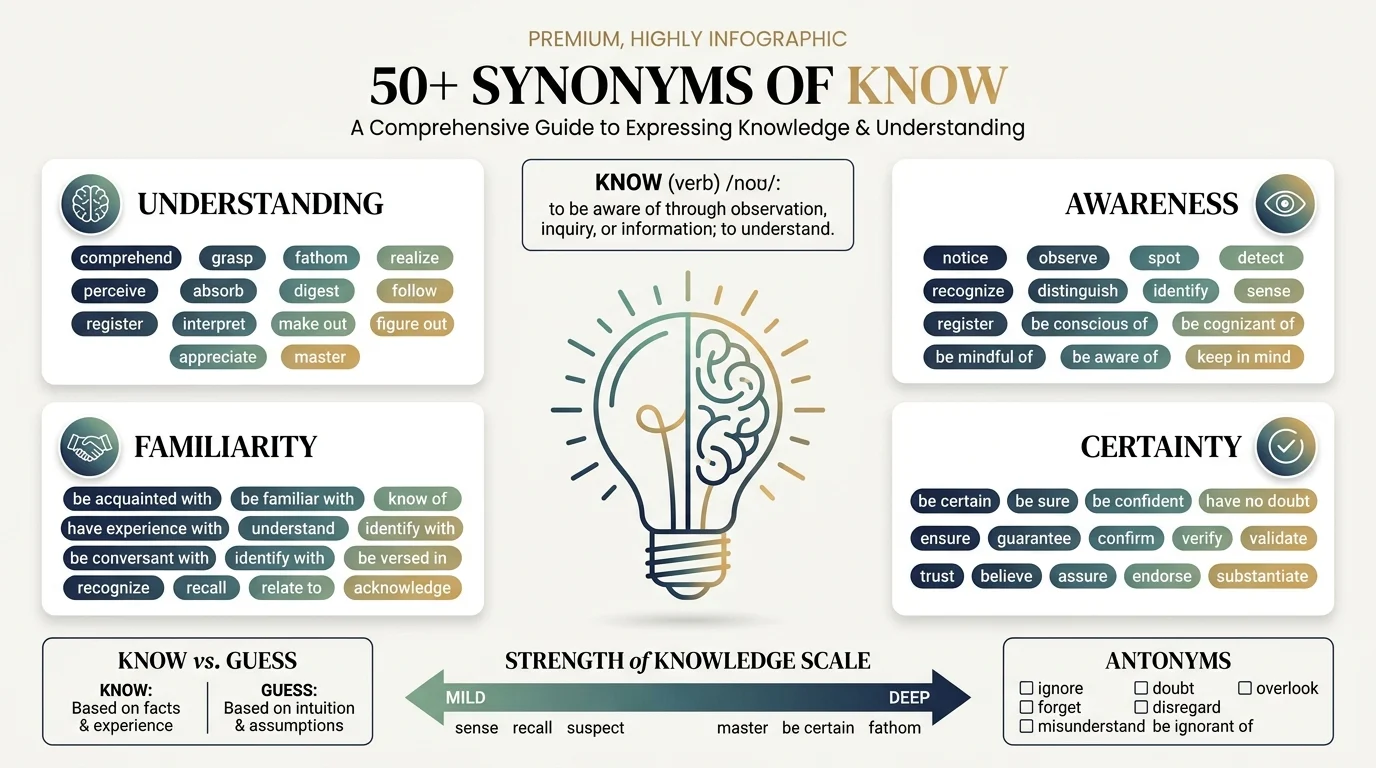
Have you ever needed to describe understanding, familiarity, or awareness but felt that “know” was too simple or repetitive? You want to capture the specific type of knowledge, whether it is deep understanding, recognition, or certainty, and the word “know” comes to mind. Choosing the right synonym for “know” can transform a basic statement into a precise expression of comprehension, familiarity, or confidence. This guide explores the best synonyms of know, explaining exactly which word to use and when.
Quick Ans: “Know” means to be aware of, to understand, to be familiar with, or to recognize. For formal writing, choose comprehend, recognize, or perceive. For casual conversation, use get, understand, or realize. For deep knowledge, use master or grasp. For familiarity, use recognize or identify.
Meaning, Tone, and Context
Understanding the core meaning of “know” is the first step to using it effectively.
Simple Definition: To have knowledge of; to be aware of; to understand; to be familiar with; to recognize.
Part of Speech: Verb.
Overall Tone: Neutral. It is a fundamental word used across all contexts.
Formality Level: Neutral. The word works in casual and formal contexts, though more specific alternatives exist.
Common Uses: Native English speakers use it to describe awareness (“I know the answer”), familiarity (“I know her well”), understanding (“I know what you mean”), and certainty (“I know it will work”).
Word Forms: Related words include the noun knowledge, the adjective knowing, and the adverb knowingly.
When and How to Use “Know”
“Know” is the perfect choice when you want to describe awareness, understanding, or familiarity. Here are seven realistic examples.
Awareness: “I know the answer to that question.”
Familiarity: “She knows the city very well.”
Understanding: “I know what you mean.”
Certainty: “I know this will work.”
Recognition: “I know him by sight.”
Skill: “He knows how to play the piano.”
Information: “Do you know the time?”
Best Synonyms of “Know”
No synonym is identical in every situation. Here is your guide to the best replacement for “know” based on your writing context.
For Understanding and Comprehension
Most Formal: Comprehend means to understand fully. “I comprehend the complexity of the issue.”
Grasp: Grasp means to understand intellectually. “She grasped the concept quickly.”
Understand: Understand means to perceive the meaning. “I understand your concern.”
Perceive: Perceive means to become aware of. “He perceived the danger immediately.”
For Awareness and Recognition
Recognize: Recognize means to identify from previous knowledge. “I recognize her face.”
Identify: Identify means to establish who or what. “Can you identify the suspect?”
Realize: Realize means to become fully aware. “I realized my mistake.”
Acknowledge: Acknowledge means to accept or admit. “He acknowledged the truth.”
For Familiarity and Experience
Be familiar with: Be familiar with means to have knowledge of. “I am familiar with this software.”
Be acquainted with: Be acquainted with means to have personal knowledge. “She is acquainted with the mayor.”
Master: Master means to have complete knowledge. “He mastered the art of negotiation.”
Learn: Learn means to gain knowledge. “I learned the truth yesterday.”
For Certainty and Confidence
Be certain: Be certain means to have no doubt. “I am certain of the outcome.”
Be sure: Be sure means to be confident. “Are you sure about that?”
Believe: Believe means to accept as true. “I believe he is honest.”
Trust: Trust means to have confidence in. “I trust her judgment.”
When Not to Use “Know”
Using “know” can sound wrong or awkward in certain situations.
When You Mean “Think”: “Know” implies certainty. “Think” implies opinion.
Better Choice: Think or believe. “I think it will rain.”
When You Mean “Learn”: “Know” is a state. “Learn” is a process.
Better Choice: Learn or discover. “I learned the truth yesterday.”
When It Sounds Too Simple: In formal writing, “know” can sound basic.
Better Choice: Comprehend or perceive. “I comprehend the situation.”
Words Commonly Confused With “Know”
| Word | Difference | When to Use | Example |
|---|---|---|---|
| Understand | Grasp the meaning | Comprehension | “I understand you.” |
| Recognize | Identify from memory | Familiarity | “I recognize him.” |
| Realize | Become aware | Sudden awareness | “I realized my error.” |
| Learn | Gain knowledge | Process of gaining | “I learned French.” |
| Believe | Accept as true | Opinion | “I believe you.” |
| Think | Have an opinion | Uncertainty | “I think so.” |
Best Synonyms of “Know” by Context
| Context | Best Synonym | Why It Works | Example |
|---|---|---|---|
| Formal writing | Comprehend | Formal and precise | “I comprehend the complexity.” |
| Academic | Understand | Standard in research | “I understand the theory.” |
| Professional | Recognize | Professional and clear | “I recognize the issue.” |
| Casual | Get | Simple and natural | “I get it.” |
| Familiarity | Be familiar with | Specific to familiarity | “I am familiar with the process.” |
| Certainty | Be certain | Strong confidence | “I am certain of success.” |
| Realization | Realize | Sudden awareness | “I realized the truth.” |
How to Choose the Best Synonym of “Know”
Choosing the right word is a simple decision. Answer these questions.
What type of knowing am I describing? For understanding, use comprehend or grasp. And For awareness, use recognize or realize. For familiarity, use be familiar with. For certainty, use be certain.
What is my audience? For a formal report, use comprehend or perceive. For a friend, use get or understand.
What is my purpose? Are you describing knowledge, awareness, or familiarity? The correct synonym depends entirely on this.
What is the emotional strength? Master is strong. Think is weaker. Pick the one that matches your message.
Real Life Examples of “Know”
School: Basic: “I know the answer.” Improved: “I comprehend the solution.”
College: Basic: “She knows the theory.” Improved: “She understands the theory deeply.”
Workplace: Basic: “I know the procedure.” Improved: “I am familiar with the procedure.”
Business: Basic: “We know the market.” Improved: “We understand the market dynamics.”
Email: Basic: “I know your concern.” Improved: “I acknowledge your concern.”
Conversation: Basic: “I know what you mean.” Improved: “I get what you mean.”
Storytelling: Basic: “He knew the truth.” Improved: “He perceived the truth.”
Top 10 Synonyms of “Know”
| Synonym | Simple Meaning | Best Used For | Example Sentence |
|---|---|---|---|
| Comprehend | Understand fully | Formal and academic | “I comprehend the complexity.” |
| Understand | Grasp the meaning | General and academic | “I understand your point.” |
| Recognize | Identify from memory | Familiarity and awareness | “I recognize her face.” |
| Realize | Become aware | Sudden awareness | “I realized my mistake.” |
| Perceive | Become aware of | Formal and sensory | “He perceived the danger.” |
| Grasp | Understand intellectually | Academic and general | “She grasped the concept.” |
| Master | Have complete knowledge | Skill and expertise | “He mastered the technique.” |
| Be familiar with | Have knowledge of | Professional and general | “I am familiar with the software.” |
| Acknowledge | Accept or admit | Formal and professional | “He acknowledged the truth.” |
| Identify | Establish who or what | Recognition and analysis | “Can you identify the problem?” |
Synonyms of “Know” by Usage
Professional vs. Personal Synonyms
In the workplace, choose comprehend, recognize, or be familiar with. With friends, use get, understand, or realize.
Formal vs. Conversational Synonyms
For formal writing, use comprehend, perceive, or acknowledge. For casual conversations, use get, understand, or realize.
Academic Synonyms
For research and essays, choose comprehend for deep understanding, understand for general knowledge, and perceive for awareness.
Professional and Business Synonyms
For maximum impact, choose recognize for issues, be familiar with for procedures, and acknowledge for communication.
Creative and Literary Synonyms
To add emotion and imagery, choose perceive, grasp, or master. These words create depth.
Slang or Modern Synonyms
In modern American slang, get, dig, or catch are common. For example, “I dig it.” These are casual and should be avoided in formal writing.
Strongest to Mildest Synonyms
Mild: think, believe, guess
Moderate: know, understand, realize
Strong: comprehend, recognize, grasp
Very Strong: master, perceive, be certain
Emotional vs. Neutral Synonyms
Emotional Synonyms: Perceive, realize, acknowledge. These words hint at awareness and discovery. Use them when you want to evoke feeling.
Neutral Synonyms: Know, understand, recognize. These words communicate factual information.
Antonyms of “Know”
| Antonym | Meaning | Example Sentence |
|---|---|---|
| Ignore | Refuse to acknowledge | “He ignored the warning.” |
| Misunderstand | Fail to understand | “She misunderstood the instructions.” |
| Forget | Fail to remember | “I forgot the answer.” |
| Doubt | Feel uncertain | “I doubt his story.” |
| Question | Express uncertainty | “I question the validity.” |
| Misinterpret | Understand incorrectly | “He misinterpreted the message.” |
| Overlook | Fail to notice | “She overlooked the error.” |
| Neglect | Fail to care for | “He neglected his duties.” |
| Disregard | Pay no attention | “She disregarded the advice.” |
| Confuse | Mix up | “I confused the two names.” |
| Misread | Read incorrectly | “He misread the situation.” |
| Underestimate | Judge as less than | “They underestimated the challenge.” |
| Overestimate | Judge as more than | “He overestimated his ability.” |
| Be unaware | Not know | “She was unaware of the change.” |
| Be ignorant | Lack knowledge | “He was ignorant of the facts.” |
Comparison: “Know” vs Similar Words
Know vs. Understand
Main Difference: “Know” is awareness. “Understand” is comprehension.
Which Is Stronger? “Understand” is deeper.
Which Is More Formal? Both are neutral.
When to Use Each: Use “know” for facts. Use “understand” for meaning.
Examples:
Know: “I know the answer.”
Understand: “I understand the concept.”
Know vs. Recognize
Main Difference: “Know” is general. “Recognize” is identifying from memory.
Which Is Stronger? “Recognize” is more specific.
Which Is More Formal? Both are neutral.
When to Use Each: Use “recognize” for faces and patterns. Use “know” for general knowledge.
Examples:
Know: “I know her.”
Recognize: “I recognize her face.”
Know vs. Realize
Main Difference: “Know” is a state. “Realize” is a moment of awareness.
Which Is Stronger? “Realize” is more dynamic.
Which Is More Formal? Both are neutral.
When to Use Each: Use “realize” for sudden awareness. Use “know” for ongoing knowledge.
Examples:
Know: “I know the truth.”
Realize: “I realized the truth.”
Know vs. Learn
Main Difference: “Know” is a state. “Learn” is a process.
Which Is Stronger? “Learn” is more active.
Which Is More Formal? Both are neutral.
When to Use Each: Use “learn” for gaining knowledge. Use “know” for having knowledge.
Examples:
Know: “I know French.”
Learn: “I learned French.”
Know vs. Believe
Main Difference: “Know” implies certainty. “Believe” implies opinion.
Which Is Stronger? “Know” is stronger for certainty.
Which Is More Formal? Both are neutral.
When to Use Each: Use “know” for facts. Use “believe” for opinions.
Examples:
Know: “I know it is true.”
Believe: “I believe it is true.”
Know vs. Comprehend
Main Difference: “Comprehend” is formal and deep. “Know” is general.
Which Is Stronger? “Comprehend” is stronger for understanding.
Which Is More Formal? “Comprehend” is more formal.
When to Use Each: Use “comprehend” in formal writing. Use “know” in general contexts.
Examples:
Know: “I know the topic.”
Comprehend: “I comprehend the topic.”
Common Phrases and Expressions with “Know”
Phrase: Know by heart
Meaning: Memorize completely.
Example Sentence: “She knows the poem by heart.”
Phrase: Know-how
Meaning: Practical knowledge.
Example Sentence: “He has the know-how to fix it.”
Phrase: In the know
Meaning: Having inside information.
Example Sentence: “She is in the know.”
Phrase: Know better
Meaning: Be wise enough not to do something.
Example Sentence: “You should know better.”
Phrase: Know the ropes
Meaning: Understand how things work.
Example Sentence: “He knows the ropes.”
Phrase: As far as I know
Meaning: Based on my knowledge.
Example Sentence: “As far as I know, it is true.”
Common Mistakes to Avoid
Mistake 1: Using “know” when you mean “think”.
Incorrect: “I know it will rain.”
Better: “I think it will rain.”
Why: “Know” implies certainty.
Mistake 2: Using “know” when you mean “learn”.
Incorrect: “I knew French last year.”
Better: “I learned French last year.”
Why: “Learn” is the process.
Mistake 3: Overusing “know” in conversation.
Incorrect: “I know the answer.”
Better: “I understand the answer.”
Why: “Understand” adds variety.
Mistake 4: Using “know” when you mean “recognize”.
Incorrect: “I know her face.”
Better: “I recognize her face.”
Why: “Recognize” is for identification.
Mistake 5: Using “know” when you mean “comprehend”.
Incorrect: “I know the complexity.”
Better: “I comprehend the complexity.”
Why: “Comprehend” is for deep understanding.
Frequently Asked Questions
1. What are the best synonyms of “know”?
The best synonyms depend on your context. For understanding, choose comprehend or grasp. And For awareness, use recognize or realize. For familiarity, use be familiar with. For certainty, use be certain.
2. What are the best formal synonyms of “know”?
The best formal synonyms are comprehend, perceive, and acknowledge. These words are suitable for academic papers, professional reports, and business communications.
3. What are common informal synonyms of “know”?
For informal settings, use get, understand, or realize. These alternatives sound more natural in everyday conversation.
4. What is another word for “know” in professional writing?
In professional writing, comprehend is an excellent choice. It conveys deep understanding. Recognize is also strong for awareness.
5. What is the difference between “know” and “understand”?
“Know” is awareness of facts. “Understand” is comprehension of meaning. Use “know” for facts and “understand” for concepts.
6. What is the opposite of “know”?
The most direct opposites (antonyms) of know are ignore, misunderstand, and forget. These words describe a lack of knowledge or awareness.
Conclusion
“Know” is a fundamental and versatile word for describing awareness, understanding, and familiarity. The term is neutral and widely accepted in all contexts, yet it can sound too simple for formal writing or too vague for specific descriptions. The best choice among the synonyms of know depends entirely on your audience, tone, and purpose. Remember, no single synonym works perfectly in every situation. Your goal is to choose the word that communicates your message with the most clarity and impact. A practical tip for your vocabulary growth is to pay attention to how writers describe knowledge and awareness and practice using different synonyms in your writing.










2 thoughts on “50+ Synonyms of Know: Meanings, Uses, Examples, and Best Alternatives 2026”