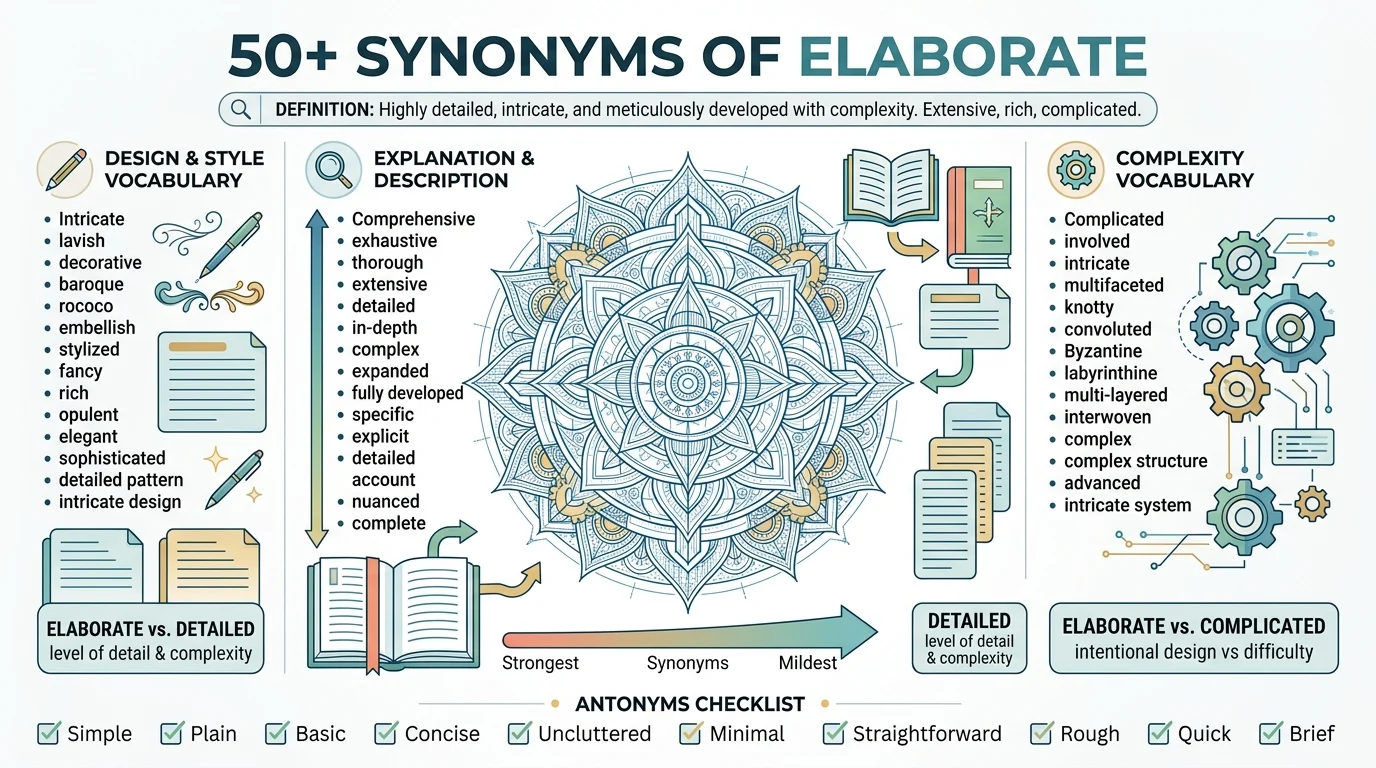
Have you ever needed to describe something detailed and complicated or to explain an idea more fully but felt that “detailed” or “explain” was too simple? You want to capture the complexity, the intricacy, or the act of adding more information, and the word “elaborate” comes to mind. Choosing the right synonym for “elaborate” can transform a basic description into a precise expression of complexity or clarification. This guide explores the best synonyms of elaborate, explaining exactly which word to use and when.
Quick Ans: “Elaborate” means involving many carefully arranged parts, or to explain something in greater detail. For complex designs, choose intricate or ornate. For detailed explanations, use detailed or thorough. For the verb form meaning to explain, use expound, elucidate, or clarify. For complicated systems, use complex or complicated.
Meaning, Tone, and Context
Understanding the core meaning of “elaborate” is the first step to using it effectively.
Simple Definition: Involving many carefully arranged parts or details; complicated. As a verb, to explain or describe in greater detail.
Part of Speech: Adjective and verb.
Overall Tone: Neutral. As an adjective, it can be positive (intricate) or negative (overly complicated). As a verb, it is neutral and informative.
Formality Level: Neutral to formal. The word is appropriate in most contexts.
Common Uses: Native English speakers use it to describe designs, plans, meals, and explanations. For example, “The palace had an elaborate design,” or “Could you elaborate on that point?”
Word Forms: Related words include the noun elaboration, the adverb elaborately, and the adjective elaborative.
When and How to Use “Elaborate”
“Elaborate” is the perfect choice when you want to describe complexity or ask for more detail. Here are seven realistic examples.
Describing Design: “The wedding cake had an elaborate design with intricate sugar flowers.”
And Describing Plans: “They made elaborate preparations for the event.”
Describing Meals: “The chef prepared an elaborate five-course meal.”
Asking for Detail: “Could you elaborate on your proposal?”
Explaining: “He elaborated on the reasons for the decision.”
Academic: “The theory is elaborate and requires careful study.”
Social Media: “The costume was so elaborate that it took hours to make.”
Best Synonyms of “Elaborate”
No synonym is identical in every situation. Here is your guide to the best replacement for “elaborate” based on your writing context.
For Complex Designs and Structures (Adjective)
Most Precise: Intricate means very complicated or detailed. “The intricate lace pattern was beautiful.”
Decorative: Ornate means elaborately decorated. “The ornate ceiling was stunning.”
Detailed: Detailed means having many details. “The detailed map showed every street.”
Complex: Complex means consisting of many interconnected parts. “The complex system required expert management.”
Complicated: Complicated means difficult to understand. “The instructions were too complicated.”
Fancy: Fancy means elaborate or decorated. “The fancy restaurant had an elaborate menu.”
For the Verb Meaning to Explain (Verb)
Most Formal: Elucidate means to make clear or explain. “The professor elucidated the difficult concept.”
Detailed Explanation: Expound means to present and explain in detail. “He expounded his theory at length.”
Clarify: Clarify means to make clear. “Could you clarify your meaning?”
Explain: Explain is the simplest synonym. “Please explain the process.”
Detail: Detail means to describe item by item. “She detailed the plan step by step.”
Expand on: Expand on means to give more information. “Could you expand on that idea?”
When Not to Use “Elaborate”
Using “elaborate” can sound wrong or awkward in certain situations.
When It Sounds Too Negative: “Elaborate” can imply overly complicated.
Better Choice: Detailed or thorough. “The report was thorough.”
When You Mean “Simple”: “Elaborate” is the opposite of simple.
Better Choice: Simple or basic. “The design is simple.”
When It Sounds Too Formal: In casual conversation, “elaborate” can sound stiff.
Better Choice: Fancy or detailed. “That is a fancy dress.”
Words Commonly Confused With “Elaborate”
| Word | Difference | When to Use | Example |
|---|---|---|---|
| Intricate | Very detailed and complicated | Designs and patterns | “Intricate carvings.” |
| Ornate | Elaborately decorated | Architecture and art | “Ornate furniture.” |
| Complex | Many interconnected parts | Systems and problems | “Complex system.” |
| Complicated | Difficult to understand | Instructions and situations | “Complicated rules.” |
| Detailed | Having many details | Reports and descriptions | “Detailed report.” |
| Elucidate | To make clear | Formal explanations | “Elucidate the concept.” |
| Expound | To explain in detail | Formal speeches and writing | “Expound a theory.” |
Best Synonyms of “Elaborate” by Context
| Context | Best Synonym | Why It Works | Example |
|---|---|---|---|
| Design and art | Intricate | Precise for detailed patterns | “Intricate design.” |
| Architecture | Ornate | Specific to decoration | “Ornate architecture.” |
| Systems | Complex | Accurate for interconnected parts | “Complex system.” |
| Instructions | Complicated | Clear for difficulty | “Complicated instructions.” |
| Reports | Detailed | Specific for information | “Detailed report.” |
| Formal explanation | Elucidate | Formal and clear | “Elucidate the theory.” |
| Speeches | Expound | Formal and detailed | “Expound on the topic.” |
| Casual conversation | Fancy | Informal and descriptive | “Fancy dinner.” |
How to Choose the Best Synonym of “Elaborate”
Choosing the right word is a simple decision. Answer these questions.
Am I using “elaborate” as an adjective or a verb? For adjective, use intricate, ornate, or complex. For verb, use elucidate, expound, or explain.
What type of complexity am I describing? For design, use intricate or ornate. And For systems, use complex. For instructions, use complicated.
What is my audience? For a formal report, use intricate or elucidate. For a friend, use fancy or explain.
What is the emotional strength? Intricate is positive. Complicated can be negative. Pick the one that matches your message.
Real Life Examples of “Elaborate”
School: Basic: “The project was elaborate.” Improved: “The project was detailed and well-researched.”
College: Basic: “The theory is elaborate.” Improved: “The theory is complex and requires careful study.”
Workplace: Basic: “Please elaborate on the plan.” Improved: “Please expand on the plan.”
Business: Basic: “The design is elaborate.” Improved: “The design is intricate and sophisticated.”
Email: Basic: “Can you elaborate?” Improved: “Could you clarify that point?”
Conversation: Basic: “That is elaborate.” Improved: “That is fancy.”
Storytelling: Basic: “The palace was elaborate.” Improved: “The palace was ornate and magnificent.”
Top 10 Synonyms of “Elaborate”
| Synonym | Simple Meaning | Best Used For | Example Sentence |
|---|---|---|---|
| Intricate | Very detailed and complicated | Designs, patterns, art | “The intricate lace was handmade.” |
| Ornate | Elaborately decorated | Architecture, furniture | “The ornate ceiling was gilded.” |
| Detailed | Having many details | Reports, descriptions | “The detailed report covered everything.” |
| Complex | Many interconnected parts | Systems, problems | “The complex system required experts.” |
| Complicated | Difficult to understand | Instructions, situations | “The complicated rules confused everyone.” |
| Elucidate | To make clear | Formal explanations | “The professor elucidated the theory.” |
| Expound | To explain in detail | Formal speeches, writing | “He expounded his views at length.” |
| Clarify | To make clear | Questions, explanations | “Could you clarify your meaning?” |
| Fancy | Elaborate or decorated | Casual descriptions | “The fancy restaurant was expensive.” |
| Thorough | Complete and detailed | Reports, analysis | “The thorough analysis was impressive.” |
Synonyms of “Elaborate” by Usage
Professional vs. Personal Synonyms
In the workplace, choose detailed, complex, or elucidate. With friends, use fancy, complicated, or explain.
Formal vs. Conversational Synonyms
For formal writing, use intricate, ornate, elucidate, or expound. For casual conversations, use fancy, detailed, or explain.
Academic Synonyms
For research and essays, choose complex for theories, detailed for reports, and elucidate for explanations.
Professional and Business Synonyms
For maximum impact, choose intricate for designs, complex for systems, and thorough for analysis.
Creative and Literary Synonyms
To add emotion and imagery, choose ornate, intricate, or elaborate. These words create atmosphere.
Slang or Modern Synonyms
In modern American slang, fancy, detailed, or complicated are common. For example, “That is a fancy setup.” These are casual and should be avoided in formal writing.
Strongest to Mildest Synonyms
Mild: simple, basic, plain
Moderate: elaborate, detailed, fancy
Strong: intricate, complex, ornate
Very Strong: complicated, byzantine, convoluted
Emotional vs. Neutral Synonyms
Emotional Synonyms: Ornate, intricate, fancy. These words hint at beauty or admiration. Use them when you want to evoke feeling.
Neutral Synonyms: Detailed, complex, thorough. These words simply communicate factual information.
Antonyms of “Elaborate”
| Antonym | Meaning | Example Sentence |
|---|---|---|
| Simple | Easy to understand | “The design is simple.” |
| Basic | Fundamental and plain | “The basic model is affordable.” |
| Plain | Not decorated | “The plain dress was elegant.” |
| Simple | Not complicated | “The instructions are simple.” |
| Unadorned | Not decorated | “The unadorned walls were white.” |
| Straightforward | Easy and clear | “The process is straightforward.” |
| Minimal | Very small in amount | “The minimal design was modern.” |
| Bare | Without covering | “The bare room needed furniture.” |
| Undecorated | Without decoration | “The undecorated tree looked sad.” |
| Plain | Simple and uncomplicated | “The plain truth is enough.” |
| Sparse | Thinly distributed | “The sparse furnishings were minimal.” |
| Uncomplicated | Simple and easy | “The uncomplicated plan worked.” |
| Elementary | Basic and simple | “The elementary concepts are easy.” |
| Rudimentary | Basic and undeveloped | “The rudimentary tools were old.” |
| Simplistic | Overly simple | “The simplistic view missed the point.” |
Comparison: “Elaborate” vs Similar Words
Elaborate vs. Intricate
Main Difference: “Elaborate” means many parts. “Intricate” means very detailed and complicated.
Which Is Stronger? “Intricate” is stronger for detail.
Which Is More Formal? Both are formal.
When to Use Each: Use “intricate” for patterns. Use “elaborate” for general complexity.
Examples:
Elaborate: “An elaborate plan.”
Intricate: “An intricate design.”
Elaborate vs. Ornate
Main Difference: “Ornate” means decorated. “Elaborate” means complex.
Which Is Stronger? “Ornate” is more specific to decoration.
Which Is More Formal? Both are formal.
When to Use Each: Use “ornate” for decoration. Use “elaborate” for general complexity.
Examples:
Elaborate: “An elaborate ceremony.”
Ornate: “An ornate frame.”
Elaborate vs. Complex
Main Difference: “Complex” means interconnected parts. “Elaborate” means many carefully arranged parts.
Which Is Stronger? “Complex” is more technical.
Which Is More Formal? Both are formal.
When to Use Each: Use “complex” for systems. Use “elaborate” for designs.
Examples:
Elaborate: “An elaborate costume.”
Complex: “A complex system.”
Elaborate vs. Complicated
Main Difference: “Complicated” means difficult. “Elaborate” means detailed.
Which Is Stronger? “Complicated” is more negative.
Which Is More Formal? Both are neutral.
When to Use Each: Use “complicated” for difficulty. Use “elaborate” for detail.
Examples:
Elaborate: “An elaborate explanation.”
Complicated: “A complicated problem.”
Elaborate vs. Elucidate
Main Difference: “Elaborate” means to explain more. “Elucidate” means to make clear.
Which Is Stronger? “Elucidate” is more formal.
Which Is More Formal? “Elucidate” is more formal.
When to Use Each: Use “elucidate” for formal explanations. Use “elaborate” for general explanations.
Examples:
Elaborate: “Could you elaborate?”
Elucidate: “The professor elucidated the concept.”
Elaborate vs. Expound
Main Difference: “Expound” means to explain in detail. “Elaborate” means to add detail.
Which Is Stronger? “Expound” is more formal.
Which Is More Formal? “Expound” is more formal.
When to Use Each: Use “expound” in formal writing. Use “elaborate” in general contexts.
Examples:
Elaborate: “He elaborated on the plan.”
Expound: “He expounded his theory.”
Common Phrases and Expressions with “Elaborate”
Phrase: Elaborate on
Meaning: To explain in more detail.
Example Sentence: “Could you elaborate on that point?”
Phrase: Elaborate design
Meaning: A complex and detailed design.
Example Sentence: “The dress had an elaborate design.”
Phrase: Elaborate plan
Meaning: A detailed and complicated plan.
Example Sentence: “They devised an elaborate plan.”
Phrase: Elaborate meal
Meaning: A multi-course, fancy meal.
Example Sentence: “The chef prepared an elaborate meal.”
Phrase: Elaborate ceremony
Meaning: A complex and formal ceremony.
Example Sentence: “The elaborate ceremony lasted hours.”
Phrase: Elaborate hoax
Meaning: A complicated trick.
Example Sentence: “The elaborate hoax fooled everyone.”
Common Mistakes to Avoid
Mistake 1: Using “elaborate” when you mean “simple”.
Incorrect: “The elaborate instructions were easy.”
Better: “The simple instructions were easy.”
Why: “Elaborate” means complex.
Mistake 2: Using “elaborate” when you mean “explain”.
Incorrect: “Please elaborate the process.”
Better: “Please explain the process.”
Why: “Elaborate” is used with “on.”
Mistake 3: Using “elaborate” in casual conversation.
Incorrect: “That is an elaborate dress.”
Better: “That is a fancy dress.”
Why: “Fancy” sounds more natural.
Mistake 4: Using “elaborate” when you mean “intricate”.
Incorrect: “The elaborate pattern was detailed.”
Better: “The intricate pattern was detailed.”
Why: “Intricate” is more precise for patterns.
Mistake 5: Using “elaborate” when you mean “complex”.
Incorrect: “The elaborate system was hard to manage.”
Better: “The complex system was hard to manage.”
Why: “Complex” is more precise for systems.
Frequently Asked Questions
1. What are the best synonyms of “elaborate”?
The best synonyms depend on your context. For designs, choose intricate or ornate. And For systems, use complex. For explanations, use elucidate or expound.
2. What are the best formal synonyms of “elaborate”?
The best formal synonyms are intricate, ornate, elucidate, and expound. These words are suitable for academic papers, professional reports, and formal writing.
3. What are common informal synonyms of “elaborate”?
For informal settings, use fancy, detailed, or explain. These alternatives sound more natural in everyday conversation.
4. What is another word for “elaborate” in professional writing?
In professional writing, intricate is an excellent choice for designs. Elucidate is also strong for explanations.
5. What is the difference between “elaborate” and “intricate”?
“Elaborate” means many carefully arranged parts. “Intricate” means very detailed and complicated. Use “intricate” for patterns and “elaborate” for general complexity.
6. What is the opposite of “elaborate”?
The most direct opposites (antonyms) of elaborate are simple, basic, and plain. These words describe things that are not complex.
Conclusion
“Elaborate” is a versatile and valuable word for describing complexity and explaining in detail. The term is neutral and widely accepted in most contexts, yet it can sound too formal for casual conversation or too vague for specific descriptions. The best choice among the synonyms of elaborate depends entirely on your audience, tone, and purpose. Remember, no single synonym works perfectly in every situation. Your goal is to choose the word that communicates your message with the most clarity and impact. A practical tip for your vocabulary growth is to pay attention to how writers describe complexity and detail and practice using different synonyms in your writing.










1 thought on “50+ Synonyms of Elaborate: Meanings, Uses, Examples, and Best Alternatives 2026”