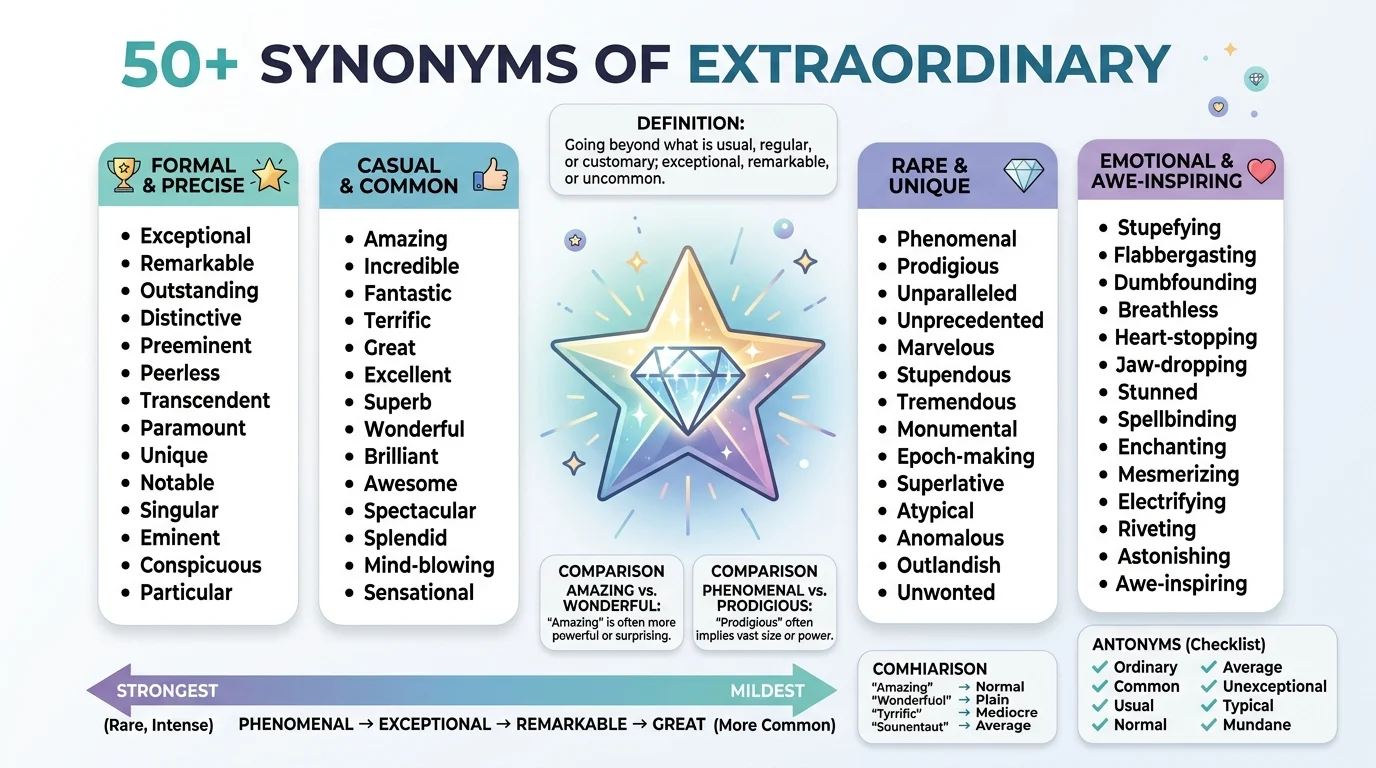
Have you ever needed to describe something so remarkable that “good” or “great” felt too weak? You want to capture the sheer rarity and impressiveness of a person, event, or achievement, and the word “extraordinary” comes to mind. Choosing the right synonym for “extraordinary” can transform a simple compliment into a powerful statement of wonder and distinction. This guide explores the best synonyms of extraordinary, explaining exactly which word to use and when.
Quick Ans: “Extraordinary” means very unusual, remarkable, or beyond what is ordinary. For formal writing, choose exceptional or remarkable. For casual conversation, use amazing or incredible. For rare achievements, use phenomenal or prodigious. For emotional emphasis, use breathtaking or astonishing.
Meaning, Tone, and Context
Understanding the core meaning of “extraordinary” is the first step to using it effectively.
Simple Definition: Beyond what is usual, ordinary, or expected. Remarkable and noteworthy.
Part of Speech: Adjective.
Overall Tone: Positive and emphatic. It indicates admiration, surprise, or distinction.
Formality Level: Neutral to formal. The word is appropriate in most contexts.
Common Uses: Native English speakers use it to describe people, talents, events, achievements, and circumstances. For example, “She has an extraordinary talent for music,” or “It was an extraordinary coincidence.”
Word Forms: Related words include the adverb extraordinarily and the noun extraordinariness.
When and How to Use “Extraordinary”
“Extraordinary” is the perfect choice when you want to emphasize that something exceeds normal expectations. Here are seven realistic examples.
Professional: “The team achieved extraordinary results this quarter.”
Academic: “The research revealed extraordinary findings about the human brain.”
Workplace: “Her extraordinary dedication inspired the entire department.”
Personal: “He has an extraordinary memory for details.”
Email: “We received an extraordinary response to our campaign.”
Resume: “Delivered extraordinary performance in a high-pressure environment.”
Social Media: “Witnessing an extraordinary sunset tonight.”
Best Synonyms of “Extraordinary”
No synonym is identical in every situation. Here is your guide to the best replacement for “extraordinary” based on your writing context.
For Formal and Academic Contexts
Most Formal: Exceptional means unusually excellent. “Her exceptional performance earned her a promotion.”
Noteworthy: Remarkable means worthy of attention. “The discovery was remarkable.”
Rare: Singular means exceptionally unique. “His singular talent set him apart.”
Outstanding: Outstanding means exceptionally good. “The results were outstanding.”
For Casual and Emphatic Contexts
Amazing: Amazing means causing great wonder. “The view was amazing.”
Incredible: Incredible means impossible to believe. “The recovery was incredible.”
Unbelievable: Unbelievable means hard to believe. “The coincidence was unbelievable.”
For Rare and Impressive Achievements
Phenomenal: Phenomenal means extraordinary or remarkable. “The growth was phenomenal.”
Prodigious: Prodigious means remarkably great in extent. “He had a prodigious appetite for work.”
Miraculous: Miraculous means extraordinary and seemingly supernatural. “The escape was miraculous.”
For Emotional Emphasis
Astonishing: Astonishing means causing great surprise. “The announcement was astonishing.”
Breathtaking: Breathtaking means inspiring awe. “The scenery was breathtaking.”
Staggering: Staggering means deeply shocking or overwhelming. “The cost was staggering.”
When Not to Use “Extraordinary”
Using “extraordinary” can sound wrong or awkward in certain situations.
When You Mean “Good”: “Extraordinary” is stronger than “good.”
Better Choice: Good or great. “The meal was good.”
When It Sounds Too Dramatic: For minor things, “extraordinary” is too strong.
Better Choice: Nice or pleasant. “We had a nice time.”
When You Mean “Odd”: “Extraordinary” can mean unusual, but “odd” is for strange.
Better Choice: Odd or strange. “That is an odd habit.”
Words Commonly Confused With “Extraordinary”
| Word | Difference | When to Use | Example |
|---|---|---|---|
| Remarkable | Worthy of attention | General and formal | “A remarkable achievement.” |
| Exceptional | Unusually excellent | Formal and professional | “Exceptional performance.” |
| Outstanding | Exceptionally good | Professional and academic | “Outstanding results.” |
| Phenomenal | Extraordinary, remarkable | Emphatic and positive | “Phenomenal growth.” |
| Amazing | Causing great wonder | Casual and emotional | “Amazing news!” |
| Incredible | Impossible to believe | Casual and emphatic | “Incredible talent.” |
Best Synonyms of “Extraordinary” by Context
| Context | Best Synonym | Why It Works | Example |
|---|---|---|---|
| Formal writing | Exceptional | Formal and precise | “Exceptional service.” |
| Academic writing | Remarkable | Standard in research | “A remarkable discovery.” |
| Professional | Outstanding | Professional and strong | “Outstanding performance.” |
| Casual conversation | Amazing | Simple and natural | “Amazing view!” |
| Emotional emphasis | Breathtaking | Evokes awe | “Breathtaking scenery.” |
| Rare achievement | Phenomenal | Emphasizes rarity | “Phenomenal success.” |
| Storytelling | Miraculous | Evokes wonder | “A miraculous escape.” |
How to Choose the Best Synonym of “Extraordinary”
Choosing the right word is a simple decision. Answer these questions.
What type of extraordinary am I describing? For formal, use exceptional or remarkable. And For casual, use amazing or incredible. For rarity, use phenomenal or singular. For emotion, use breathtaking or astonishing.
What is my audience? For a formal report, use exceptional or outstanding. For a friend, use amazing or incredible.
What is my purpose? Are you praising, surprising, or describing? The correct synonym depends entirely on this.
What is the emotional strength? Breathtaking and astonishing are stronger. Remarkable is milder. Pick the one that matches your message.
Real Life Examples of “Extraordinary”
School: Basic: “The student is extraordinary.” Improved: “The student is exceptional in mathematics.”
College: Basic: “The discovery was extraordinary.” Improved: “The discovery was remarkable and changed the field.”
Workplace: Basic: “Her work is extraordinary.” Improved: “Her work is outstanding and consistently exceeds expectations.”
Business: Basic: “The growth was extraordinary.” Improved: “The growth was phenomenal, exceeding all projections.”
Email: Basic: “We received an extraordinary response.” Improved: “We received an amazing response from our customers.”
Conversation: Basic: “That was extraordinary.” Improved: “That was incredible.”
Storytelling: Basic: “The escape was extraordinary.” Improved: “The escape was miraculous and defied all odds.”
Top 10 Synonyms of “Extraordinary”
| Synonym | Simple Meaning | Best Used For | Example Sentence |
|---|---|---|---|
| Exceptional | Unusually excellent | Formal and professional | “Exceptional performance.” |
| Remarkable | Worthy of attention | Academic and formal | “A remarkable discovery.” |
| Outstanding | Exceptionally good | Professional and academic | “Outstanding results.” |
| Phenomenal | Extraordinary, remarkable | Emphatic and positive | “Phenomenal growth.” |
| Singular | Exceptionally unique | Formal and literary | “A singular talent.” |
| Amazing | Causing great wonder | Casual and emotional | “Amazing news!” |
| Incredible | Impossible to believe | Casual and emphatic | “Incredible talent.” |
| Astonishing | Causing great surprise | Emotional and emphatic | “Astonishing results.” |
| Breathtaking | Inspiring awe | Descriptive and emotional | “Breathtaking scenery.” |
| Miraculous | Extraordinary, seemingly supernatural | Storytelling and emotional | “A miraculous escape.” |
Synonyms of “Extraordinary” by Usage
Professional vs. Personal Synonyms
In the workplace, choose exceptional, outstanding, or remarkable. With friends, use amazing, incredible, or awesome.
Formal vs. Conversational Synonyms
For formal writing, use exceptional, remarkable, singular, or phenomenal. For casual conversations, use amazing, incredible, or unbelievable.
Academic Synonyms
For research and essays, choose remarkable for findings, exceptional for performance, and singular for unique cases.
Professional and Business Synonyms
For maximum impact, choose outstanding for performance, exceptional for service, and phenomenal for growth.
Creative and Literary Synonyms
To add emotion and imagery, choose breathtaking, miraculous, or astonishing. These words create atmosphere.
Slang or Modern Synonyms
In modern American slang, awesome, epic, or mind-blowing are common. For example, “That was epic.” These are casual and should be avoided in formal writing.
Strongest to Mildest Synonyms
Mild: good, great, nice
Moderate: extraordinary, remarkable, exceptional
Strong: outstanding, phenomenal, astonishing
Very Strong: breathtaking, miraculous, staggering
Emotional vs. Neutral Synonyms
Emotional Synonyms: Breathtaking, astonishing, miraculous. These words hint at awe and wonder. Use them when you want to evoke feeling.
Neutral Synonyms: Exceptional, remarkable, outstanding. These words communicate factual information about quality.
Antonyms of “Extraordinary”
| Antonym | Meaning | Example Sentence |
|---|---|---|
| Ordinary | Normal, not special | “It was an ordinary day.” |
| Common | Occurring frequently | “A common occurrence.” |
| Usual | What happens most often | “The usual routine.” |
| Typical | Representing the usual case | “A typical example.” |
| Average | Middle of the range | “Average performance.” |
| Unremarkable | Not notable | “An unremarkable event.” |
| Mundane | Dull and ordinary | “Mundane tasks.” |
| Routine | Regular and habitual | “A routine check.” |
| Standard | The usual or expected | “Standard procedure.” |
| Normal | Conforming to the standard | “Normal behavior.” |
| Commonplace | Ordinary and not unusual | “A commonplace event.” |
| Everyday | Common and usual | “Everyday life.” |
| Plain | Simple and ordinary | “A plain design.” |
| Prosaic | Dull and unimaginative | “A prosaic explanation.” |
| Banal | Boring and unoriginal | “A banal remark.” |
Comparison: “Extraordinary” vs Similar Words
Extraordinary vs. Remarkable
Main Difference: “Remarkable” means worthy of attention. “Extraordinary” means beyond ordinary.
Which Is Stronger? “Extraordinary” is stronger.
Which Is More Formal? Both are formal.
When to Use Each: Use “remarkable” for notable things. Use “extraordinary” for exceptional things.
Examples:
Extraordinary: “An extraordinary achievement.”
Remarkable: “A remarkable discovery.”
Extraordinary vs. Exceptional
Main Difference: “Exceptional” means unusually excellent. “Extraordinary” means beyond ordinary.
Which Is Stronger? “Extraordinary” is slightly stronger.
Which Is More Formal? Both are formal.
When to Use Each: Use “exceptional” for excellence. Use “extraordinary” for rarity.
Examples:
Extraordinary: “An extraordinary event.”
Exceptional: “Exceptional performance.”
Extraordinary vs. Outstanding
Main Difference: “Outstanding” means exceptionally good. “Extraordinary” means beyond ordinary.
Which Is Stronger? “Extraordinary” is stronger for rarity.
Which Is More Formal? Both are formal.
When to Use Each: Use “outstanding” for performance. Use “extraordinary” for events.
Examples:
Extraordinary: “An extraordinary coincidence.”
Outstanding: “Outstanding results.”
Extraordinary vs. Amazing
Main Difference: “Amazing” is casual. “Extraordinary” is formal.
Which Is Stronger? “Extraordinary” is more formal.
Which Is More Formal? “Extraordinary” is more formal.
When to Use Each: Use “amazing” in casual conversation. Use “extraordinary” in formal writing.
Examples:
Extraordinary: “An extraordinary talent.”
Amazing: “Amazing talent!”
Extraordinary vs. Phenomenal
Main Difference: “Phenomenal” emphasizes remarkable extent. “Extraordinary” is broader.
Which Is Stronger? “Phenomenal” is stronger for scale.
Which Is More Formal? Both are formal.
When to Use Each: Use “phenomenal” for growth. Use “extraordinary” for general contexts.
Examples:
Extraordinary: “An extraordinary achievement.”
Phenomenal: “Phenomenal growth.”
Extraordinary vs. Miraculous
Main Difference: “Miraculous” implies supernatural intervention. “Extraordinary” is natural.
Which Is Stronger? “Miraculous” is stronger for wonder.
Which Is More Formal? Both are formal.
When to Use Each: Use “miraculous” for escapes. Use “extraordinary” for general contexts.
Examples:
Extraordinary: “An extraordinary recovery.”
Miraculous: “A miraculous escape.”
Common Phrases and Expressions with “Extraordinary”
Phrase: Extraordinary circumstances
Meaning: Unusual and exceptional conditions.
Example Sentence: “The policy applies only in extraordinary circumstances.”
Phrase: Extraordinary measures
Meaning: Unusual actions taken in special situations.
Example Sentence: “The government took extraordinary measures.”
Phrase: Extraordinary talent
Meaning: Exceptional ability.
Example Sentence: “She has extraordinary talent.”
Phrase: Extraordinary achievement
Meaning: A remarkable accomplishment.
Example Sentence: “Landing on the moon was an extraordinary achievement.”
Phrase: Extraordinary rendition
Meaning: The transfer of a detainee to another country.
Example Sentence: “The practice of extraordinary rendition was controversial.”
Common Mistakes to Avoid
Mistake 1: Using “extraordinary” when you mean “good”.
Incorrect: “The pizza was extraordinary.”
Better: “The pizza was good.”
Why: “Extraordinary” is for remarkable things.
Mistake 2: Using “extraordinary” in casual conversation.
Incorrect: “That movie was extraordinary.”
Better: “That movie was amazing.”
Why: “Amazing” sounds more natural.
Mistake 3: Using “extraordinary” when you mean “odd”.
Incorrect: “He has an extraordinary habit.”
Better: “He has an odd habit.”
Why: “Odd” is for strange things.
Mistake 4: Using “extraordinary” when you mean “outstanding”.
Incorrect: “Her extraordinary performance was praised.”
Better: “Her outstanding performance was praised.”
Why: “Outstanding” is for performance.
Mistake 5: Using “extraordinary” when you mean “phenomenal”.
Incorrect: “The extraordinary growth impressed investors.”
Better: “The phenomenal growth impressed investors.”
Why: “Phenomenal” is for growth.
Frequently Asked Questions
1. What are the best synonyms of “extraordinary”?
The best synonyms depend on your context. For formal writing, choose exceptional or remarkable. And For casual conversation, use amazing or incredible. For rarity, use phenomenal or singular.
2. What are the best formal synonyms of “extraordinary”?
The best formal synonyms are exceptional, remarkable, and singular. These words are suitable for academic papers, professional reports, and business communications.
3. What are common informal synonyms of “extraordinary”?
For informal settings, use amazing, incredible, or awesome. These alternatives sound more natural in everyday conversation.
4. What is another word for “extraordinary” in professional writing?
In professional writing, exceptional is an excellent choice. It conveys unusual excellence. Outstanding is also strong for performance.
5. What is the difference between “extraordinary” and “remarkable”?
“Extraordinary” means beyond ordinary. “Remarkable” means worthy of attention. Use “extraordinary” for rare things and “remarkable” for notable things.
6. What is the opposite of “extraordinary”?
The most direct opposites (antonyms) of extraordinary are ordinary, common, and unremarkable. These words describe things that are normal and not special.
Conclusion
“Extraordinary” is a powerful and uplifting word for describing people, events, and achievements that go beyond the ordinary. The term is neutral and widely accepted in most contexts, yet it can sound too dramatic for minor things or too formal for casual conversation. The best choice among the synonyms of extraordinary depends entirely on your audience, tone, and purpose. Remember, no single synonym works perfectly in every situation. Your goal is to choose the word that communicates your message with the most clarity and impact. A practical tip for your vocabulary growth is to pay attention to how writers express wonder and admiration and practice using different synonyms in your writing.










2 thoughts on “50+ Synonyms of Extraordinary: Meanings, Uses, Examples, and Best Alternatives 2026”