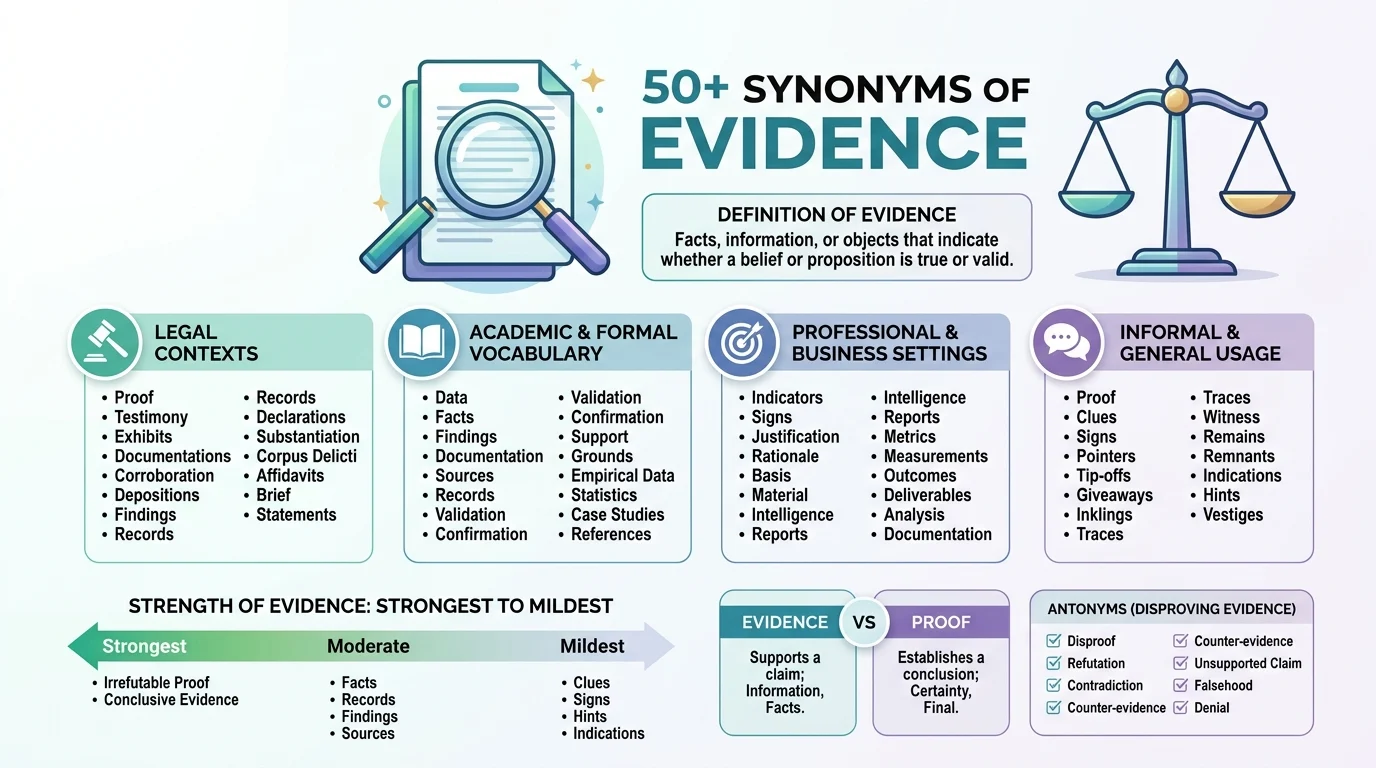
Ever found yourself needing to back up a claim but felt stuck using the same word repeatedly? You want to show proof, point to a sign, or present a convincing argument, and the word “evidence” comes to mind. Choosing the right synonym for “evidence” can transform a vague assertion into a powerful, credible statement. This guide explores the best synonyms of evidence, explaining exactly which word to use and when.
Quick Ans: “Evidence” means the information or objects that help prove whether something is true . It is a neutral noun. For strong proof, choose proof or confirmation. For a sign, use indication or manifestation. In legal contexts, testimony or exhibit are precise. For physical traces, select trace or mark. For a direct, undeniable case, use corroboration or substantiation .
Meaning, Tone, and Context
Understanding the core meaning of “evidence” is the first step to using it effectively.
Simple Definition: Information, signs, or objects that help establish a fact or prove a claim . It is the basis for belief or disbelief .
Part of Speech: Noun and verb .
Overall Tone: Neutral and analytical. It is used in everyday life, science, and the law.
Formality Level: Neutral to formal.
Common Uses: Native English speakers use it to describe scientific proof, signs of a struggle, or information presented in court. For example, “The evidence points to the suspect,” or “There is no evidence of his involvement.”
Word Forms: Related words include the verb evidence (to show clearly) and evident (obvious).
When and How to Use “Evidence”
“Evidence” is the perfect choice when you want to show support for a claim. Here are seven realistic examples.
Formal/Scientific: “The evidence from the study supports the new theory.”
Professional: “We have strong evidence that our strategy is working.”
Academic: “Historical evidence confirms the existence of the ancient city.”
Workplace: “The project’s success is evidence of our team’s effort.”
Personal: “The muddy footprints were evidence that someone had been there.”
Email: “We need more evidence before making a final decision.”
Legal: “The prosecution presented key evidence in the trial.”
Best Synonyms of “Evidence”
No synonym is identical in every situation. Here is your guide to the best replacement for “evidence” based on your writing context.
For Strong, Definite Proof
- Proof is the strongest synonym. It means evidence that is so complete it removes all reasonable doubt . Use it when you can prove something beyond question.
- Corroboration is used for evidence that supports or confirms an existing piece of evidence . It is formal and precise.
- Substantiation means giving solid evidence to support a claim . It is a professional, formal word.
Or For Signs or Clues
- Indication is a sign that suggests something is true, but it is not as strong as definite proof .
- Manifestation is a formal word meaning a clear sign or display of something .
- Trace or Mark are used for small, physical signs that show that something happened .
For Legal Contexts
- Testimony is the evidence given by a witness in court .
- Exhibit is a physical piece of evidence presented in court .
When Not to Use “Evidence”
Using “evidence” can sound less strong than intended or formal in certain situations.
When You Mean a Small Indication: “Evidence” sounds too formal and strong for a small sign.
Better Choice: Hint or suggestion. “There was just a hint of cinnamon in the cake” .
When You Have Undeniable Proof: If you have facts that are beyond dispute, “evidence” is not strong enough.
Better Choice: Proof. “We have proof that he stole the money.”
When It Sounds Too Technical in Casual Speech: “Evidence” can sound stiff.
Better Choice: Sign or clue. “The wet towel was a sign that she had taken a shower.”
Words Commonly Confused With “Evidence”
Several words are often mixed up with “evidence.” Here is how to keep them straight .
Word: Proof
Difference: Evidence is information that supports a claim. Proof is so strong it removes all doubt .
When to Use: Use it when you are certain.
Example: “We have proof of his innocence.”
Word: Testimony
Difference: Testimony is evidence given verbally, especially by a witness in court .
When to Use: Use this for spoken statements.
Example: “The witness’s testimony was crucial.”
Word: Exhibit
Difference: An exhibit is a physical piece of evidence used in court .
When to Use: Use it for documents or objects.
Example: “The prosecutor entered the knife into evidence as Exhibit A” .
Word: Indication
Difference: An indication is a sign that suggests something, but it is not strong enough to be proof .
When to Use: Use this for weaker signs.
Example: “The dark clouds were an indication of rain.”
Best Synonyms of “Evidence” by Context
| Context | Best Synonym | Why It Works | Example |
|---|---|---|---|
| Strong Proof | Proof | Removes all reasonable doubt . | “We have proof that he was there.” |
| Legal Spoken | Testimony | Precise for court statements . | “Her testimony was compelling.” |
| Legal Physical | Exhibit | The correct term for objects . | “The murder weapon was Exhibit A.” |
| A Clear Sign | Manifestation | Formal for a visible display . | “The protest was a manifestation of public anger.” |
| Small Physical Sign | Trace | Accurate for remnants . | “They found traces of the poison.” |
How to Choose the Best Synonym of “Evidence”
Choosing the right word is a simple decision. Answer these questions.
What is the strength of the information? If it is beyond doubt, use proof. And if it supports a claim, use evidence . If it is a small sign, use indication or trace.
What is the context? If it is a courtroom, testimony is for words , and exhibit is for objects . For informal situations, sign or clue is natural.
What is my audience? For a professor, use corroboration. For a friend, use sign.
Top 10 Synonyms of “Evidence”
| Synonym | Simple Meaning | Best Used For | Example Sentence |
|---|---|---|---|
| Proof | Facts that show something is true without doubt | Strong, undeniable cases | “Do you have proof that you paid the bill?” |
| Confirmation | Additional evidence that proves something | Support for existing data | “The second experiment provided confirmation of the results.” |
| Corroboration | Evidence that supports an existing claim | Formal contexts | “We need corroboration for that statement.” |
| Substantiation | Solid evidence to back up a claim | Professional and formal contexts | “The theory requires substantiation.” |
| Testimony | Spoken evidence from a witness | Legal and professional contexts | “The witness gave powerful testimony.” |
| Indication | A sign that suggests something | Weak or circumstantial evidence | “There is no indication that she is guilty.” |
| Manifestation | A very clear sign or display | Formal and descriptive contexts | “The riots were a manifestation of public frustration.” |
| Trace | A very small, physical sign | Forensic or scientific contexts | “Police found traces of blood.” |
| Exhibit | A physical object used as evidence | Legal contexts | “The document was marked as Exhibit A.” |
| Sign | A physical object that shows something | Everyday conversation | “Dark clouds are a sign of rain.” |
Common Mistakes to Avoid
Mistake 1: Using “evidence” when you mean “proof”.
Incorrect: “We have evidence that he is guilty beyond any doubt.”
Better: “We have proof that he is guilty.”
Why: “Proof” is stronger and implies no doubt .
Mistake 2: Using “evidence” in a vague way.
Incorrect: “There is evidence against him.”
Better: “There is testimony from witnesses and exhibits that point to his guilt.”
Why: Being specific about the type of evidence makes the statement more powerful.
Frequently Asked Questions
1. What are the best synonyms of “evidence”?
The best synonyms depend on your context. For strong proof, use proof or confirmation. And for a sign, use indication or trace . For legal contexts, use testimony or exhibit .
2. What are the best formal synonyms of “evidence”?
The best formal synonyms are corroboration, substantiation, and testimony . These are used in professional reports and legal writing.
3. What are common informal synonyms of “evidence”?
For informal settings, use sign, clue, or trace .
4. What is the difference between “evidence” and “proof”?
Evidence is information that supports a claim. Proof is evidence so strong it removes all reasonable doubt .
Conclusion
“Evidence” is a powerful and essential word for supporting claims and providing proof. The best choice among the synonyms of evidence depends entirely on your audience, tone, and purpose. Remember, no single synonym works perfectly in every situation. Your goal is to choose the word that communicates your message with the most clarity and impact. A practical tip for your vocabulary growth is to analyze the evidence in articles you read and think about which word best describes it.










1 thought on “50+ Synonyms of Evidence: Meanings, Uses, Examples, and Best Alternatives 2026”